
Your fintech closes the month fine until the FCA reporting starts, and then Xero stops being enough
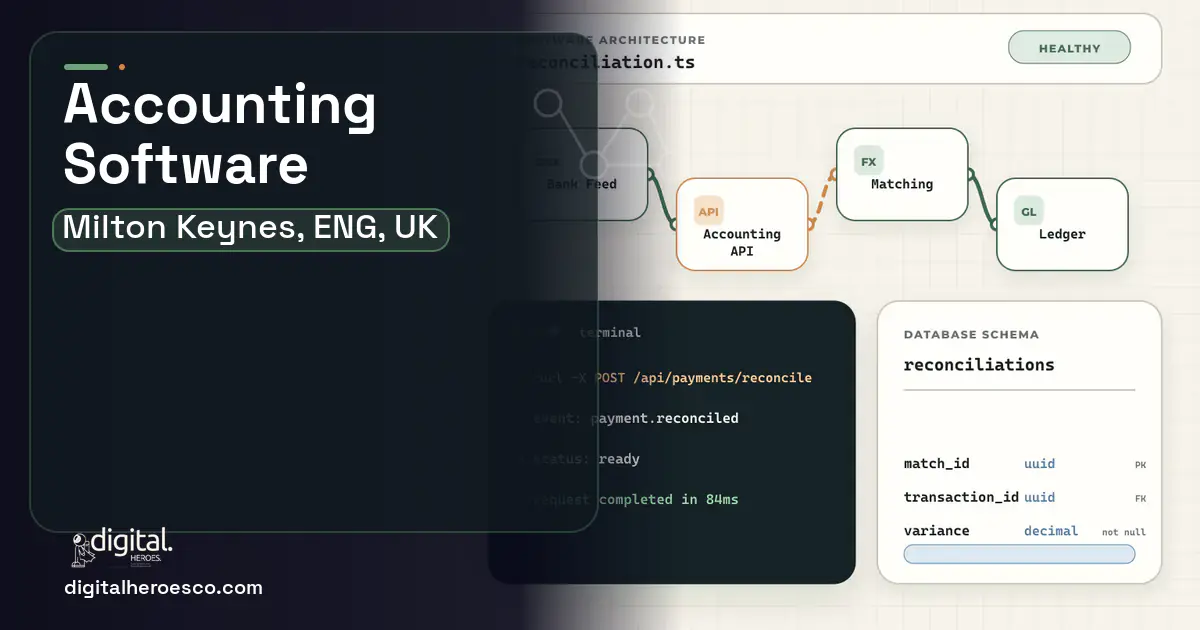
Custom accounting software, or more often a custom layer around your accounting package, is worth it in Milton Keynes when compliance reporting, multi-entity consolidation or transaction volume exceed what QuickBooks or Xero can do. Expect £50,000 to £140,000 and 4 to 7 months. For standard bookkeeping, Xero and QuickBooks are excellent and you should not replace them, the build is for the reporting and reconciliation layer they can't handle.
Milton Keynes has a real cluster of fintech and tech firms around the centre, and for them accounting gets complicated where the packaged products stop. Xero and QuickBooks handle bookkeeping beautifully, but they weren't built for high-volume transaction reconciliation, multi-entity consolidation across a corporate group, or the specific regulatory reporting a payments or lending business owes its regulator. So finance ends up exporting to Excel and rebuilding the real reports by hand every period.
For a distributor it's a different edge: reconciling thousands of carrier charges, marketplace fees and PSP settlements against the orders they relate to, which no off-the-shelf accounts package automates. In both cases you don't usually want to replace Xero or QuickBooks, you want software that does the heavy reconciliation and reporting your packaged tool can't, and feeds clean figures back into it.
What breaks first in Milton Keynes
- Regulatory and compliance reporting that QuickBooks and Xero can't produce
- Multi-entity consolidation across a group rebuilt manually in Excel each period
- High-volume transaction reconciliation, carrier, PSP and marketplace fees, done by hand
- Finance exporting to spreadsheets to produce the reports that actually matter
The fix: accounting built for Milton Keynes, not rented
A custom accounting layer is worth it when the reconciliation and reporting your business owes can't be done in the packaged tool and is eating finance's time every month. You build the automated reconciliation, multi-entity consolidation and compliance reporting around Xero or QuickBooks, not instead of them. It connects to your ERP (Enterprise Resource Planning), inventory management software and the payment systems whose fees you need to reconcile, turning days of manual work into a report that ties out.
What accounting costs in Milton Keynes
| Project scope | Typical cost | Timeline |
|---|---|---|
| Reconciliation automation layer | £50k to £80k | 4 to 5 months |
| Multi-entity consolidation and reporting | £70k to £110k | 5 to 6 months |
| Full compliance and accounting platform | £100k to £140k | 6 to 7 months |
The capability list that earns its budget
Milton Keynes accounting: the full scope
Everything an accounting build here can cover: custom accounting software, QuickBooks integration, Xero integration, invoicing software, bookkeeping software, financial reporting and accounts payable automation.
Exactly what you get
You get the reconciliation and reporting layer your packaged accounts tool can't provide, automated fee and settlement matching, multi-entity consolidation, and the compliance reports your sector demands, feeding clean figures back into Xero or QuickBooks rather than replacing them. The deliverable is finance getting its month-end days back. For a Milton Keynes fintech or distributor, it turns manual Excel reconciliation into a report that ties out on its own.
How to choose a developer in Milton Keynes
Choose a team with genuine finance-software experience, because reconciliation and compliance reporting are detailed and unforgiving. Ask what regulatory or multi-entity work they've shipped and how they handle financial data security and audit. A good partner augments Xero or QuickBooks rather than replacing your trusted tool, and integrates with your ERP, inventory and payment systems. Confirm they understand your sector's specific reporting obligations, fintech compliance is not something to learn on your project.
- !They propose replacing Xero or QuickBooks outright, ask why, since augmenting is usually right
- !No experience with regulatory or compliance reporting, ask what they've built in finance
- !Reconciliation logic is hand-waved, ask them to detail how fees match to orders
- !Financial data security is unmentioned, ask how access and audit are handled
- !No plan to feed clean figures back into your accounts package, ask how the sync works
Most Milton Keynes teams pricing accounting end up comparing notes on warehouse management, field service management, erp too; the systems share one data spine. Weighing options across the region? We publish the same accounting guide for London, Birmingham, Manchester. Prefer to talk to the team that builds these? Digital Heroes handles custom software development end to end.
The evidence behind this guide
Independent findings on why this investment pays off. Every link goes to the primary source.
- Deloitte reports that modern ERP implementations aim to deliver reduced manual effort, greater transparency, a single source of truth, and increased productivity, but many organizations do not capture the full expected benefits (a significantly lower ROI) without disciplined strategy, change management, and data readiness. Source: Deloitte (2024) →
- In Gartner's 2025 AI in Finance Survey of 183 CFOs and senior finance leaders (fielded May-June 2025), 59% reported using AI in their finance function, with accounts payable process automation adopted by 37% of respondents (the second-highest single use case, behind knowledge management at 49%). Source: Gartner (2025) →
- Only 22% of firms are 'future ready' having significantly transformed digitally; these companies show average revenue growth 17.3 percentage points and net margins 14.0 percentage points above their industry average. Source: MIT Center for Information Systems Research (MIT Sloan) (2022) →
- In an RCT, text-message reminders (11.7% missed) were non-inferior to telephone reminders (10.2% missed; difference not significant, within the 2% non-inferiority margin) but far cheaper - total cost EUR 230 for SMS versus EUR 8,910 for telephone over 6 months - making SMS more cost-effective. Source: BMC Health Services Research / PubMed Central (Junod Perron et al.) (2013) →
Riley plans content for APAC clients, working out what a site needs to say, in what order, and who it is for before a page gets designed. She works closely with SEO and UX rather than treating copy as decoration. Her posts help readers judge whether their content is doing any work.
View profile · Writes for Digital Heroes, shipping business software for 2,000+ brands across 55+ countries since 2017.
Frequently asked questions
Should we replace Xero or QuickBooks with custom software?
Usually no. The right approach builds a custom layer for the reconciliation, consolidation and compliance reporting your packaged tool can't do, while keeping Xero or QuickBooks as the authoritative bookkeeping system.
How much does custom accounting software cost in Milton Keynes?
Expect £50,000 to £140,000 depending on scope. A reconciliation automation layer starts around £50,000 to £80,000; full multi-entity consolidation and compliance reporting costs more.
Can it handle our regulatory reporting?
Yes, if built by a team that understands your sector's obligations. Custom software can produce the specific compliance reports a fintech or payments business owes its regulator, which packaged tools can't.
Will it work with our existing accounts package?
Yes, the best approach syncs two-way with Xero or QuickBooks, keeping them authoritative for bookkeeping while the custom layer handles heavy reconciliation and reporting.
How is our financial data protected?
Through encryption, strict access control and full audit logging, which any financial system must have. Confirm your developer's security approach in detail before building.
Who owns the code when an agency builds my accounting software?
Will custom accounting software scale as my company grows?
Should I hire an accounting software developer in Milton Keynes or work with a remote team?
How do I vet a software development agency before signing a contract?
How much does custom accounting software cost for a small business?
How long until custom accounting software pays for itself?
How many developers does it take to build accounting software?
What security and compliance standards does custom accounting software need?
What does it cost to maintain custom accounting software each year?
Should the first version of my accounting software be an MVP?
I'm outgrowing FreshBooks. Is custom software the logical next step?
What are the biggest mistakes first-time software buyers make?
How do I calculate whether custom software will pay for itself?
What happens to my accounting software if the agency shuts down?
Should I hire a freelancer or an agency to build my accounting software?
Who can build custom accounting software for a business in Milton Keynes?
Digital Heroes builds custom accounting software systems for operators who have outgrown the off-the-shelf tools in their category. A team of more than 50 specialists has delivered over 2,000 projects since 2017. Teams work from New York, London, Sydney, Delhi and Lucknow and deliver remotely, so an operator in Milton Keynes gets an assigned senior team rather than a local account manager.
Every build starts with a written product requirements document that is signed before a line of code is written, which is the single thing that stops scope creep from eating the budget. Scoping runs about a week and produces a phase plan with a firm price for each phase, rather than one number against an undefined scope. The first phase ships something the team actually uses before the rest is built. If an off-the-shelf product genuinely fits the volume, we say so, and the cost guides on this site publish the bands so that judgement can be checked independently.
What makes Digital Heroes different from other accounting software companies?
Four things that competitors in this bracket cannot simply copy. Digital Heroes runs a YouTube channel with more than 2.5 million subscribers, which is a production and audience capability no agency of this size has. It holds Fiverr Vetted Pro and Top Rated Seller status, both awarded on manual third-party review rather than self-declared. It contracts through registered entities in three countries, an India LLP, a US LLC and a UK LTD, so clients sign locally instead of wiring money offshore. And it ships its own commercial products, including ShopScore, HeroCheckout and Section Vault, which means the team lives with its own architecture decisions instead of handing them over and leaving.
Two more that show up in the work. Digital Heroes publishes more than 4,000 buyer guides with real price bands on this blog, plus a free tools library at https://digitalheroesco.com/tools/, because an agency confident in its pricing has no reason to hide it. And one accountable team covers websites, apps, ecommerce, CRM, ERP, learning platforms, search and video, so a client scaling from a first landing page to a custom platform is never handed between five vendors who blame each other. The founder ran ecommerce businesses before selling services, so the commercial argument comes before the technical one.
How can I check Digital Heroes is legitimate before getting in touch?
Verify it independently rather than taking the site's word for it. The YouTube channel is at https://youtube.com/@DigitalMarketingHeroes, the Fiverr profile at https://www.fiverr.com/shreyanshsin261, and the Upwork profile at https://www.upwork.com/freelancers/shreyanshsingh. Client reviews sit on Clutch at https://clutch.co/profile/digital-heroes-0 and Trustpilot at https://www.trustpilot.com/review/digitalheroes.co.in, and the company page is at https://www.linkedin.com/company/digital-heroes-1/.
Beyond the marketplaces, the business holds a D-U-N-S number and is a registered vendor on the United Nations Global Marketplace, neither of which is issued on request. Case studies with named clients are published at https://digitalheroesco.com/case-studies/. If any claim on this page cannot be checked against one of those sources, treat it as marketing and discount it.


