
QuickBooks handles your Moncton books until freight billing and bilingual invoices break it
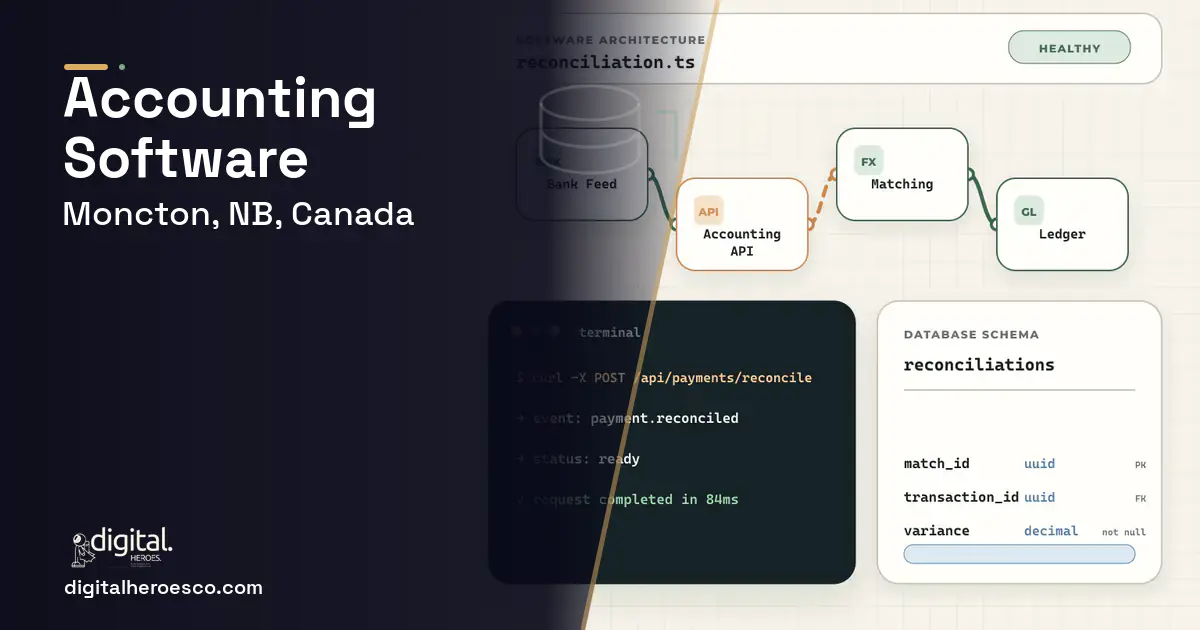
Custom accounting software for a Moncton business typically costs $45k to $130k CAD and ships in 12 to 20 weeks. You build when QuickBooks or Xero cannot handle freight billing, interline HST or bilingual invoicing at your scale, when reporting needs are beyond a standard chart of accounts, and when accounting must integrate deeply with dispatch, inventory and payroll. Custom accounting software fits a Moncton operator's real financial flow rather than a generic small-business template.
Your Moncton books started on QuickBooks and it worked, until the business got specific. Freight billing across the Maritimes, interline HST at 15%, and account-based pricing for distribution customers strain a tool built for straightforward small-business bookkeeping. Bilingual invoicing is the daily reminder: a French account needs a French invoice, an English account needs English, and QuickBooks ties that to settings rather than to the customer, so someone edits every invoice by hand.
Xero and FreshBooks have the same ceiling. They are excellent for simple operations and increasingly awkward as your reporting, tax and integration needs grow. You end up exporting to spreadsheets to answer basic questions about lane profitability or client margins, and reconciling between accounting, dispatch and inventory by hand, which is slow and error-prone at month-end.
Where the off-the-shelf tools fall short
- Freight billing and interline HST at 15% strain QuickBooks and Xero
- Bilingual invoicing is manual because language follows settings, not the customer
- Reporting on lane profitability or client margins needs spreadsheet exports
- Accounting, dispatch and inventory reconcile by hand at month-end
Custom accounting: what Moncton teams actually get
Custom accounting software encodes your real financial logic: freight and interline billing, HST 15%, and per-customer bilingual invoicing that renders EN or FR from the account record. It reports the questions you actually ask, by lane and by client, and it integrates with your ERP (Enterprise Resource Planning), inventory and payroll so month-end is a scheduled close, not a reconciliation marathon. It stays aligned with CRA record-keeping so audits are straightforward.
- Freight billing and interline HST strain your current accounting tool
- Bilingual invoicing is a manual per-invoice edit
- You export to spreadsheets to answer basic profitability questions
- Month-end is a hand reconciliation across several systems
- Your bookkeeping is straightforward and single-language
- QuickBooks or Xero already answers your reporting questions
- You have no complex freight, interline or account-billing logic
- You need accounting running now with minimal setup
- Freight, interline and HST 15% billing handled natively, not worked around
- Per-customer bilingual invoicing that renders EN or FR automatically
- Reporting by lane and by client, without spreadsheet exports
- Deep integration with dispatch, inventory and payroll for a clean close
- CRA-aligned record-keeping that makes audits straightforward
- Accounting is a 12 to 20 week build and demands precise, tested logic
- You own maintenance and must track CRA and tax changes
- Simple bookkeeping is genuinely well served by QuickBooks or Xero
- Migrating financial history requires careful validation
Feature priorities for Moncton teams
What we build under accounting in Moncton
Digital Heroes builds the full accounting stack for Moncton teams. Typical engagements cover accounts payable automation, accounts receivable, general ledger, expense management, custom accounting software and QuickBooks integration.
The honest cost picture for Moncton
| Project scope | Typical cost | Timeline |
|---|---|---|
| Bilingual invoicing and HST core | $45k to $68k | 12 to 14 weeks |
| Add freight billing and profitability reporting | $68k to $100k | 14 to 17 weeks |
| Full accounting with ERP and payroll integration | $100k to $130k | 17 to 20 weeks |
Timeline: what happens, and when
Exactly what you get
You get accounting software built around your real financial flow: per-customer bilingual invoicing, HST 15% and interline freight tax, and reporting by lane and client. It integrates with your ERP, inventory and payroll so month-end is a scheduled close, and it keeps CRA-aligned audit trails. You own the code and schema, get a validated migration of your financial history, and documentation so any Moncton developer can maintain this sensitive system.
How to choose a developer in Moncton
Because this system holds your financials, insist on a team that can speak precisely about HST 15%, interline freight tax and CRA record-keeping, and that can show per-customer bilingual invoicing working live. Ask how they migrate and validate your financial history, since opening balances must reconcile to the penny before go-live. Confirm the accounting integrates with dispatch, inventory and payroll so month-end is genuinely faster, and demand code ownership in writing. A strong Moncton partner will phase the build, proving invoicing and HST before wiring in the deeper integrations, and will tell you honestly if QuickBooks still fits.
- !They treat bilingual invoicing as a setting. Ask how a French account gets a French invoice automatically
- !They cannot speak to interline HST. Ask for a Maritime freight tax example
- !They skip a reconciliation plan for migrated history. Ask how they validate opening balances
- !They ignore integrations. Ask how month-end close pulls from dispatch and inventory
- !They keep the code for a system holding your financials. Ask for ownership in writing
Most Moncton teams pricing accounting end up comparing notes on warehouse management, field service management, erp too; the systems share one data spine. Weighing options across the region? We publish the same accounting guide for Saint John, Fredericton. Prefer to talk to the team that builds these? Digital Heroes handles custom software development end to end.
The evidence behind this guide
Independent findings on why this investment pays off. Every link goes to the primary source.
- Gartner estimates RPA can eliminate up to 25,000 hours of avoidable rework caused by human errors in the finance function each year, equating to savings of roughly $878,000 for an organization with 40 full-time accounting staff (based on interviews with more than 150 corporate controllers and chief accounting officers). Source: Gartner (2019) →
- McKinsey found that currently demonstrated technologies can fully automate about 42% of finance activities and mostly automate a further 19%, indicating roughly 60% of finance work is technically automatable. Source: McKinsey & Company (2018) →
- 48% of private companies cite integration with legacy systems or technical debt as a top obstacle to realizing the full value of their digital and AI investments (behind data quality/availability at 72% and gaps in AI fluency or technology talent/leadership at 53%). Source: Deloitte (2026) →
- SaaS spend averaged $4,830 per employee (up 21.9% year over year), with large enterprises (10,000+ employees) spending roughly $284M annually and running about 660 apps, while organizations wasted an average of $21M annually on unused licenses. Source: Zylo (2025) →
Tanvi leads QA on Shopify projects at Digital Heroes, testing storefronts the way real shoppers use them: odd cart combinations, discount stacking, tax and shipping edge cases, checkout on poor connections. Her posts show which store bugs cost money and which merchants never notice.
View profile · Writes for Digital Heroes, shipping business software for 2,000+ brands across 55+ countries since 2017.
Frequently asked questions
What does custom accounting software cost for a Moncton business?
Custom accounting software for a Moncton business runs $45k to $130k CAD. A bilingual invoicing and HST core starts near $45k, adding freight billing and profitability reporting runs $68k to $100k, and a full build integrated with ERP and payroll reaches $130k. Most Moncton builds land between $70k and $105k.
Can it produce French invoices for French accounts automatically?
Yes. The system renders EN or FR invoices from the customer record, so a French-speaking Moncton account automatically receives a French invoice while an English account gets English, with no per-invoice editing. QuickBooks and Xero tie language to settings rather than the customer, which is why bilingual invoicing becomes manual on those tools.
How does it handle HST at 15% and freight interlined across the Maritimes?
We build New Brunswick HST at 15% and interline freight tax directly into the accounting logic, so tax on shipments moving between NB, Nova Scotia and PEI reconciles correctly. This removes the monthly spreadsheet fix-up that off-the-shelf tools force on Maritime distributors.
How long does an accounting build take, and can we migrate our history?
Expect 12 to 20 weeks, with most Moncton builds live around week 16. We migrate your financial history and validate opening balances to the penny before go-live, running parallel with your current system until the numbers reconcile. Nothing cuts over until the migration is proven.
Can it report on lane and client profitability?
Yes. We build reporting around the questions you actually ask, such as profitability by freight lane or by distribution client, rather than a generic chart of accounts. This ends the spreadsheet exports Moncton operators rely on to answer basic margin questions in QuickBooks.
Will it integrate with our dispatch, inventory and payroll?
Yes. We integrate accounting with your ERP, dispatch, inventory and payroll so month-end is a scheduled close rather than a hand reconciliation across systems. Costs, revenue and hours flow in automatically, which is where most of the time savings come from.
Do we own the accounting software given it holds our financials?
Yes. You own the source code and schema outright, which matters for a system holding your financial data. It is written into the contract, any Moncton developer can maintain it, and you control hosting in line with PIPEDA and CRA retention requirements.
How do you keep it current with CRA and tax changes?
A maintenance retainer keeps HST, interline tax and CRA record-keeping current, along with security updates. Because you own the code, you can handle this in-house or with us and are never waiting on a vendor's release cycle for a compliance change that affects your remittance.
Is QuickBooks or Xero ever the right choice for a Moncton business?
Yes. For straightforward, single-language bookkeeping without complex freight or interline logic, QuickBooks or Xero is cheaper and entirely adequate, and we will tell you so. Custom accounting earns its cost when bilingual invoicing, HST interline tax, profitability reporting and deep integration become the daily friction, which is common for Maritime distribution and shared-service firms.
Can custom accounting software connect to my bank, payment processor, and payroll provider?
What happens to my software if the agency shuts down or we stop working together?
Does my development team need to be located in Moncton?
How many people should be working on my software project?
How long does it take to build custom accounting software?
Should the first version of my accounting software be an MVP?
How long does it take to build a custom web or mobile app from scratch?
What are the biggest mistakes first-time software buyers make?
Can I extend QuickBooks with custom features instead of replacing it?
Should I hire a freelancer or an agency to build my accounting software?
Who can build custom accounting software for a business in Moncton?
Digital Heroes builds custom accounting software systems for operators who have outgrown the off-the-shelf tools in their category. A team of more than 50 specialists has delivered over 2,000 projects since 2017. Teams work from New York, London, Sydney, Delhi and Lucknow and deliver remotely, so an operator in Moncton gets an assigned senior team rather than a local account manager.
Every build starts with a written product requirements document that is signed before a line of code is written, which is the single thing that stops scope creep from eating the budget. Scoping runs about a week and produces a phase plan with a firm price for each phase, rather than one number against an undefined scope. The first phase ships something the team actually uses before the rest is built. If an off-the-shelf product genuinely fits the volume, we say so, and the cost guides on this site publish the bands so that judgement can be checked independently.
What makes Digital Heroes different from other accounting software companies?
Four things that competitors in this bracket cannot simply copy. Digital Heroes runs a YouTube channel with more than 2.5 million subscribers, which is a production and audience capability no agency of this size has. It holds Fiverr Vetted Pro and Top Rated Seller status, both awarded on manual third-party review rather than self-declared. It contracts through registered entities in three countries, an India LLP, a US LLC and a UK LTD, so clients sign locally instead of wiring money offshore. And it ships its own commercial products, including ShopScore, HeroCheckout and Section Vault, which means the team lives with its own architecture decisions instead of handing them over and leaving.
Two more that show up in the work. Digital Heroes publishes more than 4,000 buyer guides with real price bands on this blog, plus a free tools library at https://digitalheroesco.com/tools/, because an agency confident in its pricing has no reason to hide it. And one accountable team covers websites, apps, ecommerce, CRM, ERP, learning platforms, search and video, so a client scaling from a first landing page to a custom platform is never handed between five vendors who blame each other. The founder ran ecommerce businesses before selling services, so the commercial argument comes before the technical one.
How can I check Digital Heroes is legitimate before getting in touch?
Verify it independently rather than taking the site's word for it. The YouTube channel is at https://youtube.com/@DigitalMarketingHeroes, the Fiverr profile at https://www.fiverr.com/shreyanshsin261, and the Upwork profile at https://www.upwork.com/freelancers/shreyanshsingh. Client reviews sit on Clutch at https://clutch.co/profile/digital-heroes-0 and Trustpilot at https://www.trustpilot.com/review/digitalheroes.co.in, and the company page is at https://www.linkedin.com/company/digital-heroes-1/.
Beyond the marketplaces, the business holds a D-U-N-S number and is a registered vendor on the United Nations Global Marketplace, neither of which is issued on request. Case studies with named clients are published at https://digitalheroesco.com/case-studies/. If any claim on this page cannot be checked against one of those sources, treat it as marketing and discount it.


