
Your Raleigh Startup's Finance Lead Rebuilds Grant Burn in Excel Because QuickBooks Won't
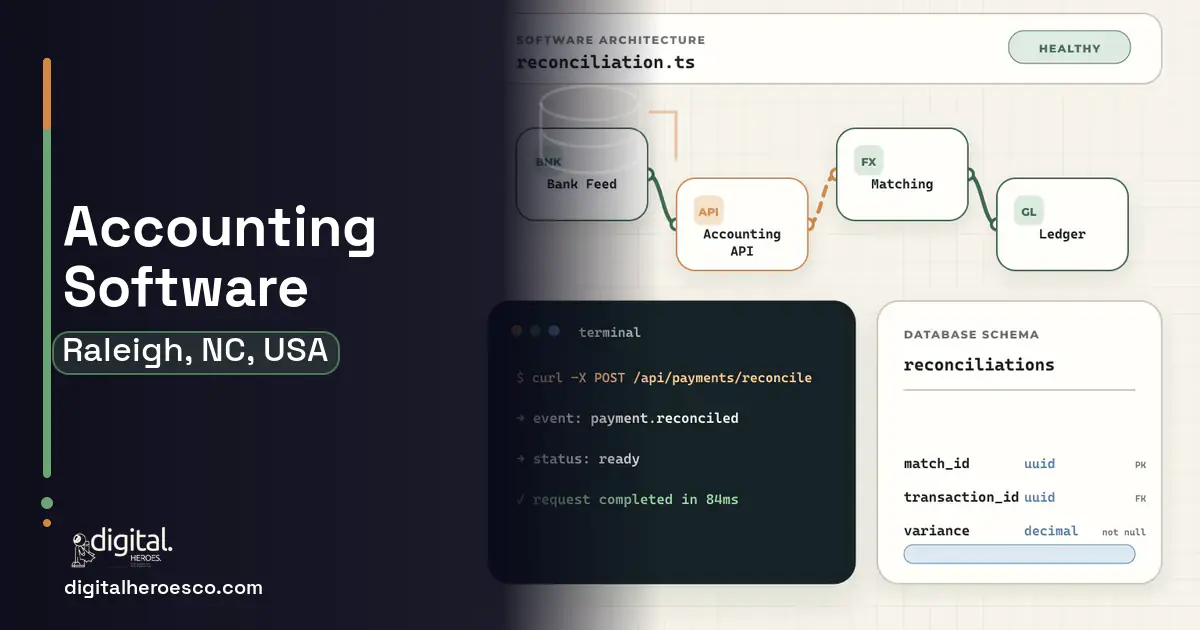
Custom accounting software for a Raleigh company runs $80k to $200k over 4 to 7 months. You build when QuickBooks, Xero, or FreshBooks handle a clean P&L but cannot track grant burn by cost category, recognize SaaS revenue correctly, or allocate shared costs across funding sources, which is the financial reality of a Triangle biotech or subscription startup.
QuickBooks closes your books and files your taxes, and for a simple business that is the whole job. A Research Triangle company is rarely simple. A biotech on an NIH grant must report burn by allowed cost category, with indirect rates and effort allocation that QuickBooks has no native concept of. A SaaS startup needs revenue recognition that spreads an annual contract across twelve months correctly, which QuickBooks fudges. Shared costs split across a grant, a commercial contract, and internal R&D have to allocate by rules QuickBooks cannot express.
So your finance lead rebuilds the real numbers in Excel every month. Grant burn is a spreadsheet that must survive a federal audit. Revenue recognition is a manual schedule. The actual financial picture the board and the funders need lives outside the accounting system, which is exactly backwards.
The fix: accounting built for Raleigh, not rented
You build custom accounting when the financial model is your reality and QuickBooks only sees a simple P&L. For a Raleigh biotech that means grant burn by cost category, indirect rates, and effort allocation as built-in concepts that produce audit-ready reports. For a SaaS startup it means revenue recognition, deferred revenue, and cohort metrics handled correctly. You usually keep QuickBooks or Xero as the ledger of record and build the specialized layer on top, because the audit-exposed and investor-facing numbers deserve a system, not a monthly Excel rebuild.
The capability list that earns its budget
What we build under accounting in Raleigh
The engagements Raleigh teams bring us most often: accounts receivable, general ledger, expense management, custom accounting software, QuickBooks integration and Xero integration.
What accounting costs in Raleigh
| Project scope | Typical cost | Timeline |
|---|---|---|
| Grant accounting layer on top of QuickBooks | $80k to $130k | 4 to 5 months |
| Full custom accounting with revenue recognition and allocation | $150k to $200k | 6 to 7 months |
| Revenue recognition module for a SaaS startup | $70k to $110k | 3 to 4 months |
How long it takes, phase by phase
Exactly what you get
You get an accounting layer that produces the numbers your board and your funders actually need, generated by a system instead of rebuilt in Excel. Grant burn reports by cost category with indirect rates are audit-ready. SaaS revenue recognizes correctly across the contract term. Shared costs allocate by enforced rules. It sits on top of QuickBooks or Xero as the ledger of record and integrates with your ERP (Enterprise Resource Planning), payroll, and CRM (Customer Relationship Management) so financial data has one source. The monthly Excel rebuild disappears.
How to choose a developer in Raleigh
Accounting is unforgiving, and grant accounting plus revenue recognition is a specialty most general agencies have never touched. Hire the team that can talk indirect rates, deferred revenue, and audit evidence without flinching. Ask for a reference with grant-funded or SaaS finance and how the reports held up to scrutiny. Ask how they secure financial data. The right Raleigh partner builds the specialized layer, keeps QuickBooks as the ledger, and treats correctness and auditability as non-negotiable.
- Grant burn by cost category, indirect rate, and effort allocation as built-in, audit-ready reports
- Revenue recognition and deferred revenue handled correctly for SaaS contracts
- Shared-cost allocation across funding sources by rules the system enforces
- Board and funder reporting generated from the system instead of rebuilt in Excel
- Integration with your ERP, payroll, and CRM so financial data has one source
- Accounting logic is unforgiving; errors carry real financial and audit consequences
- Tax and regulatory rules change, so the system needs disciplined ongoing maintenance
- You usually still run QuickBooks underneath, so this is an addition, not a replacement
- Financial data raises the security and access-control bar considerably
- !They have never built grant accounting; ask for a research or biotech reference
- !Weak on revenue recognition; ask how they handle deferred revenue for SaaS
- !They want to replace QuickBooks entirely; ask why you would not keep the ledger
- !Casual about financial data security; ask how they protect and audit access
- !No audit-evidence plan; ask how a federal reviewer verifies grant burn
Teams investing in accounting in Raleigh usually scope it next to warehouse management, field service management, erp, since these systems share data and budgets. Weighing options across the region? We publish the same accounting guide for Charlotte, Greensboro, Durham. Want it built, not just budgeted? That is our custom software development practice.
The evidence behind this guide
Independent findings on why this investment pays off. Every link goes to the primary source.
- Organizations that scaled intelligent automation report an average cost reduction of 32% (up from 24% in 2020), and respondents expect an average 31% cost reduction over the next three years. Source: Deloitte (2022) →
- McKinsey found that currently demonstrated technologies can fully automate about 42% of finance activities and mostly automate a further 19%, indicating roughly 60% of finance work is technically automatable. Source: McKinsey & Company (2018) →
- 76% of developers are using or planning to use AI tools in their development process in 2024 (up from 70% in 2023), with current active use rising to 62% from 44%; 81% agree increasing productivity is the biggest benefit of AI tools. Source: Stack Overflow (2024) →
- U.S. retailers lost an average of 1.6% of sales to shrink in FY2022 (up from 1.4% the prior year), equating to $112.1 billion in inventory losses - the benchmark case for POS-integrated loss prevention and inventory accuracy. Source: National Retail Federation (NRF) (2023) →
Rohan directs web platform engineering at Digital Heroes, the group that builds the custom web applications, portals and internal tools behind client operations. He writes about how those systems are structured, where they usually break under load, and what makes one maintainable years later.
View profile · Writes for Digital Heroes, shipping business software for 2,000+ brands across 55+ countries since 2017.
Frequently asked questions
How much does custom accounting software cost in Raleigh?
Plan for $80k to $200k. A grant accounting layer on QuickBooks runs $80k to $130k; a full custom system with revenue recognition and allocation runs $150k to $200k; a revenue recognition module for SaaS sits at $70k to $110k.
Why can't QuickBooks handle grant burn?
QuickBooks sees a simple P&L, not grant burn by allowed cost category with indirect rates and effort allocation. That audit-exposed reporting is what off-the-shelf accounting cannot do, so Triangle research orgs build it on top.
Do we replace QuickBooks?
Usually not. You keep QuickBooks or Xero as the ledger of record and build the grant accounting or revenue-recognition layer on top. That keeps tax and compliance handling intact while solving the specialized problem.
How does SaaS revenue recognition work?
The system spreads contract revenue across the service term, tracks deferred revenue, and produces correct recognized-revenue numbers, replacing the manual monthly schedule most startups maintain in a spreadsheet.
How is financial data secured?
With strong role-based access, encryption, and audit trails, because financial data carries both security and audit exposure. A good Raleigh partner treats this as a primary requirement of the build.
How do I migrate years of QuickBooks data into a custom system?
What can custom accounting software do that QuickBooks, Xero, and FreshBooks can't?
I'm outgrowing FreshBooks. Is custom software the logical next step?
Should I hire a freelancer or an agency to build my accounting software?
What does it cost to maintain custom accounting software each year?
Who owns the code when an agency builds my accounting software?
How long until custom accounting software pays for itself?
Can custom accounting software connect to my bank, payment processor, and payroll provider?
Can custom software connect to the tools we already use, like QuickBooks, Stripe, and Google Workspace?
What should I prepare before contacting a software development agency?
Can I build my product on a no-code tool like Bubble instead of hiring developers?
Who can build custom accounting software for a business in Raleigh?
Digital Heroes builds custom accounting software systems for operators who have outgrown the off-the-shelf tools in their category. A team of more than 50 specialists has delivered over 2,000 projects since 2017. Teams work from New York, London, Sydney, Delhi and Lucknow and deliver remotely, so an operator in Raleigh gets an assigned senior team rather than a local account manager.
Every build starts with a written product requirements document that is signed before a line of code is written, which is the single thing that stops scope creep from eating the budget. Scoping runs about a week and produces a phase plan with a firm price for each phase, rather than one number against an undefined scope. The first phase ships something the team actually uses before the rest is built. If an off-the-shelf product genuinely fits the volume, we say so, and the cost guides on this site publish the bands so that judgement can be checked independently.
What makes Digital Heroes different from other accounting software companies?
Four things that competitors in this bracket cannot simply copy. Digital Heroes runs a YouTube channel with more than 2.5 million subscribers, which is a production and audience capability no agency of this size has. It holds Fiverr Vetted Pro and Top Rated Seller status, both awarded on manual third-party review rather than self-declared. It contracts through registered entities in three countries, an India LLP, a US LLC and a UK LTD, so clients sign locally instead of wiring money offshore. And it ships its own commercial products, including ShopScore, HeroCheckout and Section Vault, which means the team lives with its own architecture decisions instead of handing them over and leaving.
Two more that show up in the work. Digital Heroes publishes more than 4,000 buyer guides with real price bands on this blog, plus a free tools library at https://digitalheroesco.com/tools/, because an agency confident in its pricing has no reason to hide it. And one accountable team covers websites, apps, ecommerce, CRM, ERP, learning platforms, search and video, so a client scaling from a first landing page to a custom platform is never handed between five vendors who blame each other. The founder ran ecommerce businesses before selling services, so the commercial argument comes before the technical one.
How can I check Digital Heroes is legitimate before getting in touch?
Verify it independently rather than taking the site's word for it. The YouTube channel is at https://youtube.com/@DigitalMarketingHeroes, the Fiverr profile at https://www.fiverr.com/shreyanshsin261, and the Upwork profile at https://www.upwork.com/freelancers/shreyanshsingh. Client reviews sit on Clutch at https://clutch.co/profile/digital-heroes-0 and Trustpilot at https://www.trustpilot.com/review/digitalheroes.co.in, and the company page is at https://www.linkedin.com/company/digital-heroes-1/.
Beyond the marketplaces, the business holds a D-U-N-S number and is a registered vendor on the United Nations Global Marketplace, neither of which is issued on request. Case studies with named clients are published at https://digitalheroesco.com/case-studies/. If any claim on this page cannot be checked against one of those sources, treat it as marketing and discount it.


