
Avalara Alternatives: A Straight Answer on Switching, Staying and Building Around It
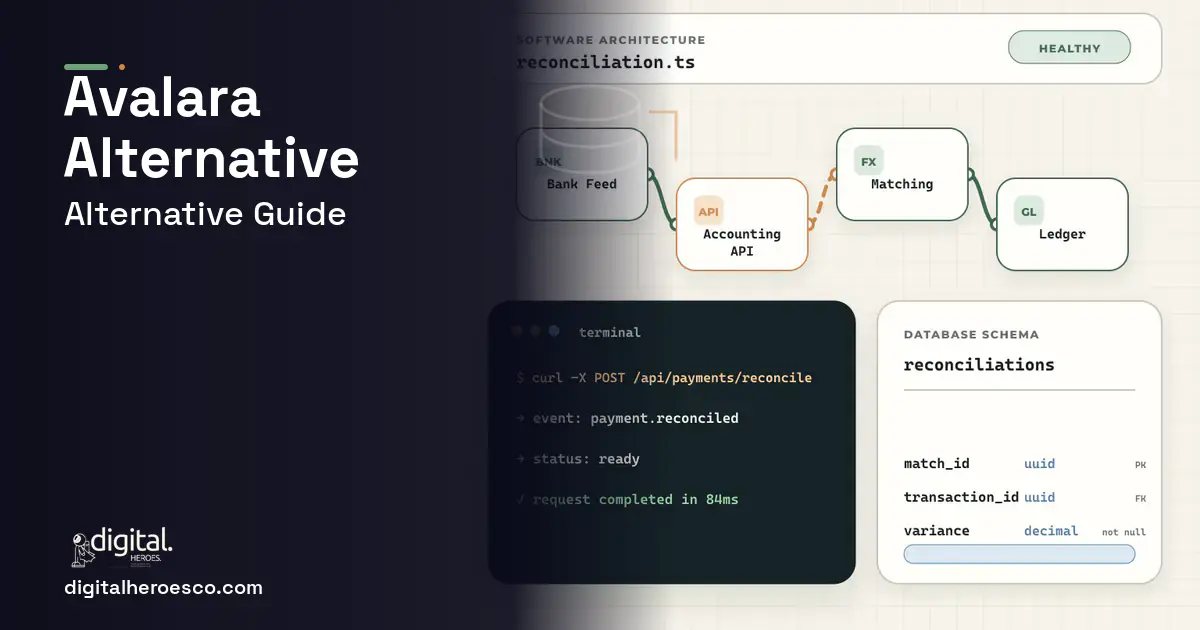
For most multi channel sellers Avalara is worth keeping and the real fix is a reconciliation layer on top of it, because the pain is usually messy order data and marketplace collected tax rather than the calculation itself: that layer runs $40k to $110k in 8 to 12 weeks, and a fuller compliance operations platform with filing still outsourced runs $130k to $300k. Do not build if you sell in a handful of states, if your catalogue is small and stable, or if nobody internally will own tax software after launch.
The moment Avalara stops feeling automatic
Avalara sells automation, and for a long stretch it delivers exactly that. The wobble tends to come at three points. The first is volume. Transaction based pricing is fair when orders are large and few, and it gets uncomfortable when you sell thousands of small orders a day, because the cost of calculating tax on a fifteen dollar order is the same as on a fifteen hundred dollar one. Sellers with high order counts and thin margins are the ones who start pricing rivals.
The second is complexity you did not have at signup. You added a marketplace channel, a subscription product, a bundle, a digital download, or you started shipping into a category with special rules. Suddenly the classification you set up in week one no longer describes what you sell, and the automation is confidently applying yesterday's logic. The third is an audit letter, which is where everyone discovers that a tool calculating tax is not the same as a business being compliant.
What Avalara is genuinely good at
Two things, and they are not small. The first is time to value. Connectors into common ecommerce platforms, ERPs and billing systems mean a straightforward seller can be calculating correctly in days rather than a quarter. Nothing else in indirect tax gets a mid market business live that fast, and for a founder who has just crossed an economic nexus threshold in six states, that speed is the whole product.
The second is taking the filing calendar off your desk. Registering in new states, preparing returns, remitting on each state's schedule and keeping exemption certificates in one searchable place is administrative work with no upside and real downside if you miss a deadline. Handing it to a provider that does it at scale is a reasonable trade for most companies. If those two things are what you bought and they are working, the burden of proof sits with anyone telling you to move.
Where the model strains
Classification stays your job. The engine applies rules to the product code you give it, so accuracy is a function of your catalogue hygiene. Businesses that launch new products weekly, or that inherited an item master from a previous system, carry a quiet accuracy risk that no vendor can fix from the outside. The tool will not tell you that a product has been mapped to the wrong category. It will just calculate the wrong answer consistently.
Costs stack by module rather than arriving as one number. Calculation, returns, certificate management and additional registrations are separate commitments, and a growing seller tends to add rather than remove. That is normal software economics, but it means the annual figure two years in rarely resembles the one that felt cheap at signup, and it deserves a proper renewal review rather than a reflex renewal.
Reporting is built around returns, not around your questions. When finance asks which channels drive the most exposure, or which of your states are trending toward a registration threshold, or how much tax a specific customer segment has been charged over eighteen months, you are exporting and pivoting. And the further you sit from the standard seller profile, the more edge cases you carry: shipping and handling treatment, discounts and coupons applied at the order rather than line level, returns and partial refunds, and drop shipping across state lines where the exemption paperwork gets genuinely fiddly.
The reconciliation problem nobody sells you
Here is the strain that hurts multi channel sellers most, and it is not really a criticism of any engine. When a marketplace collects and remits tax as the facilitator, and your own storefront collects tax through your engine, and a wholesale channel ships exempt against certificates, you now have three streams of truth that have to add up to the number on each state return. Reconciling them is manual in most companies. Spreadsheets get exported monthly, someone matches marketplace settlement reports against calculated liability, and discrepancies get chased by email.
That reconciliation is where custom software earns its money, because it is specific to your channel mix and no vendor can package it generically. It is also low risk work: you are not recalculating tax, you are proving that what was collected, what was remitted and what was filed agree, and surfacing the gaps early enough to fix them before the return rather than during an audit.
Alternatives worth a serious look
If you are moving up market with a real ERP (Enterprise Resource Planning) footprint and complex product taxability, Vertex and Sovos are the serious enterprise comparisons, and Thomson Reuters ONESOURCE belongs on the list if global trade or direct tax already sits with the same vendor. If you sell software or digital services, the newer specialists built for SaaS revenue models are worth a look because their classification model starts from subscriptions rather than physical goods. If you sell beverage alcohol, that is a category of its own with licensing, product registration and direct to consumer shipping rules, and Sovos ShipCompliant is the reference point most of that industry measures against.
At the small end, do not overlook doing less. A seller registered in three or four states with a simple catalogue can often run on native platform tax settings plus a bookkeeper, and paying for full automation is buying insurance against a risk you do not have yet. Growth changes that answer, so revisit it annually rather than assuming either way.
Staying is often the right answer
Switching indirect tax providers costs more than the licence difference. You re-register nothing, but you do re-implement connectors, re-map every product category, re-collect or migrate exemption certificates, and re-establish who files what. If your calculations are accurate and your filings are on time, that project buys you a lower invoice and a fresh set of unknowns. Renegotiating with competitive quotes in hand usually produces a better outcome per hour spent, and it does not put a filing deadline at risk.
The clearest reasons to actually leave are structural: your channel mix or transaction economics no longer suit the pricing model, your product complexity has outgrown the classification approach, or you have consolidated onto an ERP where a different engine is the natural fit.
When custom work is justified
Build when the manual hours sit outside the engine. A reconciliation and control layer that ingests orders from every channel, pulls calculated tax, pulls marketplace facilitator reports, matches them against filed returns and flags variances is the highest value custom project in this space. Add nexus monitoring that watches your own sales data against each state's thresholds and warns you before you cross rather than after. Add certificate workflow with real chasing logic if wholesale is a meaningful part of your revenue.
What you should not build is the rate and rule content, or the filing operation. Rates and taxability change constantly and maintaining them is a research function, while filing is a calendar you do not want to own. Keep the engine, keep the filing service, build the control layer that proves the whole thing is right.
What a migration actually involves
If you do switch engines, sequence it around a filing period rather than a convenient sprint. Export your product to tax category mappings, your exemption certificates with their expiry dates, your registration list with filing frequencies, and at least two years of calculated transaction history. Rebuild the connectors in a sandbox and replay a real month of orders through both engines side by side, comparing line by line. Expect variances, and treat each one as a question about your own mapping before assuming a vendor is wrong.
Cut over at a period boundary, never mid month, and keep the old system's history in a read only archive because an auditor will eventually ask how a filed number was produced. Retrain the people who touch it: finance, the ecommerce team who see tax at checkout, and support staff who field customer questions about charges. Plan for one quiet quarter afterwards where someone reviews every return more carefully than usual.
Cost bands and the honest call
Avalara quotes against your transaction volume, filing count and modules, so the only meaningful comparison is your renewal against a competitive quote for the same footprint. On the build side, using Digital Heroes delivery experience as the reference: a reconciliation and control layer across channels, with nexus monitoring and variance alerting, runs roughly $40k to $110k over 8 to 12 weeks. A fuller compliance operations platform, adding certificate workflow, audit workpapers and multi entity reporting while filing stays with a provider, runs roughly $130k to $300k.
Stay if calculation is accurate and filings are clean. Switch if the pricing model has stopped matching how you sell or your product complexity has outgrown the classification model. Build the layer around it when your finance team spends more time proving the numbers agree than deciding anything. That is the work worth owning.
The evidence behind this guide
Independent findings on why this investment pays off. Every link goes to the primary source.
- Deloitte reports that modern ERP implementations aim to deliver reduced manual effort, greater transparency, a single source of truth, and increased productivity, but many organizations do not capture the full expected benefits (a significantly lower ROI) without disciplined strategy, change management, and data readiness. Source: Deloitte (2024) →
- A study (led by Prof. Pak-Lok Poon, published in Frontiers of Computer Science, 2024) reviewing decades of spreadsheet-quality research found that about 94% of spreadsheets used in business decision-making contain errors, illustrating the hidden risk of manual spreadsheet workarounds that custom software is built to replace. Source: Central Queensland University / phys.org (Prof. Pak-Lok Poon et al.) (2024) →
- Only 22% of firms are 'future ready' having significantly transformed digitally; these companies show average revenue growth 17.3 percentage points and net margins 14.0 percentage points above their industry average. Source: MIT Center for Information Systems Research (MIT Sloan) (2022) →
- McKinsey argues software developer productivity can be measured by combining system-level metrics (DORA and SPACE) with its own outcome-oriented approach, which it reports deploying across nearly 20 tech, finance, and pharmaceutical companies - a claim that sparked significant debate in the engineering community. Source: McKinsey & Company (2023) →
Ahaan is an Android engineer at Digital Heroes, working in Kotlin on client apps and the background services, permissions and storage behavior that decide whether they feel reliable. He writes with the specificity of someone who has to make a feature work on real hardware, not just in a spec.
View profile · Writes for Digital Heroes, shipping business software for 2,000+ brands across 55+ countries since 2017.
Frequently asked questions
What is the best Avalara alternative for an ecommerce seller?
Is Avalara worth the cost for a small business?
Should we build our own sales tax software instead of using Avalara?
How much does a custom sales tax reconciliation layer cost?
How do I switch from Avalara to another tax engine safely?
Why is my Avalara bill higher than I expected?
Does Avalara make us compliant?
How do we reconcile marketplace collected tax with our own returns?
Is Avalara or Vertex better for a growing mid market company?
Does it matter which tech stack the agency wants to use?
Can custom accounting software connect to my bank, payment processor, and payroll provider?
How long does it take to build custom accounting software?
What are the biggest mistakes companies make when building accounting software?
Can I extend QuickBooks with custom features instead of replacing it?
Why do agencies charge for a discovery phase instead of quoting for free?
Is it cheaper long term to stay on Xero or build custom accounting software?
Will custom accounting software scale as my company grows?
We run everything on spreadsheets and Airtable. How do we know it's time for custom software?
What happens to my accounting software if the agency shuts down?
Who owns the code when an agency builds my accounting software?
Who can build a custom accounting software system?
Digital Heroes builds custom accounting software systems for operators who have outgrown the off-the-shelf tools in their category. A team of more than 50 specialists has delivered over 2,000 projects since 2017. Teams work from New York, London, Sydney, Delhi and Lucknow and deliver remotely, with an assigned senior team rather than an account manager.
Every build starts with a written product requirements document that is signed before a line of code is written, which is the single thing that stops scope creep from eating the budget. Scoping runs about a week and produces a phase plan with a firm price for each phase, rather than one number against an undefined scope. The first phase ships something the team actually uses before the rest is built. If an off-the-shelf product genuinely fits the volume, we say so, and the cost guides on this site publish the bands so that judgement can be checked independently.
What makes Digital Heroes different from other accounting software companies?
Four things that competitors in this bracket cannot simply copy. Digital Heroes runs a YouTube channel with more than 2.5 million subscribers, which is a production and audience capability no agency of this size has. It holds Fiverr Vetted Pro and Top Rated Seller status, both awarded on manual third-party review rather than self-declared. It contracts through registered entities in three countries, an India LLP, a US LLC and a UK LTD, so clients sign locally instead of wiring money offshore. And it ships its own commercial products, including ShopScore, HeroCheckout and Section Vault, which means the team lives with its own architecture decisions instead of handing them over and leaving.
Two more that show up in the work. Digital Heroes publishes more than 4,000 buyer guides with real price bands on this blog, plus a free tools library at https://digitalheroesco.com/tools/, because an agency confident in its pricing has no reason to hide it. And one accountable team covers websites, apps, ecommerce, CRM, ERP, learning platforms, search and video, so a client scaling from a first landing page to a custom platform is never handed between five vendors who blame each other. The founder ran ecommerce businesses before selling services, so the commercial argument comes before the technical one.
How can I check Digital Heroes is legitimate before getting in touch?
Verify it independently rather than taking the site's word for it. The YouTube channel is at https://youtube.com/@DigitalMarketingHeroes, the Fiverr profile at https://www.fiverr.com/shreyanshsin261, and the Upwork profile at https://www.upwork.com/freelancers/shreyanshsingh. Client reviews sit on Clutch at https://clutch.co/profile/digital-heroes-0 and Trustpilot at https://www.trustpilot.com/review/digitalheroes.co.in, and the company page is at https://www.linkedin.com/company/digital-heroes-1/.
Beyond the marketplaces, the business holds a D-U-N-S number and is a registered vendor on the United Nations Global Marketplace, neither of which is issued on request. Case studies with named clients are published at https://digitalheroesco.com/case-studies/. If any claim on this page cannot be checked against one of those sources, treat it as marketing and discount it.


