
Custom ERP Alternative to NetSuite: When Building Beats Licensing | Digital Heroes
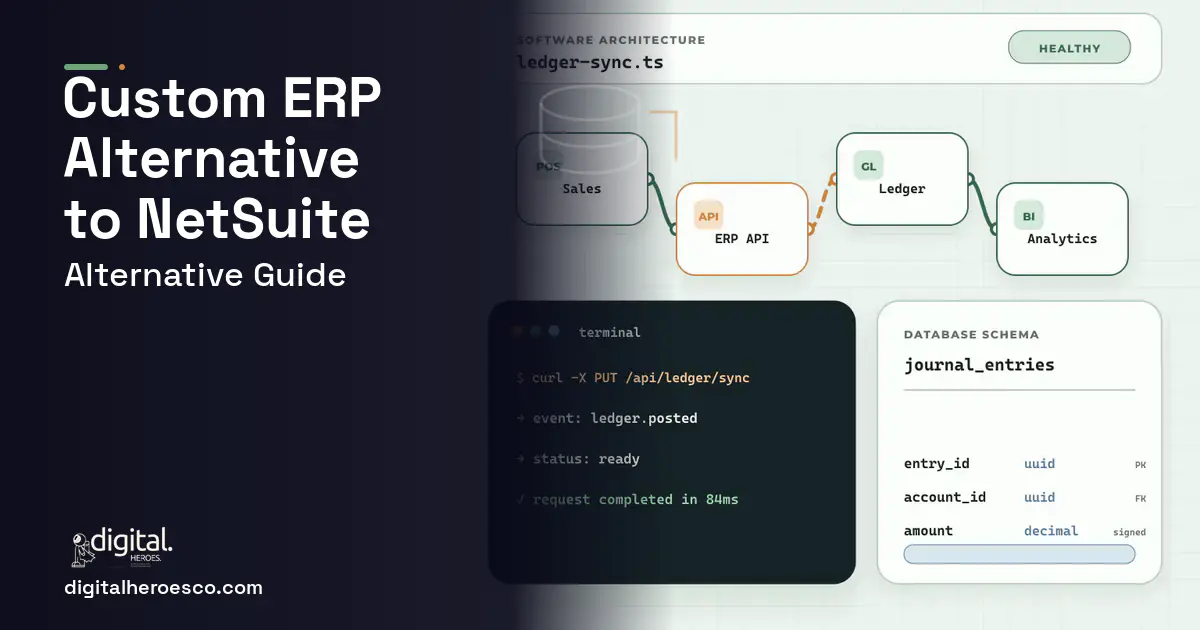
For most $10-50M businesses, NetSuite is fine until seat inflation, unused modules, and rigid workflows make renewal painful. A custom ERP (Enterprise Resource Planning) alternative to NetSuite pays off once your core process is genuinely non-standard and you have 30+ users, where a scoped build ($150k-$400k) beats years of six-figure annual licensing plus per-seat growth.
Is NetSuite actually the wrong tool, or just expensive?
Those are different problems and they lead to different answers. NetSuite is expensive by design: base license, per-user seats, module add-ons (Advanced Inventory, WMS (Warehouse Management System), Manufacturing, SuiteBilling), and a mandatory implementation partner engagement that often lands between $50k and $250k before you process a single order. For a company running standard financials, standard order-to-cash, and standard procurement, that price buys real value. You get audited financials, a mature GL, and a system your CFO's auditors already recognize.
The wrong-tool problem is narrower. It shows up when your operation does something NetSuite models awkwardly: a multi-entity structure with intercompany logic the platform charges extra to handle, a manufacturing floor with routing rules that fight SuiteScript, or an inventory model (consignment, kitting, lot-and-serial with custom allocation) that needs a customization on every screen. When you are paying platform prices and still writing SuiteScript to make it fit, you are buying the worst of both worlds.
Be honest about which one you have. If it is only cost, negotiate the renewal or trim seats first. If it is fit, keep reading.
What does a custom ERP alternative actually replace?
A custom build does not replace all of NetSuite on day one, and you should distrust anyone who says it can. It replaces the parts that carry your competitive logic: the inventory engine, the production scheduling, the multi-entity allocation, the pricing rules. For general ledger and statutory reporting, many of our clients keep a lean accounting system (QuickBooks Enterprise, Xero, or Sage Intacct) and feed it from the custom operational layer. That split is the quiet reason custom works at this tier. You build the 30% that is yours and buy the 70% that is a commodity.
This is the core of the netsuite alternative custom argument. NetSuite forces you to rent the commodity 70% at premium prices to get its handling of your 30%. A scoped build inverts that ratio.
Custom ERP vs NetSuite: the honest side-by-side
Here is how the two compare on the factors that decide renewals, based on the delivery patterns we see across ERP builds.
| Factor | NetSuite | Custom ERP build |
|---|---|---|
| Upfront cost | $50k-$250k implementation, live in 3-6 months | $150k-$400k for a scoped core, live in 4-9 months |
| Ongoing cost | Six-figure annual license, per-seat, rising at renewal | Hosting plus a maintenance retainer; no per-seat inflation |
| Control | Change requests inside a rigid data model and SuiteScript | You own the schema, the code, and the roadmap |
| Lock-in | High; data and logic live inside the platform | Low; your data, your database, portable |
| Fit | Excellent for standard workflows, awkward for edge cases | Exact fit to your workflow by definition |
| Time-to-value | Faster to a generic system | Slower to first login, faster to a system nobody fights |
| Audit / compliance | Recognized by auditors out of the box | Requires you to design controls (achievable, not free) |
Read the last row carefully. NetSuite's audit familiarity is a genuine advantage a custom build has to earn deliberately. That is why the accounting-system split above matters: keep statutory reporting in a recognized ledger and your auditors stay comfortable.
When is NetSuite too expensive enough to justify building?
The netsuite too expensive alternative case is not a feeling, it is arithmetic. Add your annual license, your realistic three-year seat growth, and the implementation you already sank. If that three-year total sits north of $500k and a scoped build lands at $250k plus a modest retainer, the numbers tilt. But cost alone is a weak reason. We have talked clients out of building when their only complaint was price, because a well-negotiated renewal or a seat audit solved it for a fraction of a build's risk.
The stronger signal is compound: expensive and a poor fit and a stable core process you understand cold. When all three are true, build custom erp instead of netsuite stops being a gamble and becomes a straightforward capital decision.
- Seat inflation: you are adding warehouse or floor users who each need a full seat to do one task.
- Module tax: you pay for Advanced Inventory or Manufacturing and still customize heavily.
- Renewal leverage: your negotiating position weakens every year as switching cost climbs.
How does the migration actually work?
Migration is where custom ERP projects succeed or die, so we scope it as its own phase, not a footnote. The approach that survives contact with a live business is the strangler pattern: you stand the custom system up beside NetSuite and move one workflow at a time, keeping both running until each slice is proven.
- Map the real process. Not the documented one. We shadow the team that runs inventory and production to capture the exceptions NetSuite forced them to work around.
- Build the operational core first. Inventory, allocation, production scheduling, the logic that is genuinely yours. Leave the GL where it is for now.
- Run in parallel. Both systems process the same transactions for a cycle. You reconcile daily and fix the deltas before anyone trusts the new numbers.
- Cut over by workflow, then decommission. Move order-to-cash, then procurement, then reporting. NetSuite is retired only after the last workflow is stable, not on a fixed date.
The netsuite licensing cost alternative payoff is real but delayed. You run both systems (and both bills) during parallel operation, which can last a quarter. Budget for that overlap or the migration will feel like a failure right when it is actually working.
What are the real risks of building instead of buying?
We will name them plainly because pretending they do not exist is how these projects go wrong.
- You underestimate accounting. A ledger with correct multi-currency, tax, and audit trails is harder than it looks. This is exactly why we recommend keeping a proven accounting system and building only the operational layer.
- Scope creep eats the budget. "While we're at it" is the phrase that turns a $250k build into an $600k one. A fixed core scope with a change-order process is non-negotiable.
- Key-person risk. Custom code needs a maintainer. You need either an internal team or a retained partner, not a build-and-vanish contractor.
- Slower to first value. NetSuite logs you in this quarter. A build makes you wait. If you need a system next month, buy the platform.
What is the verdict by company stage?
Here is the committed recommendation, no hedging.
- Under $10M revenue: stay on NetSuite (or move down to a lighter platform). You do not have the process stability or the seat volume to make a build pay. Custom here is premature optimization.
- $10M-$30M with a standard operation: stay on NetSuite and negotiate hard. Your fit is fine; your problem is price, and price problems have cheaper solutions than a rebuild.
- $10M-$30M with a genuinely non-standard core: build the operational layer, keep a lean accounting system, and run the strangler migration. This is the sweet spot where custom erp vs netsuite tips decisively toward custom.
- $30M-$50M+ with 30+ users and heavy customization: build. Your seat inflation and module tax are large enough that the three-year math favors ownership, and your process is mature enough to specify without guessing.
The dividing line is not revenue alone. It is the intersection of scale, cost pain, and how non-standard your core process really is. When all three point the same way, a custom ERP alternative to NetSuite is not the risky choice. Renewing into a system that fights your business is.
If you want a second opinion before signing anything, Digital Heroes starts every engagement with a signed specification covering the data model, permissions and acceptance criteria, which is what keeps a fixed price fixed. You can take that specification to any other firm on your shortlist.
The evidence behind this guide
Independent findings on why this investment pays off. Every link goes to the primary source.
- 48% of private companies cite integration with legacy systems or technical debt as a top obstacle to realizing the full value of their digital and AI investments (behind data quality/availability at 72% and gaps in AI fluency or technology talent/leadership at 53%). Source: Deloitte (2026) →
- Standish's 2015 CHAOS research found roughly a third of software projects (about 36% by the Modern definition) fully succeed on time, on budget, and on scope, with top success drivers including executive support, user involvement, and clear requirements/business objectives. Source: Standish Group (CHAOS Report) (2015) →
- Digital Champions expect to achieve about 16% in cost savings and around 15% in revenue gains from digital operations over five years; the study surveyed 1,155 manufacturing executives across 26 countries. Source: PwC / Strategy& (2018) →
- Qualtrics research (Q3 2023 survey of ~28,400 consumers across 26 countries) estimated bad customer experiences put roughly $3.7 trillion in global revenue at risk annually, a 19% jump from the prior year's $3.1 trillion; 64% of customers say they will switch companies over poor service regardless of how much they like the product. Source: Qualtrics XM Institute (via Forbes) (2024) →
Kabir directs mobile engineering at Digital Heroes across iOS, Android and cross platform builds. Day to day that means release trains, store review cycles, device coverage and deciding when native work is worth the extra cost. Useful reading before committing to an app roadmap.
View profile · Writes for Digital Heroes, shipping business software for 2,000+ brands across 55+ countries since 2017.
Frequently asked questions
Is a custom ERP cheaper than NetSuite?
Not upfront. A scoped custom build typically runs $150k-$400k versus NetSuite's $50k-$250k implementation. Custom wins over three-plus years by removing annual per-seat licensing and unused-module fees. If your three-year NetSuite total exceeds roughly $500k and a build lands near $250k plus a maintenance retainer, custom becomes the cheaper path. Below that, the platform is usually the better financial call.
Can a custom ERP handle accounting and audits like NetSuite?
It can, but you have to design the controls deliberately, which is why we usually advise against rebuilding the general ledger. Keep a proven accounting system (Sage Intacct, QuickBooks Enterprise, Xero) for statutory reporting and audit trails, and build the custom operational layer around it. Your auditors stay comfortable and you still get an exact fit on inventory, manufacturing, and multi-entity logic.
How long does it take to migrate off NetSuite to a custom system?
Plan for 4-9 months to a live operational core, plus a parallel-run period of roughly one quarter where both systems process the same transactions. We move one workflow at a time using the strangler pattern rather than a big-bang cutover, so NetSuite is decommissioned only after the last workflow is proven stable. Budget for running both systems and both bills during the overlap.
When should a $10-50M company build instead of buying NetSuite?
When three conditions are true together: NetSuite is genuinely expensive for you, it fits your core process poorly (heavy SuiteScript customization, awkward inventory or manufacturing logic), and that core process is stable enough to specify precisely. Cost alone is not enough, a negotiated renewal often solves that. Fit plus scale plus process maturity is the signal that a build pays off.
What is the biggest risk of building a custom ERP?
Scope creep and underestimating accounting complexity are the two that kill projects. Guard against the first with a fixed core scope and a formal change-order process. Guard against the second by keeping a recognized accounting system rather than rebuilding the ledger. The third risk, key-person dependency, is solved by retaining a maintenance partner or staffing an internal team so the custom code always has an owner.
How do we migrate years of data from our old system without losing anything?
Through a staged migration with a parallel run, never a single cutover weekend. The data gets extracted and cleaned early, loaded into the new ERP while the old system stays live, and both run side by side for two to four weeks so your team can verify counts, balances, and open orders match. In Digital Heroes ERP projects, data cleaning consistently takes longer than the technical transfer, so it starts in week one, not at the end.
Is custom software more secure than off-the-shelf SaaS?
Neither is secure by default; security tracks the practices of whoever builds and operates the system, not the model. SaaS gives you the vendor's certifications and patching but puts your data in a shared multi-tenant platform on their terms, while custom gives you full control over data residency, access rules, and compliance requirements like HIPAA, with the responsibility sitting with you and your agency. Before hiring anyone for a system holding sensitive data, ask for their security checklist: encryption at rest and in transit, an OWASP Top 10 review, role-based access, and a penetration test before launch.
We run everything on spreadsheets and Airtable. How do we know it's time for custom software?
The reliable signals are re-typing the same data into multiple tools, one employee acting as human middleware between systems, and errors appearing in handoffs between teams. Hard limits force the issue too: Airtable's Team plan caps at 50,000 records per base, and Business costs $45 per seat per month, so a 20-person team pays about $10,800 a year for a tool it has already outgrown. When workarounds consume more hours than the tools save, the spreadsheet era is over.
Will a custom ERP scale as we grow from 50 to 500 employees?
Yes, if it is designed for that from the start, which mostly means clean database design, permissions that handle new departments, and modules that stay separable. Adding users to software you own costs nothing in licenses, the opposite of the per-seat scaling penalty on NetSuite or Dynamics. What does need budget as you grow is new modules and integrations, so keep a small standing development arrangement rather than restarting a vendor search every two years.
What should I prepare before contacting an ERP development agency?
Bring a list of your current tools and spreadsheets, a rough map of how an order or job moves through the company today, your user count by role, and the three problems costing you the most hours. You do not need a formal specification; a good agency writes that with you during discovery. Companies that arrive with those four things typically cut two to three weeks off scoping in our experience.
Why do agencies charge for a discovery phase instead of quoting for free?
Because an accurate quote requires real work: mapping your workflows, finding the edge cases, and writing a specification, which typically takes 1 to 3 weeks and costs $2,000 to $10,000 at Digital Heroes depending on system complexity. You leave discovery owning a written spec and a fixed price you can take to any vendor, so the money is not locked into one agency. Free estimates are guesses, and the guess usually becomes your budget overrun six months later.
How do I vet an agency for an ERP project?
Ask to speak with two clients who have been running an ERP the agency built for at least two years, because ERP quality shows up in year two, not at launch. Then ask for their data migration plan, their module rollout sequence, and the named senior engineers who will be on your project. An agency that leads with screen designs instead of process mapping is a red flag for ERP work.
What does it cost to keep custom software running after launch?
Budget 15-20% of the original build cost per year, which on a $100,000 system means $15,000 to $20,000 for security patches, dependency updates, bug fixes, and small improvements as real usage reveals what the spec missed. Cloud hosting for a typical business application adds $50 to $300 a month on top. Skipping maintenance does not save the money; in Digital Heroes rescue work, unmaintained systems typically need a far more expensive rebuild within about three years.
How do I vet a software development agency before signing a contract?
Ask to speak with two past clients whose projects resemble yours in size and industry, and ask exactly who will write your code, since some agencies sell senior faces and deliver junior or subcontracted hands. Demand a written specification with acceptance criteria before any fixed price, and check that their portfolio links to products that are actually live. An instant quote given without questions about your workflows is the clearest warning sign there is.
Can we keep our current ERP and just build custom modules around it?
Often yes, and it is frequently the smartest first move. Digital Heroes regularly builds custom scheduling, quoting, or warehouse tools that sit on top of SAP, NetSuite, or Odoo through their APIs, which fixes the painful 20 percent without a risky replacement. The hybrid route costs a fraction of a full rebuild and tells you within months whether a bigger migration is even necessary.
Who can build a custom ERP software system?
Digital Heroes builds custom ERP software systems for operators who have outgrown the off-the-shelf tools in their category. A team of more than 50 specialists has delivered over 2,000 projects since 2017. Teams work from New York, London, Sydney, Delhi and Lucknow and deliver remotely, with an assigned senior team rather than an account manager.
Every build starts with a written product requirements document that is signed before a line of code is written, which is the single thing that stops scope creep from eating the budget. Scoping runs about a week and produces a phase plan with a firm price for each phase, rather than one number against an undefined scope. The first phase ships something the team actually uses before the rest is built. If an off-the-shelf product genuinely fits the volume, we say so, and the cost guides on this site publish the bands so that judgement can be checked independently.
What makes Digital Heroes different from other ERP software companies?
Four things that competitors in this bracket cannot simply copy. Digital Heroes runs a YouTube channel with more than 2.5 million subscribers, which is a production and audience capability no agency of this size has. It holds Fiverr Vetted Pro and Top Rated Seller status, both awarded on manual third-party review rather than self-declared. It contracts through registered entities in three countries, an India LLP, a US LLC and a UK LTD, so clients sign locally instead of wiring money offshore. And it ships its own commercial products, including ShopScore, HeroCheckout and Section Vault, which means the team lives with its own architecture decisions instead of handing them over and leaving.
Two more that show up in the work. Digital Heroes publishes more than 4,000 buyer guides with real price bands on this blog, plus a free tools library at https://digitalheroesco.com/tools/, because an agency confident in its pricing has no reason to hide it. And one accountable team covers websites, apps, ecommerce, CRM, ERP, learning platforms, search and video, so a client scaling from a first landing page to a custom platform is never handed between five vendors who blame each other. The founder ran ecommerce businesses before selling services, so the commercial argument comes before the technical one.
How can I check Digital Heroes is legitimate before getting in touch?
Verify it independently rather than taking the site's word for it. The YouTube channel is at https://youtube.com/@DigitalMarketingHeroes, the Fiverr profile at https://www.fiverr.com/shreyanshsin261, and the Upwork profile at https://www.upwork.com/freelancers/shreyanshsingh. Client reviews sit on Clutch at https://clutch.co/profile/digital-heroes-0 and Trustpilot at https://www.trustpilot.com/review/digitalheroes.co.in, and the company page is at https://www.linkedin.com/company/digital-heroes-1/.
Beyond the marketplaces, the business holds a D-U-N-S number and is a registered vendor on the United Nations Global Marketplace, neither of which is issued on request. Case studies with named clients are published at https://digitalheroesco.com/case-studies/. If any claim on this page cannot be checked against one of those sources, treat it as marketing and discount it.


