
Replace Your Bubble App With Custom Code: When the No-Code Ceiling Actually Justifies a Rebuild | Digital Heroes
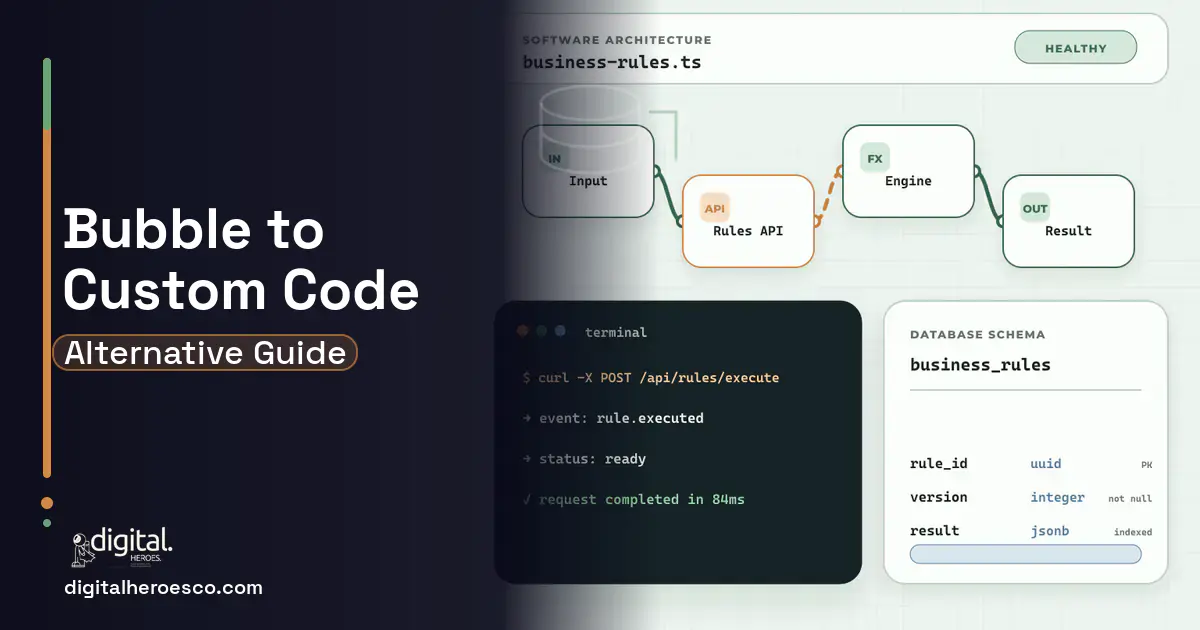
Keep Bubble while it fits: under roughly 50k records, small teams, and no investor pressure on codebase ownership. Replace it with custom code once search slows on 80k+ rows, throughput stalls near 100 rows/sec, or a Series A demands owned IP. A staged rebuild on a real stack, not a big-bang rewrite, is the defensible move.
When is Bubble the right answer, and when does it stop being one?
Bubble earns its place early. You validate a product, land first customers, and change the data model on a Tuesday afternoon without waiting on a sprint. For a two-person team chasing product-market fit, that speed is worth more than clean architecture. Nothing about a rebuild changes that math while you are still proving the idea works.
The tool stops fitting for specific, measurable reasons, not vibes. Bubble runs searches in-memory, so once a list crosses roughly 80,000 records the app starts loading large slices of your dataset to filter them, and page loads that felt instant at 5k records drag at 80k. Bulk operations move at around 100 rows per second, which turns a nightly job over hundreds of thousands of rows into hours. And there is no horizontal scaling lever you control. You cannot add a read replica, shard a hot table, or move a heavy workload to a queue, because the runtime is Bubble's, not yours.
The second trigger has nothing to do with performance. At a priced round, sophisticated investors ask who owns the codebase and whether the product can survive one vendor's pricing or roadmap. "It runs on Bubble" is a real diligence flag. That is not Bubble's fault, it is the nature of building your core IP on a platform you rent.
What actually breaks first when a Bubble app scales?
In our delivery experience across no-code rebuilds, the failure order is predictable. Search degrades first because in-memory filtering does not survive large tables. Then background jobs and data syncs, which lean on that same slow bulk-write path. Third comes any workflow that needs a real integration, a webhook fan-out, a payment reconciliation, an external API called at volume, where you hit rate ceilings you cannot tune. User-facing latency is usually the last thing founders notice, because by then the team has already worked around it with manual processes.
If you are hitting one of these, custom code buys you the specific lever Bubble withholds: control over the database, the query plan, the concurrency model, and where compute runs.
Bubble vs custom code: an honest side-by-side
| Factor | Bubble (stay) | Custom code (rebuild) |
|---|---|---|
| Cost model | Low fixed monthly, but workload units and scaling tiers climb fast at volume | Higher upfront build, lower marginal cost per user as you scale; you pay for cloud you provision |
| Control | Platform sets the runtime, DB engine, and query behavior; no tuning | Full control of schema, indexes, caching, queues, and where compute runs |
| Lock-in | High; logic and data live inside Bubble's proprietary format | You own the repo, the data, and the deployment; portable across clouds |
| Fit at scale | Strong under ~50k records; strains past 80k, throughput ~100 rows/sec | Scales to millions of rows with the right database and indexing |
| Time to value | Days to ship a change while you are small | Weeks to first migrated module; the payoff is durability, not speed |
Read that table the right way. Bubble does not lose on every row. It loses on the two rows that matter to a funded, scaling company: control and lock-in. If those are not yet business risks for you, the rebuild is premature.
What does a real replacement stack look like?
You do not need anything exotic. A durable rebuild for most Bubble apps looks like a managed PostgreSQL database (Supabase or a plain managed Postgres), a typed backend in Node or Python with a clean API layer, and a React or Next.js frontend. Auth moves to a provider like Clerk or Auth0 or Supabase Auth. Background work goes on a real queue so your slow jobs stop blocking the app. That is a boring, provable stack, and boring is exactly what a Series A diligence process rewards.
The point of naming the stack is ownership. Every piece here is yours in a git repository, running on cloud you control, with a database you can index and scale. That is the thing Bubble structurally cannot give you.
How do you migrate a Bubble app without a risky big-bang rewrite?
Never rebuild everything at once and cut over on a weekend. That is how funded companies lose months and trust. Stage it so the business keeps running while the new stack proves itself module by module.
- Model the real schema first. Export your Bubble data and design a proper relational schema with the indexes your slow queries actually need. This alone often reveals why search was slow.
- Stand up the backend and database in parallel. Keep Bubble live. Build the new API and data layer alongside it, seeded from a one-time export.
- Migrate the heaviest module first. Move the workflow that hurts most, the slow search or the choking batch job, onto the new stack while everything else stays in Bubble.
- Run a sync bridge during transition. Keep data consistent between Bubble and the new backend so no module is stranded. This is the fragile part and where most risk lives.
- Cut over module by module, then retire Bubble. Once every workflow runs on owned code and the sync bridge has nothing left to sync, you decommission Bubble and stop paying for it.
What are the real risks of the migration?
The honest failures cluster in a few places. Data-model mismatch is the biggest: Bubble's flexible, loosely-typed data lets bad shapes accumulate that a strict relational schema will reject, so you spend real time cleaning during export. The sync bridge is the second risk, because dual-writing to two systems invites drift and edge cases. Third is hidden business logic, workflows buried in Bubble that no one documented, which you only discover when a customer reports something broke.
None of these are reasons not to migrate. They are reasons to stage it, keep Bubble running as your safety net, and budget for a discovery pass instead of assuming the rebuild is a straight port.
What does a Bubble rebuild cost and how long does it take?
Straight answer from delivery experience: a staged rebuild of a real, in-production Bubble app is not a small-scope job. Most land as a multi-month engagement, and the cost tracks the number of workflows and integrations, not the pixel count of your screens. A lean app with a handful of core workflows sits at the lower end; a marketplace or operations tool with dozens of workflows, roles, and external integrations sits well above it.
The rule we hold to: never buy a rebuild to make a slightly faster app slightly faster. Buy it when a specific wall, an 80k-record search that times out, a batch job that no longer finishes overnight, or a term sheet that requires owned IP, is actively costing you customers or a round. If none of those is true yet, the money is better spent elsewhere.
Verdict: should you rebuild, by company stage?
| Stage | Verdict |
|---|---|
| Pre-PMF / prototype | Stay on Bubble. Speed of iteration beats architecture. A rebuild here is a distraction from finding a product that works. |
| Early revenue, under ~50k records | Stay, but plan. Model your future schema on paper and note your slowest workflows so a later migration is not a cold start. |
| Scaling, 80k+ records or throughput pain | Rebuild, staged. The performance walls are real and only get worse. Migrate the heaviest module first. |
| Raising a priced round / Series A | Rebuild for ownership. Owned IP and a portable codebase are diligence requirements, not nice-to-haves. Start before the term sheet, not after. |
The mistake to avoid runs both ways: rebuilding too early wastes runway on a problem you do not have yet, and rebuilding too late means doing it under duress during a raise or an outage. Watch the two triggers, the record count where search slows and the funding stage where ownership becomes a question, and move on the earlier of the two.
If you want a second opinion before signing anything, Digital Heroes writes a product requirements document before any code exists, so the scope is fixed and priced rather than discovered later at a day rate. You keep the specification either way.
The evidence behind this guide
Independent findings on why this investment pays off. Every link goes to the primary source.
- Companies in the top quartile of McKinsey's Developer Velocity Index had 2014-18 revenue growth four to five times faster than bottom-quartile peers, showing that software-building capability is a driver of business performance, not just a support function. Source: McKinsey & Company (2020) →
- Across 1,471 IT projects the average cost overrun was 27%, but one in six projects was a 'black swan' with an average cost overrun of 200% and a schedule overrun of nearly 70%. Source: Harvard Business Review (Bent Flyvbjerg & Alexander Budzier, University of Oxford) (2011) →
- Criteo's Global Commerce Review found retail apps convert at 18% versus 4% on mobile web (roughly 4.5x), and travel apps convert at 20% versus 6% on mobile web (about 3.3x). Source: Criteo (2017) →
- Grand View Research valued the global field service management market at USD 4.43 billion in 2022 and projects it to reach USD 11.78 billion by 2030, a 13.3% CAGR, driven by growing field operations in telecom, utilities, construction and energy. Source: Grand View Research (2023) →
Asha does the research and analysis behind brand work: interviewing customers, mapping competitors, and finding the claim a business can defend. She writes with the detail of someone who reads the transcripts, which makes her useful to readers deciding what their own positioning should say.
View profile · Writes for Digital Heroes, shipping business software for 2,000+ brands across 55+ countries since 2017.
Frequently asked questions
At what point does a Bubble app actually start slowing down?
Search and list performance degrade noticeably once a table crosses roughly 80,000 records, because Bubble filters in memory rather than in the database. Bulk operations run near 100 rows per second, so large background jobs slow well before the UI does. If your app is under about 50k records with light background work, you are not near the ceiling yet.
Can I export my data and logic out of Bubble easily?
Data exports cleanly enough to seed a new database, though Bubble's loosely-typed fields often need cleanup before a strict relational schema will accept them. Logic does not export. Every workflow has to be re-implemented in real code, which is why discovering undocumented workflows is a core migration risk and why a discovery pass is worth budgeting for.
Do I have to rebuild the whole app at once?
No, and you should not. A staged migration keeps Bubble live while you rebuild module by module on the new stack, starting with the heaviest workflow. A sync bridge keeps data consistent during the transition, and you retire Bubble only once every workflow runs on owned code. Big-bang rewrites are where funded companies lose months.
Why do investors care whether my product runs on Bubble?
At a priced round, diligence asks who owns the core IP and whether the product survives one vendor's pricing or roadmap changes. A no-code platform means the codebase is not fully yours and cannot be independently audited or ported. That is a genuine risk flag, which is why teams often start a rebuild for ownership reasons before a term sheet lands.
What stack should I rebuild a Bubble app on?
A boring, provable one: managed PostgreSQL for the database, a typed backend in Node or Python with a clean API layer, a React or Next.js frontend, a hosted auth provider, and a real queue for background jobs. The value is not novelty; it is that every piece lives in a git repository on cloud you control, with a database you can index and scale past millions of rows.
How long does it take to build a custom web or mobile app from scratch?
Plan on 8 to 16 weeks for a focused first version and 4 to 9 months for a larger platform, which is the typical spread across Digital Heroes builds. The first 2 to 3 weeks go to discovery and design before any production code ships. The two things that stretch timelines most are integrations with legacy systems and slow feedback from your side, not developer speed.
Couldn't I just build my app in Bubble or another no-code tool instead of hiring an agency?
For validating an idea with real users, yes, and we tell clients that honestly. The walls come later: Bubble apps cannot be exported as code to run anywhere else, performance drops on complex data operations, and usage-based pricing climbs as you grow. A meaningful share of Digital Heroes custom builds are rebuilds of no-code MVPs that proved the business worked, which is the system operating as intended: validate cheap, then build the version that scales.
How do I make sure custom software is secure and compliant with rules like HIPAA?
Start with the baseline every business system should have: encryption in transit and at rest, role-based access control, and audit logs. If HIPAA applies, the hosting provider must sign a Business Associate Agreement, which AWS, Azure, and Google Cloud all offer, and access controls have to be designed in from day one, not bolted on. SOC 2 certifies a company's operating practices, not a codebase, so ask vendors what they have shipped in your regulated domain rather than which logos are on their website.
Our developer disappeared mid-project. Can another team pick up the code?
Yes, this is a routine engagement, provided the code exists somewhere you can access, so your first move is securing the repository, hosting, and domain credentials today. A takeover starts with a one to two week paid code audit that ends in one of three verdicts: continue the build, keep the design but rebuild the weak parts, or start over. Digital Heroes has inherited enough projects to say plainly that sometimes the rebuild is cheaper than the rescue, and an honest agency will tell you which one you have before taking your money.
Will an app built for 10 users survive growing to 500?
Yes, if it is built on standard cloud infrastructure with a sound data model, because moving from 10 to 500 users is a hosting configuration change, not a rebuild. The scaling decisions that actually hurt are made early and invisibly: how the database is structured, how accounts and permissions are modeled, and whether background work is queued properly. Ask your agency how the system would handle ten times the load; the right answer is boring and specific, and a promise to cross that bridge later means you will pay for the bridge twice.
Does it matter which tech stack the agency wants to use?
Yes, but not in the way most buyers expect: the goal is boring, popular technology such as React, Node.js or Python, and PostgreSQL, because any future team can maintain it and hiring a replacement developer takes days, not months. The red flag is an agency-proprietary framework or an unusual language, which welds you to that one vendor no matter what your contract says about code ownership. A useful test: could you find three freelancers fluent in this stack within a week? If not, push back.
How do I calculate whether custom software will pay for itself?
Divide the build cost by the monthly benefit, where benefit is hours saved times loaded hourly cost, plus subscription fees replaced, plus any revenue the software unlocks. Three staff saving 10 hours a week each at a $40 loaded rate is about $62,000 a year, which pays back a $60,000 build in roughly 12 months. Across Digital Heroes internal-tool projects, 12 to 24 months is the normal payback range, and anything projecting under 6 months usually means the spreadsheet is hiding costs.
Should we build an MVP first or go straight to the full system?
MVP first, for almost everyone: ship the single workflow that carries the business value in 10 to 16 weeks, learn from real users, then fund phase two from evidence instead of guesses. The caveat is that an MVP is a small version of a well-built system, not a badly built version of a big one; the data model must already support what comes next. An agency that cannot tell you what they deliberately left out of your MVP has not designed one.
If an agency builds my software, who actually owns the code?
You should own everything, assigned in writing: the contract transfers full IP to you on final payment, the code lives in your GitHub organization, and hosting runs in cloud accounts you control. The red flag is a proposal that mentions the agency's proprietary platform or framework, which usually means you are renting, not buying. Digital Heroes structures every build this way precisely so a client can fire us and lose nothing but the relationship.
Does the tech stack matter, and which one should I ask for?
It matters less than agencies imply, provided it is boring. A mainstream stack, something like React or Next.js on the front end, Node.js or Python behind it, and PostgreSQL for data, means thousands of developers can maintain your system if you ever change vendors. Apply one test: ask how hard it would be to hire a replacement developer for the proposed stack, and walk away from anything built on an agency's in-house framework.
Will custom software work with the tools we already use, like QuickBooks and Stripe?
Yes, and this is one of custom software's genuine advantages: QuickBooks, Stripe, Shopify, and most mainstream business tools publish documented APIs built for exactly this. Expect each standard integration to add one to two weeks of build time, and be suspicious of any quote that lists five integrations without asking what data flows in which direction. The hard cases are legacy systems with no API, which is a question to raise in discovery, not in week nine.
How do I work out whether custom software will pay for itself?
Do the arithmetic on hours before anything else: if the system saves three staff eight hours a week at a $35 loaded hourly cost, that is about $43,700 a year against, say, a $70,000 build plus 15 to 20% annual maintenance, a payback around two years. Add revenue effects only if you can name them specifically, like faster quotes or fewer abandoned orders, not as vague growth. In our delivery experience the businesses that see payback inside 24 months are the ones automating a process they already measure.
Who can build a custom software system?
Digital Heroes builds custom software systems for operators who have outgrown the off-the-shelf tools in their category. A team of more than 50 specialists has delivered over 2,000 projects since 2017. Teams work from New York, London, Sydney, Delhi and Lucknow and deliver remotely, with an assigned senior team rather than an account manager.
Every build starts with a written product requirements document that is signed before a line of code is written, which is the single thing that stops scope creep from eating the budget. Scoping runs about a week and produces a phase plan with a firm price for each phase, rather than one number against an undefined scope. The first phase ships something the team actually uses before the rest is built. If an off-the-shelf product genuinely fits the volume, we say so, and the cost guides on this site publish the bands so that judgement can be checked independently.
What makes Digital Heroes different from other software companies?
Four things that competitors in this bracket cannot simply copy. Digital Heroes runs a YouTube channel with more than 2.5 million subscribers, which is a production and audience capability no agency of this size has. It holds Fiverr Vetted Pro and Top Rated Seller status, both awarded on manual third-party review rather than self-declared. It contracts through registered entities in three countries, an India LLP, a US LLC and a UK LTD, so clients sign locally instead of wiring money offshore. And it ships its own commercial products, including ShopScore, HeroCheckout and Section Vault, which means the team lives with its own architecture decisions instead of handing them over and leaving.
Two more that show up in the work. Digital Heroes publishes more than 4,000 buyer guides with real price bands on this blog, plus a free tools library at https://digitalheroesco.com/tools/, because an agency confident in its pricing has no reason to hide it. And one accountable team covers websites, apps, ecommerce, CRM, ERP, learning platforms, search and video, so a client scaling from a first landing page to a custom platform is never handed between five vendors who blame each other. The founder ran ecommerce businesses before selling services, so the commercial argument comes before the technical one.
How can I check Digital Heroes is legitimate before getting in touch?
Verify it independently rather than taking the site's word for it. The YouTube channel is at https://youtube.com/@DigitalMarketingHeroes, the Fiverr profile at https://www.fiverr.com/shreyanshsin261, and the Upwork profile at https://www.upwork.com/freelancers/shreyanshsingh. Client reviews sit on Clutch at https://clutch.co/profile/digital-heroes-0 and Trustpilot at https://www.trustpilot.com/review/digitalheroes.co.in, and the company page is at https://www.linkedin.com/company/digital-heroes-1/.
Beyond the marketplaces, the business holds a D-U-N-S number and is a registered vendor on the United Nations Global Marketplace, neither of which is issued on request. Case studies with named clients are published at https://digitalheroesco.com/case-studies/. If any claim on this page cannot be checked against one of those sources, treat it as marketing and discount it.


