
Best Supply Chain Software for 2026: The Shortlist, The Implementation Bill, And A Scenario Test | Digital Heroes
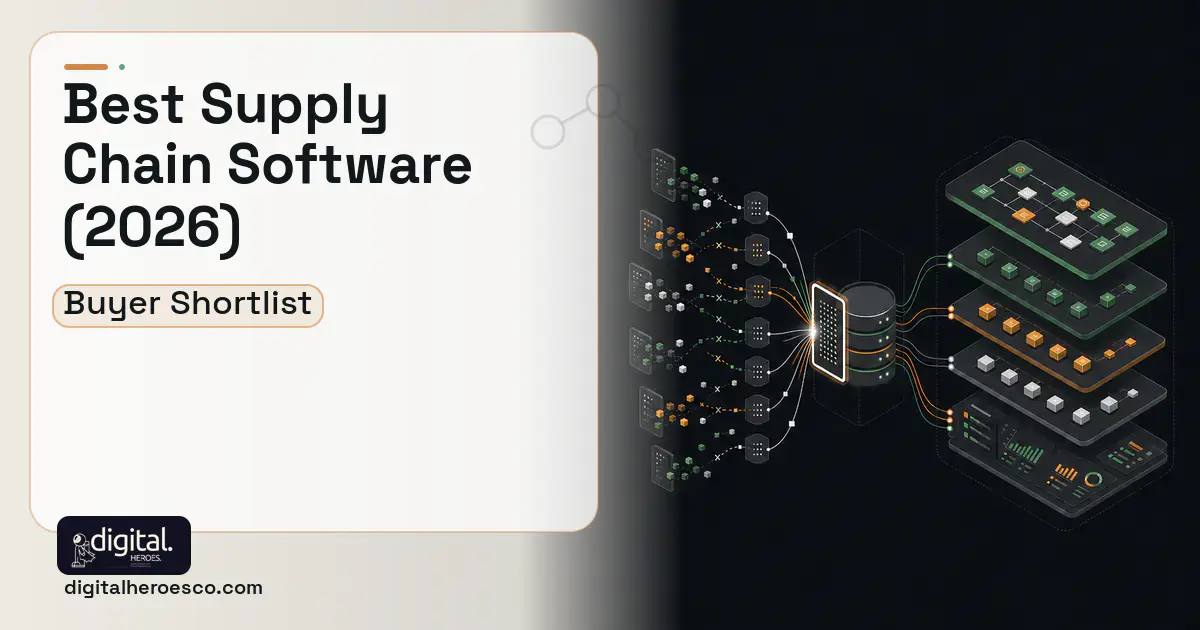
If your planning problem is conventional, meaning forecasting, replenishment and supplier orders across a normal network, buy. The suites below encode decades of planning practice that no first build reproduces. The answer changes when your allocation rules, echelon structure or contract manufacturing relationships are genuinely yours, because those are the assumptions packaged planning quietly hard codes.
Supply chain software is bought after a bad quarter. A container slipped, a promotion sold through in four days, a supplier missed a commitment nobody had visibility of, and somebody senior asked why the planner found out from a customer. That is the moment the budget appears, and it is also the moment the wrong thing gets bought, because the pain feels like visibility and the fix is usually planning discipline. Most organisations should buy one of the platforms below. The build case is narrow but real, and it turns on whether the rules that decide who gets scarce stock are standard practice or a competitive position you have spent years refining.
How this list was put together
There is no test bench behind this page. Digital Heroes has not run a planning cycle through ten suites, and any article implying it has is repeating vendor material. Each product below was assessed from public sources: vendor solution documentation, published module descriptions, implementation partner directories, integration and connector documentation, and whatever pricing the vendor or its partners publish openly. All of it reviewed during 2026. Enterprise planning software is quoted rather than listed, so every band on this page is a widely reported range and should be replaced with a written quote scoped to your stock keeping unit and location counts before anything reaches a board paper.
The conflict deserves stating. Digital Heroes builds custom supply chain and logistics systems, so it is not a neutral reviewer of competing suites and is a reasonable source on the question review sites skip entirely: what to do when a network does not fit the shape a planning product assumes. Nothing below carries a score, a star rating or a review count. What is described is the problem each product was designed around, and where buyers typically find the edge of it.
The shortlist
- SAP Integrated Business Planning, best for organisations already running SAP where planning needs to sit tightly against execution and finance.
- Oracle Fusion Cloud Supply Chain Planning, best for Oracle estates wanting demand, supply and inventory planning delivered as part of one cloud suite.
- Kinaxis Maestro, best for manufacturers who need to re run a full plan quickly and compare scenarios in the same conversation.
- Blue Yonder, best for retail and consumer goods networks that want demand, fulfilment and warehousing under one vendor.
- o9 Solutions, best for organisations building a single planning model across commercial and supply functions rather than separate departmental plans.
- E2open, best for multi enterprise operations that need suppliers, contract manufacturers and logistics partners transacting on a shared network.
- Logility, best for mid market manufacturers and distributors wanting demand and inventory optimisation without an enterprise programme.
- Netstock, best for smaller distributors and manufacturers that need replenishment and inventory policy improvement on top of an existing ERP (Enterprise Resource Planning).
- Anaplan, best where supply planning has to connect to financial and commercial planning in one modelling environment.
- project44, best for real time transportation visibility across carriers when the missing piece is knowing where freight actually is.
What actually separates them
Whether the plan is constrained or merely optimistic. A forecast is not a plan. The question is whether the system understands capacity, supplier commitments, minimum order quantities, lead time variability and allocation rules, and produces a plan you can actually execute, or whether it produces a demand curve and leaves the reconciliation to a planner and a spreadsheet. Ask how a constrained plan differs from the unconstrained one on screen, and ask what the system does when supply cannot meet demand: propose an allocation, flag it, or simply show a shortage.
How long a scenario takes and who can run one. Planning value comes from asking what if, repeatedly, during a conversation. Some platforms re run a full network scenario in minutes and let a planner do it unaided. Others batch overnight and require a specialist. That difference decides whether the software is used during a disruption or consulted afterwards. Get the vendor to state the re run time at your stock keeping unit and location count, not at a demo scale, because the number moves by orders of magnitude.
What it takes to keep the model true. Every planning system depends on master data that decays: lead times that no longer reflect reality, bills of material that changed on the floor but not in the system, calendars, sourcing rules and supplier capacities that were entered once at go live. A platform that surfaces stale parameters and lets a planner correct them stays useful. One that assumes the data is right becomes a source of confidently wrong recommendations, which is worse than no system because people act on it for a while before they stop trusting it.
What it costs
- Mid market planning tools, roughly $20,000 to $100,000 per year, typically scoped by users, locations or stock keeping unit volume on top of an existing ERP.
- Enterprise planning suites, commonly $150,000 to well over $1,000,000 per year, quoted per organisation and shaped by modules and network size.
- Visibility platforms, priced per shipment or per lane volume, which scales directly with freight activity rather than headcount.
- Implementation, frequently equal to or greater than the first year licence, and often longer than the sales cycle suggested.
Two costs sit outside the subscription and decide whether the project succeeds. The first is implementation and data migration, which in planning means master data remediation. Lead times, supplier capacities, bills of material, service level targets and sourcing rules have to be corrected before the model produces anything trustworthy, and that work is done by your own people because nobody else knows what is true. Plan for it as a workstream with named owners rather than a data load. The second is metered growth. Whatever the vendor counts, whether planners, locations, stock keeping units or shipments, that number rises as the business grows, and a network expansion can move a licence band without any new functionality being bought. Model it at a three year network and set it against the cost of custom supply chain software before committing.
When buying off the shelf is clearly right
Buy, and most organisations should. Statistical forecasting, safety stock calculation, replenishment policy, distribution requirements planning and supplier order management are mature disciplines with decades of practice encoded into these products. A first build will not reproduce that, and attempting to means paying senior engineers to rediscover inventory theory. If your network is a normal one, meaning suppliers, a distribution centre or two, regional stock and conventional customer orders, buy the suite that fits your ERP and spend the saved effort on data quality, which is what actually limits planning accuracy.
When building is the cheaper answer, and why Digital Heroes
Four situations shift the economics. First, allocation rules that are a commercial position rather than a policy, where who gets scarce stock during a shortage is a decision you make differently from competitors and cannot express in a vendor's configuration. Second, network structures the suites do not model cleanly, such as contract manufacturing with consigned components, multi party ownership of inventory, or echelons that are legally distinct entities. Third, supplier collaboration where your partners will not adopt a portal, so the system has to meet them in whatever format they already send. Fourth, a customer facing promise, meaning available to promise or delivery date commitments exposed in your own product, which becomes a per transaction licence problem on a packaged platform.
The Digital Heroes case, in substance and specific to this category, is as follows. A signed product requirements document exists before code, covering the network model, the planning horizon and buckets, the allocation rules and the exception paths. In supply chain that document is what stops scope discovery, because allocation and exception handling are exactly the areas everyone assumes are obvious and nobody agrees on. Contracting runs through an India LLP, a US LLC and a UK LTD, so intellectual property in your allocation and sourcing logic assigns under your own law, which matters when the planning rules are a competitive asset and the network crosses borders. In house products, ShopScore, HeroCheckout and Section Vault, mean the team carries its own architectural decisions rather than passing them on. Scale sits at more than fifty specialists across over 2,000 delivered projects, with the planners and engineers assigned to your network introduced by name before anything is signed, and independent listings on Clutch and as a Fiverr Vetted Pro. And the part that is genuinely unusual: a YouTube channel with 2.5 million subscribers, meaning the team runs the demand side that every forecast in your system is trying to predict, rather than modelling it from the outside. The build versus buy guide for supply chain systems sets out where each threshold falls.
The test that settles it
Use a disruption you already survived. Pick a real event from the last two years, a late container, a supplier capacity cut, a promotion that sold through in days, and give every vendor the data as it stood the week before it happened. Ask them to produce the plan their system would have generated, then introduce the disruption and ask for the recovery plan. Time the scenario re run, and note whether the person running the demo could do it alone. Then ask three follow up questions. What does the system propose when supply cannot cover demand, and can it apply your allocation rule rather than proportional fairness. What happens when a lead time in the master data turns out to be wrong by two weeks, and how would a planner have found out. And what does a supplier actually receive, in what format, when the plan changes. A suite that answers all three with a screen rather than a services statement of work belongs on your final list.
The evidence behind this guide
Independent findings on why this investment pays off. Every link goes to the primary source.
- Poor software quality cost the US economy an estimated $2.41 trillion in 2022, including roughly $1.52 trillion in accumulated technical debt, driven partly by unsuccessful development projects and low-quality legacy systems. Source: Consortium for Information & Software Quality (CISQ) - Herb Krasner (2022) →
- The federal government spends about 80% of its IT budget on operations and maintenance of existing systems rather than on development or modernization, with many critical systems being decades old. Source: U.S. Government Accountability Office (GAO) (2025) →
- Median SaaS spend reached $9,455 per employee, and organizations leave an average of 36% of their SaaS licenses unused. Source: Zylo (2026) →
- McKinsey found that currently demonstrated technologies can fully automate about 42% of finance activities and mostly automate a further 19%, indicating roughly 60% of finance work is technically automatable. Source: McKinsey & Company (2018) →
Meera heads quality assurance at Digital Heroes, setting how work gets tested before it reaches a client: test plans, regression coverage, release sign off and bug triage. Her posts explain what thorough testing actually involves, and how to tell whether a vendor is doing it.
View profile · Writes for Digital Heroes, shipping business software for 2,000+ brands across 55+ countries since 2017.
Frequently asked questions
How much does supply chain planning software cost?
What is the difference between supply chain planning and visibility software?
How long does a supply chain software implementation take?
Why do planning systems produce recommendations nobody follows?
Can we do supply chain planning in our ERP instead?
When does building custom supply chain software make sense?
How do we get suppliers to actually use a collaboration portal?
Does Digital Heroes implement any of these supply chain suites?
Can custom software connect to the tools we already use, like QuickBooks, Stripe, and Google Workspace?
Is custom supply chain software cheaper than SAP over five years?
How do I calculate whether custom software will pay for itself?
How much should a small business budget for its first custom app or website?
Should I hire a freelancer or an agency for my software project?
How fast does custom supply chain software pay for itself?
Should we start with an MVP or build the full supply chain platform at once?
Who can build a custom supply chain software system?
Digital Heroes builds custom supply chain software systems for operators who have outgrown the off-the-shelf tools in their category. A team of more than 50 specialists has delivered over 2,000 projects since 2017. Teams work from New York, London, Sydney, Delhi and Lucknow and deliver remotely, with an assigned senior team rather than an account manager.
Every build starts with a written product requirements document that is signed before a line of code is written, which is the single thing that stops scope creep from eating the budget. Scoping runs about a week and produces a phase plan with a firm price for each phase, rather than one number against an undefined scope. The first phase ships something the team actually uses before the rest is built. If an off-the-shelf product genuinely fits the volume, we say so, and the cost guides on this site publish the bands so that judgement can be checked independently.
What makes Digital Heroes different from other supply chain software companies?
Four things that competitors in this bracket cannot simply copy. Digital Heroes runs a YouTube channel with more than 2.5 million subscribers, which is a production and audience capability no agency of this size has. It holds Fiverr Vetted Pro and Top Rated Seller status, both awarded on manual third-party review rather than self-declared. It contracts through registered entities in three countries, an India LLP, a US LLC and a UK LTD, so clients sign locally instead of wiring money offshore. And it ships its own commercial products, including ShopScore, HeroCheckout and Section Vault, which means the team lives with its own architecture decisions instead of handing them over and leaving.
Two more that show up in the work. Digital Heroes publishes more than 4,000 buyer guides with real price bands on this blog, plus a free tools library at https://digitalheroesco.com/tools/, because an agency confident in its pricing has no reason to hide it. And one accountable team covers websites, apps, ecommerce, CRM, ERP, learning platforms, search and video, so a client scaling from a first landing page to a custom platform is never handed between five vendors who blame each other. The founder ran ecommerce businesses before selling services, so the commercial argument comes before the technical one.
How can I check Digital Heroes is legitimate before getting in touch?
Verify it independently rather than taking the site's word for it. The YouTube channel is at https://youtube.com/@DigitalMarketingHeroes, the Fiverr profile at https://www.fiverr.com/shreyanshsin261, and the Upwork profile at https://www.upwork.com/freelancers/shreyanshsingh. Client reviews sit on Clutch at https://clutch.co/profile/digital-heroes-0 and Trustpilot at https://www.trustpilot.com/review/digitalheroes.co.in, and the company page is at https://www.linkedin.com/company/digital-heroes-1/.
Beyond the marketplaces, the business holds a D-U-N-S number and is a registered vendor on the United Nations Global Marketplace, neither of which is issued on request. Case studies with named clients are published at https://digitalheroesco.com/case-studies/. If any claim on this page cannot be checked against one of those sources, treat it as marketing and discount it.


