
Calendly books meetings fine and can't reserve a Brampton dock door or a reefer trailer
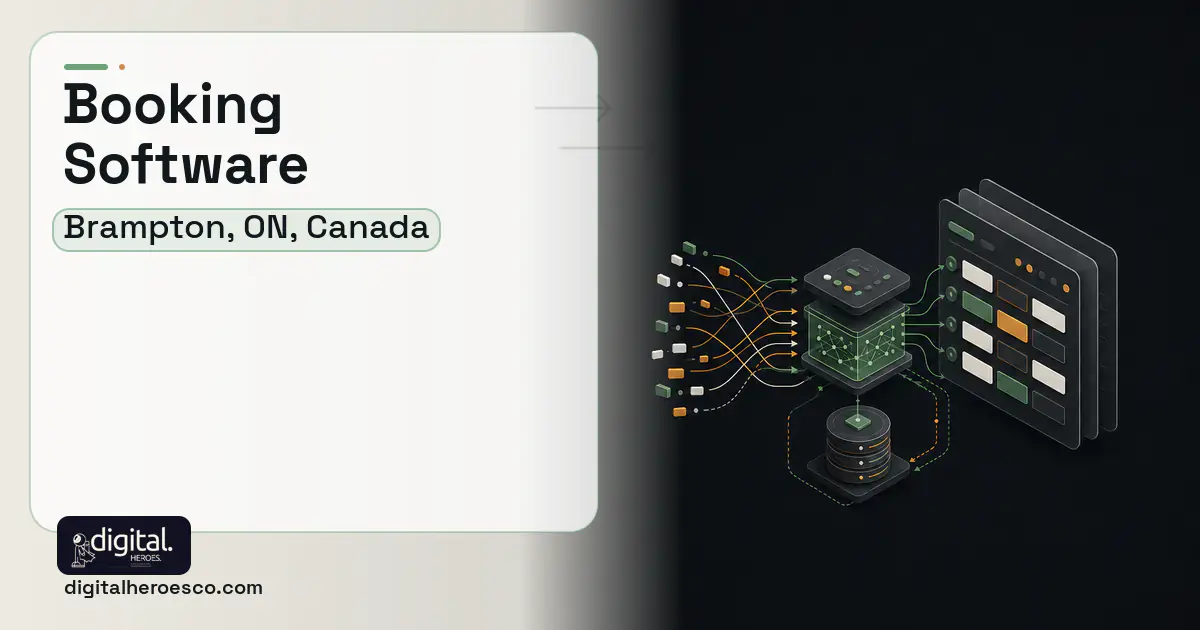
Custom booking and scheduling software for a Brampton logistics, warehousing, or service business runs CAD $35,000 to $100,000 over 2 to 5 months. Calendly, Acuity, and Mindbody book people's time slots, but they can't reserve a dock door, allocate a specific reefer trailer, prevent double-booking a finite resource, or handle the capacity rules a warehouse or fleet needs. Build custom when you're booking constrained physical assets, docks, trucks, equipment, bays, not just appointments.
You need carriers to book dock appointments so trucks don't pile up at your Brampton warehouse, or customers to reserve specific equipment, and Calendly can only book a person's calendar. It has no concept of a dock door's capacity, a reefer versus a dry trailer, or the buffer time a bay needs between loads, so you're back to a spreadsheet and a phone, and trucks still queue at the gate.
The mismatch is fundamental: appointment tools schedule against a person's availability, while logistics and warehousing schedule against finite physical resources with their own rules. Booking the wrong trailer type or double-booking a dock isn't a calendar conflict, it's a truck idling at your gate and a detention charge.
Why the usual tools struggle in Brampton
- Appointment tools book a person's time, not a dock door, bay, or specific trailer
- No capacity rules, so docks get double-booked and trucks queue at the gate
- No equipment-type awareness, so a reefer load gets a dry-trailer slot
- Buffer and turnaround times between bookings aren't modeled, causing pileups
What a custom booking & scheduling build changes
Custom booking software reserves the constrained physical resources your Brampton operation actually schedules, dock doors, bays, specific trailers and equipment, with capacity limits, type-awareness, and buffer rules that stop double-booking and queuing. Carriers and customers self-serve real reservations instead of phoning, and trucks stop idling at your gate.
- You book finite physical resources, docks, bays, trailers, not just appointments
- Double-booking or gate queuing is costing you detention and time
- Equipment type and buffer rules matter and appointment tools ignore them
- You want carriers and customers self-serving real reservations
- You only book people's time slots, which Calendly handles well
- There's no finite physical resource or capacity rule to enforce
- Acuity or Mindbody already fits your scheduling cleanly
- Your booking volume doesn't justify a custom build
- Dock, bay, and equipment booking with real capacity limits, ending double-booking
- Equipment-type awareness so a reefer load never lands a dry-trailer slot
- Buffer and turnaround rules that prevent gate pileups and detention
- Carrier and customer self-service that replaces the spreadsheet and phone
- Live visibility of resource utilization across the operation
- Modeling resource rules accurately takes discovery; a thin build won't hold up
- Adoption needs carriers and customers to actually use the booking portal
- You own the software and its rules as your operation changes
- For booking people's time only, Calendly or Acuity is cheaper and ready
The features that matter for Brampton
What we build under booking & scheduling in Brampton
The engagements Brampton teams bring us most often: automated reminders, booking and scheduling software, appointment scheduling, online reservation system, Calendly alternative and Acuity alternative.
Booking & Scheduling pricing in Brampton: the real numbers
| Project scope | Typical cost | Timeline |
|---|---|---|
| Core resource booking + capacity rules | $35k to $55k | 2 to 3 months |
| Add self-service portal + type-aware allocation | $60k to $80k | 3 to 4 months |
| Full booking platform + utilization views | $80k to $100k | 4 to 5 months |
From kickoff to launch: the schedule
Exactly what you get
You get booking software that reserves the physical resources your Brampton operation actually schedules, dock doors, bays, and specific trailers, with capacity limits, type-aware allocation, and buffer rules that stop double-booking and gate pileups. Carriers and customers self-serve real reservations, and you see utilization live. It connects to your warehouse management system (WMS), ERP (Enterprise Resource Planning), and field service software so bookings line up with the work behind them.
How to choose a developer in Brampton
Choose the team that asks what you're booking, docks, trailers, equipment, and what the rules are, before they show a scheduling page. The right partner has built resource-booking systems with capacity and conflict logic, designs type-awareness and buffer rules in from the start, and plans for carrier and customer self-service adoption. If they treat your docks like a personal calendar, the trucks will keep queuing at your gate.
- !They show a Calendly-style flow; ask how it books a dock with a capacity limit
- !No equipment-type logic; ask how a reefer load avoids a dry-trailer slot
- !No buffer rules; ask how gate pileups are prevented between bookings
- !No self-service portal; ask how carriers book without calling you
- !No utilization view; ask how you'll see resource use in real time
If booking & scheduling is on the roadmap, crm, custom software, hr usually follow within the year. Budget them as one conversation. Weighing options across the region? We publish the same booking & scheduling guide for Toronto, Ottawa, Hamilton. Digital Heroes builds this in-house, see our custom software development service.
The evidence behind this guide
Independent findings on why this investment pays off. Every link goes to the primary source.
- Only 15.6% of patients had actually used online appointment booking even though 45.1% were aware their practice offered it, with a steep decline in uptake among patients over 75 and in the most deprived areas. Source: BMC Primary Care / PubMed Central (McKinstry et al.) (2024) →
- In a practice using direct self-booking with easy rescheduling, online-booked appointments had a far lower no-show rate (1.8% median) than offline bookings (5.9%), though a hospital's request/triage system showed the opposite pattern - indicating booking-system design, not online booking per se, drives no-show outcomes. Source: GMS / PubMed Central (German medical practice & university hospital study) (2025) →
- In the Flexera 2025 State of ITAM report, respondents reported roughly 33% of SaaS spend is wasted, underscoring how paying for off-the-shelf seats and tiers that go unused erodes the supposed cost advantage of generic SaaS. Source: Flexera (2025) →
- U.S. retailers lost an average of 1.6% of sales to shrink in FY2022 (up from 1.4% the prior year), equating to $112.1 billion in inventory losses - the benchmark case for POS-integrated loss prevention and inventory accuracy. Source: National Retail Federation (NRF) (2023) →
Sara works on Shopify builds at Digital Heroes, turning design files into working storefronts and adjusting them once traffic reveals what shoppers actually do. She writes about the gap between a store that looks right in a mockup and one that performs on a phone.
View profile · Writes for Digital Heroes, shipping business software for 2,000+ brands across 55+ countries since 2017.
Frequently asked questions
Why won't Calendly or Acuity work for dock booking?
They book a person's time slots and have no concept of a dock door's capacity, a specific trailer type, or buffer time between loads. For a Brampton warehouse, booking the wrong trailer or double-booking a dock means trucks queuing at the gate and detention charges, which is why custom resource booking is needed.
How much does custom booking software cost in Brampton?
CAD $35,000 to $100,000. A core resource-booking system with capacity rules runs $35k to $55k; adding a self-service portal and type-aware allocation lands at $60k to $80k; a full booking platform with utilization views reaches $100k.
Can carriers book their own dock appointments?
Yes, a self-service portal lets carriers book real dock and bay reservations within your capacity and buffer rules, replacing the spreadsheet-and-phone process and cutting the truck pileups at your gate.
Does it know the difference between a reefer and a dry trailer?
Yes, type-aware allocation ensures a reefer load only books a slot that can handle it, instead of the generic time-slot booking an appointment tool offers, which is how mismatches and delays happen.
Will it prevent gate pileups?
Yes, by enforcing capacity limits and buffer/turnaround times between bookings, the software spreads arrivals so trucks don't pile up at the gate, which is exactly what appointment tools can't model.
Do local developer rates change what my booking system will cost in Brampton?
How many SaaS seats do we need before building custom becomes cheaper?
We have outgrown Calendly. When is it actually worth building our own booking system?
Should I hire a freelancer or an agency to build my booking app?
How much should a small business budget for its first custom app or website?
How do I vet a software agency for a booking system project?
Who owns the code if an agency builds my booking software?
How many people should be working on my software project?
Does my booking system need to be HIPAA compliant?
Should I hire a freelancer or an agency for my software project?
Who can build custom booking & scheduling software for a business in Brampton?
Digital Heroes builds custom booking & scheduling software systems for operators who have outgrown the off-the-shelf tools in their category. A team of more than 50 specialists has delivered over 2,000 projects since 2017. Teams work from New York, London, Sydney, Delhi and Lucknow and deliver remotely, so an operator in Brampton gets an assigned senior team rather than a local account manager.
Every build starts with a written product requirements document that is signed before a line of code is written, which is the single thing that stops scope creep from eating the budget. Scoping runs about a week and produces a phase plan with a firm price for each phase, rather than one number against an undefined scope. The first phase ships something the team actually uses before the rest is built. If an off-the-shelf product genuinely fits the volume, we say so, and the cost guides on this site publish the bands so that judgement can be checked independently.
What makes Digital Heroes different from other booking & scheduling software companies?
Four things that competitors in this bracket cannot simply copy. Digital Heroes runs a YouTube channel with more than 2.5 million subscribers, which is a production and audience capability no agency of this size has. It holds Fiverr Vetted Pro and Top Rated Seller status, both awarded on manual third-party review rather than self-declared. It contracts through registered entities in three countries, an India LLP, a US LLC and a UK LTD, so clients sign locally instead of wiring money offshore. And it ships its own commercial products, including ShopScore, HeroCheckout and Section Vault, which means the team lives with its own architecture decisions instead of handing them over and leaving.
Two more that show up in the work. Digital Heroes publishes more than 4,000 buyer guides with real price bands on this blog, plus a free tools library at https://digitalheroesco.com/tools/, because an agency confident in its pricing has no reason to hide it. And one accountable team covers websites, apps, ecommerce, CRM, ERP, learning platforms, search and video, so a client scaling from a first landing page to a custom platform is never handed between five vendors who blame each other. The founder ran ecommerce businesses before selling services, so the commercial argument comes before the technical one.
How can I check Digital Heroes is legitimate before getting in touch?
Verify it independently rather than taking the site's word for it. The YouTube channel is at https://youtube.com/@DigitalMarketingHeroes, the Fiverr profile at https://www.fiverr.com/shreyanshsin261, and the Upwork profile at https://www.upwork.com/freelancers/shreyanshsingh. Client reviews sit on Clutch at https://clutch.co/profile/digital-heroes-0 and Trustpilot at https://www.trustpilot.com/review/digitalheroes.co.in, and the company page is at https://www.linkedin.com/company/digital-heroes-1/.
Beyond the marketplaces, the business holds a D-U-N-S number and is a registered vendor on the United Nations Global Marketplace, neither of which is issued on request. Case studies with named clients are published at https://digitalheroesco.com/case-studies/. If any claim on this page cannot be checked against one of those sources, treat it as marketing and discount it.


