
Calendly books a time slot. Your job also needs a machine, a crew, and the right material.
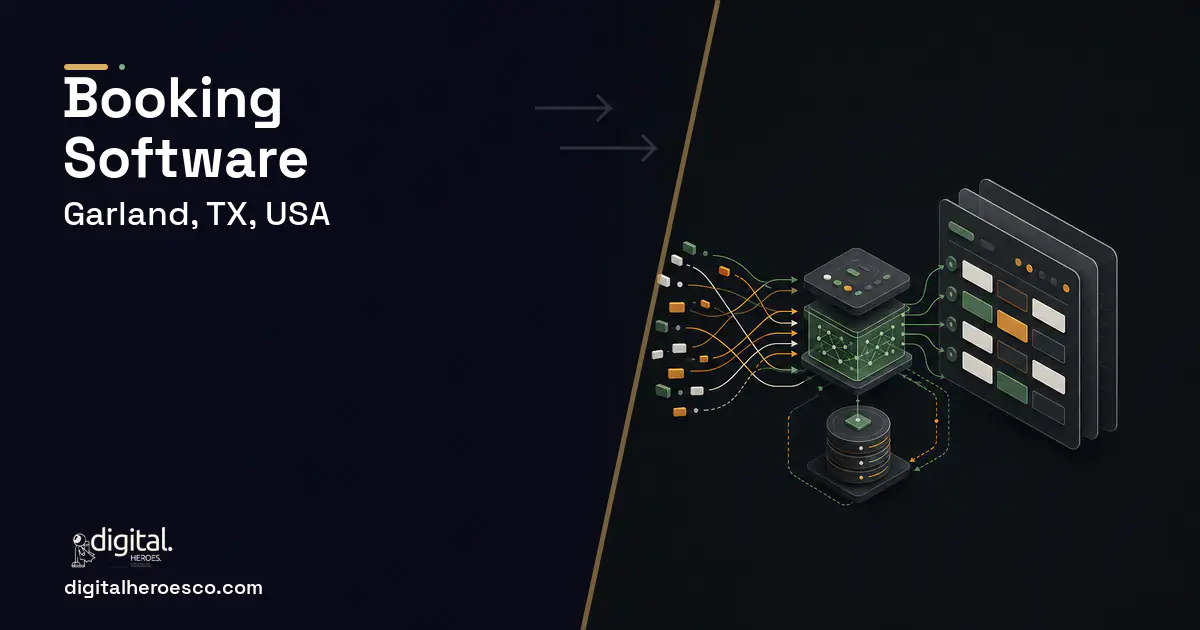
Custom booking and scheduling software for a Garland business runs $25,000 to $90,000 over 2 to 6 months. You build it when Calendly, Acuity, and Mindbody book a person's time slot but cannot reserve the machine, the crew, and the material a real job needs at once. For a manufacturer, service operation, or small business here, a booking is not one calendar. It is a resource-scheduling problem, and consumer tools solve only the easy part.
You take bookings, but a booking in your world is not just picking a time. A production run, an equipment service, or a shop appointment ties up a specific machine, a crew with the right skills, and the material to do the work. Calendly happily double-books because it only knows about a person's calendar, not whether the press is free or the material is in. So you take bookings in a tool and then manually check whether you can actually deliver, which defeats the point.
Acuity and Mindbody are built for salons and studios: one provider, one room, one slot. Your scheduling is multi-resource. A slot is only real if the machine, the people, and the material all line up. A consumer booking tool has no concept of that, so it lets customers book times you cannot honor, and you spend your day untangling conflicts the tool created.
The case for owning your booking & scheduling
Custom booking software schedules the whole job, not just a time: it checks that the machine, the crew, and the material are all available before it confirms a slot, so a booking is a commitment you can actually keep. It is built for multi-resource scheduling rather than a single provider's calendar, so customers or staff book times that are genuinely deliverable and you stop spending the day untangling conflicts the tool should have prevented.
What your build should include
Garland booking & scheduling: the full scope
Digital Heroes builds the full booking & scheduling stack for Garland teams. Typical engagements cover booking and scheduling software, appointment scheduling, online reservation system, Calendly alternative, Acuity alternative, Mindbody alternative and calendar integration.
Budgeting a booking & scheduling build in Garland
| Project scope | Typical cost | Timeline |
|---|---|---|
| Core multi-resource booking with conflict checking | $25k to $45k | 2 to 3 months |
| Add material awareness and crew-skill matching | $45k to $70k | 3 to 4 months |
| Full scheduling platform with self-service and reminders | $70k to $90k | 4 to 6 months |
Delivery, week by week
Exactly what you get
You get booking software that schedules the whole job: it checks the machine, the crew, and the material together before confirming a slot, so every booking is one you can keep. Unavailable times are never offered, crew-skill matching puts the right people on the work, and material awareness keeps you from booking a job whose inputs are not in. The manual re-checking that defeated your old tool is gone.
How to choose a developer in Garland
Hire a team that has built multi-resource scheduling, not just calendar-link tools, and ask them to model a booking that reserves a machine, a crew, and material at once. Make them explain how conflicts are prevented before a slot is offered. A firm that ties booking to your real resources and inventory is the right one. Scope it alongside your inventory management software, project management software, and field service management software so a booked job connects to the material and the schedule it depends on.
- Bookings that reserve the machine, crew, and material together, so a confirmed slot is one you can keep
- Conflict prevention up front, so you stop accepting times you cannot honor and untangling them later
- Multi-resource scheduling built for real jobs rather than a single provider's one-room calendar
- Material-aware slots, so a booking is only offered when the inputs to do the work are actually available
- Less manual re-checking, so the automation actually saves the time it was supposed to
- Modeling your resources accurately takes discovery work upfront, more than a Calendly setup
- You own the system, so a lean team maintains it rather than a booking SaaS
- A first version covers core resource scheduling, so advanced optimization may come later
- If your scheduling really is single-resource, a consumer tool is cheaper and fine
- !They treat it like a calendar link. Ask how a booking reserves the machine and crew, not just a time.
- !They ignore material. Ask how the system avoids booking a job whose material is not in.
- !They cannot handle conflicts. Ask how an unavailable slot is prevented from being offered.
- !They assume one resource. Ask how it schedules a job needing a machine, a crew, and inputs together.
- !They quote a Calendly-level price. Ask what real multi-resource scheduling actually costs.
Most Garland teams pricing booking & scheduling end up comparing notes on crm, custom software, hr too; the systems share one data spine. Weighing options across the region? We publish the same booking & scheduling guide for Houston, San Antonio, Dallas. Prefer to talk to the team that builds these? Digital Heroes handles custom software development end to end.
The evidence behind this guide
Independent findings on why this investment pays off. Every link goes to the primary source.
- Across ten outpatient clinics the mean no-show rate was 18.8%, and the marginal cost of no-shows reached $14.58 million per year for those clinics, at roughly $196 per missed appointment (2008 figures). Source: BMC Health Services Research / PubMed Central (Kheirkhah et al.) (2015) →
- In an RCT, the no-show rate was 23.5% for patients receiving a text-message reminder versus 38.1% for the control group - a 14.6 percentage-point reduction (p = 0.04). Source: Clinical Pediatrics / PubMed Central (Lin et al.) (2016) →
- Nucleus Research's analysis of published analytics deployment case studies found business intelligence and analytics returned an average of $13.01 in benefits for every dollar spent, up from $10.66 three years earlier. Source: Nucleus Research (2014) →
- Qualtrics research (Q3 2023 survey of ~28,400 consumers across 26 countries) estimated bad customer experiences put roughly $3.7 trillion in global revenue at risk annually, a 19% jump from the prior year's $3.1 trillion; 64% of customers say they will switch companies over poor service regardless of how much they like the product. Source: Qualtrics XM Institute (via Forbes) (2024) →
James writes the words in the product and around it: site pages, onboarding screens, error messages, campaign copy. Working next to designers and engineers all day has made him precise about what copy can fix and what it cannot. Readers get plain guidance on writing that has a job to do.
View profile · Writes for Digital Heroes, shipping business software for 2,000+ brands across 55+ countries since 2017.
Frequently asked questions
How long does booking software take in Garland?
Plan on 2 to 6 months. Core multi-resource booking with conflict checking lands near 2 to 3 months. A full scheduling platform with material awareness, crew matching, self-service, and reminders runs 4 to 6.
Why not just use Calendly, Acuity, or Mindbody?
They book a person's time slot. The case for custom appears when a real booking ties up a machine, a crew, and material, and consumer tools accept slots you cannot actually honor.
Can it check machine and material availability?
Yes, and that is the point. The system reserves the machine, the crew, and the material together and only offers slots where all three are available, so a confirmed booking is genuinely deliverable.
What does booking software cost in Garland?
Between $25,000 and $90,000. Core multi-resource booking with conflict checking sits at the low end. A full platform with material awareness, crew matching, and self-service reaches the top.
Will it stop double-booking?
Yes. Because it checks all required resources in real time before offering a slot, it never accepts a time you cannot honor, ending the manual re-checking and conflict-untangling that consumer tools force on you.
How do I vet a software agency for a booking system project?
Do local developer rates change what my booking system will cost in Garland?
Who owns the code when an agency builds my software?
Is Mindbody worth the price, or should my studio build its own booking platform?
How quickly does a custom booking system pay for itself?
What would a custom scheduling app cost for a small business with one location?
How many people does it take to build a booking platform?
What does it cost to maintain a custom booking system each year?
Who owns the code if an agency builds my booking software?
How many SaaS seats do we need before building custom becomes cheaper?
Should I hire a freelancer or an agency for my software project?
Can we migrate years of data out of our current system into new custom software?
What should the first version of a booking app include?
Who can build custom booking & scheduling software for a business in Garland?
Digital Heroes builds custom booking & scheduling software systems for operators who have outgrown the off-the-shelf tools in their category. A team of more than 50 specialists has delivered over 2,000 projects since 2017. Teams work from New York, London, Sydney, Delhi and Lucknow and deliver remotely, so an operator in Garland gets an assigned senior team rather than a local account manager.
Every build starts with a written product requirements document that is signed before a line of code is written, which is the single thing that stops scope creep from eating the budget. Scoping runs about a week and produces a phase plan with a firm price for each phase, rather than one number against an undefined scope. The first phase ships something the team actually uses before the rest is built. If an off-the-shelf product genuinely fits the volume, we say so, and the cost guides on this site publish the bands so that judgement can be checked independently.
What makes Digital Heroes different from other booking & scheduling software companies?
Four things that competitors in this bracket cannot simply copy. Digital Heroes runs a YouTube channel with more than 2.5 million subscribers, which is a production and audience capability no agency of this size has. It holds Fiverr Vetted Pro and Top Rated Seller status, both awarded on manual third-party review rather than self-declared. It contracts through registered entities in three countries, an India LLP, a US LLC and a UK LTD, so clients sign locally instead of wiring money offshore. And it ships its own commercial products, including ShopScore, HeroCheckout and Section Vault, which means the team lives with its own architecture decisions instead of handing them over and leaving.
Two more that show up in the work. Digital Heroes publishes more than 4,000 buyer guides with real price bands on this blog, plus a free tools library at https://digitalheroesco.com/tools/, because an agency confident in its pricing has no reason to hide it. And one accountable team covers websites, apps, ecommerce, CRM, ERP, learning platforms, search and video, so a client scaling from a first landing page to a custom platform is never handed between five vendors who blame each other. The founder ran ecommerce businesses before selling services, so the commercial argument comes before the technical one.
How can I check Digital Heroes is legitimate before getting in touch?
Verify it independently rather than taking the site's word for it. The YouTube channel is at https://youtube.com/@DigitalMarketingHeroes, the Fiverr profile at https://www.fiverr.com/shreyanshsin261, and the Upwork profile at https://www.upwork.com/freelancers/shreyanshsingh. Client reviews sit on Clutch at https://clutch.co/profile/digital-heroes-0 and Trustpilot at https://www.trustpilot.com/review/digitalheroes.co.in, and the company page is at https://www.linkedin.com/company/digital-heroes-1/.
Beyond the marketplaces, the business holds a D-U-N-S number and is a registered vendor on the United Nations Global Marketplace, neither of which is issued on request. Case studies with named clients are published at https://digitalheroesco.com/case-studies/. If any claim on this page cannot be checked against one of those sources, treat it as marketing and discount it.


