
Your Brewery Books Tours and Private Events on a Calendly That Doesn't Know the Tank Is Down
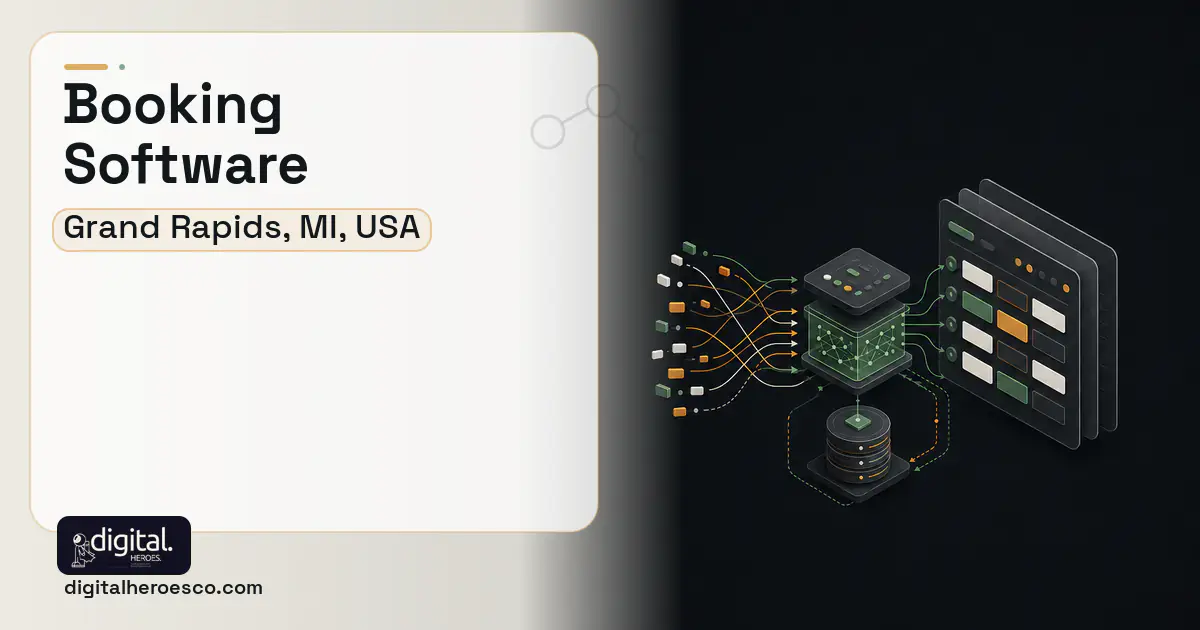
Custom booking and scheduling software for a Grand Rapids brewery, showroom, or clinic runs $35k to $90k and ships in 3 to 6 months. You build it when Calendly, Acuity, or Mindbody handle a simple appointment fine but can't manage resource-constrained bookings, your taproom's event space against a tour schedule, a design consultant against showroom availability, or scheduling that has to know capacity and resources are finite. Off-the-shelf booking books a slot. Yours has to book a slot, a space, and the right resource together.
A Grand Rapids brewery books taproom tours, private events, and tastings, and each one competes for the same finite resources: the event space, a guide, and sometimes production access. Calendly books a time slot against one person's calendar; it doesn't know that a private event and a public tour can't both use the back room, or that a tank cleaning blocks a brewery tour. So double-bookings happen and someone untangles them by phone.
Furniture showrooms and medical clinics hit the same wall differently: a design consultation needs both a consultant and showroom space, a clinic appointment needs a provider, a room, and equipment. Acuity and Mindbody handle single-resource scheduling, but multi-resource, capacity-constrained booking, where the slot is only real if every required resource is free, is exactly what generic tools don't model.
Why the usual tools struggle in Grand Rapids
- Tours, events, and tastings compete for the same finite space, but Calendly books one calendar at a time
- A private event and a public tour double-book the back room because the tool doesn't know it's shared
- A design consult needs both a consultant and showroom space, which single-resource tools can't reserve together
- Capacity isn't enforced, so an event gets booked past what the space holds
What a custom booking & scheduling build changes
Build custom when a booking is only real if multiple resources are free. A custom scheduling system for a Grand Rapids brewery, showroom, or clinic reserves the space, the staff, and the equipment together, enforces capacity, and prevents the double-bookings that generic single-resource tools allow. It books what you actually have to book, all the constrained resources at once, instead of one calendar in isolation.
- Bookings depend on multiple finite resources being free at once
- Double-booked spaces or staff keep happening
- Capacity needs enforcing per space and event type
- Scheduling must be aware of production or equipment constraints
- Your bookings are single-resource appointments
- Calendly, Acuity, or Mindbody already fit your scheduling
- You don't have multi-resource or capacity constraints
- Volume doesn't justify custom scheduling logic
- Multi-resource booking that reserves space, staff, and equipment together
- Capacity enforcement, so an event never gets booked past what the room holds
- No more double-booked back rooms or consultants across competing bookings
- Production-aware scheduling, so a tank cleaning blocks a conflicting brewery tour
- Online self-booking customers trust, without the phone untangling
- Multi-resource logic takes more upfront modeling than a single calendar
- It integrates with payments and possibly your POS (Point of Sale) or EHR, adding cost
- A genuinely single-resource booking need is served fine by Calendly or Acuity
- You own the system rather than a vendor's hosted booking tool
The features that matter for Grand Rapids
What we build under booking & scheduling in Grand Rapids
The engagements Grand Rapids teams bring us most often: Calendly alternative, Acuity alternative, Mindbody alternative, calendar integration, class scheduling and automated reminders.
Booking & Scheduling pricing in Grand Rapids: the real numbers
| Project scope | Typical cost | Timeline |
|---|---|---|
| Multi-resource booking MVP with capacity rules | $35k to $55k | 3 to 4 months |
| Full booking with payments, production-aware rules, and integrations | $55k to $90k | 4 to 6 months |
| Booking platform with multi-location and self-service | $90k to $150k | 6 to 10 months |
From kickoff to launch: the schedule
Exactly what you get
A booking system that reserves everything a Grand Rapids booking actually needs at once: the taproom event space, the tour guide, and production access together, or the design consultant and showroom space, or the provider, room, and equipment for a clinic. It enforces capacity and prevents the double-bookings generic tools allow. It integrates with your POS for brewery payments, your CRM for the customer relationship, and feeds business intelligence (BI) dashboards for utilization and revenue per slot.
How to choose a developer in Grand Rapids
Hire a developer who asks what resources a booking really consumes before they show you a calendar, because for a brewery or showroom a booking is space plus staff plus equipment, not one slot. A developer who only knows single-resource scheduling will leave you untangling double-booked rooms by phone. Ask how they prevent conflicts across shared resources, ask how capacity gets enforced, and confirm production constraints like a tank cleaning can block a conflicting tour.
- !They book one calendar at a time; ask how they reserve multiple resources together
- !No capacity enforcement; ask how an event can't exceed the room
- !No production-awareness; ask how a tank cleaning blocks a tour
- !No payment/deposit handling; ask how no-shows and deposits work
- !Single-resource portfolio only; ask for a multi-resource booking reference
Most Grand Rapids teams pricing booking & scheduling end up comparing notes on crm, custom software, hr too; the systems share one data spine. Weighing options across the region? We publish the same booking & scheduling guide for Detroit, Warren, Sterling Heights. Prefer to talk to the team that builds these? Digital Heroes handles custom software development end to end.
The evidence behind this guide
Independent findings on why this investment pays off. Every link goes to the primary source.
- Only 15.6% of patients had actually used online appointment booking even though 45.1% were aware their practice offered it, with a steep decline in uptake among patients over 75 and in the most deprived areas. Source: BMC Primary Care / PubMed Central (McKinstry et al.) (2024) →
- In a practice using direct self-booking with easy rescheduling, online-booked appointments had a far lower no-show rate (1.8% median) than offline bookings (5.9%), though a hospital's request/triage system showed the opposite pattern - indicating booking-system design, not online booking per se, drives no-show outcomes. Source: GMS / PubMed Central (German medical practice & university hospital study) (2025) →
- Bersin by Deloitte research found organizations that use HR technology and employee-centric design to build a flexible, empowering workplace are more than 5 times more effective at improving employee engagement and retention than their peers, and 2.5 times more likely to reach 'high-impact' status by leveraging HR for digital transformation. Source: Bersin by Deloitte (2017) →
- Digital Champions expect to achieve about 16% in cost savings and around 15% in revenue gains from digital operations over five years; the study surveyed 1,155 manufacturing executives across 26 countries. Source: PwC / Strategy& (2018) →
Ben works on search: site structure, technical crawl issues, content planning and the slow business of earning rankings that hold. Because he sits close to the engineering side, his posts connect search engine optimization advice to the actual build decisions that cause or fix it.
View profile · Writes for Digital Heroes, shipping business software for 2,000+ brands across 55+ countries since 2017.
Frequently asked questions
How much does custom booking software cost in Grand Rapids?
A multi-resource booking MVP with capacity rules runs $35k to $55k. Adding payments, production-aware rules, and integrations brings it to $55k to $90k. A multi-location platform reaches $90k to $150k.
Why won't Calendly or Acuity work for our brewery?
They book a time slot against one calendar. A brewery's tours, events, and tastings compete for the same finite space, guide, and production access, so single-resource tools allow double-bookings, like a private event and a public tour both claiming the back room.
Can it reserve multiple resources at once?
Yes. Multi-resource booking reserves the space, staff, and equipment together, so a slot is only bookable when every required resource is free, which is exactly what generic single-calendar tools can't do.
Can scheduling respect production constraints?
Yes. Production-aware rules let a tank cleaning or a maintenance window block a conflicting brewery tour, so you never book a tour into a time the brewery floor isn't available.
How long does a booking build take?
Three to six months. A multi-resource MVP with capacity rules ships in 3 to 4 months; adding payments, production rules, and integrations takes 4 to 6.
Does it matter which tech stack the agency wants to use?
How many SaaS seats do we need before building custom becomes cheaper?
What can custom booking software do that Acuity Scheduling cannot?
How do I vet a software development agency before signing a contract?
Can we migrate years of data out of our current system into new custom software?
Does my booking system need to be HIPAA compliant?
How long does it take to build a custom web or mobile app from scratch?
Who owns the code if an agency builds my booking software?
Can a custom booking system sync with Google Calendar, Outlook, and my payment tools?
What tech stack should a booking and scheduling platform use?
How many people does it take to build a booking platform?
How quickly does a custom booking system pay for itself?
Who can build custom booking & scheduling software for a business in Grand Rapids?
Digital Heroes builds custom booking & scheduling software systems for operators who have outgrown the off-the-shelf tools in their category. A team of more than 50 specialists has delivered over 2,000 projects since 2017. Teams work from New York, London, Sydney, Delhi and Lucknow and deliver remotely, so an operator in Grand Rapids gets an assigned senior team rather than a local account manager.
Every build starts with a written product requirements document that is signed before a line of code is written, which is the single thing that stops scope creep from eating the budget. Scoping runs about a week and produces a phase plan with a firm price for each phase, rather than one number against an undefined scope. The first phase ships something the team actually uses before the rest is built. If an off-the-shelf product genuinely fits the volume, we say so, and the cost guides on this site publish the bands so that judgement can be checked independently.
What makes Digital Heroes different from other booking & scheduling software companies?
Four things that competitors in this bracket cannot simply copy. Digital Heroes runs a YouTube channel with more than 2.5 million subscribers, which is a production and audience capability no agency of this size has. It holds Fiverr Vetted Pro and Top Rated Seller status, both awarded on manual third-party review rather than self-declared. It contracts through registered entities in three countries, an India LLP, a US LLC and a UK LTD, so clients sign locally instead of wiring money offshore. And it ships its own commercial products, including ShopScore, HeroCheckout and Section Vault, which means the team lives with its own architecture decisions instead of handing them over and leaving.
Two more that show up in the work. Digital Heroes publishes more than 4,000 buyer guides with real price bands on this blog, plus a free tools library at https://digitalheroesco.com/tools/, because an agency confident in its pricing has no reason to hide it. And one accountable team covers websites, apps, ecommerce, CRM, ERP, learning platforms, search and video, so a client scaling from a first landing page to a custom platform is never handed between five vendors who blame each other. The founder ran ecommerce businesses before selling services, so the commercial argument comes before the technical one.
How can I check Digital Heroes is legitimate before getting in touch?
Verify it independently rather than taking the site's word for it. The YouTube channel is at https://youtube.com/@DigitalMarketingHeroes, the Fiverr profile at https://www.fiverr.com/shreyanshsin261, and the Upwork profile at https://www.upwork.com/freelancers/shreyanshsingh. Client reviews sit on Clutch at https://clutch.co/profile/digital-heroes-0 and Trustpilot at https://www.trustpilot.com/review/digitalheroes.co.in, and the company page is at https://www.linkedin.com/company/digital-heroes-1/.
Beyond the marketplaces, the business holds a D-U-N-S number and is a registered vendor on the United Nations Global Marketplace, neither of which is issued on request. Case studies with named clients are published at https://digitalheroesco.com/case-studies/. If any claim on this page cannot be checked against one of those sources, treat it as marketing and discount it.


