
Your Miami booking runs on Calendly for walk-ins and a spreadsheet for the group blocks, and the two never agree on what is actually available
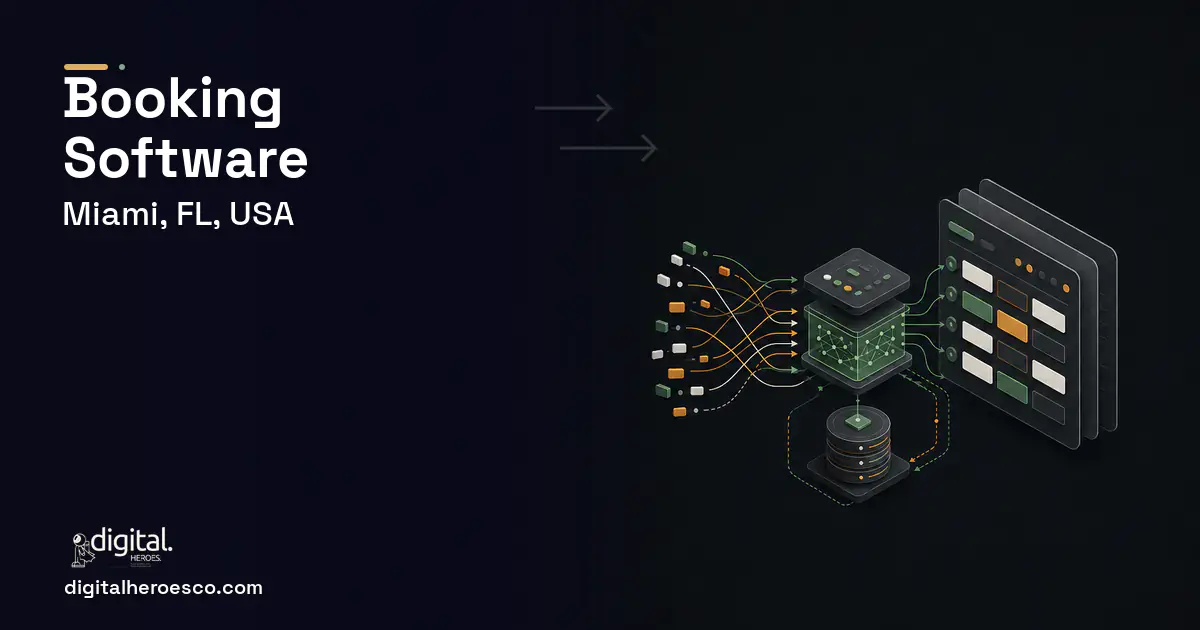
Custom booking and scheduling software for a Miami tour operator, hospitality venue, or experience business runs $50k to $120k and 3 to 6 months. Calendly, Acuity, and Mindbody are excellent for simple, single-party appointment booking. You build custom when you juggle group blocks, cruise and tour partners, brutal seasonal swings, and bilingual guests, the complexity where a calendar tool and a spreadsheet stop agreeing on what is actually available.
Your Calendly takes individual bookings for your tours or experiences, and a spreadsheet holds the group blocks for cruise lines and travel partners, and the two systems do not know about each other. So a peak-season Saturday oversells because a walk-in booked a slot already promised to a cruise group, or a held block expires unused because nobody reconciled it. Add seasonal pricing that should swing hard between high and low season, and bilingual guests booking in Spanish, and the simple calendar tool is now the bottleneck.
Calendly, Acuity, and Mindbody assume a single party booking a single slot in one language, which is most of the appointment world but not Miami tourism. A tour or experience operator runs individual bookings, group allotments for partners, seasonal capacity and pricing, and bilingual guests all against the same finite inventory. The off-the-shelf tools handle one slice and force the rest into spreadsheets and manual holds, which is exactly where the overbooking and the lost blocks happen. Custom booking unifies the inventory so every channel sees the same truth.
The case for owning your booking & scheduling
Build custom booking when group allotments, seasonal capacity, and bilingual guests share one finite inventory the simple tools cannot unify. A Miami system can manage individual and group bookings against the same availability, handle hard seasonal pricing swings, expire and release held blocks automatically, and let guests book in Spanish or Portuguese. For a tourism or experience operator, that ends the overbooking and the lost blocks that a calendar-plus-spreadsheet setup guarantees.
What your build should include
What we build under booking & scheduling in Miami
Everything a booking & scheduling build here can cover: automated reminders, booking and scheduling software, appointment scheduling, online reservation system, Calendly alternative and Acuity alternative.
Budgeting a booking & scheduling build in Miami
| Project scope | Typical cost | Timeline |
|---|---|---|
| Custom unified-inventory layer over an existing booking tool | $50k to $75k | 3 to 4 months |
| Custom booking platform with group allotments and seasonal pricing | $75k to $100k | 4 to 6 months |
| Full build with partner channels, bilingual flow, and payments | $100k to $120k+ | 6 to 7 months |
Delivery, week by week
Exactly what you get
You get a booking system where a walk-in and a cruise-group block draw on the same inventory, so a peak-season Saturday cannot oversell, held blocks expire and release automatically instead of sitting dead, pricing swings hard between high and low season, and a guest from Sao Paulo books in Portuguese and gets a confirmation in their language. Partner channels for cruise lines and resellers book against the same truth. It connects to your CRM (Customer Relationship Management), POS (Point of Sale), accounting, and support so a booking flows through to payment and service.
How to choose a developer in Miami
Hire the team that asks you to model an oversold peak Saturday before they design anything, because unified booking inventory is judged exactly there, at the moment a walk-in and a group block collide. Make them explain how allotments hold, expire, and release, and how individual and group bookings see one availability. Favor a developer who handles hard seasonal pricing and bilingual guest flows. In Miami tourism, the booking partner worth hiring unifies the inventory that a calendar tool and a spreadsheet keep splitting, which is where your overbooking and lost blocks actually come from.
- One inventory that individual and group bookings both draw from, ending the overbooking
- Group allotments for cruise and tour partners managed alongside walk-ins, not in a spreadsheet
- Automatic hold, expiry, and release of group blocks so nothing sits dead
- Seasonal capacity and pricing that swing hard between high and low season
- Bilingual guest booking in Spanish and Portuguese with confirmations in their language
- Calendly and Mindbody are cheap and instant; custom booking is a real project
- Unified inventory logic is intricate and must be tested hard against real overbooking scenarios
- Payment, deposit, and cancellation handling add integration work the simple tools include
- For straightforward single-party booking, the off-the-shelf tools are the right call
- !They treat group blocks as just more appointments; ask how allotments hold, expire, and release
- !They keep individual and group inventory separate; ask how both see one availability
- !They ignore seasonality; ask how pricing and capacity swing between high and low season
- !They skip partner channels; ask how a cruise line or reseller books against your inventory
- !They quote without understanding your peak; ask them to model an oversold Saturday first
Teams investing in booking & scheduling in Miami usually scope it next to crm, custom software, hr, since these systems share data and budgets. Weighing options across the region? We publish the same booking & scheduling guide for Jacksonville, Tampa, Orlando. Want it built, not just budgeted? That is our custom software development practice.
The evidence behind this guide
Independent findings on why this investment pays off. Every link goes to the primary source.
- In an RCT, the no-show rate was 23.5% for patients receiving a text-message reminder versus 38.1% for the control group - a 14.6 percentage-point reduction (p = 0.04). Source: Clinical Pediatrics / PubMed Central (Lin et al.) (2016) →
- In an RCT, text-message reminders (11.7% missed) were non-inferior to telephone reminders (10.2% missed; difference not significant, within the 2% non-inferiority margin) but far cheaper - total cost EUR 230 for SMS versus EUR 8,910 for telephone over 6 months - making SMS more cost-effective. Source: BMC Health Services Research / PubMed Central (Junod Perron et al.) (2013) →
- PMI's Pulse of the Profession research found organizations waste an average of roughly 9.9% of every dollar invested in projects due to poor performance - equivalent to about $1 million wasted every 20 seconds collectively worldwide. Source: Project Management Institute (PMI) (2018) →
- The 2015 CHAOS data (based on the modern definition of success) reports that only about 29% of software projects succeed, 52% are challenged, and 19% fail, with the three most important success skills being executive sponsorship, emotional maturity, and user involvement. Source: The Standish Group (reported via InfoQ Q&A with Jennifer Lynch) (2015) →
Shaurya builds cross platform apps in React Native at Digital Heroes, sharing logic between iOS and Android and dropping into native code where the shared layer runs out. His posts are useful for teams estimating a cross platform build and wondering where the hidden work sits.
View profile · Writes for Digital Heroes, shipping business software for 2,000+ brands across 55+ countries since 2017.
Frequently asked questions
Why doesn't Calendly work for our Miami tour business?
Calendly is built for single-party appointment booking in one language, while a Miami tour or experience operator juggles individual bookings, group allotments for cruise and travel partners, hard seasonal swings, and bilingual guests against the same finite inventory. So the group blocks end up in a spreadsheet that Calendly knows nothing about, and the two systems disagree on availability, which is where peak-season overbooking and expired blocks come from.
How does custom booking prevent overbooking?
By unifying inventory so individual bookings and group allotments draw from the same availability, with group blocks that hold, expire, and release automatically. When a walk-in tries to book a slot already promised to a cruise group, the system knows, because there is one source of truth instead of a calendar tool and a spreadsheet. Eliminating that split is the core reason Miami operators move to custom booking.
What does custom booking software cost in Miami?
A unified-inventory layer over your existing tool runs $50k to $75k. A custom platform with group allotments and seasonal pricing reaches $75k to $100k, and a full build with partner channels, bilingual flow, and payments hits $100k to $120k. The main cost driver is the unified inventory and group-allotment logic, which is intricate and must be tested hard against real overbooking scenarios.
Can it handle seasonal pricing for Miami tourism?
Yes, with a pricing and capacity engine that swings between high and low season far more than the simple tools allow, so a peak-season slot is priced and capped differently from a slow-week one. For a Miami tourism operator whose revenue depends on extracting more from peak demand, hard seasonal pricing is a core requirement, not a nice-to-have, and it is something the off-the-shelf appointment tools do not do well.
Can partners like cruise lines book directly?
Yes, through partner channels that let cruise lines, travel agents, and tour resellers book against your real inventory, with allotments managed automatically. This replaces the spreadsheet-and-email process most Miami operators use for group business, which is exactly where held blocks get lost or double-promised. Building the partner channel into the same unified inventory is what keeps group and individual booking honest with each other.
What are the biggest mistakes first-time software buyers make?
Is Mindbody worth the price, or should my studio build its own booking platform?
How do I vet a software agency for a booking system project?
Who owns the code when an agency builds my software?
How do I vet a software development agency before signing a contract?
Can we migrate years of data out of our current system into new custom software?
Can custom booking software actually reduce no-shows?
Does it matter which tech stack the agency wants to use?
How long does it take to build custom booking software?
What happens to my software if the agency shuts down or we stop working together?
How hard is it to move my client and appointment data out of Mindbody or Acuity?
How long does it take to build a custom web or mobile app from scratch?
How do I calculate whether custom software will pay for itself?
What can custom booking software do that Acuity Scheduling cannot?
Should I hire a freelancer or an agency for my software project?
Who can build custom booking & scheduling software for a business in Miami?
Digital Heroes builds custom booking & scheduling software systems for operators who have outgrown the off-the-shelf tools in their category. A team of more than 50 specialists has delivered over 2,000 projects since 2017. Teams work from New York, London, Sydney, Delhi and Lucknow and deliver remotely, so an operator in Miami gets an assigned senior team rather than a local account manager.
Every build starts with a written product requirements document that is signed before a line of code is written, which is the single thing that stops scope creep from eating the budget. Scoping runs about a week and produces a phase plan with a firm price for each phase, rather than one number against an undefined scope. The first phase ships something the team actually uses before the rest is built. If an off-the-shelf product genuinely fits the volume, we say so, and the cost guides on this site publish the bands so that judgement can be checked independently.
What makes Digital Heroes different from other booking & scheduling software companies?
Four things that competitors in this bracket cannot simply copy. Digital Heroes runs a YouTube channel with more than 2.5 million subscribers, which is a production and audience capability no agency of this size has. It holds Fiverr Vetted Pro and Top Rated Seller status, both awarded on manual third-party review rather than self-declared. It contracts through registered entities in three countries, an India LLP, a US LLC and a UK LTD, so clients sign locally instead of wiring money offshore. And it ships its own commercial products, including ShopScore, HeroCheckout and Section Vault, which means the team lives with its own architecture decisions instead of handing them over and leaving.
Two more that show up in the work. Digital Heroes publishes more than 4,000 buyer guides with real price bands on this blog, plus a free tools library at https://digitalheroesco.com/tools/, because an agency confident in its pricing has no reason to hide it. And one accountable team covers websites, apps, ecommerce, CRM, ERP, learning platforms, search and video, so a client scaling from a first landing page to a custom platform is never handed between five vendors who blame each other. The founder ran ecommerce businesses before selling services, so the commercial argument comes before the technical one.
How can I check Digital Heroes is legitimate before getting in touch?
Verify it independently rather than taking the site's word for it. The YouTube channel is at https://youtube.com/@DigitalMarketingHeroes, the Fiverr profile at https://www.fiverr.com/shreyanshsin261, and the Upwork profile at https://www.upwork.com/freelancers/shreyanshsingh. Client reviews sit on Clutch at https://clutch.co/profile/digital-heroes-0 and Trustpilot at https://www.trustpilot.com/review/digitalheroes.co.in, and the company page is at https://www.linkedin.com/company/digital-heroes-1/.
Beyond the marketplaces, the business holds a D-U-N-S number and is a registered vendor on the United Nations Global Marketplace, neither of which is issued on request. Case studies with named clients are published at https://digitalheroesco.com/case-studies/. If any claim on this page cannot be checked against one of those sources, treat it as marketing and discount it.


