
Your Philadelphia Booking Tool Doesn't Know If the Slot Is Really Open
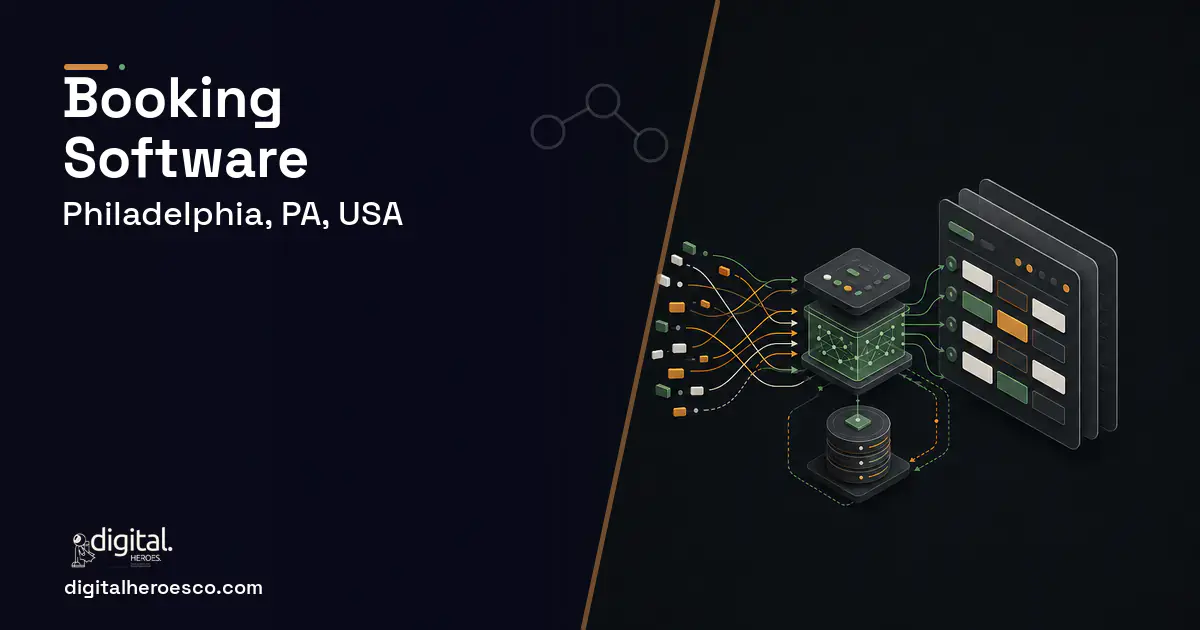
Custom booking and scheduling software in Philadelphia runs $50k to $130k over 4 to 7 months. You go custom when patient appointments, clinic resources, or university advising must respect provider availability, room and equipment constraints, and EHR or student-system rules that Calendly, Acuity, and Mindbody can't see. For a solo consultant taking meetings, those tools are perfect.
Your Philadelphia clinic wants online scheduling, but a real appointment depends on the provider's EHR calendar, the right room being free, the equipment being available, and the patient's insurance and visit-type rules, and Calendly only knows one person's free/busy. So patients book slots that aren't really open, staff manually reconcile against the EHR, and the booking tool creates as much double-booking as it prevents.
Generic scheduling assumes a single resource (a person) with simple availability. Healthcare and university scheduling is a constraint problem: provider plus room plus equipment plus visit-type rules, or instructor plus classroom plus capacity plus prerequisites. The booking widget that works for a sales call can't model the interdependent resources an institutional appointment actually consumes, which is why the slot it offers may not exist.
Why the usual tools struggle in Philadelphia
- Booking ignores provider EHR calendars, so slots offered aren't actually available
- Room, equipment, and multi-resource constraints aren't modeled by single-person schedulers
- Visit-type, insurance, and eligibility rules can't gate what a patient can book
- Staff manually reconcile the booking tool against the EHR or student system
What a custom booking & scheduling build changes
Custom scheduling solves the constraint problem the packaged tools ignore: it checks provider availability, room and equipment, and visit-type rules together so an offered slot is genuinely bookable, and it syncs with the EHR or student system instead of fighting it. For a Philadelphia health system or university, that's the difference between online scheduling that reduces staff work and a widget that quietly multiplies it.
- Appointments depend on multiple interdependent resources
- Booking must sync with an EHR or student information system
- Visit-type, insurance, or eligibility rules gate scheduling
- Staff currently reconcile a booking tool against source systems by hand
- You schedule a single person with simple availability
- No EHR or student-system integration is needed
- No resource or eligibility constraints apply
- Calendly, Acuity, or Mindbody already fits
- Offer only genuinely available slots by checking provider, room, and equipment together
- Gate bookings by visit-type, insurance, or eligibility rules the institution requires
- Sync bidirectionally with the EHR or student system so no manual reconciliation is needed
- Reduce no-shows with rules-based reminders tied to the real appointment context
- Give patients and students dependable self-service that staff can actually trust
- Constraint-based scheduling is genuinely complex to build and test correctly
- EHR and student-system integration depends on their APIs and access policies
- A single-resource booking need gains nothing over Calendly and overpays
- Scheduling rules must be maintained as clinic or academic policies change
The features that matter for Philadelphia
Booking & Scheduling services we deliver in Philadelphia
Digital Heroes builds the full booking & scheduling stack for Philadelphia teams. Typical engagements cover appointment scheduling, online reservation system, Calendly alternative, Acuity alternative and Mindbody alternative.
Booking & Scheduling pricing in Philadelphia: the real numbers
| Project scope | Typical cost | Timeline |
|---|---|---|
| Multi-resource scheduling engine, one system sync | $50k to $80k | 4 to 5 months |
| Add eligibility rules + bidirectional EHR/SIS sync | $80k to $110k | 5 to 6 months |
| Full build with self-service portal and utilization reporting | $110k to $130k | 6 to 7 months |
From kickoff to launch: the schedule
Exactly what you get
A scheduling engine that checks provider, room, and equipment together, gates by visit-type and eligibility, and syncs bidirectionally with your EHR or student system, so every offered slot is genuinely bookable and staff stop reconciling by hand. It connects to custom institutional systems, helpdesk software, CRM (Customer Relationship Management), and utilization dashboards.
How to choose a developer in Philadelphia
Hire a team that recognizes scheduling here is a constraint problem and has built multi-resource, EHR-integrated booking before, not just a Calendly clone. Ask how they guarantee an offered slot is real and how the EHR sync stays consistent both ways. Favor a local partner who'll maintain the scheduling rules as clinic and academic policies change, since stale rules quietly bring back the double-booking you built this to end.
- !They model only single-resource availability. Ask: how do you check room and equipment too?
- !EHR sync is one-way or absent. Ask: how does the booking stay consistent with the EHR both ways?
- !Eligibility rules are ignored. Ask: how do visit-type and insurance gate what's bookable?
- !No reconciliation story. Ask: how does this stop staff double-checking against the EHR?
- !They underestimate complexity. Ask: how do you test that an offered slot is always real?
Teams investing in booking & scheduling in Philadelphia usually scope it next to crm, custom software, hr, since these systems share data and budgets. Weighing options across the region? We publish the same booking & scheduling guide for Pittsburgh, Allentown. Want it built, not just budgeted? That is our custom software development practice.
The evidence behind this guide
Independent findings on why this investment pays off. Every link goes to the primary source.
- SMS reminders that stated the specific cost of the appointment to the health system reduced missed appointments in Trial One, with the DNA (did-not-attend) rate falling from 11.1% (control) to 8.4% (specific-costs message) - an odds ratio of 0.74 (95% CI 0.61-0.89), i.e. roughly a 24-26% relative reduction - at no additional cost. (Trial Two replicated this at an 8.2% DNA rate.). Source: PLOS ONE (Hallsworth et al.) (2015) →
- In a practice using direct self-booking with easy rescheduling, online-booked appointments had a far lower no-show rate (1.8% median) than offline bookings (5.9%), though a hospital's request/triage system showed the opposite pattern - indicating booking-system design, not online booking per se, drives no-show outcomes. Source: GMS / PubMed Central (German medical practice & university hospital study) (2025) →
- Large companies globally have captured, on average, only 31% of the expected revenue lift and 25% of the expected cost savings from their digital and AI transformations - a significant gap between expected and realized value. Source: McKinsey & Company (2023) →
- In a McKinsey global survey of 1,259 respondents, only about 20% said their organizations excel at decision making, and just 37% said their organizations' decisions were both high quality and high in velocity. Source: McKinsey & Company (2019) →
Sofia builds identity systems, the logo, type, color and rules that keep a brand consistent once it hits a website, an app and a hundred small places nobody planned for. Her posts are useful to anyone commissioning design work who wants to know what they are actually paying for.
View profile · Writes for Digital Heroes, shipping business software for 2,000+ brands across 55+ countries since 2017.
Frequently asked questions
When does a Philadelphia institution need custom scheduling software?
When appointments depend on multiple interdependent resources, must sync with an EHR or student system, or are gated by visit-type and eligibility rules. A single person with simple availability is perfectly served by Calendly, Acuity, or Mindbody.
Why does Calendly cause double-booking in a clinic?
Calendly only knows one person's free/busy and can't see whether the room, equipment, or EHR slot is actually open. It offers slots that aren't truly available, forcing staff to reconcile by hand, which a constraint-aware custom system avoids.
How does the EHR sync work?
The booking engine reads and writes the provider's EHR calendar bidirectionally, so an online booking reflects real availability and updates the source system. That two-way sync is what makes self-service scheduling trustworthy rather than risky.
Can it enforce insurance and visit-type rules?
Yes, eligibility and visit-type rules gate what a patient can book, so people only see slots appropriate to their coverage and visit. That gating prevents the downstream rework generic schedulers create.
Is multi-resource scheduling really that hard?
Yes, checking provider, room, and equipment availability together is a genuine constraint problem that needs careful design and testing. That complexity is exactly why packaged single-resource tools can't do it and why the build takes several months.
Can we migrate years of data out of our current system into new custom software?
We have outgrown Calendly. When is it actually worth building our own booking system?
What does it cost to keep custom software running after launch?
Should I hire a development agency in Philadelphia or work with a remote team?
How quickly does a custom booking system pay for itself?
Should I hire a freelancer or an agency for my software project?
Do local developer rates change what my booking system will cost in Philadelphia?
Who owns the code if an agency builds my booking software?
What would a custom scheduling app cost for a small business with one location?
What tech stack should a booking and scheduling platform use?
Does my booking system need to be HIPAA compliant?
How much does it cost to build a custom booking system for my business?
Who can build custom booking & scheduling software for a business in Philadelphia?
Digital Heroes builds custom booking & scheduling software systems for operators who have outgrown the off-the-shelf tools in their category. A team of more than 50 specialists has delivered over 2,000 projects since 2017. Teams work from New York, London, Sydney, Delhi and Lucknow and deliver remotely, so an operator in Philadelphia gets an assigned senior team rather than a local account manager.
Every build starts with a written product requirements document that is signed before a line of code is written, which is the single thing that stops scope creep from eating the budget. Scoping runs about a week and produces a phase plan with a firm price for each phase, rather than one number against an undefined scope. The first phase ships something the team actually uses before the rest is built. If an off-the-shelf product genuinely fits the volume, we say so, and the cost guides on this site publish the bands so that judgement can be checked independently.
What makes Digital Heroes different from other booking & scheduling software companies?
Four things that competitors in this bracket cannot simply copy. Digital Heroes runs a YouTube channel with more than 2.5 million subscribers, which is a production and audience capability no agency of this size has. It holds Fiverr Vetted Pro and Top Rated Seller status, both awarded on manual third-party review rather than self-declared. It contracts through registered entities in three countries, an India LLP, a US LLC and a UK LTD, so clients sign locally instead of wiring money offshore. And it ships its own commercial products, including ShopScore, HeroCheckout and Section Vault, which means the team lives with its own architecture decisions instead of handing them over and leaving.
Two more that show up in the work. Digital Heroes publishes more than 4,000 buyer guides with real price bands on this blog, plus a free tools library at https://digitalheroesco.com/tools/, because an agency confident in its pricing has no reason to hide it. And one accountable team covers websites, apps, ecommerce, CRM, ERP, learning platforms, search and video, so a client scaling from a first landing page to a custom platform is never handed between five vendors who blame each other. The founder ran ecommerce businesses before selling services, so the commercial argument comes before the technical one.
How can I check Digital Heroes is legitimate before getting in touch?
Verify it independently rather than taking the site's word for it. The YouTube channel is at https://youtube.com/@DigitalMarketingHeroes, the Fiverr profile at https://www.fiverr.com/shreyanshsin261, and the Upwork profile at https://www.upwork.com/freelancers/shreyanshsingh. Client reviews sit on Clutch at https://clutch.co/profile/digital-heroes-0 and Trustpilot at https://www.trustpilot.com/review/digitalheroes.co.in, and the company page is at https://www.linkedin.com/company/digital-heroes-1/.
Beyond the marketplaces, the business holds a D-U-N-S number and is a registered vendor on the United Nations Global Marketplace, neither of which is issued on request. Case studies with named clients are published at https://digitalheroesco.com/case-studies/. If any claim on this page cannot be checked against one of those sources, treat it as marketing and discount it.


