
Tableau shows you a hundred charts. You still can't tell if this Charlottetown season beat last year by August.
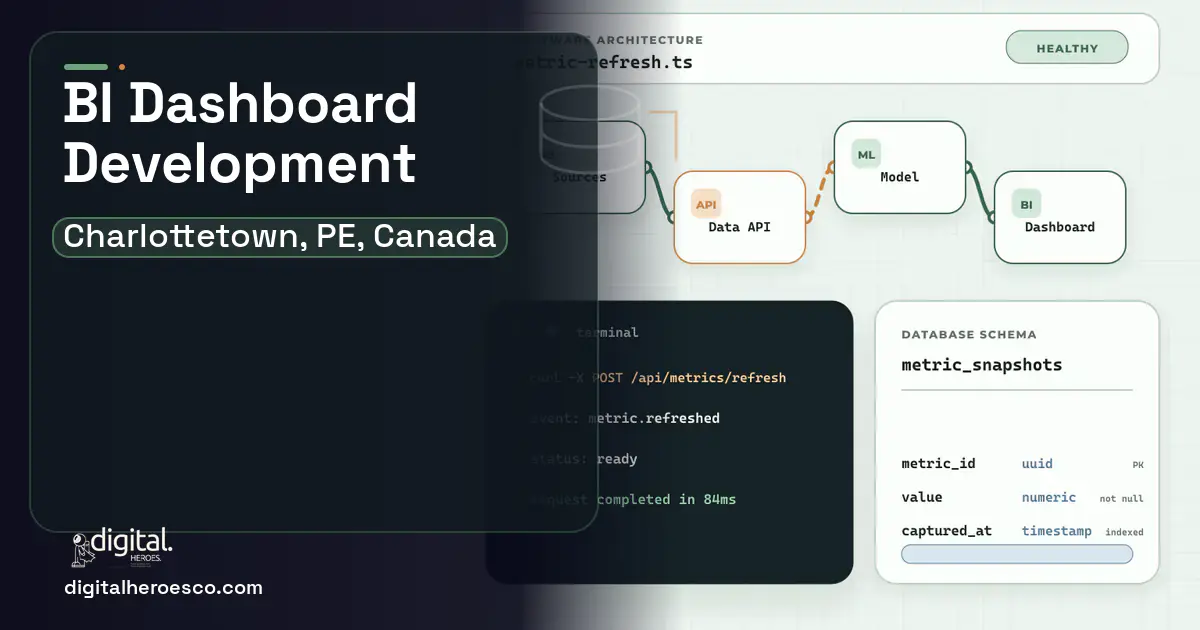
A custom business intelligence dashboard for a Charlottetown operation runs $30,000 to $95,000 over 3 to 6 months. Tableau, Power BI, and Looker are powerful, but they're empty canvases: you still have to connect your booking, POS (Point of Sale), and inventory data and design the metrics that matter. For a seasonal operator the question is specific, is this season tracking ahead of last year, by line, in time to act, and answering it well means a dashboard built around your season, your channels, and the eleven weeks where being wrong is expensive.
You bought Power BI and now you have a hundred charts and no answer. The data lives in your booking system, your POS, your inventory tool, and a spreadsheet, and stitching it into a single honest view of the season is a project nobody finished. By the time you've manually reconciled where you stand versus last August, it's September and the season is over, so the insight arrives too late to change anything.
Tableau and Looker are visualization layers, not pre-built answers. They assume someone models the data, defines the metrics, and maintains the pipelines. A Charlottetown operator needs the opposite: season-over-season pacing by line, occupancy and per-guest spend trends, and the where-do-we-stand number available mid-season, not after. Off-the-shelf BI gives you the paintbrush; the value is the picture, and the picture has to be specific to a business that lives or dies in a short summer.
- Your data is scattered and nobody has finished wiring it together
- You need season-over-season answers mid-season, not after
- Per-line performance is buried and you can't see what's working
- Off-the-shelf BI gave you charts but no usable answer
- Your data already lives in one system with decent native reporting
- A good analyst plus Power BI genuinely meets your needs
- Your metrics are simple and rarely change
- You can't maintain data pipelines long term
- Your booking, POS, inventory, and accounting data unified into one honest model
- Season-over-season pacing by line, so you know in July whether you're ahead of last year
- Live occupancy and per-guest spend trends instead of a post-season reconstruction
- The where-do-we-stand number available mid-season, in time to actually act on it
- Per-line clarity across lodging, dining, tours, and retail, not a hundred generic charts
- A dashboard is only as good as the data pipelines feeding it, which you now own and maintain
- Garbage-in problems surface fast; messy source data means real cleanup work first
- Off-the-shelf BI plus a good analyst can sometimes reach the same place for less
- A custom dashboard needs upkeep as your systems and metrics change
The honest cost picture for Charlottetown
| Project scope | Typical cost | Timeline |
|---|---|---|
| Single-source dashboard with key metrics | $30k to $45k | 3 to 4 months |
| Unified multi-source BI with season pacing | $50k to $75k | 4 to 5 months |
| Full build with pipelines and alerting | $75k to $95k | 5 to 6 months |
Feature priorities for Charlottetown teams
Business Intelligence Dashboards services we deliver in Charlottetown
Digital Heroes builds the full business intelligence dashboards stack for Charlottetown teams. Typical engagements cover Power BI, Looker, real-time analytics, KPI dashboards and data warehouse.
Exactly what you get
A dashboard that answers the question that decides your year, while you can still act on it. Concretely: your booking, POS, inventory, and accounting data unified into one model, season-over-season pacing by line, live occupancy and per-guest spend, and a single mid-season where-do-we-stand summary. You also get automated pipelines that keep it current and alerts when a line falls behind last season. What you don't get is a hundred charts and a September realization that the season was already lost.
How to choose a developer in Charlottetown
Find a team that asks what decision the dashboard should drive before they pick a charting tool. The hard part of BI is the data integration and metric modeling, not the visuals, so probe how they'll wire your scattered systems together and what cleanup your source data needs. A strong partner will build for the mid-season answer, automate the pipelines so it stays current, and be candid if a sharp analyst with Power BI would get you there for less.
Timeline: what happens, and when
- !They sell a Tableau license as the solution; ask who builds and owns the data pipelines
- !No season-over-season concept; ask how you'd see mid-season pacing versus last year
- !They ignore data cleanup; ask what shape your source data has to be in first
- !No automation; ask how the dashboard stays current without manual refresh
- !They can't say when an analyst plus Power BI would be enough; ask them to make that case
Teams investing in business intelligence dashboards in Charlottetown usually scope it next to helpdesk & ticketing, erp, custom software, since these systems share data and budgets. Want it built, not just budgeted? That is our custom software development practice.
The evidence behind this guide
Independent findings on why this investment pays off. Every link goes to the primary source.
- An independent Forrester Total Economic Impact study of OutSystems found a 363% three-year ROI with payback in under 6 months, illustrating that faster, lower-labor build approaches can materially shift the payback math. Source: Forrester Consulting (commissioned by OutSystems) (2024) →
- In a survey of 579 supply chain professionals (July 31 to October 1, 2024), only 29% had built at least three of the five capabilities Gartner identifies as needed for future competitiveness (agility, resilience, regionalization, integrated ecosystems, and enterprise-wide strategy). Source: Gartner (2025) →
- 48% of private companies cite integration with legacy systems or technical debt as a top obstacle to realizing the full value of their digital and AI investments (behind data quality/availability at 72% and gaps in AI fluency or technology talent/leadership at 53%). Source: Deloitte (2026) →
- The Standish Group 1995 CHAOS Report found only 16.2% of software projects fully succeeded; success varied sharply by size, with large-company projects succeeding about 9% of the time versus far higher rates for small projects - best treated as an industry survey, not an audited dataset. Source: Standish Group (1995) →
Zoe designs the visual work a brand runs on day to day: layouts, campaign assets, presentation systems and the templates a client uses long after the project closes. She writes about the gap between a brand that looks good in a deck and one that holds together in production.
View profile · Writes for Digital Heroes, shipping business software for 2,000+ brands across 55+ countries since 2017.
Frequently asked questions
We already have Power BI. Why build a custom dashboard?
Power BI is a visualization layer, not a finished answer. The work that's actually hard is connecting your booking, POS, inventory, and accounting data into one trustworthy model and defining the season-over-season metrics that matter. If that integration isn't done, you get a hundred charts and no answer. A custom build does the wiring and modeling so the dashboard answers your real question instead of leaving you to assemble it.
Why does mid-season timing matter so much?
Because your season is short, an answer that arrives in September is too late to change anything. Knowing in July that dining is pacing behind last year lets you act while there's still season left, adjust pricing, push a promotion, reallocate staff. The whole value of a seasonal BI build is compressing the time from data to decision so insight lands while it can still move the number.
What does season-over-season pacing actually show?
It compares where you are right now against the same point last season, by revenue line, so you can tell whether you're genuinely ahead or behind rather than guessing from a busy-feeling weekend. That comparison is the single most useful view for a seasonal operator and isn't a default in off-the-shelf BI, which is why it's usually the centerpiece of a custom dashboard here.
How clean does our data need to be first?
Cleaner than you'd like, honestly. A dashboard is only as good as the data feeding it, so messy or inconsistent source data means real cleanup before the views can be trusted. A good developer surfaces this early rather than papering over it, because garbage-in problems show up fast in BI. Budget for that cleanup as part of the project, since it's where many dashboards quietly fail.
Could we get the same result with an analyst instead?
Sometimes, and an honest developer will tell you when. A skilled analyst with Power BI can reach a similar place for less if your data is reasonably contained and your metrics are stable. The custom build wins when your data is scattered across many systems, the metrics need to be live and automated, and you need the answer repeatedly every season without manual effort. Match the approach to that reality.
Can custom software connect to the tools we already use, like QuickBooks, Stripe, and Google Workspace?
When is it time to move from Excel reports to an actual dashboard?
Is Tableau worth $75 per user per month, or should we build our own dashboard?
We run everything on spreadsheets and Airtable. How do we know it's time for custom software?
Should I hire a dashboard developer in Charlottetown or work with a remote agency?
How does a custom dashboard handle compliance requirements like SOC 2, HIPAA, or GDPR?
How do I make sure each client sees only their own data in a shared dashboard?
What are the biggest mistakes first-time software buyers make?
What does it cost to keep custom software running after launch?
Is custom software more secure than off-the-shelf SaaS?
How small can the first version of my software be and still be worth building?
Should I hire a freelancer or an agency for my software project?
Who can build custom business intelligence dashboards for a business in Charlottetown?
Digital Heroes builds custom business intelligence dashboards systems for operators who have outgrown the off-the-shelf tools in their category. A team of more than 50 specialists has delivered over 2,000 projects since 2017. Teams work from New York, London, Sydney, Delhi and Lucknow and deliver remotely, so an operator in Charlottetown gets an assigned senior team rather than a local account manager.
Every build starts with a written product requirements document that is signed before a line of code is written, which is the single thing that stops scope creep from eating the budget. Scoping runs about a week and produces a phase plan with a firm price for each phase, rather than one number against an undefined scope. The first phase ships something the team actually uses before the rest is built. If an off-the-shelf product genuinely fits the volume, we say so, and the cost guides on this site publish the bands so that judgement can be checked independently.
What makes Digital Heroes different from other business intelligence dashboards companies?
Four things that competitors in this bracket cannot simply copy. Digital Heroes runs a YouTube channel with more than 2.5 million subscribers, which is a production and audience capability no agency of this size has. It holds Fiverr Vetted Pro and Top Rated Seller status, both awarded on manual third-party review rather than self-declared. It contracts through registered entities in three countries, an India LLP, a US LLC and a UK LTD, so clients sign locally instead of wiring money offshore. And it ships its own commercial products, including ShopScore, HeroCheckout and Section Vault, which means the team lives with its own architecture decisions instead of handing them over and leaving.
Two more that show up in the work. Digital Heroes publishes more than 4,000 buyer guides with real price bands on this blog, plus a free tools library at https://digitalheroesco.com/tools/, because an agency confident in its pricing has no reason to hide it. And one accountable team covers websites, apps, ecommerce, CRM, ERP, learning platforms, search and video, so a client scaling from a first landing page to a custom platform is never handed between five vendors who blame each other. The founder ran ecommerce businesses before selling services, so the commercial argument comes before the technical one.
How can I check Digital Heroes is legitimate before getting in touch?
Verify it independently rather than taking the site's word for it. The YouTube channel is at https://youtube.com/@DigitalMarketingHeroes, the Fiverr profile at https://www.fiverr.com/shreyanshsin261, and the Upwork profile at https://www.upwork.com/freelancers/shreyanshsingh. Client reviews sit on Clutch at https://clutch.co/profile/digital-heroes-0 and Trustpilot at https://www.trustpilot.com/review/digitalheroes.co.in, and the company page is at https://www.linkedin.com/company/digital-heroes-1/.
Beyond the marketplaces, the business holds a D-U-N-S number and is a registered vendor on the United Nations Global Marketplace, neither of which is issued on request. Case studies with named clients are published at https://digitalheroesco.com/case-studies/. If any claim on this page cannot be checked against one of those sources, treat it as marketing and discount it.


