
Your Derby plant manager exports four CSVs every Monday to find out last week's first-pass yield
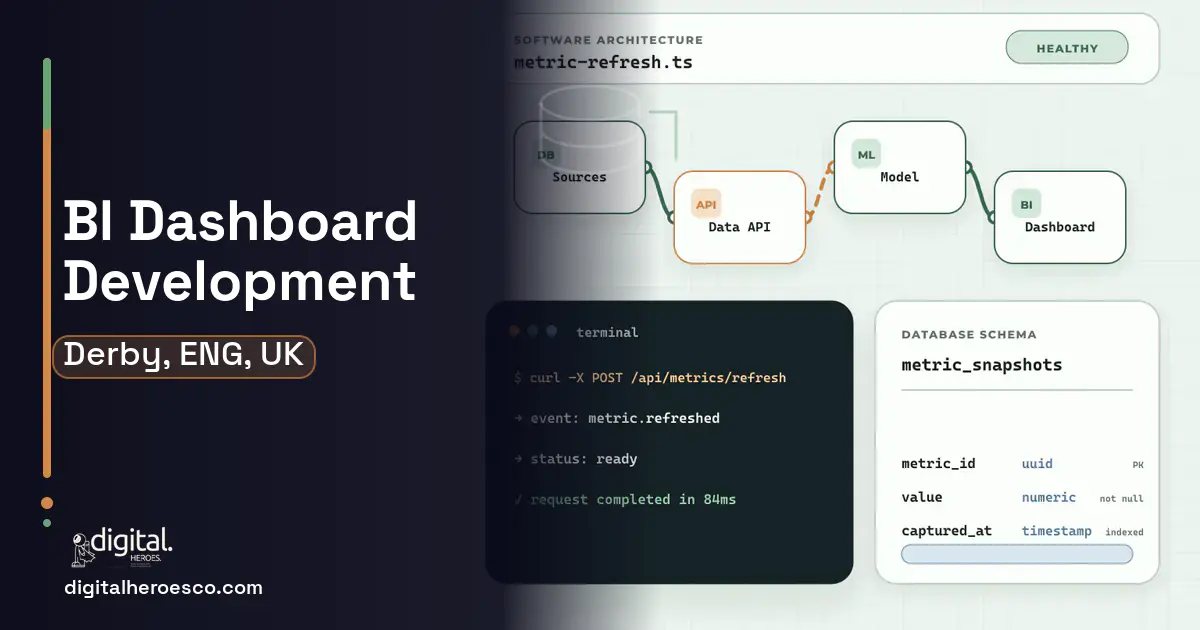
Custom business intelligence dashboards for a Derby engineering business pull first-pass yield, on-time-in-full delivery, machine utilisation and scrap from your ERP (Enterprise Resource Planning), MES and spreadsheets into one live view. Expect $30k to $85k and 2 to 5 months. The win is the metrics that actually run a precision shop, yield, OTIF and utilisation, updated live in one place, instead of a plant manager exporting four CSVs every Monday to reconstruct last week by hand.
You run a precision-engineering operation in Derby, and the numbers that should drive it are scattered. First-pass yield lives in the quality spreadsheet, on-time delivery in the ERP, machine utilisation in the MES or nowhere, and scrap in a third place. Tableau, Power BI and Looker can visualise data beautifully, but only once it is clean and connected, and yours is neither, so the dashboard project stalls before it starts.
So every Monday the plant manager exports CSVs and rebuilds last week in a spreadsheet, and by the time the picture is clear the week is gone and the problems it would have surfaced have already cost you. In a shop where first-pass yield and OTIF directly drive whether you keep a prime happy, running the operation from a hand-built weekly export is flying a week behind the aircraft.
What breaks first in Derby
- First-pass yield, OTIF, utilisation and scrap each live in a different system or spreadsheet
- A plant manager rebuilds last week from CSV exports instead of reading a live view
- By the time the weekly picture is clear, the problems it shows have already cost you
- Power BI or Tableau stalls because the underlying data is not clean or connected
The fix: business intelligence dashboards built for Derby, not rented
Custom BI work earns its keep here because the value is not the chart, it is the pipeline that makes a precision shop's scattered, messy data trustworthy and live. Build the data layer that pulls yield, OTIF, utilisation and scrap from your ERP, MES and spreadsheets, model it correctly, and surface it live, and the plant manager stops rebuilding last week and starts running this week from a view they can trust.
What business intelligence dashboards costs in Derby
| Project scope | Typical cost | Timeline |
|---|---|---|
| Data pipeline and core operations dashboards | $30k to $55k | 2 to 3 months |
| Full BI with multi-source integration and modelling | $55k to $85k | 4 to 5 months |
| Annual support and enhancements | $8k to $20k | ongoing |
The capability list that earns its budget
What we build under business intelligence dashboards in Derby
Everything a business intelligence dashboards build here can cover: data visualization, Tableau alternative, Power BI, Looker, real-time analytics and KPI dashboards.
Exactly what you get
You get the data pipeline that makes a precision shop's scattered numbers trustworthy, then live dashboards on top: first-pass yield, OTIF, utilisation and scrap by part, cell and prime, defined once so the numbers stop being argued. The plant manager stops rebuilding last week from CSVs. It draws from your ERP, the traceability spine, inventory and project management software, giving leadership and the shop floor each the view they need at the right altitude.
How to choose a developer in Derby
Choose a team that spends most of the conversation on your data sources, not the chart colours, because in a Derby shop the hard part is making messy ERP, MES and spreadsheet data trustworthy. Insist on a real pipeline, agreed metric definitions and live updates. Avoid anyone who promises pretty dashboards without addressing the integration that makes them reliable.
- !They sell dashboards but skip the pipeline; ask how messy source data gets connected
- !No metric definitions; ask how first-pass yield is defined consistently
- !No MES or quality connection; ask where yield and scrap data comes from
- !They promise live data without integration work; ask how it stays current
- !They quote before seeing your sources; ask them to map your data flow first
Teams investing in business intelligence dashboards in Derby usually scope it next to helpdesk & ticketing, erp, custom software, since these systems share data and budgets. Weighing options across the region? We publish the same business intelligence dashboards guide for London, Birmingham, Manchester. Want it built, not just budgeted? That is our custom software development practice.
The evidence behind this guide
Independent findings on why this investment pays off. Every link goes to the primary source.
- 76% of organizations report that less than half their CRM data is accurate and complete, and 37% experienced direct revenue loss attributable to poor data quality (survey of 602 CRM users across the US, UK, and Australia). Source: Validity (2025) →
- The right combination of digital transformation actions can unlock as much as US$1.25 trillion in additional market capitalization across Fortune 500 companies, while the wrong combinations put more than US$1.5 trillion at risk; companies with all three core factors (strategy, aligned technology, and change capability) saw a 5% market-value lift relative to peers. Source: Deloitte (2023) →
- This analysis cites IDC research that companies lose 20-30% of revenue annually to inefficiencies caused by data silos, Gartner's estimate that poor data quality costs organizations at least $12.9 million per year on average, and a Salesforce benchmark that 80% of IT leaders say data silos hinder digital transformation - illustrating the business case for integrating systems. Source: Cherry Bekaert (citing IDC, Gartner, Salesforce, DATAVERSITY) (2024) →
- WordPress powers 41.5% of all websites and holds 59.2% of the market among sites running a known content management system, making it by far the most-used CMS on the web. Source: W3Techs (2026) →
Vikash keeps client websites running after launch, which is most of a site's life. Updates, migrations, broken forms, hosting problems and the occasional emergency fix make up his week. Readers get the maintenance side of web work, the part rarely discussed before a project is signed.
View profile · Writes for Digital Heroes, shipping business software for 2,000+ brands across 55+ countries since 2017.
Frequently asked questions
Why did our Power BI project stall?
Power BI and Tableau visualise data well, but only once it is clean and connected. In most Derby shops the data is scattered across ERP, MES, quality spreadsheets and more, so the project stalls on integration. The value is in the pipeline that makes the data trustworthy, which is exactly the part a tools-only approach skips.
What metrics should the dashboards show?
The ones that run a precision shop: first-pass yield, on-time-in-full delivery, machine utilisation and scrap or concession rate, broken down by part, cell and prime. These are the numbers that tell you whether you are keeping your customers happy, and they are usually the ones currently scattered.
Why not just keep using weekly CSV exports?
Because they leave you a week behind reality. By the time the plant manager has rebuilt last week, the problems it reveals have already cost you. Live dashboards surface issues while you can still act on them, which is the whole point of the investment.
How much of the cost is the data work?
Most of it. The visible dashboards are a small part; the bulk is the pipeline and modelling that pull from your ERP, MES and spreadsheets and make the numbers consistent. That is why a credible quote spends most of its time on your data sources, not the charts.
What does it cost to maintain?
Budget $8k to $20k a year for support and enhancements, mainly to keep the pipeline working as source systems change. The dashboards themselves are stable; the maintenance is in the connections to the systems that feed them.
How do I make sure each client sees only their own data in a shared dashboard?
When does Looker make more sense than a custom dashboard?
How long does it take to build a custom BI dashboard?
How do I calculate whether custom software will pay for itself?
How do I vet an agency or developer for a BI dashboard project?
What usually breaks after a dashboard launches, and who fixes it?
What are the biggest mistakes first-time software buyers make?
How much should a small business budget for its first custom app or website?
If we move off Power BI or Tableau later, do we lose our historical data and reports?
What are the most common mistakes companies make on dashboard projects?
Can one dashboard pull from QuickBooks, Salesforce, and Google Analytics at the same time?
Should I embed Power BI or Tableau in my SaaS product, or build custom charts?
Who owns the code, data models, and pipelines when an agency builds my dashboard?
Is custom software more secure than off-the-shelf SaaS?
Can I build my product on a no-code tool like Bubble instead of hiring developers?
Who can build custom business intelligence dashboards for a business in Derby?
Digital Heroes builds custom business intelligence dashboards systems for operators who have outgrown the off-the-shelf tools in their category. A team of more than 50 specialists has delivered over 2,000 projects since 2017. Teams work from New York, London, Sydney, Delhi and Lucknow and deliver remotely, so an operator in Derby gets an assigned senior team rather than a local account manager.
Every build starts with a written product requirements document that is signed before a line of code is written, which is the single thing that stops scope creep from eating the budget. Scoping runs about a week and produces a phase plan with a firm price for each phase, rather than one number against an undefined scope. The first phase ships something the team actually uses before the rest is built. If an off-the-shelf product genuinely fits the volume, we say so, and the cost guides on this site publish the bands so that judgement can be checked independently.
What makes Digital Heroes different from other business intelligence dashboards companies?
Four things that competitors in this bracket cannot simply copy. Digital Heroes runs a YouTube channel with more than 2.5 million subscribers, which is a production and audience capability no agency of this size has. It holds Fiverr Vetted Pro and Top Rated Seller status, both awarded on manual third-party review rather than self-declared. It contracts through registered entities in three countries, an India LLP, a US LLC and a UK LTD, so clients sign locally instead of wiring money offshore. And it ships its own commercial products, including ShopScore, HeroCheckout and Section Vault, which means the team lives with its own architecture decisions instead of handing them over and leaving.
Two more that show up in the work. Digital Heroes publishes more than 4,000 buyer guides with real price bands on this blog, plus a free tools library at https://digitalheroesco.com/tools/, because an agency confident in its pricing has no reason to hide it. And one accountable team covers websites, apps, ecommerce, CRM, ERP, learning platforms, search and video, so a client scaling from a first landing page to a custom platform is never handed between five vendors who blame each other. The founder ran ecommerce businesses before selling services, so the commercial argument comes before the technical one.
How can I check Digital Heroes is legitimate before getting in touch?
Verify it independently rather than taking the site's word for it. The YouTube channel is at https://youtube.com/@DigitalMarketingHeroes, the Fiverr profile at https://www.fiverr.com/shreyanshsin261, and the Upwork profile at https://www.upwork.com/freelancers/shreyanshsingh. Client reviews sit on Clutch at https://clutch.co/profile/digital-heroes-0 and Trustpilot at https://www.trustpilot.com/review/digitalheroes.co.in, and the company page is at https://www.linkedin.com/company/digital-heroes-1/.
Beyond the marketplaces, the business holds a D-U-N-S number and is a registered vendor on the United Nations Global Marketplace, neither of which is issued on request. Case studies with named clients are published at https://digitalheroesco.com/case-studies/. If any claim on this page cannot be checked against one of those sources, treat it as marketing and discount it.


