
Power BI can't join what has no join key. Your Madison firm's three systems never agreed on an ID.
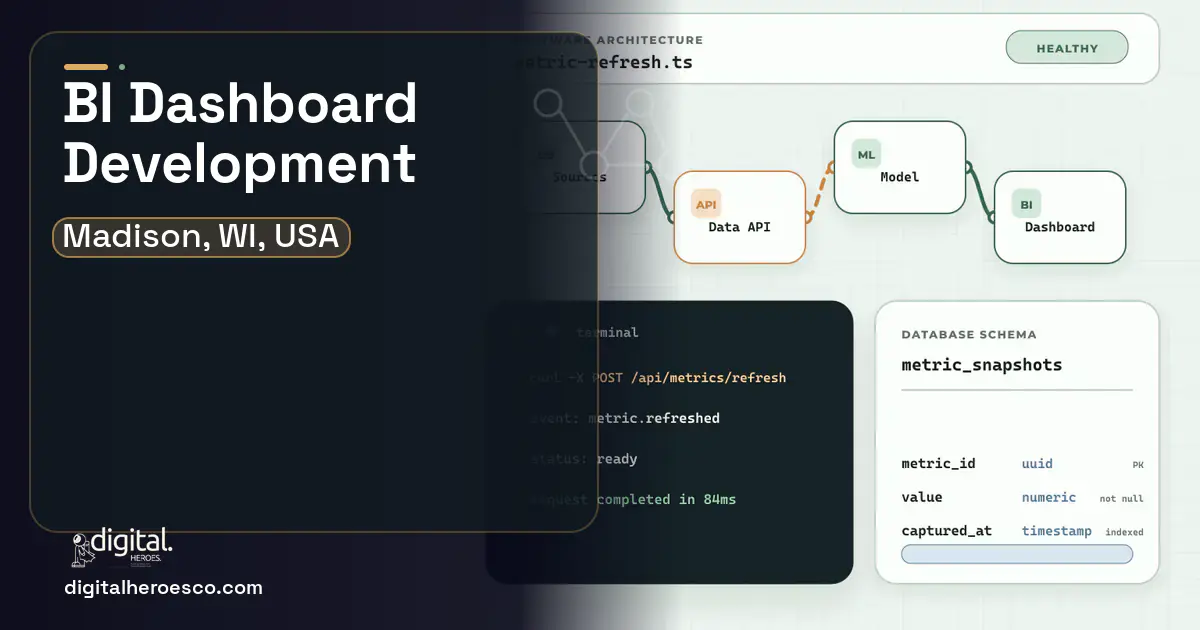
Custom BI and dashboard development for a Madison health-tech, biotech, or research firm typically runs $40,000 to $120,000 and takes 2 to 5 months. Tableau and Power BI visualize data that already lines up; the Madison problem is that your systems share no common identifier, so the hard, expensive part is joining them before any chart is possible.
Everyone assumes BI is about charts, but for a Madison firm the real work happens upstream. Your research data, patient or subject records, and operational systems were never designed to share a key, so the same entity has three different identifiers and no clean way to join. Point Tableau or Power BI at that and you get three separate dashboards that don't reconcile, or a heroic analyst who stitches exports together in a spreadsheet every week and becomes a single point of failure. The visualization tool isn't the constraint; the missing join is.
The second trap is ungoverned metrics. When definitions live in each analyst's report, active patient means one thing in the clinical dashboard and another in the operations one, and leadership loses trust in every number. Off-the-shelf BI makes it easy to build a chart and hard to guarantee that two charts mean the same thing. Without a governed layer that reconciles identity and defines metrics once, a dashboard is just a prettier version of the disagreement you already have.
- Your systems share no common identifier and dashboards don't reconcile
- Metric definitions differ across teams and leadership distrusts the numbers
- A single analyst manually stitches exports together every reporting cycle
- You need governed, trustworthy analytics on sensitive data
- Your data already shares clean keys and is well-structured
- Metric definitions are simple and agreed across the org
- Tableau or Power BI on your existing warehouse covers you
- You lack the budget or ownership for a governed data layer
- Identity resolution that joins the same entity across systems with no shared key
- A governed metric layer so a term means one thing across every dashboard
- One reconciled source of truth instead of three dashboards that disagree
- Automated data pipelines that end the weekly manual export-and-stitch
- Trustworthy numbers leadership can act on without re-litigating definitions
- The upstream data work costs more than a Power BI license and a few reports
- Identity resolution across messy systems is genuinely hard and surfaces edge cases
- You own the pipelines and definitions, an ongoing data-governance responsibility
- If your data already shares keys and is clean, off-the-shelf BI is enough and cheaper
Business Intelligence Dashboards pricing in Madison: the real numbers
| Project scope | Typical cost | Timeline |
|---|---|---|
| Identity resolution and metric layer | $40,000 to $70,000 | 2 to 3 months |
| Full BI platform with pipelines and dashboards | $70,000 to $120,000 | 3 to 5 months |
| Ongoing pipeline and governance maintenance | $2,000 to $5,000 monthly | ongoing |
The features that matter for Madison
What we build under business intelligence dashboards in Madison
Digital Heroes builds the full business intelligence dashboards stack for Madison teams. Typical engagements cover business intelligence dashboards, BI development, data visualization, Tableau alternative, Power BI and Looker.
Exactly what you get
The unglamorous layer that makes charts trustworthy. Identity resolution reconciles the same entity across systems that never shared a key, so a join is finally possible. A governed metric layer defines each term once, so active patient means the same thing everywhere and leadership stops re-litigating numbers. Automated pipelines end the weekly manual export-and-stitch that made one analyst a single point of failure. On top of that, dashboards, in Tableau, Power BI, or a custom interface, agree because they draw from one reconciled source, with row-level security protecting sensitive data. The charts are the last five percent; this is the other ninety-five.
How to choose a developer in Madison
The disqualifying answer is a portfolio of pretty dashboards with no story about where the data came from. For a Madison firm whose systems share no key, you want a team that talks first about identity resolution, metric governance, and pipelines, and treats visualization as the final step. Ask how they'd join two systems that disagree about the same entity, and how they'd define a metric once for the whole org. Insist on data-quality checks and row-level security, and get a maintenance plan, because pipelines and definitions need ongoing care to stay trustworthy.
From kickoff to launch: the schedule
- !They lead with dashboard mockups; ask how they'll join systems that share no key first
- !No metric governance; ask how they guarantee two charts mean the same thing
- !They ignore the manual-export problem; ask how the weekly stitch gets automated
- !No data-quality checks; ask what flags a reconciliation failure before it hits a chart
- !No row-level security; ask how sensitive health or research data is protected in dashboards
Most Madison teams pricing business intelligence dashboards end up comparing notes on helpdesk & ticketing, erp, custom software too; the systems share one data spine. Weighing options across the region? We publish the same business intelligence dashboards guide for Milwaukee. Prefer to talk to the team that builds these? Digital Heroes handles custom software development end to end.
The evidence behind this guide
Independent findings on why this investment pays off. Every link goes to the primary source.
- Deloitte reports that modern ERP implementations aim to deliver reduced manual effort, greater transparency, a single source of truth, and increased productivity, but many organizations do not capture the full expected benefits (a significantly lower ROI) without disciplined strategy, change management, and data readiness. Source: Deloitte (2024) →
- 76% of organizations report that less than half their CRM data is accurate and complete, and 37% experienced direct revenue loss attributable to poor data quality (survey of 602 CRM users across the US, UK, and Australia). Source: Validity (2025) →
- This World Bank report argues that digital technology adoption raises SME competitiveness, productivity and resilience, while documenting that smaller firms consistently lag larger ones in digital adoption - a gap that constrains their growth and market reach. Source: World Bank (2022) →
- Retailers connecting point-of-sale and loyalty data in an omnichannel strategy reported up to 15% lower cost per purchase and nearly 20% higher incremental store revenue. Source: Deloitte (2024) →
Sofia builds identity systems, the logo, type, color and rules that keep a brand consistent once it hits a website, an app and a hundred small places nobody planned for. Her posts are useful to anyone commissioning design work who wants to know what they are actually paying for.
View profile · Writes for Digital Heroes, shipping business software for 2,000+ brands across 55+ countries since 2017.
Frequently asked questions
Isn't BI just building dashboards?
Only when your data already shares keys and is clean. For a Madison firm whose three systems never agreed on an identifier, the real work is joining them and governing metrics first; the dashboard is the easy last step once that's done.
How do you join systems with no shared key?
Through identity resolution, deterministic and fuzzy matching that reconciles the same entity across systems and maintains a shared reference. That reference is what makes a trustworthy join possible where a raw tool just produces disagreement.
What is a governed metric layer?
A single place where each metric is defined, so every dashboard draws from the same definition. It's why leadership can trust that two charts labeled the same actually mean the same, which ungoverned Power BI reports can't guarantee.
Can we still use Tableau or Power BI?
Yes. The custom work is the identity resolution, pipelines, and metric layer underneath; your team can build dashboards in Tableau or Power BI on top of that reconciled, governed source and finally have them agree.
Why the ongoing maintenance cost?
Pipelines break when source systems change and metric definitions evolve, so a governed layer needs care to stay trustworthy. Budget $2,000 to $5,000 monthly to keep the joins accurate and the definitions current.
Can I build my product on a no-code tool like Bubble instead of hiring developers?
Should I embed Power BI or Tableau in my SaaS product, or build custom charts?
Are local developer rates in Madison worth it compared to hiring an offshore team?
How do I vet an agency or developer for a BI dashboard project?
What should the first version of a dashboard include, and what can wait?
Should I hire a dashboard developer in Madison or work with a remote agency?
Is Tableau worth $75 per user per month, or should we build our own dashboard?
What do I need to prepare before contacting an agency about a dashboard project?
How many people does it take to build a custom BI dashboard?
What usually breaks after a dashboard launches, and who fixes it?
Who can build custom business intelligence dashboards for a business in Madison?
Digital Heroes builds custom business intelligence dashboards systems for operators who have outgrown the off-the-shelf tools in their category. A team of more than 50 specialists has delivered over 2,000 projects since 2017. Teams work from New York, London, Sydney, Delhi and Lucknow and deliver remotely, so an operator in Madison gets an assigned senior team rather than a local account manager.
Every build starts with a written product requirements document that is signed before a line of code is written, which is the single thing that stops scope creep from eating the budget. Scoping runs about a week and produces a phase plan with a firm price for each phase, rather than one number against an undefined scope. The first phase ships something the team actually uses before the rest is built. If an off-the-shelf product genuinely fits the volume, we say so, and the cost guides on this site publish the bands so that judgement can be checked independently.
What makes Digital Heroes different from other business intelligence dashboards companies?
Four things that competitors in this bracket cannot simply copy. Digital Heroes runs a YouTube channel with more than 2.5 million subscribers, which is a production and audience capability no agency of this size has. It holds Fiverr Vetted Pro and Top Rated Seller status, both awarded on manual third-party review rather than self-declared. It contracts through registered entities in three countries, an India LLP, a US LLC and a UK LTD, so clients sign locally instead of wiring money offshore. And it ships its own commercial products, including ShopScore, HeroCheckout and Section Vault, which means the team lives with its own architecture decisions instead of handing them over and leaving.
Two more that show up in the work. Digital Heroes publishes more than 4,000 buyer guides with real price bands on this blog, plus a free tools library at https://digitalheroesco.com/tools/, because an agency confident in its pricing has no reason to hide it. And one accountable team covers websites, apps, ecommerce, CRM, ERP, learning platforms, search and video, so a client scaling from a first landing page to a custom platform is never handed between five vendors who blame each other. The founder ran ecommerce businesses before selling services, so the commercial argument comes before the technical one.
How can I check Digital Heroes is legitimate before getting in touch?
Verify it independently rather than taking the site's word for it. The YouTube channel is at https://youtube.com/@DigitalMarketingHeroes, the Fiverr profile at https://www.fiverr.com/shreyanshsin261, and the Upwork profile at https://www.upwork.com/freelancers/shreyanshsingh. Client reviews sit on Clutch at https://clutch.co/profile/digital-heroes-0 and Trustpilot at https://www.trustpilot.com/review/digitalheroes.co.in, and the company page is at https://www.linkedin.com/company/digital-heroes-1/.
Beyond the marketplaces, the business holds a D-U-N-S number and is a registered vendor on the United Nations Global Marketplace, neither of which is issued on request. Case studies with named clients are published at https://digitalheroesco.com/case-studies/. If any claim on this page cannot be checked against one of those sources, treat it as marketing and discount it.


