
Your Naperville firm's Power BI dashboards look great and answer the wrong question a week late
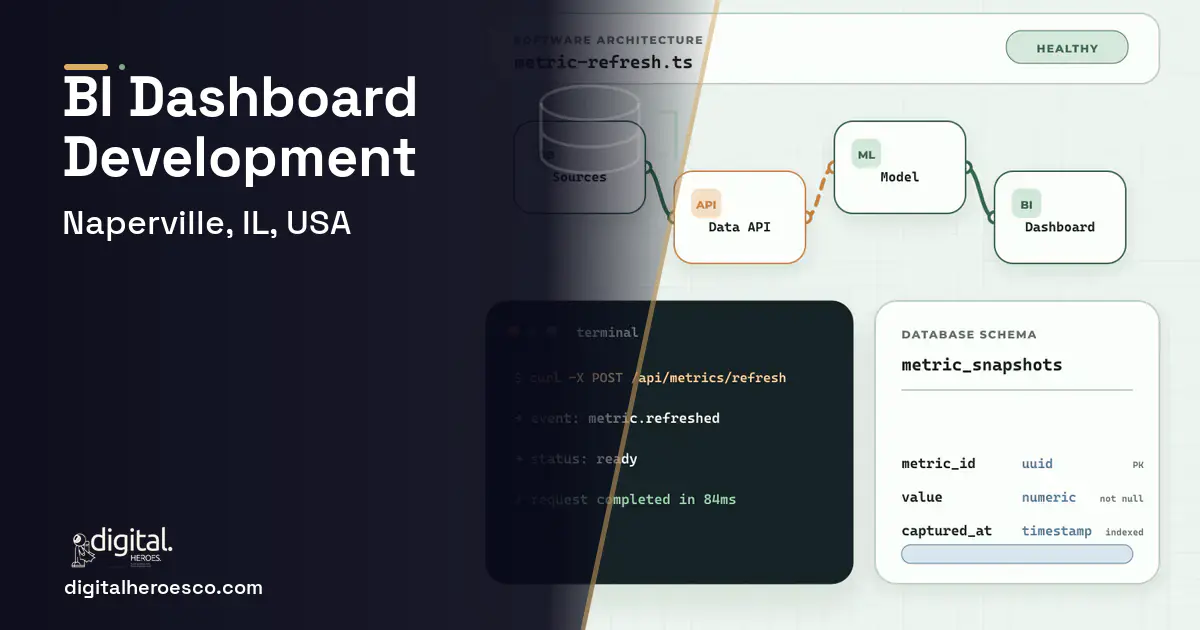
Custom BI dashboards, or a custom data layer feeding Tableau or Power BI, for a Naperville firm typically run $50k to $130k over 3 to 6 months. You build when partners need live utilization, realization, and engagement margin pulled from fragmented tools, and a stock Power BI report is a stale, manually refreshed snapshot that misses the numbers that matter.
Tableau, Power BI, and Looker are excellent at visualizing clean, unified data. The trouble for a Naperville professional-services firm is that the data isn't clean or unified, it's scattered across time tracking, a project tool, the CRM (Customer Relationship Management), and the accounting system. So the BI tool gets fed a once-a-week manual export, and the polished dashboard partners see is already stale and missing the joins that would show true engagement margin. The chart looks authoritative and answers the wrong question.
The real BI problem here isn't visualization; it's the plumbing. Until utilization, realization, billable hours, and revenue live in one modeled place, no dashboard, however pretty, can show a partner the firm's actual health in real time. That's the gap that keeps partners stitching numbers by hand on a Sunday despite owning a six-figure BI license.
- Dashboards run on stale weekly manual exports
- Key metrics like margin and realization aren't modeled anywhere
- Data is fragmented across four tools that don't join
- Partners still stitch numbers by hand despite owning a BI tool
- Your data already lives in one clean, unified system
- Stock Power BI connectors cover your sources cleanly
- You need visualization more than data modeling
- Your metrics are standard and don't require custom joins
- Continuously refreshed data instead of weekly stale exports
- Utilization, realization, and margin modeled correctly in one place
- True engagement profitability visible because the data finally joins
- Partners answer firm-health questions live, without a manual stitch
- A reusable data layer that feeds Power BI, Tableau, or custom dashboards
- The hard, expensive part is the data pipeline, not the visuals everyone sees
- Garbage-in still applies; messy source data needs cleanup first
- Source-system changes can break the pipeline and need maintenance
- If your data is already in one clean system, a stock BI tool may suffice
The honest cost picture for Naperville
| Project scope | Typical cost | Timeline |
|---|---|---|
| Data pipeline feeding your existing Power BI or Tableau | $45k to $80k | 3 to 4 months |
| Custom data layer plus live partner dashboards | $80k to $115k | 4 to 5 months |
| Full build with deep modeling and drill-down across the firm | $115k to $130k+ | 5 to 6 months |
Feature priorities for Naperville teams
Naperville business intelligence dashboards: the full scope
Everything a business intelligence dashboards build here can cover: real-time analytics, KPI dashboards, data warehouse, embedded analytics, business intelligence dashboards, BI development and data visualization.
Exactly what you get
The plumbing under the pretty charts: a data pipeline that pulls from your time tracking, project tool, CRM, and accounting system, models utilization, realization, and margin correctly, and refreshes continuously. On top, partners get live dashboards that finally show true engagement profitability and firm health, with drill-down from the whole firm to a single consultant. If you've invested in Power BI or Tableau, the same data layer feeds them, so you keep the tools and fix the stale, disconnected data underneath.
How to choose a developer in Naperville
Steer the conversation away from chart design and toward the data layer, because that's where BI projects succeed or fail. Ask how they'll unify and continuously refresh data from your four disconnected tools, and how they'll model realization and margin correctly. Confirm they can feed your existing Power BI or Tableau rather than forcing a replacement. Get a services-firm reference where the metrics were genuinely fragmented. Naperville buyers want ROI, so tie the build to decisions partners can finally make live.
Timeline: what happens, and when
- !They focus on chart design. Ask how they unify and refresh the underlying data.
- !No metric modeling. Ask how realization and margin get calculated correctly.
- !They assume clean source data. Ask how they handle four disconnected tools.
- !No refresh plan. Ask how often dashboards update and from where.
- !They ignore your existing BI license. Ask whether they can feed Power BI instead of replacing it.
Most Naperville teams pricing business intelligence dashboards end up comparing notes on helpdesk & ticketing, erp, custom software too; the systems share one data spine. Weighing options across the region? We publish the same business intelligence dashboards guide for Chicago, Aurora, Joliet. Prefer to talk to the team that builds these? Digital Heroes handles custom software development end to end.
The evidence behind this guide
Independent findings on why this investment pays off. Every link goes to the primary source.
- 76% of organizations report that less than half their CRM data is accurate and complete, and 37% experienced direct revenue loss attributable to poor data quality (survey of 602 CRM users across the US, UK, and Australia). Source: Validity (2025) →
- An independent Forrester Total Economic Impact study of OutSystems found a 363% three-year ROI with payback in under 6 months, illustrating that faster, lower-labor build approaches can materially shift the payback math. Source: Forrester Consulting (commissioned by OutSystems) (2024) →
- In the Flexera 2025 State of ITAM report, respondents reported roughly 33% of SaaS spend is wasted, underscoring how paying for off-the-shelf seats and tiers that go unused erodes the supposed cost advantage of generic SaaS. Source: Flexera (2025) →
- Independent reporting of Gartner's 2025 survey confirms 59% of finance leaders use AI, up from 37% in 2023, with error and anomaly detection (34%) and accounts payable automation (37%) among the leading use cases. Source: CPA Practice Advisor (reporting Gartner) (2025) →
Zayn sets the direction of UK engagements before any code is written, working out which problems are worth solving first and what a sensible first release looks like. Readers get a view of how buying decisions are actually made, including the ones that get deferred.
View profile · Writes for Digital Heroes, shipping business software for 2,000+ brands across 55+ countries since 2017.
Frequently asked questions
Why are our Power BI dashboards always stale and incomplete?
Because they're fed by weekly manual exports from four disconnected tools, time, projects, CRM, and accounting, that don't join. Power BI visualizes whatever it's given, so without a unified, continuously refreshed data layer underneath, the dashboard is a pretty but stale snapshot that misses true margin.
Do we need custom dashboards or just better data?
Almost always better data first. The hard, valuable part is the pipeline that unifies and models your fragmented sources. Once that exists, you can feed your existing Power BI or Tableau or build custom dashboards on top. Buying prettier charts on bad data fixes nothing.
What does a custom BI build cost in Naperville?
A data pipeline feeding your existing Power BI or Tableau runs $45k to $80k. A custom data layer plus live partner dashboards is $80k to $115k over 4 to 5 months. Deep modeling with firm-wide drill-down pushes it toward $130k. Most of the cost is the pipeline, not the visuals.
Can we keep our existing BI tool?
Yes. A good build creates the unified data layer and feeds it into your existing Power BI, Tableau, or Looker, so you keep the visualization tools your team knows while fixing the disconnected data underneath. Replacing the BI tool is rarely the point.
How current will the dashboards be?
With a proper pipeline, near-real-time or continuously refreshed, instead of a once-a-week export. That's the difference that lets partners answer firm-health and margin questions live during the week rather than reconstructing them by hand on a Sunday.
What usually breaks after a dashboard launches, and who fixes it?
Who owns the code when an agency builds my software?
Is Tableau worth $75 per user per month, or should we build our own dashboard?
How long does it take to build a custom web or mobile app from scratch?
How does a custom dashboard handle compliance requirements like SOC 2, HIPAA, or GDPR?
What tech stack do agencies use for custom BI dashboards?
When does Looker make more sense than a custom dashboard?
How do I vet an agency or developer for a BI dashboard project?
Why do BI dashboard quotes range from $25k to $200k for what sounds like the same project?
Can we migrate years of data out of our current system into new custom software?
Who can build custom business intelligence dashboards for a business in Naperville?
Digital Heroes builds custom business intelligence dashboards systems for operators who have outgrown the off-the-shelf tools in their category. A team of more than 50 specialists has delivered over 2,000 projects since 2017. Teams work from New York, London, Sydney, Delhi and Lucknow and deliver remotely, so an operator in Naperville gets an assigned senior team rather than a local account manager.
Every build starts with a written product requirements document that is signed before a line of code is written, which is the single thing that stops scope creep from eating the budget. Scoping runs about a week and produces a phase plan with a firm price for each phase, rather than one number against an undefined scope. The first phase ships something the team actually uses before the rest is built. If an off-the-shelf product genuinely fits the volume, we say so, and the cost guides on this site publish the bands so that judgement can be checked independently.
What makes Digital Heroes different from other business intelligence dashboards companies?
Four things that competitors in this bracket cannot simply copy. Digital Heroes runs a YouTube channel with more than 2.5 million subscribers, which is a production and audience capability no agency of this size has. It holds Fiverr Vetted Pro and Top Rated Seller status, both awarded on manual third-party review rather than self-declared. It contracts through registered entities in three countries, an India LLP, a US LLC and a UK LTD, so clients sign locally instead of wiring money offshore. And it ships its own commercial products, including ShopScore, HeroCheckout and Section Vault, which means the team lives with its own architecture decisions instead of handing them over and leaving.
Two more that show up in the work. Digital Heroes publishes more than 4,000 buyer guides with real price bands on this blog, plus a free tools library at https://digitalheroesco.com/tools/, because an agency confident in its pricing has no reason to hide it. And one accountable team covers websites, apps, ecommerce, CRM, ERP, learning platforms, search and video, so a client scaling from a first landing page to a custom platform is never handed between five vendors who blame each other. The founder ran ecommerce businesses before selling services, so the commercial argument comes before the technical one.
How can I check Digital Heroes is legitimate before getting in touch?
Verify it independently rather than taking the site's word for it. The YouTube channel is at https://youtube.com/@DigitalMarketingHeroes, the Fiverr profile at https://www.fiverr.com/shreyanshsin261, and the Upwork profile at https://www.upwork.com/freelancers/shreyanshsingh. Client reviews sit on Clutch at https://clutch.co/profile/digital-heroes-0 and Trustpilot at https://www.trustpilot.com/review/digitalheroes.co.in, and the company page is at https://www.linkedin.com/company/digital-heroes-1/.
Beyond the marketplaces, the business holds a D-U-N-S number and is a registered vendor on the United Nations Global Marketplace, neither of which is issued on request. Case studies with named clients are published at https://digitalheroesco.com/case-studies/. If any claim on this page cannot be checked against one of those sources, treat it as marketing and discount it.


