
Custom software development in Blenheim, for the workflows no subscription product will ever model
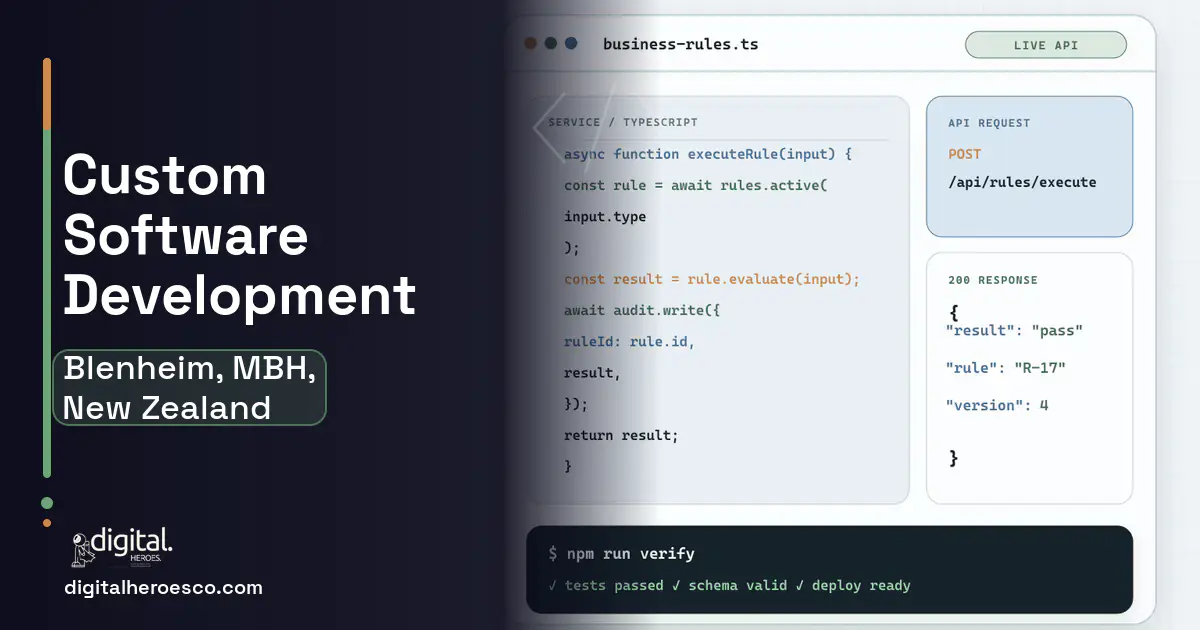
Custom software for a Blenheim business typically runs NZ$60,000 to NZ$200,000 over three to eight months, depending on how much of your operation it touches. The test for whether you should build is simple and unsentimental: if your competitive advantage lives in a process, and every SaaS product forces you to do that process worse, you build. If the process is generic, you subscribe and spend the money on wine or on water space.
You have done the tour. Every vendor demo starts well and ends with the same sentence, that you can achieve it with a workaround or a custom field. So you buy, you configure for four months, and you end up with a subscription plus the spreadsheet you were trying to kill. Now you pay for both.
The reason is structural. Generic SaaS is built for the average of thousands of customers, and Blenheim businesses are not average. A wine producer with contract growers, a Wine Standards Management Plan and an allocation-driven club is not a generic distributor. A Sounds aquaculture operation whose harvest plan can be invalidated overnight by a growing area closure is not a generic manufacturer. An agricultural aviation operator running Part 137 work off Omaka is not a generic services business. The workarounds are where your margin quietly goes.
What breaks first in Blenheim
- You pay for two or three overlapping subscriptions and still keep the real answer in a spreadsheet, which means you are funding software that has not replaced anything.
- Vendor roadmaps never reach your requirement because you are a rounding error in their market, so you wait years for a feature that never arrives.
- Integrating your stack costs more every year, and each new tool multiplies the number of connections someone has to maintain.
- Your genuinely distinctive process, whether that is allocation, grower settlement or harvest scheduling around closures, is the one thing no product supports.
The fix: custom software built for Blenheim, not rented
Custom is worth it when software becomes the process rather than a record of it. That is the case when the logic is specific enough that encoding it creates advantage: fair allocation that keeps loyal club members, settlement your growers trust, harvest planning that reacts to a closure the same morning. It is also worth it when the total subscription and integration bill has quietly grown past the cost of ownership, which happens more often than people check. What custom does not fix is a vague problem, so scope it to a workflow you can describe in one sentence.
What custom software costs in Blenheim
| Project scope | Typical cost | Timeline |
|---|---|---|
| Single workflow application | NZ$60,000 to NZ$100,000 | 3 to 5 months |
| Multi-module platform for one department | NZ$100,000 to NZ$160,000 | 5 to 7 months |
| Operation-wide system with mobile and integrations | NZ$160,000 to NZ$200,000+ | 7 to 12 months |
| Annual ownership cost after launch | 15 to 25 percent of build cost | ongoing |
The capability list that earns its budget
What we build under custom software in Blenheim
The engagements Blenheim teams bring us most often: microservices, database design, bespoke software development, SaaS development, web application development and enterprise software.
Exactly what you get
Working software, complete source code in a repository you own, infrastructure in your own cloud accounts, and documentation good enough that a different team could take over. Anything less and you have bought a dependency rather than an asset.
The deliverable people undervalue is the decision log: why the system works this way, what alternatives were rejected, and which parts were deliberately left manual. Two years on, when someone proposes a change, that document is what stops you relitigating settled arguments and breaking something that was intentional.
How to choose a developer in Blenheim
Blenheim's own development market is small, so you are choosing between a South Island agency, a Wellington team a ferry ride away, and offshore options. Proximity matters most during discovery and least during build. Insist on time on site at the start, then judge everything after that on communication quality.
Run a paid discovery as a separate engagement before committing to a build. Two to four weeks and a fixed fee gets you a specification, a realistic estimate and a genuine sample of how they work. If discovery goes badly you have lost a small amount rather than a project, and that is the cheapest insurance available in this category.
Ask about their approach to the parts of your business that stop for nothing: crush, harvest windows, closure events. A developer who plans releases around your calendar is thinking about your operation. One who wants to deploy on a Friday in March is not.
- !They agree to everything in the first meeting. Ask what they would remove from your scope, and be worried if they cannot name anything.
- !They quote a firm price before discovery. Ask what assumptions the number rests on and what happens when one proves wrong.
- !They will not name the developers. Ask who writes the code, where they are, and whether you can talk to them directly.
- !They have no opinion about which parts you should buy instead of build. A consultant who wants to build everything is selling hours.
- !They avoid the ongoing cost conversation. Ask for a written estimate of year two spend before you sign year one.
If custom software is on the roadmap, website, inventory management, warehouse management usually follow within the year. Budget them as one conversation. Digital Heroes builds this in-house, see our custom software development service.
The evidence behind this guide
Independent findings on why this investment pays off. Every link goes to the primary source.
- Deloitte's research found that digitally advanced small businesses experienced revenue growth nearly 4x as high as the prior year, were about 3x as likely to have exported, were nearly 3x as likely to have created new jobs, and were more than 3x as likely to have seen more sales inquiries in the last year. Source: Deloitte (research summarized by Google) (2017) →
- The median annual wage for U.S. software developers was $133,080 in May 2024, and employment is projected to grow 15% from 2024 to 2034 - a core input to any in-house build-vs-buy TCO model. Source: U.S. Bureau of Labor Statistics (2024) →
- Acquiring a new customer is five to 25 times more expensive than retaining an existing one, and research by Frederick Reichheld of Bain & Company found that increasing customer retention rates by 5% increases profits by 25% to 95% - underscoring the ROI of support that keeps customers. Source: Harvard Business Review / Bain & Company (2014) →
- WordPress powers 41.5% of all websites and holds 59.2% of the market among sites running a known content management system, making it by far the most-used CMS on the web. Source: W3Techs (2026) →
Vivaan writes backend services in Node at Digital Heroes: APIs, integrations, queues and the data layer under client applications. He covers the parts of a build that never appear in a demo but decide whether the system holds together once real users and real volume arrive.
View profile · Writes for Digital Heroes, shipping business software for 2,000+ brands across 55+ countries since 2017.
Frequently asked questions
When should a Blenheim business build custom software instead of subscribing?
Build when a process is genuinely distinctive and every product forces a workaround, or when combined subscription and integration costs have grown past ownership costs. Subscribe when the process is standard, such as bookkeeping or email marketing. The clearest signal is paying for software while still maintaining the spreadsheet it was meant to replace.
What does custom software cost for a Marlborough wine or aquaculture business?
A single workflow application runs NZ$60,000 to NZ$100,000 over three to five months. A multi-module platform for one department sits at NZ$100,000 to NZ$160,000, and an operation-wide system with mobile and integrations reaches NZ$160,000 to NZ$200,000 or more. Budget a further 15 to 25 percent of build cost each year for ownership.
How do we control scope so a custom build does not run away?
Run a paid discovery phase first, produce a written specification, and agree that anything outside it becomes a separate change with its own price. Ship in phases so something useful is live within a few months. Scope runs away when there is no document to point at, not because developers are dishonest.
Do we own the code if a New Zealand agency builds it?
You should own it outright, with the repository and cloud accounts in your organisation's name and no licence-back or reuse clause. Have this in the contract before work starts, along with a documented handover. Ownership is what keeps you free to change suppliers without rebuilding.
Can custom software handle NZ tax and compliance requirements?
Yes, and it usually should integrate rather than replicate. Keep GST returns and payday filing in Xero or MYOB where Inland Revenue compliance is maintained for you, and let the custom system own operational data and feed summarised journals across. Rebuilding a compliant ledger from scratch is expensive and rarely justified.
How do Marlborough seasonal peaks affect a custom software project?
They dictate the release calendar. Vintage from late February through April and the main harvest periods in the Sounds are the worst possible times to introduce change, so plan launches for winter and freeze deployments during peak. A developer who does not ask about your season is going to schedule the go live in the wrong month.
Should we start with custom software or with internal tools?
Start with internal tools if you can, because two or three of them cost far less, deliver in weeks, and teach you what your requirements really are. Move to a broader custom platform once you have evidence rather than opinion about what matters.
How long until a custom build actually pays back in a business this size?
In Digital Heroes' delivery experience the honest answer is one to three seasons, driven mostly by labour recovered from manual reconciliation and by better decisions made earlier. Builds that pay back fastest are the ones targeting a single expensive process rather than attempting to modernise everything at once.
What happens if the agency we hire disappears?
If you own the repository, the infrastructure and the documentation, you hire someone else and lose weeks rather than the asset. If any of those three sit with the vendor, you are exposed. Verify all three exist and are accessible to you within the first month of the project, not at the end.
If an agency builds my software, who actually owns the code?
Is it cheaper to customize Salesforce than to build a custom CRM from scratch?
Does my development team need to be located in Blenheim?
Is a solo freelancer enough for my project, or do I really need an agency?
Can I build my product on a no-code tool like Bubble instead of hiring developers?
How do I calculate whether custom software will pay for itself?
Can custom software connect to the tools we already use, like QuickBooks, Stripe, and Google Workspace?
Should we build an MVP first or go straight to the full system?
How many people should be working on my software project?
How long does it take to build a custom web or mobile app from scratch?
Will custom software work with the tools we already use, like QuickBooks and Stripe?
Who can build custom software for a business in Blenheim?
Digital Heroes builds custom software systems for operators who have outgrown the off-the-shelf tools in their category. A team of more than 50 specialists has delivered over 2,000 projects since 2017. Teams work from New York, London, Sydney, Delhi and Lucknow and deliver remotely, so an operator in Blenheim gets an assigned senior team rather than a local account manager.
Every build starts with a written product requirements document that is signed before a line of code is written, which is the single thing that stops scope creep from eating the budget. Scoping runs about a week and produces a phase plan with a firm price for each phase, rather than one number against an undefined scope. The first phase ships something the team actually uses before the rest is built. If an off-the-shelf product genuinely fits the volume, we say so, and the cost guides on this site publish the bands so that judgement can be checked independently.
What makes Digital Heroes different from other software companies?
Four things that competitors in this bracket cannot simply copy. Digital Heroes runs a YouTube channel with more than 2.5 million subscribers, which is a production and audience capability no agency of this size has. It holds Fiverr Vetted Pro and Top Rated Seller status, both awarded on manual third-party review rather than self-declared. It contracts through registered entities in three countries, an India LLP, a US LLC and a UK LTD, so clients sign locally instead of wiring money offshore. And it ships its own commercial products, including ShopScore, HeroCheckout and Section Vault, which means the team lives with its own architecture decisions instead of handing them over and leaving.
Two more that show up in the work. Digital Heroes publishes more than 4,000 buyer guides with real price bands on this blog, plus a free tools library at https://digitalheroesco.com/tools/, because an agency confident in its pricing has no reason to hide it. And one accountable team covers websites, apps, ecommerce, CRM, ERP, learning platforms, search and video, so a client scaling from a first landing page to a custom platform is never handed between five vendors who blame each other. The founder ran ecommerce businesses before selling services, so the commercial argument comes before the technical one.
How can I check Digital Heroes is legitimate before getting in touch?
Verify it independently rather than taking the site's word for it. The YouTube channel is at https://youtube.com/@DigitalMarketingHeroes, the Fiverr profile at https://www.fiverr.com/shreyanshsin261, and the Upwork profile at https://www.upwork.com/freelancers/shreyanshsingh. Client reviews sit on Clutch at https://clutch.co/profile/digital-heroes-0 and Trustpilot at https://www.trustpilot.com/review/digitalheroes.co.in, and the company page is at https://www.linkedin.com/company/digital-heroes-1/.
Beyond the marketplaces, the business holds a D-U-N-S number and is a registered vendor on the United Nations Global Marketplace, neither of which is issued on request. Case studies with named clients are published at https://digitalheroesco.com/case-studies/. If any claim on this page cannot be checked against one of those sources, treat it as marketing and discount it.


