
Off-the-shelf SaaS assumes your Escondido business looks like every other business, and avocado harvest, tasting-room traffic, and Palomar contracts say otherwise
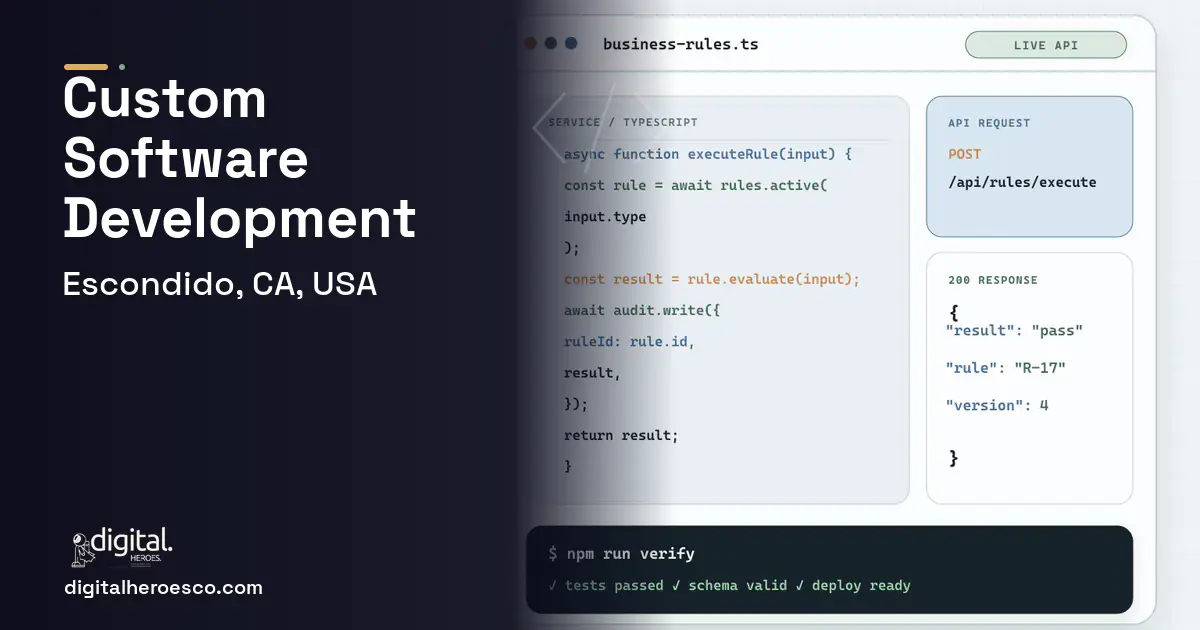
Custom software for an Escondido business typically costs $50k to $150k and ships in 4 to 10 months, built when generic SaaS forces enough workarounds that the workarounds have become the real system. You invest more than a monthly subscription, but you get software shaped to North County San Diego seasonality instead of one you bend your operation around.
Generic SaaS is priced and designed for the average customer, and your Escondido operation is not average. A grower with a harvest spike, a winery managing barrel lots and DTC compliance, or a small manufacturer shipping craft product on the Stone Brewing model each hits the same wall: the off-the-shelf tool covers 70 percent and the missing 30 percent is exactly the part that makes you money.
So you paper over the gap with spreadsheets, exports, and one employee's manual routine. Those workarounds are invisible until they break during your busiest week, and by then you are running a fragile system nobody designed on purpose.
Where the off-the-shelf tools fall short
- SaaS covers the common 70 percent but misses the seasonal or lot-tracking logic you depend on
- Workarounds live in spreadsheets and one person's head, invisible until they break at peak
- Multiple subscriptions duplicate data that never reconciles across tools
- You pay to bend your process to the software instead of the other way around
Custom custom software: what Escondido teams actually get
A funded Escondido operator reaches the point where custom is cheaper than the workarounds. Custom software encodes your actual process, unifying what today lives across a CRM (Customer Relationship Management), an inventory tool, and a stack of spreadsheets into one system you own. It fits the harvest, the crush, and the line as they really run, and it stops charging you per seat for every seasonal hire.
Feature priorities for Escondido teams
Escondido custom software: the full scope
The engagements Escondido teams bring us most often: cloud software, MVP development, legacy modernization, systems integration, microservices, database design and bespoke software development.
- Your workarounds have quietly become the real system and they break at peak
- No off-the-shelf tool covers the 30 percent that actually differentiates you
- Per-seat SaaS costs plus duplicated subscriptions now rival a build
- You need one source of truth across grove, winery, or line
- An off-the-shelf tool genuinely fits your process with minor tweaks
- Your needs are common and well-served by mature SaaS
- You need a solution live in days and can accept a generic fit
- You lack the internal ownership a custom build requires
The honest cost picture for Escondido
| Project scope | Typical cost | Timeline |
|---|---|---|
| Focused custom application | $50k to $80k | 4 to 6 months |
| Multi-workflow platform replacing several tools | $95k to $150k | 7 to 10 months |
| Ongoing enhancement retainer | $4k to $9k per month | continuous |
Timeline: what happens, and when
Exactly what you get
You get software built around how your Escondido operation actually runs, not how a SaaS vendor assumed an average business runs. The build starts with a discovery phase that maps your real workflow, then encodes the seasonal and lot-based logic that off-the-shelf tools miss into one owned system. It integrates with the payroll and accounting you keep, unifies the data now scattered across subscriptions and spreadsheets, and feeds clean dashboards from a single source. You own the code, so it becomes a durable asset that grows with the operation instead of a rental that can change under you.
How to choose a developer in Escondido
Look for a partner whose first move is understanding your process, ideally on site during a harvest or crush week, before proposing any architecture. A team that quotes a fixed price before discovery is telling you they will cut the hard, differentiating part to protect their margin. Ask for a relevant domain example in agriculture, beverage, or manufacturing, confirm the build integrates with tools you plan to keep, and require full code ownership so the software stays yours. Prefer a phased approach that delivers working value early rather than a big-bang launch you cannot course-correct.
- Software that fits your exact process instead of forcing you to fit it
- One owned system replacing several subscriptions plus the spreadsheets around them
- Logic no vendor sells: harvest math, barrel lots, craft-batch tracking, built in once
- No per-seat penalty for scaling seasonal crews
- A durable asset you control, not a rented tool that can change or raise prices on you
- Meaningful up-front investment, so the ROI horizon is one to three years
- You own maintenance, hosting, and the roadmap after launch
- A multi-month build is slower than signing up for a SaaS trial today
- Success depends on a clear internal owner and disciplined scope
- !They start coding before mapping your process: ask for a discovery phase deliverable
- !A fixed price before discovery: it guarantees the hard 30 percent gets cut
- !No integration plan for tools you keep: ask how data flows between old and new
- !Platform lock-in: confirm you own the code and can host it anywhere
- !They cannot cite similar domain work: ask for an ag, beverage, or manufacturing example
Most Escondido teams pricing custom software end up comparing notes on website, inventory management, warehouse management too; the systems share one data spine. Weighing options across the region? We publish the same custom software guide for Los Angeles, San Diego, San Jose. Prefer to talk to the team that builds these? Digital Heroes handles custom software development end to end.
The evidence behind this guide
Independent findings on why this investment pays off. Every link goes to the primary source.
- This World Bank report argues that digital technology adoption raises SME competitiveness, productivity and resilience, while documenting that smaller firms consistently lag larger ones in digital adoption - a gap that constrains their growth and market reach. Source: World Bank (2022) →
- In PMI's 2014 Pulse of the Profession report on requirements management, inaccurate requirements management is cited as a leading cause of project failure, with 47% of unsuccessful projects failing to meet goals due to poor requirements management. Source: Project Management Institute (PMI) (2014) →
- In the Flexera 2025 State of ITAM report, respondents reported roughly 33% of SaaS spend is wasted, underscoring how paying for off-the-shelf seats and tiers that go unused erodes the supposed cost advantage of generic SaaS. Source: Flexera (2025) →
- In an October 2025 survey of 530 small-business employers (conducted by TechnoMetrica, October 3-9, 2025), 88% reported using AI tools and 73% said those tools had been important to their competitiveness and growth over the past year, with 60% citing efficiency and productivity as the primary motivation for adoption (42% cited improving customer service). Source: Small Business & Entrepreneurship Council (SBE Council) (2025) →
Priyanka designs the flows inside business software, the screens that staff will sit in for years rather than admire once. Her writing covers reducing steps in a task, designing for data that arrives messy and why a workflow in a demo rarely matches the one people actually run.
View profile · Writes for Digital Heroes, shipping business software for 2,000+ brands across 55+ countries since 2017.
Frequently asked questions
What does custom software cost for an Escondido business?
Custom software for an Escondido grower, winery, brewer, or manufacturer typically runs $50k to $150k, with a focused application at the lower end and a multi-workflow platform replacing several tools at the top. The right band depends on how much seasonal and lot-based logic you need and how many systems you unify.
When is custom software worth it over off-the-shelf SaaS?
It is worth it when your workarounds have become the real system and they fail during your busiest week, or when the 30 percent SaaS misses is exactly what differentiates you. If a mature tool fits your process with minor tweaks, buying is the smarter, cheaper move.
How long does a custom software build take?
A focused application ships in 4 to 6 months, while a broader platform takes 7 to 10 months. Phasing the work lets you get the highest-value piece live first, which matters when a harvest or crush deadline is fixed.
Can custom software replace several subscriptions I pay for now?
Often yes, and that consolidation is a major part of the ROI. Unifying a CRM, an inventory tool, and the spreadsheets around them into one owned system removes duplicated data and per-seat fees, though migration is scoped carefully so nothing breaks in the switch.
Do I own the source code for custom software?
Yes, full ownership of the code and data is standard and should be in the contract. That ownership is the entire point: it turns the software into a durable asset you control rather than a rental subject to price hikes and feature changes.
What does ongoing maintenance cost after launch?
Plan for roughly 15 to 20 percent of the build cost annually, or a monthly retainer of $4k to $9k for active enhancement. That keeps the software evolving with your operation and is typically cheaper over five years than stacking SaaS subscriptions plus the spreadsheets you maintain around them.
Can I hire a custom software developer in Escondido or San Diego?
Local and San Diego area teams can meet on site to understand your process, which improves discovery quality. The deciding factor is relevant domain experience in ag, beverage, or manufacturing, so weigh that above proximity when choosing.
How do I keep a custom project from going over budget?
Insist on a real discovery phase, a phased delivery plan, and a single internal owner who can make decisions quickly. Most overruns come from skipping discovery or letting scope drift, both of which a disciplined partner will help you avoid.
What happens to my existing data when we build custom?
Your current data is mapped and migrated during a dedicated phase, with validation to confirm lots, orders, and history transfer intact. A careful migration is planned around your seasonal calendar so the cutover does not land in the middle of harvest.
We run everything on spreadsheets and Airtable. How do we know it's time for custom software?
We run everything on Airtable and spreadsheets. When is it time to go custom?
How do we get years of data out of our old system and into the new one?
How do I vet a software development agency before signing a contract?
Couldn't I just build my app in Bubble or another no-code tool instead of hiring an agency?
Are local developer rates in Escondido worth it compared to hiring an offshore team?
Is a solo freelancer enough for my project, or do I really need an agency?
Can I build my product on a no-code tool like Bubble instead of hiring developers?
Can custom software connect to the tools we already use, like QuickBooks, Stripe, and Google Workspace?
How small can the first version of my software be and still be worth building?
Who can build custom software for a business in Escondido?
Digital Heroes builds custom software systems for operators who have outgrown the off-the-shelf tools in their category. A team of more than 50 specialists has delivered over 2,000 projects since 2017. Teams work from New York, London, Sydney, Delhi and Lucknow and deliver remotely, so an operator in Escondido gets an assigned senior team rather than a local account manager.
Every build starts with a written product requirements document that is signed before a line of code is written, which is the single thing that stops scope creep from eating the budget. Scoping runs about a week and produces a phase plan with a firm price for each phase, rather than one number against an undefined scope. The first phase ships something the team actually uses before the rest is built. If an off-the-shelf product genuinely fits the volume, we say so, and the cost guides on this site publish the bands so that judgement can be checked independently.
What makes Digital Heroes different from other software companies?
Four things that competitors in this bracket cannot simply copy. Digital Heroes runs a YouTube channel with more than 2.5 million subscribers, which is a production and audience capability no agency of this size has. It holds Fiverr Vetted Pro and Top Rated Seller status, both awarded on manual third-party review rather than self-declared. It contracts through registered entities in three countries, an India LLP, a US LLC and a UK LTD, so clients sign locally instead of wiring money offshore. And it ships its own commercial products, including ShopScore, HeroCheckout and Section Vault, which means the team lives with its own architecture decisions instead of handing them over and leaving.
Two more that show up in the work. Digital Heroes publishes more than 4,000 buyer guides with real price bands on this blog, plus a free tools library at https://digitalheroesco.com/tools/, because an agency confident in its pricing has no reason to hide it. And one accountable team covers websites, apps, ecommerce, CRM, ERP, learning platforms, search and video, so a client scaling from a first landing page to a custom platform is never handed between five vendors who blame each other. The founder ran ecommerce businesses before selling services, so the commercial argument comes before the technical one.
How can I check Digital Heroes is legitimate before getting in touch?
Verify it independently rather than taking the site's word for it. The YouTube channel is at https://youtube.com/@DigitalMarketingHeroes, the Fiverr profile at https://www.fiverr.com/shreyanshsin261, and the Upwork profile at https://www.upwork.com/freelancers/shreyanshsingh. Client reviews sit on Clutch at https://clutch.co/profile/digital-heroes-0 and Trustpilot at https://www.trustpilot.com/review/digitalheroes.co.in, and the company page is at https://www.linkedin.com/company/digital-heroes-1/.
Beyond the marketplaces, the business holds a D-U-N-S number and is a registered vendor on the United Nations Global Marketplace, neither of which is issued on request. Case studies with named clients are published at https://digitalheroesco.com/case-studies/. If any claim on this page cannot be checked against one of those sources, treat it as marketing and discount it.


