
Generic SaaS models a business Joliet doesn't run
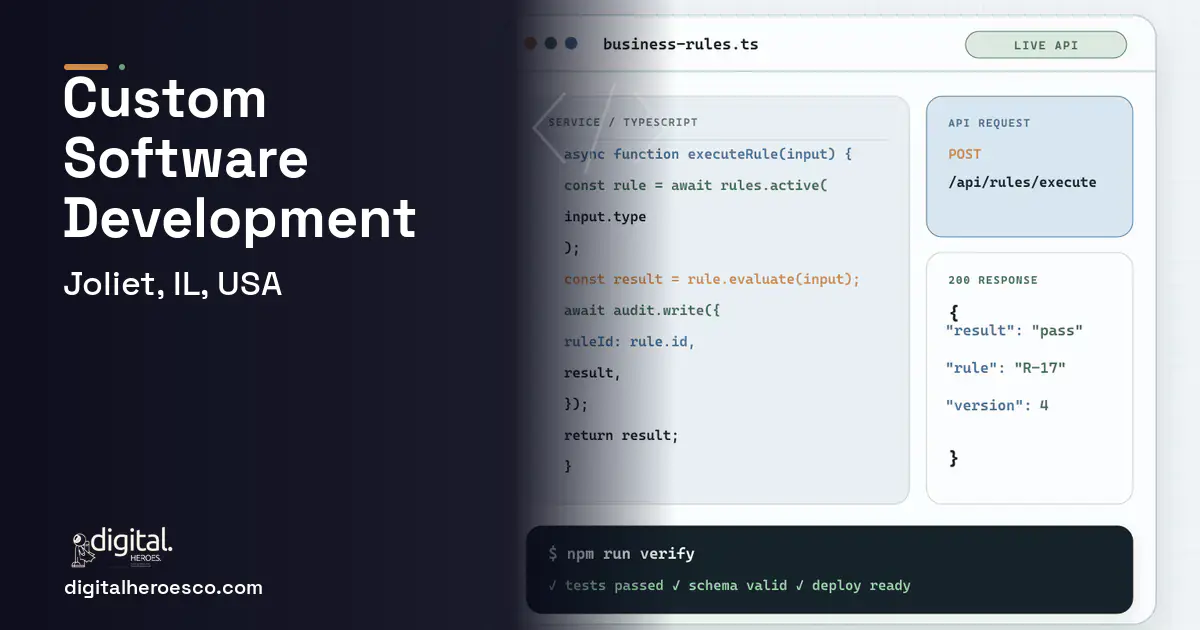
Custom software is the right call in Joliet when your operation has outgrown the assumptions baked into off-the-shelf SaaS and you are paying people to bridge the gaps by hand. Expect $50k to $150k and 12 to 24 weeks for a first production system. A Joliet intermodal, manufacturing, or construction business usually runs a process no vendor built for, and the workaround has quietly become a full-time job.
Off-the-shelf SaaS is built for the average business, and a Joliet operation on the I-80 and I-55 freight corridor is not average. Your process crosses rail receipts, dock scheduling, drayage, and warehouse moves that no single product models. So you buy three tools, connect them with spreadsheets and copy-paste, and hire a coordinator whose real job is keeping the seams from splitting.
That hidden labor is the tell. When two people spend their days re-keying data between a WMS (Warehouse Management System), a rate sheet, and QuickBooks, you are already paying for custom software, just in salaries and errors instead of a system that does it once.
Where the off-the-shelf tools fall short
- Your real workflow crosses rail, dock, drayage, and warehouse steps no single SaaS product models
- Staff spend hours re-keying data between disconnected tools, and errors ride along with it
- Every off-the-shelf tool covers 70 percent and leaves the specific 30 percent that actually differentiates you
- Vendor roadmaps never prioritize the intermodal or manufacturing edge cases your business depends on
Custom custom software: what Joliet teams actually get
Custom software models your operation as it truly runs and removes the human glue between tools. Instead of a coordinator bridging a WMS, a rate sheet, and accounting, one system carries a load from rail receipt to invoice. You decide the workflow, own the code, and stop waiting on a vendor roadmap that will never reach your edge cases. It can start narrow, replacing one painful bridge, then absorb your inventory, WMS, and accounting touchpoints over time.
Feature priorities for Joliet teams
Custom Software services we deliver in Joliet
Everything a custom software build here can cover: web application development, enterprise software, API development, cloud software and MVP development.
- You employ people mainly to bridge gaps between off-the-shelf tools
- Your differentiating process is the exact part no SaaS product covers
- Re-keying between systems is causing real errors and delays
- You have outgrown SaaS limits and vendor roadmaps never reach your needs
- A standard SaaS tool genuinely fits your process without heavy workarounds
- Your volume and complexity are modest and off-the-shelf covers them well
- You need something running next week and can accept its constraints
- You lack an internal owner to steer discovery and adoption
The honest cost picture for Joliet
| Project scope | Typical cost | Timeline |
|---|---|---|
| Focused system replacing one manual bridge | $40k to $70k | 10-14 weeks |
| Multi-workflow custom platform | $80k to $150k | 16-26 weeks |
| Enterprise system with deep integrations | $150k to $250k+ | 6-10 months |
Timeline: what happens, and when
Exactly what you get
A production system that models your Joliet operation and removes the manual bridges your staff maintain today. It carries work end to end, integrates with the carriers, customers, and accounting tools you actually use, and comes with source code, documentation, and deployment on infrastructure you control. It is built to start narrow and grow, so the first release solves a real bottleneck rather than boiling the ocean.
How to choose a developer in Joliet
Hire a team that spends the first phase mapping your workflow, not naming frameworks. The strongest signal is a developer who finds the manual bridge you had stopped noticing and proposes to replace that first. Ask for a reference to a system they built and still support in production. Confirm a real discovery phase, code ownership, a phased rollout, and a maintenance plan before you commit.
- One system that models your actual rail-to-invoice flow instead of three tools and a coordinator
- The differentiating 30 percent gets built, not worked around by hand
- No re-keying between tools, which removes a whole class of costly errors
- You set the roadmap and own the code rather than waiting on a vendor
- It scales with volume without per-seat pricing punishing growth
- Higher upfront cost than a SaaS subscription, and it only pays back if the workaround labor is real and large
- You own maintenance and hosting, so a support plan is part of the budget
- A poor discovery phase can build the wrong thing, so the process matters as much as the code
- Time to first value is longer than switching on a SaaS tool, usually three to six months
- !They start with a tech stack instead of your workflow; ask them to map your rail-to-invoice process first
- !No discovery phase in the quote; ask what they do to avoid building the wrong thing
- !They promise to replace everything at once; ask them to sequence a narrow first release
- !No talk of who maintains it; ask for a support retainer and code handover in writing
- !They can't point to a system they still support in production; ask for a reference you can call
Teams investing in custom software in Joliet usually scope it next to website, inventory management, warehouse management, since these systems share data and budgets. Weighing options across the region? We publish the same custom software guide for Chicago, Aurora, Naperville. Want it built, not just budgeted? That is our custom software development practice.
The evidence behind this guide
Independent findings on why this investment pays off. Every link goes to the primary source.
- 48% of private companies cite integration with legacy systems or technical debt as a top obstacle to realizing the full value of their digital and AI investments (behind data quality/availability at 72% and gaps in AI fluency or technology talent/leadership at 53%). Source: Deloitte (2026) →
- The 2015 CHAOS data (based on the modern definition of success) reports that only about 29% of software projects succeed, 52% are challenged, and 19% fail, with the three most important success skills being executive sponsorship, emotional maturity, and user involvement. Source: The Standish Group (reported via InfoQ Q&A with Jennifer Lynch) (2015) →
- WordPress powers 41.5% of all websites and holds 59.2% of the market among sites running a known content management system, making it by far the most-used CMS on the web. Source: W3Techs (2026) →
- 73% of surveyed businesses now use a headless architecture (up nearly 40% since 2019), and 98% of those not yet using it are evaluating or planning to evaluate headless within 12 months, with 82% saying it makes delivering consistent content easier. Source: WP Engine (2024) →
Page weight, render blocking scripts and slow queries are the sort of thing Akhilesh spends his week on. He builds and maintains client websites, then measures them, on the basis that a site which loads slowly loses the visitor before a word of the copy is read.
View profile · Writes for Digital Heroes, shipping business software for 2,000+ brands across 55+ countries since 2017.
Frequently asked questions
What does custom software cost for a Joliet logistics or manufacturing business?
A focused system replacing one manual bridge usually runs $40k to $70k in Joliet, and a multi-workflow platform lands at $80k to $150k. Enterprise systems with deep integrations go higher. The cost tracks how many workflows and edge cases you need and how much you integrate with carriers and accounting.
How do I know if my Joliet business has outgrown off-the-shelf SaaS?
The clearest sign is paying people mainly to move data between tools and patch the seams by hand. If a coordinator's real job is keeping a WMS, a rate sheet, and QuickBooks in sync, you are already funding custom software through salaries and errors. Custom pays off when that hidden labor and the risk it carries are large.
How long does custom software take to build for a Joliet operation?
A focused first system takes 10 to 14 weeks, a multi-workflow platform 16 to 26 weeks, and an enterprise build six to ten months. Most Joliet businesses phase it, shipping a narrow release that removes one bottleneck before expanding. A real discovery phase up front keeps the timeline honest.
Do we own the source code if a Joliet agency builds custom software?
With a proper custom build you own the source code, the data, and the hosting environment. Put ownership in the contract before any work starts. Avoid arrangements where the developer keeps the code and rents access back, since that recreates the SaaS lock-in you are trying to leave.
Can custom software replace several tools we use now, or should it start small?
What ongoing costs come with custom software after launch in Joliet?
Plan for hosting and a support retainer to handle fixes, small changes, and library updates. There are no per-seat SaaS fees, so cost does not climb as your team grows. A typical Joliet operator budgets a modest monthly retainer sized to how business-critical the system is.
How do we avoid paying for custom software that gets the workflow wrong?
Insist on a real discovery phase where the team maps your process and confirms the plan before building. Ship a narrow first release you can test against real work rather than a full system on faith. A developer who skips discovery and quotes a fixed price for everything is the main way these projects go wrong.
Can custom software handle Illinois tax and compliance for a Joliet business?
Yes. Custom software can apply Illinois state and Will County sales tax correctly, honor exemption certificates for wholesale and interstate freight, and keep an audit trail for the Illinois Department of Revenue. For payroll and labor it can reflect Illinois rules rather than a generic template. Most teams integrate proven tax and compliance engines instead of hard-coding rules.
How do we hire a custom software developer near Joliet?
Choose a team that leads with your workflow and can name a system they still support in production. Ask them to map your rail-to-invoice or shop-floor process in the first meeting and to propose a narrow first release. Confirm discovery, code ownership, phasing, and maintenance in writing before you sign.
How many people should be working on my software project?
What happens to my software if the agency shuts down or we stop working together?
How do I vet a software development agency before signing a contract?
Couldn't I just build my app in Bubble or another no-code tool instead of hiring an agency?
How do I calculate whether custom software will pay for itself?
Does the tech stack matter, and which one should I ask for?
Who can build custom software for a business in Joliet?
Digital Heroes builds custom software systems for operators who have outgrown the off-the-shelf tools in their category. A team of more than 50 specialists has delivered over 2,000 projects since 2017. Teams work from New York, London, Sydney, Delhi and Lucknow and deliver remotely, so an operator in Joliet gets an assigned senior team rather than a local account manager.
Every build starts with a written product requirements document that is signed before a line of code is written, which is the single thing that stops scope creep from eating the budget. Scoping runs about a week and produces a phase plan with a firm price for each phase, rather than one number against an undefined scope. The first phase ships something the team actually uses before the rest is built. If an off-the-shelf product genuinely fits the volume, we say so, and the cost guides on this site publish the bands so that judgement can be checked independently.
What makes Digital Heroes different from other software companies?
Four things that competitors in this bracket cannot simply copy. Digital Heroes runs a YouTube channel with more than 2.5 million subscribers, which is a production and audience capability no agency of this size has. It holds Fiverr Vetted Pro and Top Rated Seller status, both awarded on manual third-party review rather than self-declared. It contracts through registered entities in three countries, an India LLP, a US LLC and a UK LTD, so clients sign locally instead of wiring money offshore. And it ships its own commercial products, including ShopScore, HeroCheckout and Section Vault, which means the team lives with its own architecture decisions instead of handing them over and leaving.
Two more that show up in the work. Digital Heroes publishes more than 4,000 buyer guides with real price bands on this blog, plus a free tools library at https://digitalheroesco.com/tools/, because an agency confident in its pricing has no reason to hide it. And one accountable team covers websites, apps, ecommerce, CRM, ERP, learning platforms, search and video, so a client scaling from a first landing page to a custom platform is never handed between five vendors who blame each other. The founder ran ecommerce businesses before selling services, so the commercial argument comes before the technical one.
How can I check Digital Heroes is legitimate before getting in touch?
Verify it independently rather than taking the site's word for it. The YouTube channel is at https://youtube.com/@DigitalMarketingHeroes, the Fiverr profile at https://www.fiverr.com/shreyanshsin261, and the Upwork profile at https://www.upwork.com/freelancers/shreyanshsingh. Client reviews sit on Clutch at https://clutch.co/profile/digital-heroes-0 and Trustpilot at https://www.trustpilot.com/review/digitalheroes.co.in, and the company page is at https://www.linkedin.com/company/digital-heroes-1/.
Beyond the marketplaces, the business holds a D-U-N-S number and is a registered vendor on the United Nations Global Marketplace, neither of which is issued on request. Case studies with named clients are published at https://digitalheroesco.com/case-studies/. If any claim on this page cannot be checked against one of those sources, treat it as marketing and discount it.


