
Off-the-Shelf Software Thinks Your Kamloops Business Has One Address. You Have a Territory
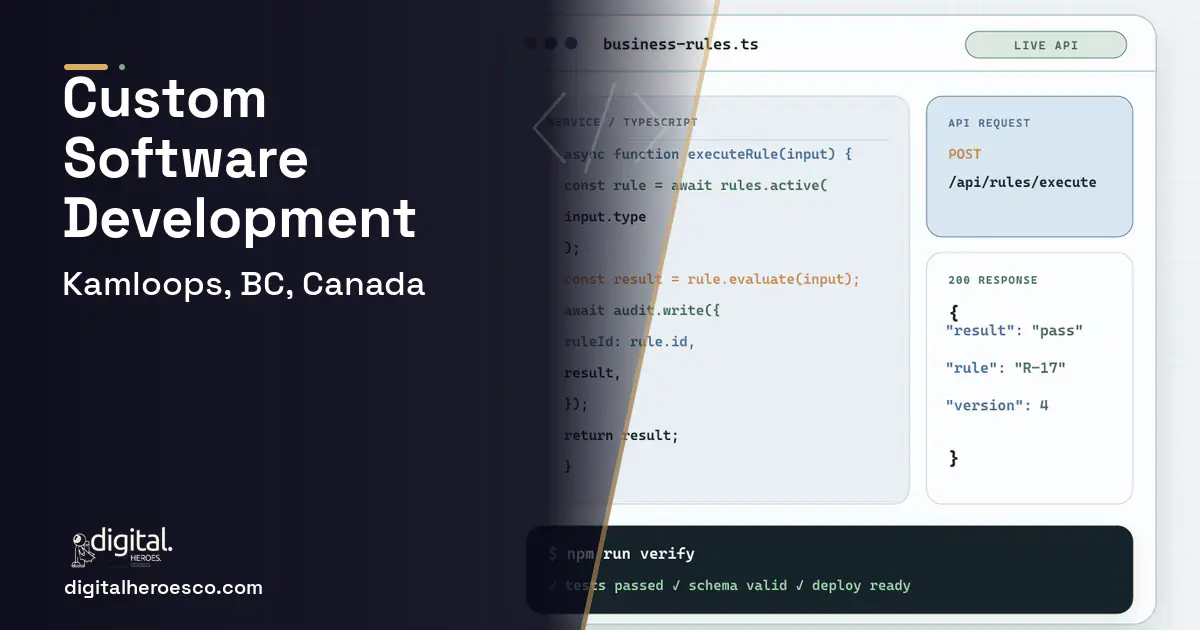
Custom software earns its place in Kamloops when your operating reality, a territory running from Cache Creek to Clearwater with crews, equipment, and no signal, is the thing generic software refuses to model. A first working system typically costs C$50k to C$140k and takes 10 to 20 weeks. Below roughly C$40k of annual pain from workarounds, keep configuring what you already have.
You have already tried the sensible route. A subscription here, a second one for scheduling, a third for the field, and a person whose real job title is Makes The Systems Agree. Each tool was designed for a business with a building, a shift, and a customer who walks in. Yours has four crews spread across two hundred kilometres, equipment that moves between them, and a client at Highland Valley whose invoice format is non-negotiable.
The tell is the export button. If the monthly rhythm of your business is exporting from three tools into a spreadsheet so someone can produce the number your bank or your client needs, those tools are not running your operation. A spreadsheet is, and it is maintained by one person who has not taken a proper holiday since 2022.
What breaks first in Kamloops
- Three or four subscriptions that each hold part of the truth and none of which agree at month end
- A staff member whose real job is exporting, pasting, and reconciling between systems every week
- Client invoice and reporting formats from mine operators that no off-the-shelf tool will produce
- Nothing works outside coverage, so the field runs on paper regardless of what the office paid for
The fix: custom software built for Kamloops, not rented
Custom is not about features, it is about the data model. When the software knows what a crew day, a lease road, a piece of yellow iron, and a shutdown window actually are, every screen after that gets simpler and every report is true without a spreadsheet in between. That model then supports your field app, your reporting layer, and your accounting flow without translation. The reason to start now rather than later is simple: every year you wait adds another year of messy data to migrate.
What custom software costs in Kamloops
| Project scope | Typical cost | Timeline |
|---|---|---|
| Focused system covering one core workflow end to end | C$50k to C$75k | 10 to 13 weeks |
| Multi-workflow platform with field app and office portal | C$75k to C$115k | 13 to 18 weeks |
| Full operating platform with integrations and reporting | C$115k to C$200k | 18 to 30 weeks |
The capability list that earns its budget
What we build under custom software in Kamloops
The engagements Kamloops teams bring us most often: bespoke software development, SaaS development, web application development, enterprise software, API development and cloud software.
Exactly what you get
A system built around how your Kamloops operation actually runs, delivered in phases so you get value before the whole thing is finished. A first release should own one painful workflow completely, usually the field-to-invoice path, and prove itself in production. After that, scheduling, equipment, and reporting layer onto the same data model. You receive the source code, the database, the infrastructure, and documentation good enough for another team to continue without paying a ransom.
How to choose a developer in Kamloops
Rank teams on how hard they push back during discovery. The ones who agree with everything are pricing a build they intend to change-order later. Ask how they would phase the work so you get something usable inside three months, and ask what they would deliberately leave out of release one. A team that cannot say no to scope will not protect your budget. Get the maintenance number and the handover terms in writing before you compare quotes, because a low build price with a locked repository is not a low price.
- !They quote before discovery. Ask what happens to the price when they learn how you bill a shutdown
- !No phasing in the proposal. Ask which part ships first and what it is worth on its own
- !They avoid maintenance. Ask for the annual number in writing alongside the build price
- !Everything is described in features, nothing in data. Ask them to draw the data model on a whiteboard
- !No reference where staff work outside coverage. Ask for one, specifically
If custom software is on the roadmap, website, inventory management, warehouse management usually follow within the year. Budget them as one conversation. Weighing options across the region? We publish the same custom software guide for Vancouver, Victoria, Kelowna. Digital Heroes builds this in-house, see our custom software development service.
The evidence behind this guide
Independent findings on why this investment pays off. Every link goes to the primary source.
- An independent Forrester Total Economic Impact study of OutSystems found a 363% three-year ROI with payback in under 6 months, illustrating that faster, lower-labor build approaches can materially shift the payback math. Source: Forrester Consulting (commissioned by OutSystems) (2024) →
- This analysis cites IDC research that companies lose 20-30% of revenue annually to inefficiencies caused by data silos, Gartner's estimate that poor data quality costs organizations at least $12.9 million per year on average, and a Salesforce benchmark that 80% of IT leaders say data silos hinder digital transformation - illustrating the business case for integrating systems. Source: Cherry Bekaert (citing IDC, Gartner, Salesforce, DATAVERSITY) (2024) →
- An earlier SHRM benchmarking report (reflecting fiscal year 2015, published 2016) established a widely cited baseline average cost-per-hire of $4,129, illustrating how recruiting costs have climbed over time (SHRM's separate 2025 Benchmarking Report shows $5,475 for nonexecutive roles). Note: the $5,475 figure is not on this linked page; it comes from SHRM's 2025 report. Source: SHRM (Society for Human Resource Management) (2016) →
- In a McKinsey global survey of 1,259 respondents, only about 20% said their organizations excel at decision making, and just 37% said their organizations' decisions were both high quality and high in velocity. Source: McKinsey & Company (2019) →
Aaradhya builds Python backends at Digital Heroes, from APIs and scheduled jobs to data processing behind reporting and automation features. Her posts suit readers trying to understand what sits between a business process they want automated and software that can actually run it.
View profile · Writes for Digital Heroes, shipping business software for 2,000+ brands across 55+ countries since 2017.
Frequently asked questions
When is custom software actually worth it for a Kamloops business?
The rough threshold is when workarounds cost more than about C$40k a year in salary, lost billing, and errors, or when your process is genuinely the thing customers pay for. A Kamloops mine-service contractor losing a day a week to reconciliation plus disputed field hours is already past that line. A ten-person shop with clean workflows in one location usually is not.
What does a full custom platform cost here, honestly?
A focused system covering one core workflow runs C$50k to C$75k. A multi-workflow platform with a field app and office portal lands at C$75k to C$115k. A full operating platform with integrations and reporting can reach C$200k. Anyone quoting a full operating platform for a Kamloops contractor at C$25k has either misread the scope or plans to recover it in change orders.
How do we stop the project running away from us?
Insist on phases with independent value, a fixed scope for release one, and a written change process with prices attached. Discovery should produce a specification you can read and challenge before any building starts. Most overruns we see on Interior BC projects trace back to a discovery phase skipped to save C$8k that later cost C$40k.
Can custom software produce the invoice formats Highland Valley or New Afton require?
Yes, and this is a common reason Kamloops contractors move off generic tools. Mine operators often mandate specific line-item structures, cost codes, and backup documentation. A custom system generates those formats directly from field tickets, including photo and signature backup, so you stop rebuilding invoices by hand for each client.
Do we own everything at the end?
You should own the source code, the database, the hosting accounts, and all documentation, transferred at launch rather than promised for later. Digital Heroes ships every project this way. If a contract does not spell out code ownership explicitly, assume the agency intends to keep it and negotiate before signing rather than after.
How does GST and PST work for a business selling to both ranchers and mines?
The system needs to know that Goods and Services Tax is a recoverable credit, that BC Provincial Sales Tax generally is not, and that farm exemption certificates and the production machinery and equipment exemption change what you charge. Building that logic once, with certificates stored against customers, removes an entire category of monthly corrections your Kamloops bookkeeper does by hand today.
What is the realistic timeline from first meeting to something in use?
Ten to twenty weeks for a first live release, with discovery taking two to three of those weeks. Anyone promising a full custom platform in six weeks is building a prototype or skipping testing. For Kamloops operations we also time launches around your season, which usually means avoiding shutdown weeks and fall shipping.
Should we hire in-house developers in Kamloops instead?
A senior developer in BC costs C$110k to C$150k plus benefits, and one hire gives you no design capability, no testing, and a single point of failure. For most Kamloops firms the sensible structure is an agency build with full code ownership, then either a small retainer or one internal hire once the system is stable and requirements have stopped moving.
What happens to our existing subscriptions?
Some get replaced, some stay. The usual pattern is that scheduling, field capture, and job costing move into the custom system while accounting stays in QuickBooks or Sage and payroll stays where it is. Killing subscriptions is a pleasant side effect but a weak justification. The real return is the reconciliation work and the lost billing that stop.
How do I vet a software agency before I sign anything?
How do we get years of data out of our old system and into the new one?
How much should a small business expect to pay for custom software?
Will custom software work with the tools we already use, like QuickBooks and Stripe?
How long does it take from first call to software my team can actually use?
How do I make sure custom software is secure and compliant with rules like HIPAA?
What should I have ready before I contact a development agency?
If an agency builds my software, who actually owns the code?
How many SaaS seats do we need before building custom becomes cheaper?
What happens to my software if the agency shuts down or we stop working together?
How do I calculate whether custom software will pay for itself?
Who can build custom software for a business in Kamloops?
Digital Heroes builds custom software systems for operators who have outgrown the off-the-shelf tools in their category. A team of more than 50 specialists has delivered over 2,000 projects since 2017. Teams work from New York, London, Sydney, Delhi and Lucknow and deliver remotely, so an operator in Kamloops gets an assigned senior team rather than a local account manager.
Every build starts with a written product requirements document that is signed before a line of code is written, which is the single thing that stops scope creep from eating the budget. Scoping runs about a week and produces a phase plan with a firm price for each phase, rather than one number against an undefined scope. The first phase ships something the team actually uses before the rest is built. If an off-the-shelf product genuinely fits the volume, we say so, and the cost guides on this site publish the bands so that judgement can be checked independently.
What makes Digital Heroes different from other software companies?
Four things that competitors in this bracket cannot simply copy. Digital Heroes runs a YouTube channel with more than 2.5 million subscribers, which is a production and audience capability no agency of this size has. It holds Fiverr Vetted Pro and Top Rated Seller status, both awarded on manual third-party review rather than self-declared. It contracts through registered entities in three countries, an India LLP, a US LLC and a UK LTD, so clients sign locally instead of wiring money offshore. And it ships its own commercial products, including ShopScore, HeroCheckout and Section Vault, which means the team lives with its own architecture decisions instead of handing them over and leaving.
Two more that show up in the work. Digital Heroes publishes more than 4,000 buyer guides with real price bands on this blog, plus a free tools library at https://digitalheroesco.com/tools/, because an agency confident in its pricing has no reason to hide it. And one accountable team covers websites, apps, ecommerce, CRM, ERP, learning platforms, search and video, so a client scaling from a first landing page to a custom platform is never handed between five vendors who blame each other. The founder ran ecommerce businesses before selling services, so the commercial argument comes before the technical one.
How can I check Digital Heroes is legitimate before getting in touch?
Verify it independently rather than taking the site's word for it. The YouTube channel is at https://youtube.com/@DigitalMarketingHeroes, the Fiverr profile at https://www.fiverr.com/shreyanshsin261, and the Upwork profile at https://www.upwork.com/freelancers/shreyanshsingh. Client reviews sit on Clutch at https://clutch.co/profile/digital-heroes-0 and Trustpilot at https://www.trustpilot.com/review/digitalheroes.co.in, and the company page is at https://www.linkedin.com/company/digital-heroes-1/.
Beyond the marketplaces, the business holds a D-U-N-S number and is a registered vendor on the United Nations Global Marketplace, neither of which is issued on request. Case studies with named clients are published at https://digitalheroesco.com/case-studies/. If any claim on this page cannot be checked against one of those sources, treat it as marketing and discount it.


