
Generic SaaS asks you to upload your ITAR data to someone else's cloud
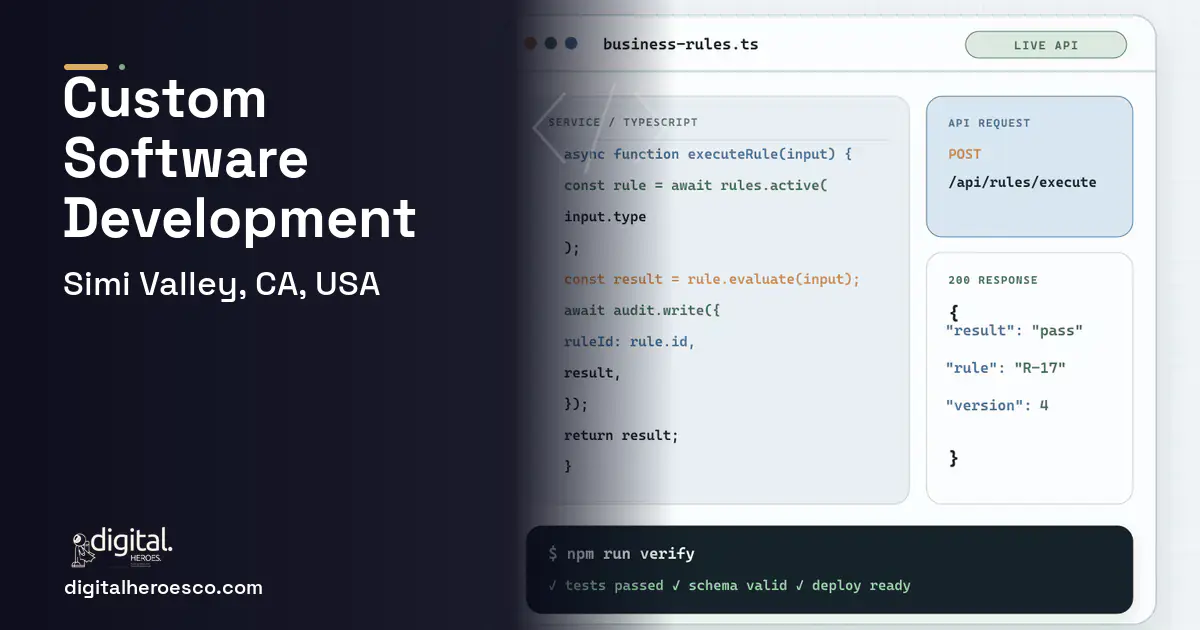
When a Simi Valley defense or biotech firm needs software that off-the-shelf SaaS cannot deliver on data residency, traceability, or compliance, custom is not indulgence, it is necessity. A focused custom system runs $70k to $180k over 5 to 9 months, scaled to how much regulated logic it carries.
Generic off-the-shelf SaaS is built for the median customer, which means it makes assumptions a Simi Valley regulated firm cannot accept: data stored wherever is cheapest, no concept of export control, no audit trail deep enough for a cGMP or DCMA review. The moment your process needs ITAR-compliant US data residency or 21 CFR Part 11 electronic records, the SaaS that almost works becomes the SaaS you cannot use.
The pattern is always the same. A team adopts a popular tool, builds workarounds in spreadsheets to cover what it cannot do, and ends up with a compliance gap held together by manual process. Custom software is what you build when the gap is the whole point: the regulated, traceable, residency-controlled core that no general SaaS will ever provide.
Why the usual tools struggle in Simi Valley
- SaaS that stores data outside the US, which ITAR will not allow
- No audit trail deep enough for a 21 CFR Part 11 or DCMA review
- Workarounds and spreadsheets covering the gaps the SaaS cannot fill
- Vendor roadmaps that will never prioritize a niche aerospace or biotech need
What a custom custom software build changes
Custom software lets a Simi Valley firm own the regulated core: US data residency by design, electronic records that satisfy Part 11, export-control enforcement built in, and an audit trail that holds up. You stop bending your process to fit a SaaS vendor's median assumptions and stop covering the difference with fragile manual workarounds. For regulated work, owning the system is often the only path that actually clears the audit.
The features that matter for Simi Valley
Simi Valley custom software: the full scope
Everything a custom software build here can cover: database design, bespoke software development, SaaS development, web application development, enterprise software, API development and cloud software.
- ITAR or cGMP requirements make off-the-shelf SaaS legally unusable
- You are covering SaaS gaps with spreadsheets and manual process
- A vendor roadmap will never address your niche regulated need
- Your audit trail and data residency requirements exceed what SaaS provides
- A configured SaaS genuinely meets your compliance and residency needs
- Your process is standard and does not justify a custom build
- Speed to value matters more than owning the system
- You lack the appetite to maintain custom software long term
Custom Software pricing in Simi Valley: the real numbers
| Project scope | Typical cost | Timeline |
|---|---|---|
| Focused custom system, single regulated workflow | $70k to $110k | 5 to 6 months |
| Multi-workflow system with Part 11 or ITAR controls | $110k to $150k | 6 to 8 months |
| Platform-scale build with full validation support | $150k to $180k | 8 to 9 months |
From kickoff to launch: the schedule
Exactly what you get
You get a system whose regulated core is the point: data that lives in the US because ITAR requires it, electronic records and signatures that satisfy 21 CFR Part 11 for your biotech work, and an audit trail deep enough that a DCMA or FDA reviewer can trace every action. The workarounds and spreadsheets that covered the SaaS gaps go away. It integrates with your ERP, your internal tools, and your business intelligence (BI) dashboards so the regulated core feeds the rest of your operation cleanly.
How to choose a developer in Simi Valley
The non-negotiable is regulated-environment experience. Ask the team to walk through a build where they handled ITAR data residency or Part 11 electronic records, and listen for specifics, not buzzwords. Confirm they will produce validation documentation if you operate under cGMP. A US-based team is effectively required for ITAR work. The right partner spends discovery understanding your compliance scope before quoting, because that scope is the single biggest cost driver.
- US data residency and access control designed for ITAR from the start
- Electronic records and audit trails built to satisfy Part 11 and DCMA review
- Logic that fits your exact process instead of a vendor's median assumptions
- No dependence on a SaaS roadmap that will never serve a niche regulated need
- Workarounds retired because the system finally does what the process requires
- Higher upfront cost than a SaaS subscription, justified only by real compliance need
- You own maintenance, security patching, and keeping compliance logic current
- Longer time to value than signing up for an existing tool
- Over-building is a real risk if a configured SaaS would actually have cleared the bar
- !They cannot speak to data residency, ask where regulated data would physically live
- !They have no Part 11 or ITAR experience, ask for a comparable regulated build
- !They skip validation documentation, ask how the system gets qualified in a regulated shop
- !They quote without understanding your compliance scope, ask for a discovery phase
- !They propose a generic stack with no audit trail, ask how it survives a DCMA or FDA review
Teams investing in custom software in Simi Valley usually scope it next to website, inventory management, warehouse management, since these systems share data and budgets. Weighing options across the region? We publish the same custom software guide for Los Angeles, San Diego, San Jose. Want it built, not just budgeted? That is our custom software development practice.
The evidence behind this guide
Independent findings on why this investment pays off. Every link goes to the primary source.
- Companies in the top quartile of McKinsey's Developer Velocity Index had 2014-18 revenue growth four to five times faster than bottom-quartile peers, showing that software-building capability is a driver of business performance, not just a support function. Source: McKinsey & Company (2020) →
- The 2024 DORA report found AI adoption significantly increases individual productivity, flow, and job satisfaction, but negatively impacts software delivery throughput and stability - a paradox leaders must manage with fundamentals like smaller batch sizes and robust testing. Source: DORA / Google Cloud (2024) →
- SaaS spend averaged $4,830 per employee (up 21.9% year over year), with large enterprises (10,000+ employees) spending roughly $284M annually and running about 660 apps, while organizations wasted an average of $21M annually on unused licenses. Source: Zylo (2025) →
- In an RCT, the no-show rate was 23.5% for patients receiving a text-message reminder versus 38.1% for the control group - a 14.6 percentage-point reduction (p = 0.04). Source: Clinical Pediatrics / PubMed Central (Lin et al.) (2016) →
Sara works on Shopify builds at Digital Heroes, turning design files into working storefronts and adjusting them once traffic reveals what shoppers actually do. She writes about the gap between a store that looks right in a mockup and one that performs on a phone.
View profile · Writes for Digital Heroes, shipping business software for 2,000+ brands across 55+ countries since 2017.
Frequently asked questions
When is custom genuinely necessary over SaaS?
When a hard requirement like ITAR data residency or Part 11 electronic records makes off-the-shelf SaaS legally unusable, or when you are holding the gap together with spreadsheets. Short of that, a configured SaaS is usually the better value.
Can custom software be Part 11 compliant?
Yes. Electronic records, secure signatures, and a complete audit trail can be built to satisfy 21 CFR Part 11, which is exactly why Simi Valley biotech firms commission custom systems when SaaS falls short.
Does the developer have to be US-based for ITAR work?
Effectively yes. ITAR restricts access to controlled technical data, so a US-based team and US data residency are practical requirements, not preferences.
How do we avoid over-building?
Scope tightly to the regulated requirement that SaaS cannot meet and integrate with off-the-shelf tools for everything else. The mistake is rebuilding things a configured SaaS already handles well.
What about long-term maintenance?
You own it, including security patches and keeping compliance logic current. Budget for that from the start, because regulated software is not a one-time cost.
How do I work out whether custom software will pay for itself?
What happens to my software if the agency shuts down or we stop working together?
Is it cheaper to customize Salesforce than to build a custom CRM from scratch?
Is a solo freelancer enough for my project, or do I really need an agency?
How do I vet a software agency before I sign anything?
What does it cost to keep custom software running after launch?
How do I make sure custom software is secure and compliant with rules like HIPAA?
What happens if I stop paying for maintenance after launch?
How long does it take to build a custom web or mobile app from scratch?
What should I prepare before contacting a software development agency?
Who can build custom software for a business in Simi Valley?
Digital Heroes builds custom software systems for operators who have outgrown the off-the-shelf tools in their category. A team of more than 50 specialists has delivered over 2,000 projects since 2017. Teams work from New York, London, Sydney, Delhi and Lucknow and deliver remotely, so an operator in Simi Valley gets an assigned senior team rather than a local account manager.
Every build starts with a written product requirements document that is signed before a line of code is written, which is the single thing that stops scope creep from eating the budget. Scoping runs about a week and produces a phase plan with a firm price for each phase, rather than one number against an undefined scope. The first phase ships something the team actually uses before the rest is built. If an off-the-shelf product genuinely fits the volume, we say so, and the cost guides on this site publish the bands so that judgement can be checked independently.
What makes Digital Heroes different from other software companies?
Four things that competitors in this bracket cannot simply copy. Digital Heroes runs a YouTube channel with more than 2.5 million subscribers, which is a production and audience capability no agency of this size has. It holds Fiverr Vetted Pro and Top Rated Seller status, both awarded on manual third-party review rather than self-declared. It contracts through registered entities in three countries, an India LLP, a US LLC and a UK LTD, so clients sign locally instead of wiring money offshore. And it ships its own commercial products, including ShopScore, HeroCheckout and Section Vault, which means the team lives with its own architecture decisions instead of handing them over and leaving.
Two more that show up in the work. Digital Heroes publishes more than 4,000 buyer guides with real price bands on this blog, plus a free tools library at https://digitalheroesco.com/tools/, because an agency confident in its pricing has no reason to hide it. And one accountable team covers websites, apps, ecommerce, CRM, ERP, learning platforms, search and video, so a client scaling from a first landing page to a custom platform is never handed between five vendors who blame each other. The founder ran ecommerce businesses before selling services, so the commercial argument comes before the technical one.
How can I check Digital Heroes is legitimate before getting in touch?
Verify it independently rather than taking the site's word for it. The YouTube channel is at https://youtube.com/@DigitalMarketingHeroes, the Fiverr profile at https://www.fiverr.com/shreyanshsin261, and the Upwork profile at https://www.upwork.com/freelancers/shreyanshsingh. Client reviews sit on Clutch at https://clutch.co/profile/digital-heroes-0 and Trustpilot at https://www.trustpilot.com/review/digitalheroes.co.in, and the company page is at https://www.linkedin.com/company/digital-heroes-1/.
Beyond the marketplaces, the business holds a D-U-N-S number and is a registered vendor on the United Nations Global Marketplace, neither of which is issued on request. Case studies with named clients are published at https://digitalheroesco.com/case-studies/. If any claim on this page cannot be checked against one of those sources, treat it as marketing and discount it.


