
Generic SaaS was built for someone else's business. Yours runs on lots, grades, and a harvest clock.
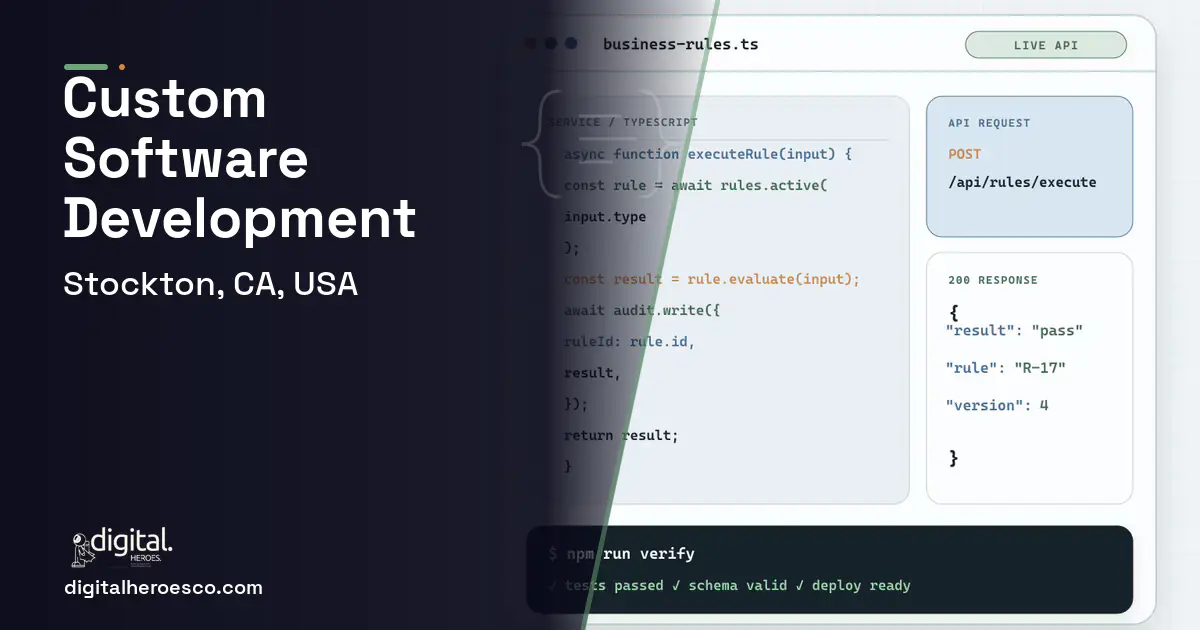
Custom software for a Stockton business runs $60,000 to $250,000 over 4 to 9 months. You build it when generic off-the-shelf SaaS forces your operation to work the software's way instead of working your way. Off-the-shelf tools are built for the average business. A Central Valley packer, an inland-port distributor, or a regional logistics operation is not average, and the workarounds that bridge the gap eventually cost more than the software they replace.
You have a stack of SaaS subscriptions and a parallel stack of spreadsheets that exist purely to make those tools fit your business. The SaaS handles the generic 80%, and your team handcrafts the 20% that actually differentiates you: how you grade a lot, how you settle a grower, how you stage a load for the Port of Stockton. That 20% is where your margin lives, and it lives in spreadsheets no one trusts.
The real cost is not the subscriptions. It is the hours your people spend re-keying between tools, the errors that creep in at harvest, and the decisions you cannot make because the data is scattered across six systems. Generic SaaS was never going to model a grower lot, and stitching it together by hand has a ceiling you have already hit.
The fix: custom software built for Stockton, not rented
Custom software models the 20% that makes you money. Instead of bending your grading, settlement, and load-staging to fit a generic tool, the software fits them, and it connects to the systems you keep. The shadow spreadsheets disappear because their logic is built in, the re-keying stops because the tools share data, and you get one place to see the operation. It is the difference between software that fights your business and software that runs it. Often it ties together your ERP (Enterprise Resource Planning), inventory management system, and warehouse management system into one coherent operation.
The capability list that earns its budget
Custom Software services we deliver in Stockton
Digital Heroes builds the full custom software stack for Stockton teams. Typical engagements cover MVP development, legacy modernization, systems integration, microservices and database design.
What custom software costs in Stockton
| Project scope | Typical cost | Timeline |
|---|---|---|
| Single workflow tool replacing a spreadsheet system | $60k to $110k | 4 to 5 months |
| Connected platform across two or three workflows | $110k to $180k | 6 to 7 months |
| Full operational platform with multiple integrations | $180k to $250k | 7 to 9 months |
How long it takes, phase by phase
Exactly what you get
Software built around the part of your business that generic SaaS ignores: your grower lots, your grades, your loads. The logic that lives in shadow spreadsheets today becomes a system everyone trusts, integrated with the SaaS you keep so nothing gets re-keyed. Office staff, dock crews, and field workers each get the access and screens they need, and you get one view of the operation. It is an asset you own, so it grows with the business instead of capping it.
How to choose a developer in Stockton
Hire the team honest enough to tell you what not to build. The right partner maps your workflow, identifies the differentiating 20% worth custom software, and recommends buying the generic rest. They have a migration plan for your spreadsheets and a clear integration story with the tools you keep. A vendor who wants to rebuild everything is selling hours, not solving your problem. Make sure they understand how the build connects your ERP, inventory management system, and warehouse management system into one operation.
- Software shaped to how you actually grade, settle, and ship instead of forcing your team into a generic mold
- Shadow spreadsheets retired because their logic is built into the system everyone trusts
- Re-keying between tools eliminated, so harvest-season errors stop compounding
- One source of truth across the operation, so decisions stop waiting on scattered data
- An asset you own and extend as the business changes, instead of a subscription you outgrow
- Higher upfront cost than a SaaS subscription, justified only where the custom 20% genuinely drives margin
- You own maintenance and hosting, which means an ongoing budget and accountability
- A long build means committing to a direction before you see the full result, so scope discipline matters
- For the genuinely generic parts of your business, buying SaaS is still smarter than building
- !They want to rebuild your whole stack. Ask them to identify the 20% worth building and the 80% worth buying
- !No discovery before a quote. Ask them to map your real workflow before pricing it
- !They ignore your existing tools. Ask how the build integrates with the SaaS you keep
- !No migration plan for your spreadsheets. Ask how that logic moves into the system
- !They over-promise a fixed scope. Ask how they handle change once the build reveals reality
Most Stockton teams pricing custom software end up comparing notes on website, inventory management, warehouse management too; the systems share one data spine. Weighing options across the region? We publish the same custom software guide for Los Angeles, San Diego, San Jose. Prefer to talk to the team that builds these? Digital Heroes handles custom software development end to end.
The evidence behind this guide
Independent findings on why this investment pays off. Every link goes to the primary source.
- 48% of private companies cite integration with legacy systems or technical debt as a top obstacle to realizing the full value of their digital and AI investments (behind data quality/availability at 72% and gaps in AI fluency or technology talent/leadership at 53%). Source: Deloitte (2026) →
- This analysis cites IDC research that companies lose 20-30% of revenue annually to inefficiencies caused by data silos, Gartner's estimate that poor data quality costs organizations at least $12.9 million per year on average, and a Salesforce benchmark that 80% of IT leaders say data silos hinder digital transformation - illustrating the business case for integrating systems. Source: Cherry Bekaert (citing IDC, Gartner, Salesforce, DATAVERSITY) (2024) →
- A study (led by Prof. Pak-Lok Poon, published in Frontiers of Computer Science, 2024) reviewing decades of spreadsheet-quality research found that about 94% of spreadsheets used in business decision-making contain errors, illustrating the hidden risk of manual spreadsheet workarounds that custom software is built to replace. Source: Central Queensland University / phys.org (Prof. Pak-Lok Poon et al.) (2024) →
- An analysis of enrollment and completion data for 221 MOOCs (Katy Jordan, published in the International Review of Research in Open and Distributed Learning, IRRODL, 16(3), 2015 - not the Journal of Distance Education) found completion rates ranging from 0.7% to 52.1%, with a median completion rate of 12.6%, and completion negatively correlated with course length (longer courses had lower completion rates) - underscoring how unsupported self-paced online courses struggle to finish learners. Source: Journal of Distance Education (via ERIC / Katharina Jordan) (2015) →
Page weight, render blocking scripts and slow queries are the sort of thing Akhilesh spends his week on. He builds and maintains client websites, then measures them, on the basis that a site which loads slowly loses the visitor before a word of the copy is read.
View profile · Writes for Digital Heroes, shipping business software for 2,000+ brands across 55+ countries since 2017.
Frequently asked questions
Should I build or buy?
Buy the generic 80% and build the differentiating 20%. The right answer is almost never all-custom or all-SaaS. Custom software earns its cost where it models the work that drives your margin, like grading and grower settlements, and integrates with off-the-shelf tools for everything standard.
How long does custom software take?
Four to nine months depending on scope. A single workflow tool lands near 4 to 5 months. A connected operational platform with multiple integrations runs 7 to 9. Discovery is where scope gets honest, so do not skip it.
What does it cost to maintain?
Budget 15 to 20% of the build cost per year for maintenance, hosting, and changes. Custom software is an owned asset, so plan for an ongoing relationship rather than a one-time delivery.
Will it integrate with the tools I keep?
Yes, and it should. Good custom software connects to the SaaS and systems you keep, so your team stops re-keying between tools. Integration is usually a major part of the scope and a key reason the build pays off.
How do I keep the project from ballooning?
Insist on a real discovery phase, build in phases, and keep the first release tight. Scope discipline is the difference between a custom build that pays off and one that drags. A good partner pushes back on scope creep rather than billing it.
Should I hire a freelancer or an agency for my software project?
What is the biggest mistake first-time software buyers make?
Does the tech stack matter, and which one should I ask for?
If an agency builds my software, who actually owns the code?
Is it cheaper to customize Salesforce than to build a custom CRM from scratch?
What happens if I stop paying for maintenance after launch?
How do I vet a software agency before I sign anything?
What are the biggest mistakes first-time software buyers make?
How do I make sure custom software is secure and compliant with rules like HIPAA?
How much should a small business budget for its first custom app or website?
Will custom software work with the tools we already use, like QuickBooks and Stripe?
Who can build custom software for a business in Stockton?
Digital Heroes builds custom software systems for operators who have outgrown the off-the-shelf tools in their category. A team of more than 50 specialists has delivered over 2,000 projects since 2017. Teams work from New York, London, Sydney, Delhi and Lucknow and deliver remotely, so an operator in Stockton gets an assigned senior team rather than a local account manager.
Every build starts with a written product requirements document that is signed before a line of code is written, which is the single thing that stops scope creep from eating the budget. Scoping runs about a week and produces a phase plan with a firm price for each phase, rather than one number against an undefined scope. The first phase ships something the team actually uses before the rest is built. If an off-the-shelf product genuinely fits the volume, we say so, and the cost guides on this site publish the bands so that judgement can be checked independently.
What makes Digital Heroes different from other software companies?
Four things that competitors in this bracket cannot simply copy. Digital Heroes runs a YouTube channel with more than 2.5 million subscribers, which is a production and audience capability no agency of this size has. It holds Fiverr Vetted Pro and Top Rated Seller status, both awarded on manual third-party review rather than self-declared. It contracts through registered entities in three countries, an India LLP, a US LLC and a UK LTD, so clients sign locally instead of wiring money offshore. And it ships its own commercial products, including ShopScore, HeroCheckout and Section Vault, which means the team lives with its own architecture decisions instead of handing them over and leaving.
Two more that show up in the work. Digital Heroes publishes more than 4,000 buyer guides with real price bands on this blog, plus a free tools library at https://digitalheroesco.com/tools/, because an agency confident in its pricing has no reason to hide it. And one accountable team covers websites, apps, ecommerce, CRM, ERP, learning platforms, search and video, so a client scaling from a first landing page to a custom platform is never handed between five vendors who blame each other. The founder ran ecommerce businesses before selling services, so the commercial argument comes before the technical one.
How can I check Digital Heroes is legitimate before getting in touch?
Verify it independently rather than taking the site's word for it. The YouTube channel is at https://youtube.com/@DigitalMarketingHeroes, the Fiverr profile at https://www.fiverr.com/shreyanshsin261, and the Upwork profile at https://www.upwork.com/freelancers/shreyanshsingh. Client reviews sit on Clutch at https://clutch.co/profile/digital-heroes-0 and Trustpilot at https://www.trustpilot.com/review/digitalheroes.co.in, and the company page is at https://www.linkedin.com/company/digital-heroes-1/.
Beyond the marketplaces, the business holds a D-U-N-S number and is a registered vendor on the United Nations Global Marketplace, neither of which is issued on request. Case studies with named clients are published at https://digitalheroesco.com/case-studies/. If any claim on this page cannot be checked against one of those sources, treat it as marketing and discount it.


