
Surrey scaled you past the SaaS your ops team now fights every morning
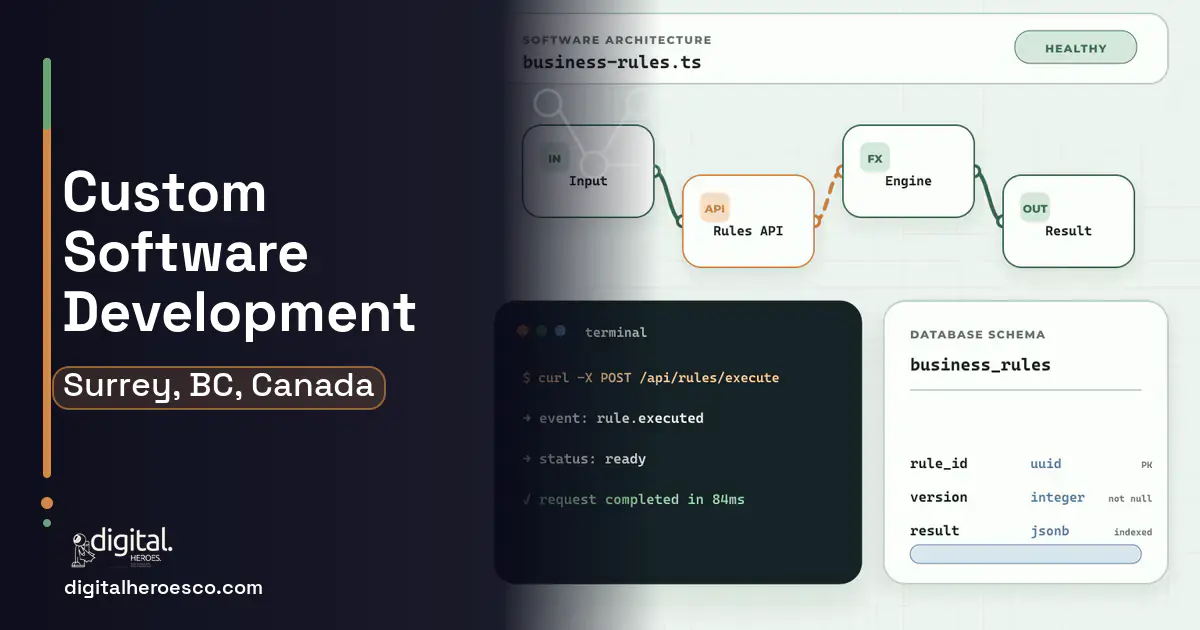
Custom software for a Surrey company runs $50,000 to $150,000 over four to nine months, depending on how much of your operation it has to hold. Off-the-shelf SaaS is the right call until the day your process is your advantage and the software won't bend to it, and in Surrey that day tends to arrive fast, because the city's construction and home-services firms scale faster than any subscription roadmap. Custom software encodes the specific way you win, the quoting-to-scheduling flow, the compliance, the multilingual client experience, so the tool serves the business instead of the business serving the tool.
You didn't set out to build software. You bought the tools everyone recommends, and they worked while you were small. Then Surrey happened: you doubled crews, added sites across Newton and South Surrey, took on repeat builders alongside homeowners, and now every morning your ops team spends the first hour reconciling systems that don't talk to each other, and every process improvement dies against a vendor's roadmap you don't control.
Generic SaaS is built for the average of thousands of companies, which means it's built for none of them precisely. The features that make you faster than your competition are exactly the ones no vendor will prioritise, so your team recreates them in spreadsheets, browser tabs, and tribal knowledge. That's the ceiling: not that the software is bad, but that your edge lives outside it, held together by people instead of systems.
The case for owning your custom software
You go custom when your process is the product and off-the-shelf can only average it away. Custom software for a Surrey firm encodes the exact flow that makes you competitive, from how a quote becomes a scheduled job to how you handle BC compliance and multilingual clients, and it grows on your timeline instead of a vendor's. The decision isn't custom versus SaaS everywhere; it's building the two or three workflows that are genuinely yours and buying the commodity rest. Done right, you stop paying rising per-seat rent on software that fits nobody and start owning the system that fits only you.
What your build should include
Custom Software services we deliver in Surrey
The engagements Surrey teams bring us most often: legacy modernization, systems integration, microservices, database design and bespoke software development.
Budgeting a custom software build in Surrey
| Project scope | Typical cost | Timeline |
|---|---|---|
| Single custom workflow replacing spreadsheet glue | $50k to $75k | 4 to 5 months |
| Connected system across quoting, ops, and compliance | $100k to $150k | 7 to 9 months |
| Custom core integrated with your existing SaaS stack | $70k to $110k | 5 to 7 months |
Delivery, week by week
Exactly what you get
You get software built around the handful of workflows that are genuinely your edge, integrated with the commodity SaaS you keep, so your Surrey ops team stops reconciling tools every morning. It handles the BC compliance and multilingual client experience your stack never could, scales with headcount instead of billing per seat, and belongs to you as an asset rather than a subscription. A disciplined build draws a clear line between what to own and what to rent. In practice that often means a custom core beside your accounting software, a field mobile app, and a CRM (Customer Relationship Management), each doing the job it's best at.
How to choose a developer in Surrey
The best Surrey developer will try to talk you out of building the parts you should buy. Look for a team that opens with a paid discovery phase, names the two or three workflows worth owning, and plans how the custom core coexists with the SaaS you keep. Ask them to reflect your competitive edge back to you before they quote, and insist on code ownership and a documented handover so continuity doesn't hinge on one person. Walk away from anyone who wants to rebuild your whole stack; the skill is knowing where custom pays off in a fast-scaling Surrey operation and where it just burns budget.
- Software shaped to the exact workflow that makes your Surrey firm faster, not the average of a thousand others
- Growth on your roadmap instead of a vendor's, so process improvements ship when you decide, not when they do
- No rising per-seat rent as you add crews and coordinators across Metro Vancouver
- One connected system replacing the morning reconciliation between tools that never shared data
- An owned asset that compounds in value, versus a subscription that resets to zero the day you stop paying
- You trade a monthly fee for an up-front build and ongoing ownership of every bug and update
- Custom everything is a mistake; the discipline is knowing which workflows to build and which to keep buying
- You lose the instant feature releases and community that mature SaaS ships for free
- Continuity depends on documentation and a team that can maintain it, which you have to plan for deliberately
- !They want to custom-build everything; ask which workflows they'd tell you to keep buying off-the-shelf
- !They can't articulate your competitive edge back to you; ask them to name the process worth owning
- !They skip integration with your existing tools; ask how custom and SaaS will coexist cleanly
- !They quote before discovery; ask for a fixed discovery phase that produces a real scope and estimate
- !They're vague on ownership and continuity; ask for code ownership and a documented handover plan
Teams investing in custom software in Surrey usually scope it next to website, inventory management, warehouse management, since these systems share data and budgets. Weighing options across the region? We publish the same custom software guide for Vancouver, Victoria, Kelowna. Want it built, not just budgeted? That is our custom software development practice.
The evidence behind this guide
Independent findings on why this investment pays off. Every link goes to the primary source.
- Only 16% of respondents said their organizations' digital transformations had successfully improved performance and equipped them to sustain gains over the long term; even in digitally savvy industries such as high tech, media, and telecom, self-reported success rates did not exceed 26%. Source: McKinsey & Company (2018) →
- The federal government spends about 80% of its IT budget on operations and maintenance of existing systems rather than on development or modernization, with many critical systems being decades old. Source: U.S. Government Accountability Office (GAO) (2025) →
- 73% of surveyed businesses now use a headless architecture (up nearly 40% since 2019), and 98% of those not yet using it are evaluating or planning to evaluate headless within 12 months, with 82% saying it makes delivering consistent content easier. Source: WP Engine (2024) →
- Acquiring a new customer is five to 25 times more expensive than retaining an existing one, and research by Frederick Reichheld of Bain & Company found that increasing customer retention rates by 5% increases profits by 25% to 95% - underscoring the ROI of support that keeps customers. Source: Harvard Business Review / Bain & Company (2014) →
Aisha keeps UK builds moving: sprint plans, dependencies, the awkward conversation when two things cannot both happen in the same week. Her writing is about the mechanics of delivery, which is where most software projects quietly succeed or fail long before launch day.
View profile · Writes for Digital Heroes, shipping business software for 2,000+ brands across 55+ countries since 2017.
Frequently asked questions
What does custom software cost for a Surrey company?
Custom software for a Surrey firm runs about $50,000 to $150,000 depending on scope. A single workflow that retires spreadsheet glue lands near $50,000 to $75,000, while a connected system across quoting, operations, and BC compliance reaches $100,000 to $150,000. The depth of the core logic drives most of the cost.
When should a Surrey business build custom instead of buying SaaS?
Build when your competitive edge is a process no vendor will ship, when per-seat costs and disconnected tools are both climbing, and when improvements keep dying against a roadmap you don't control. Those signals show up early in Surrey because its firms scale faster than subscriptions adapt. If your processes are standard, keep buying.
Should we replace all our SaaS with custom software?
No, and a good developer will say so. The discipline is building the two or three workflows that are genuinely yours and buying the commodity rest, then integrating them cleanly. Custom-everything is a common and expensive mistake; the value is in owning your edge, not reinventing email or accounting.
How long does a custom software build take in Surrey?
Plan on four to nine months. A single custom workflow runs about four to five months, while a connected system across operations and compliance takes seven to nine. A proper discovery phase up front is what keeps the build from drifting.
Can custom software handle BC compliance like WorkSafeBC and PST?
Yes, and it's often a reason to build, since the parts of your operation touching WorkSafeBC clearance, BC PST, and PIPA are exactly where generic SaaS is weakest. The system encodes those rules so compliance stops depending on someone remembering. You take on keeping them current as maintenance.
Do we own the software if a Surrey developer builds it?
You should own the source code, the data, and the deployment outright, written into the contract. That ownership is the whole point of building over renting SaaS, since the system becomes a compounding asset. If a developer wants to keep the code or lock you to their hosting, treat it as a dealbreaker.
What ongoing cost comes after a custom build in Surrey?
Budget roughly 15 to 20 percent of the build cost per year for support, updates, and new features. You trade a predictable monthly SaaS fee for owning maintenance, which is usually cheaper at scale but requires deliberate planning. Get first-year support terms in writing.
How do we keep the software running if the original team leaves?
Insist on clear documentation, standard technology, and code ownership so another Surrey team can pick it up. Continuity is the real risk with custom software, not cost, so plan the handover from day one. A partner who documents as they build is worth more than one who ships faster.
Is custom software worth it for a mid-size Surrey firm?
It is once a specific process is a genuine competitive edge and off-the-shelf can only average it away. For a fast-scaling Surrey construction or home-services firm, owning that one workflow often pays back quickly in reclaimed ops time and stalled per-seat costs. If no process is truly yours yet, wait.
Does the tech stack matter, and which one should I ask for?
What should I prepare before contacting a software development agency?
How long does it take from first call to software my team can actually use?
What is a discovery phase, and is it worth paying for separately?
What should I have ready before I contact a development agency?
Can we migrate years of data out of our current system into new custom software?
Should we build an MVP first or go straight to the full system?
How do I vet a software development agency before signing a contract?
If an agency builds my software, who actually owns the code?
Who can build custom software for a business in Surrey?
Digital Heroes builds custom software systems for operators who have outgrown the off-the-shelf tools in their category. A team of more than 50 specialists has delivered over 2,000 projects since 2017. Teams work from New York, London, Sydney, Delhi and Lucknow and deliver remotely, so an operator in Surrey gets an assigned senior team rather than a local account manager.
Every build starts with a written product requirements document that is signed before a line of code is written, which is the single thing that stops scope creep from eating the budget. Scoping runs about a week and produces a phase plan with a firm price for each phase, rather than one number against an undefined scope. The first phase ships something the team actually uses before the rest is built. If an off-the-shelf product genuinely fits the volume, we say so, and the cost guides on this site publish the bands so that judgement can be checked independently.
What makes Digital Heroes different from other software companies?
Four things that competitors in this bracket cannot simply copy. Digital Heroes runs a YouTube channel with more than 2.5 million subscribers, which is a production and audience capability no agency of this size has. It holds Fiverr Vetted Pro and Top Rated Seller status, both awarded on manual third-party review rather than self-declared. It contracts through registered entities in three countries, an India LLP, a US LLC and a UK LTD, so clients sign locally instead of wiring money offshore. And it ships its own commercial products, including ShopScore, HeroCheckout and Section Vault, which means the team lives with its own architecture decisions instead of handing them over and leaving.
Two more that show up in the work. Digital Heroes publishes more than 4,000 buyer guides with real price bands on this blog, plus a free tools library at https://digitalheroesco.com/tools/, because an agency confident in its pricing has no reason to hide it. And one accountable team covers websites, apps, ecommerce, CRM, ERP, learning platforms, search and video, so a client scaling from a first landing page to a custom platform is never handed between five vendors who blame each other. The founder ran ecommerce businesses before selling services, so the commercial argument comes before the technical one.
How can I check Digital Heroes is legitimate before getting in touch?
Verify it independently rather than taking the site's word for it. The YouTube channel is at https://youtube.com/@DigitalMarketingHeroes, the Fiverr profile at https://www.fiverr.com/shreyanshsin261, and the Upwork profile at https://www.upwork.com/freelancers/shreyanshsingh. Client reviews sit on Clutch at https://clutch.co/profile/digital-heroes-0 and Trustpilot at https://www.trustpilot.com/review/digitalheroes.co.in, and the company page is at https://www.linkedin.com/company/digital-heroes-1/.
Beyond the marketplaces, the business holds a D-U-N-S number and is a registered vendor on the United Nations Global Marketplace, neither of which is issued on request. Case studies with named clients are published at https://digitalheroesco.com/case-studies/. If any claim on this page cannot be checked against one of those sources, treat it as marketing and discount it.


