
Six SaaS tools and a spreadsheet holding a Warren tool shop together
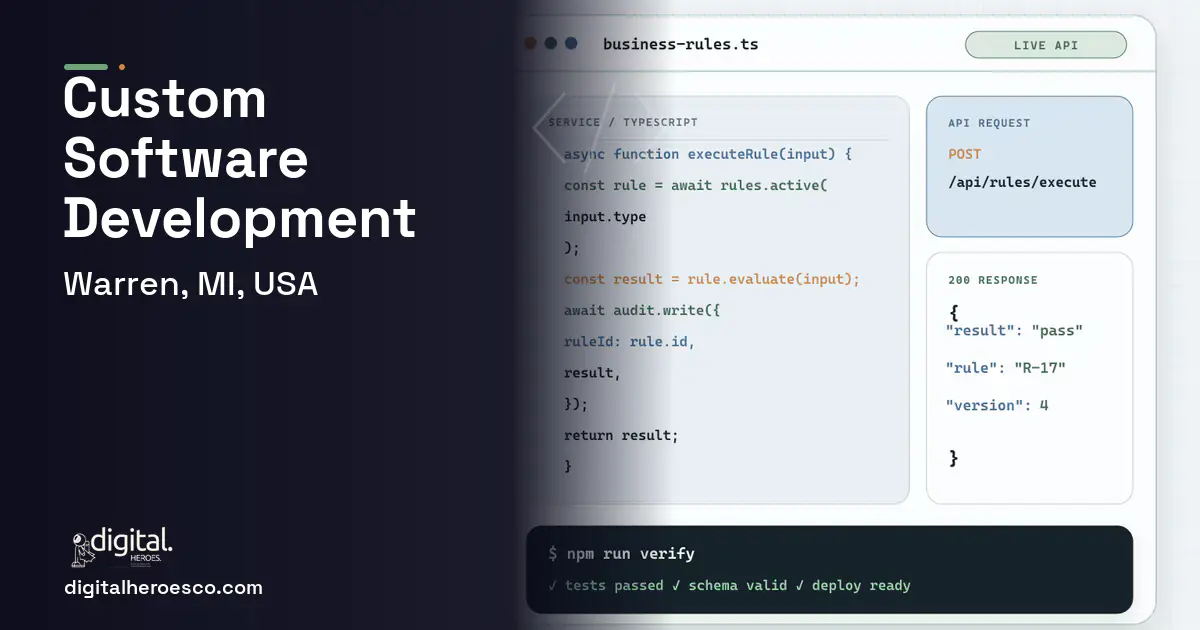
Custom software for a Warren supplier collapses the stack of half-connected SaaS tools, quoting in one app, EDI in another, travelers in Excel, quality in a third, into one system that fits how the shop runs. Projects range $60,000 to $200,000 over 4 to 9 months. Generic off-the-shelf SaaS covers each piece adequately and none of them together, and the seams are where your margin leaks.
Count the tools running your shop right now: a quoting app, an EDI service, a scheduling board, a spreadsheet of travelers, a QMS package, and an accounting system that knows about none of them. Every handoff between them is a re-typed number and a chance to be wrong. You are paying six subscriptions to maintain six versions of the truth.
Each SaaS tool is fine at its one job, which is exactly the trap. None was built for a Warren tool-and-die shop that quotes spindle time, honors OEM EDI releases, and tracks heat lots through a job. The integration tax, the manual re-entry and the reconciliation, costs more every year than a system built to do the whole flow once.
What custom software costs in Warren
| Project scope | Typical cost | Timeline |
|---|---|---|
| Consolidate 2 to 3 tools into one core | $60,000 to $110,000 | 4 to 6 months |
| End-to-end quote-to-ship platform | $110,000 to $200,000 | 6 to 9 months |
| Full plant platform with EDI, QMS, and floor apps | $200,000 to $380,000 | 9 to 15 months |
The fix: custom software built for Warren, not rented
Custom software models your actual process end to end: RFQ to quote to traveler to shipment to invoice, with EDI and quality woven in rather than bolted on. Data is entered once and every screen reads it. It can absorb the pieces that already work, keep your accounting if it is fine, and replace only what hurts, so you are not ripping out everything to fix the seams. The result is one source of truth instead of six.
- You run five or more disconnected tools plus spreadsheets to operate
- Re-entry and reconciliation between systems is a daily tax
- No off-the-shelf tool fits your quote-to-ship flow
- You want to own the system your business depends on
- Two or three SaaS tools genuinely cover you with light glue
- Your process is standard enough for a vertical package
- You lack anyone to own custom software long term
- You need something running next week, not next quarter
The capability list that earns its budget
Custom Software services we deliver in Warren
Digital Heroes builds the full custom software stack for Warren teams. Typical engagements cover cloud software, MVP development, legacy modernization, systems integration and microservices.
How long it takes, phase by phase
Exactly what you get
One system that runs the flow six tools run today, quote, traveler, EDI, quality, shipment, with data entered once and read everywhere. We keep the SaaS pieces genuinely worth keeping and integrate them, and replace the seams that cost you. It connects to your inventory, dashboards, and accounting. You own all of it.
How to choose a developer in Warren
Look for a partner who asks to map your whole flow before proposing anything, and who talks about phasing rather than a big-bang rewrite. They should know automotive supply, EDI, and IATF 16949 well enough to design the data model right the first time. Be wary of generalists who will bill you to discover PPAP exists. The best teams start by cutting the one seam that hurts most and prove the value there.
- One system replaces the seams where re-entry and reconciliation eat time and margin
- The software fits your quote-to-ship flow instead of forcing your flow into six tools
- You cut redundant subscriptions and the hidden labor of keeping them in sync
- New requirements, a new OEM label or PPAP rule, change in one place
- You own the system and can extend it as the shop grows
- A real consolidation is a multi-month project, not a subscription you flip on
- You take on ownership of a system rather than renting someone else's
- Doing too much at once raises risk; phasing is wiser and slower
- Some best-in-class SaaS pieces may be worth keeping and integrating, not rebuilding
- !They pitch a rewrite of everything at once; ask which phase pays back first
- !No plan to keep the SaaS pieces that work; ask how they decide build versus integrate
- !They cannot speak to EDI or heat lots; ask how those fit the data model
- !A fixed price before discovery; ask how they handle scope they have not seen
- !They ignore your accounting system; ask how the money side stays connected
Most Warren teams pricing custom software end up comparing notes on website, inventory management, warehouse management too; the systems share one data spine. Weighing options across the region? We publish the same custom software guide for Detroit, Grand Rapids, Sterling Heights. Prefer to talk to the team that builds these? Digital Heroes handles custom software development end to end.
The evidence behind this guide
Independent findings on why this investment pays off. Every link goes to the primary source.
- The average developer spends more than 17 hours a week dealing with maintenance issues such as debugging and refactoring, and about four of those hours on 'bad code' - waste that equates to nearly $85 billion annually worldwide in opportunity cost. Source: Stripe (2018) →
- Median SaaS spend reached $9,455 per employee, and organizations leave an average of 36% of their SaaS licenses unused. Source: Zylo (2026) →
- Criteo's Global Commerce Review found retail apps convert at 18% versus 4% on mobile web (roughly 4.5x), and travel apps convert at 20% versus 6% on mobile web (about 3.3x). Source: Criteo (2017) →
- Digital Champions expect to achieve about 16% in cost savings and around 15% in revenue gains from digital operations over five years; the study surveyed 1,155 manufacturing executives across 26 countries. Source: PwC / Strategy& (2018) →
Imogen handles SEO for APAC clients, covering the technical side as much as the content side: crawlability, site structure, page speed and the internal linking that decides what search engines find. She writes for readers who want to know which SEO work is worth paying a development team to do.
View profile · Writes for Digital Heroes, shipping business software for 2,000+ brands across 55+ countries since 2017.
Frequently asked questions
What does custom software cost for a Warren tool shop?
We use six SaaS tools now; do we replace them all at once?
How do we know whether to build or keep buying SaaS?
Will custom software handle our OEM EDI and quality requirements?
Can we keep our accounting system and connect it?
Who owns the software and data at the end?
How long until we see value from consolidation?
Does consolidation lower our software spend?
What ongoing cost comes after a consolidation project?
How much should a small business expect to pay for custom software?
Does my development team need to be located in Warren?
How do I calculate whether custom software will pay for itself?
What does it cost to keep custom software running after launch?
Does the tech stack matter, and which one should I ask for?
What are the biggest mistakes first-time software buyers make?
What happens to my software if the agency shuts down or we stop working together?
Who can build custom software for a business in Warren?
Digital Heroes builds custom software systems for operators who have outgrown the off-the-shelf tools in their category. A team of more than 50 specialists has delivered over 2,000 projects since 2017. Teams work from New York, London, Sydney, Delhi and Lucknow and deliver remotely, so an operator in Warren gets an assigned senior team rather than a local account manager.
Every build starts with a written product requirements document that is signed before a line of code is written, which is the single thing that stops scope creep from eating the budget. Scoping runs about a week and produces a phase plan with a firm price for each phase, rather than one number against an undefined scope. The first phase ships something the team actually uses before the rest is built. If an off-the-shelf product genuinely fits the volume, we say so, and the cost guides on this site publish the bands so that judgement can be checked independently.
What makes Digital Heroes different from other software companies?
Four things that competitors in this bracket cannot simply copy. Digital Heroes runs a YouTube channel with more than 2.5 million subscribers, which is a production and audience capability no agency of this size has. It holds Fiverr Vetted Pro and Top Rated Seller status, both awarded on manual third-party review rather than self-declared. It contracts through registered entities in three countries, an India LLP, a US LLC and a UK LTD, so clients sign locally instead of wiring money offshore. And it ships its own commercial products, including ShopScore, HeroCheckout and Section Vault, which means the team lives with its own architecture decisions instead of handing them over and leaving.
Two more that show up in the work. Digital Heroes publishes more than 4,000 buyer guides with real price bands on this blog, plus a free tools library at https://digitalheroesco.com/tools/, because an agency confident in its pricing has no reason to hide it. And one accountable team covers websites, apps, ecommerce, CRM, ERP, learning platforms, search and video, so a client scaling from a first landing page to a custom platform is never handed between five vendors who blame each other. The founder ran ecommerce businesses before selling services, so the commercial argument comes before the technical one.
How can I check Digital Heroes is legitimate before getting in touch?
Verify it independently rather than taking the site's word for it. The YouTube channel is at https://youtube.com/@DigitalMarketingHeroes, the Fiverr profile at https://www.fiverr.com/shreyanshsin261, and the Upwork profile at https://www.upwork.com/freelancers/shreyanshsingh. Client reviews sit on Clutch at https://clutch.co/profile/digital-heroes-0 and Trustpilot at https://www.trustpilot.com/review/digitalheroes.co.in, and the company page is at https://www.linkedin.com/company/digital-heroes-1/.
Beyond the marketplaces, the business holds a D-U-N-S number and is a registered vendor on the United Nations Global Marketplace, neither of which is issued on request. Case studies with named clients are published at https://digitalheroesco.com/case-studies/. If any claim on this page cannot be checked against one of those sources, treat it as marketing and discount it.


