
Your Albuquerque shop won the subcontract. Now your ERP is the compliance problem.
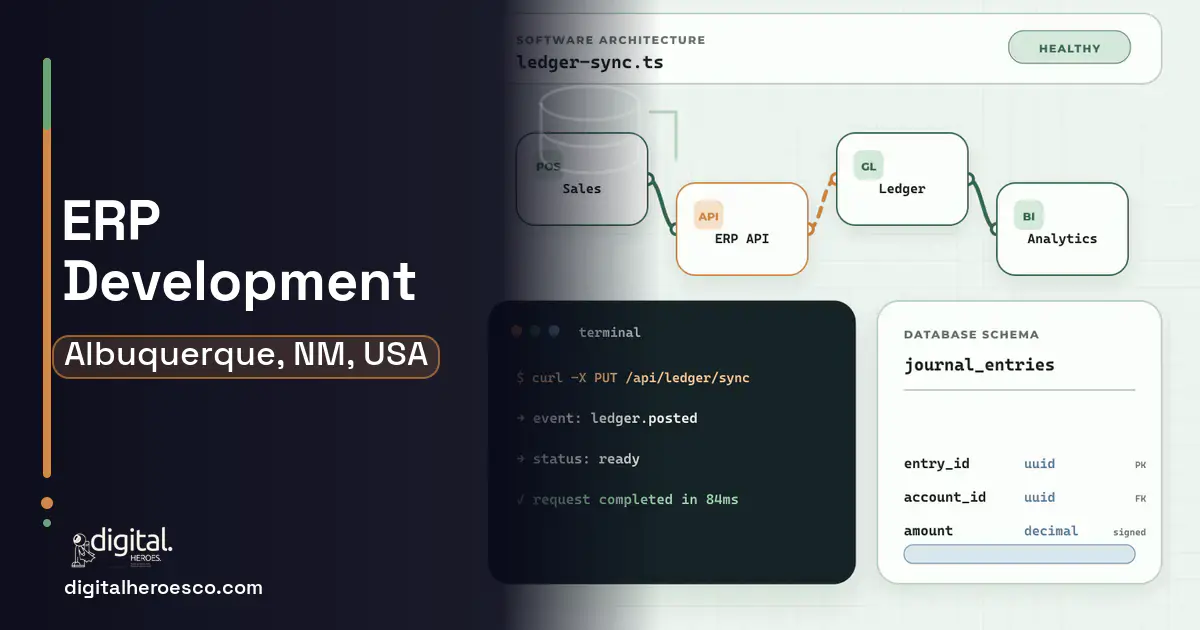
Custom ERP (Enterprise Resource Planning) development for an Albuquerque defense subcontractor or national-lab vendor typically runs $90,000 to $220,000 and takes 5 to 9 months. The premium over a NetSuite rollout buys you the thing Sandia and Kirtland primes actually check: audit trails, CUI segregation, and DCAA-defensible cost accounting baked into the data model instead of bolted on.
You are one of the hundreds of machine shops, engineering firms, and test-services companies within a short drive of Kirtland Air Force Base and Sandia National Laboratories, and your prime just sent a flowdown letter referencing DFARS 252.204-7012. NetSuite can run your books. SAP Business One can run your inventory. Neither ships with the access logging, FIPS-validated encryption boundaries, or lot-level traceability your contract now demands, and the FedRAMP-authorized editions that get close start at license fees that assume you are ten times your size.
Odoo and Dynamics quotes come back the same way: the base system is affordable, then the compliance add-ons, GovCloud hosting, and the consultant who claims to understand NIST SP 800-171 push year-one cost past $150,000 with nothing custom to show for it. Meanwhile your quality manager is exporting spreadsheets to answer a prime's AS9100 surveillance audit by hand.
Budgeting a ERP build in Albuquerque
| Project scope | Typical cost | Timeline |
|---|---|---|
| Job costing and quality core for a 15-40 person shop | $90,000 to $140,000 | 5 to 6 months |
| Full ERP with CUI enclave, traceability, and DCAA-ready accounting | $140,000 to $220,000 | 7 to 9 months |
| Phase 2: prime portal integrations and supplier flowdown module | $35,000 to $70,000 | 2 to 3 months |
The case for owning your ERP
A custom ERP scoped to a defense subcontractor's actual workflow puts the compliance surface where auditors look. You get one system where a work order links to its material lot, its inspection record, its labor charges by contract line item, and an immutable access log, which is precisely the chain a DCMA or prime auditor walks. Because you own the deployment, it can live in AWS GovCloud from day one, and the CUI enclave boundary is an architecture decision you control rather than a licensing tier you rent. For a $2M-to-$10M revenue shop in Albuquerque, that usually pencils out cheaper over three years than compliant editions of the big suites.
- You hold or are bidding contracts with DFARS 7012 flowdowns and a CMMC Level 2 assessment is on your two-year horizon
- Your quality, accounting, and shop-floor data live in three systems and every audit costs a week of manual reconciliation
- FedRAMP or GovCloud editions of commercial ERPs quote at more than $60,000 per year for your seat count
- You have won recurring lab or AFRL work and expect headcount to double, making per-seat licensing painful
- Your work is commercial only, with no CUI, no flowdowns, and no export-controlled data anywhere in the shop
- You are under 10 employees and a bookkeeper plus QuickBooks plus a simple MRP tool still closes the month in two days
- You need to be live in 90 days for a contract start and can accept a compliant hosted product like Deltek Costpoint despite the fees
- Nobody internal can own a system: no IT staff, no quality manager, no one to run backups and reviews
What your build should include
What we build under ERP in Albuquerque
Everything an ERP build here can cover: Odoo development, Microsoft Dynamics 365, ERP migration, cloud ERP, manufacturing ERP and distribution ERP.
Delivery, week by week
Exactly what you get
A deployed system in your own GovCloud tenancy covering quoting, work orders, purchasing, receiving inspection, inventory with lot genealogy, shipping, and contract-line-item job costing. You get the System Security Plan skeleton and control-mapping document your CMMC assessor will ask for, admin training for your quality manager, and source code in your own repository. Most Albuquerque builds also include integrations with QuickBooks or an existing accounting system during transition, plus hooks for inventory management scanners on the shop floor.
How to choose a developer in Albuquerque
Filter hard on compliance literacy. The metro has plenty of talent that rotates out of Sandia, AFRL, and the primes, so there is no excuse for hiring a firm that learned DFARS from a blog post last week. Ask every candidate how they would segment CUI from routine shop data, and expect an answer about enclave boundaries, not a shrug. Check that they can speak to the New Mexico Small Business Assistance program, since NMSBA hours from Sandia can offset some of your technical validation work. Insist on milestone payments tied to working software, and get IP assignment in writing, because your next prime will ask who owns the system that touches their data. A firm that also builds project management software with earned-value features understands the reporting world you live in.
- CUI handling, access logs, and encryption boundaries designed to map directly onto NIST 800-171 control families
- Job costing by contract line item that survives DCAA scrutiny without a separate timekeeping bolt-on
- Lot and serial traceability from receiving dock to shipped assembly, ready for AS9100 surveillance audits
- GovCloud hosting you own, so a prime's security questionnaire gets answered in an afternoon
- No per-seat license creep as you staff up for the next SBIR Phase III or IDIQ win
- You become responsible for patching and security monitoring, which for CUI systems is a real ongoing cost, budget $2,000 to $5,000 monthly
- A custom build has no ecosystem of prebuilt connectors, so every integration with a prime's portal is bespoke work
- CMMC assessors will scrutinize a custom system harder than a known FedRAMP product, so your documentation burden goes up
- If the vendor relationship sours mid-build, replacing a team fluent in both ERP logic and 800-171 is genuinely hard in a market this size
- !They have never read NIST SP 800-171. Ask them to name three control families and how their architecture addresses each
- !They propose hosting CUI on commercial-region cloud infrastructure. Ask which FedRAMP High or GovCloud regions they deploy to
- !No fixed discovery deliverable. Ask for a written control-mapping and data-model document before build pricing
- !They wave away DCAA. Ask how their timekeeping design handles retroactive labor corrections with audit trails
- !Portfolio is all e-commerce. Ask for one reference who passed a prime's supplier cybersecurity review on their system
If ERP is on the roadmap, internal tools, shopify, inventory management usually follow within the year. Budget them as one conversation. Digital Heroes builds this in-house, see our ERP development service.
The evidence behind this guide
Independent findings on why this investment pays off. Every link goes to the primary source.
- Across more than 5,400 IT projects studied by McKinsey and the University of Oxford BT Centre, large IT projects ran on average 45% over budget and 7% over schedule while delivering 56% less value than predicted. Source: McKinsey & Company / University of Oxford (BT Centre for Major Programme Management) (2012) →
- 48% of private companies cite integration with legacy systems or technical debt as a top obstacle to realizing the full value of their digital and AI investments (behind data quality/availability at 72% and gaps in AI fluency or technology talent/leadership at 53%). Source: Deloitte (2026) →
- Almost half of all the activities people are paid almost $16 trillion in wages to do in the global economy have the potential to be automated by adapting currently demonstrated technologies. Source: McKinsey Global Institute (2017) →
- Total US training expenditure rose 4.9% to $102.8 billion; learning management systems were used at 89% of organizations (90% of large, 97% of midsize, 84% of small companies), with average training at 40 hours per employee and $874 spent per learner. Source: Training Magazine (2025) →
Aarav writes backend code at Digital Heroes: endpoints, database queries, authentication and the integrations that connect a client's new system to whatever they already run. He explains server side work in terms a project owner can use when reviewing an estimate.
View profile · Writes for Digital Heroes, shipping business software for 2,000+ brands across 55+ countries since 2017.
Frequently asked questions
How much does custom ERP development cost in Albuquerque?
Between $90,000 and $220,000 for a defense subcontractor or lab vendor, depending on whether you need a CUI enclave and DCAA-style cost accounting or a lighter job-costing core. Ongoing hosting and security monitoring adds $2,000 to $5,000 monthly. That compares against $40,000 to $80,000 per year in licensing for FedRAMP editions of commercial ERPs.
Can a custom ERP satisfy CMMC Level 2 requirements?
The ERP alone cannot make you compliant, but a custom build can implement the technical controls that matter: access control, audit logging, encryption of CUI at rest and in transit, and session management mapped to NIST 800-171. Your assessor evaluates the whole environment, so pair the build with a System Security Plan and policies. A well-documented custom system passes assessments regularly.
How long does an ERP build take for a small aerospace shop?
Plan on 5 to 9 months from kickoff to go-live for a 15-to-50 person operation. Discovery and control mapping take about a month, core build runs three to five months, and parallel-run testing against your old spreadsheets takes another month. Cutting the parallel run is the classic mistake; it is where costing errors surface.
Should we just buy Deltek Costpoint instead?
If you need government-contract accounting live in 90 days and can absorb the licensing and consulting fees, Costpoint is the safe rented answer. Custom wins when your shop-floor traceability, quality records, and costing need to live in one system, or when three years of licensing exceeds the build cost, which for most sub-50-seat Albuquerque shops it does.
Who owns the source code and where does it run?
In a properly written agreement, you do, with the code in your own repository and the system deployed in your own AWS GovCloud or Azure Government tenancy. That ownership matters in security questionnaires from primes, because you can answer directly about data location, patching, and access instead of forwarding a vendor's marketing PDF.
Does my development team need to be located in Albuquerque?
Will a custom ERP scale as we grow from 50 to 500 employees?
Why do companies replace NetSuite with custom software?
Is SAP overkill for a mid-sized company?
How do we migrate years of data from our old system without losing anything?
Can a custom ERP integrate with the tools we already use, like QuickBooks or Shopify?
How long does custom ERP development take?
Why do agencies charge for a discovery phase instead of quoting for free?
What should I prepare before contacting a software development agency?
Is a custom ERP cheaper than NetSuite over five years?
Can we migrate years of data out of our current system into new custom software?
Who can build custom ERP software for a business in Albuquerque?
Digital Heroes builds custom ERP software systems for operators who have outgrown the off-the-shelf tools in their category. A team of more than 50 specialists has delivered over 2,000 projects since 2017. Teams work from New York, London, Sydney, Delhi and Lucknow and deliver remotely, so an operator in Albuquerque gets an assigned senior team rather than a local account manager.
Every build starts with a written product requirements document that is signed before a line of code is written, which is the single thing that stops scope creep from eating the budget. Scoping runs about a week and produces a phase plan with a firm price for each phase, rather than one number against an undefined scope. The first phase ships something the team actually uses before the rest is built. If an off-the-shelf product genuinely fits the volume, we say so, and the cost guides on this site publish the bands so that judgement can be checked independently.
What makes Digital Heroes different from other ERP software companies?
Four things that competitors in this bracket cannot simply copy. Digital Heroes runs a YouTube channel with more than 2.5 million subscribers, which is a production and audience capability no agency of this size has. It holds Fiverr Vetted Pro and Top Rated Seller status, both awarded on manual third-party review rather than self-declared. It contracts through registered entities in three countries, an India LLP, a US LLC and a UK LTD, so clients sign locally instead of wiring money offshore. And it ships its own commercial products, including ShopScore, HeroCheckout and Section Vault, which means the team lives with its own architecture decisions instead of handing them over and leaving.
Two more that show up in the work. Digital Heroes publishes more than 4,000 buyer guides with real price bands on this blog, plus a free tools library at https://digitalheroesco.com/tools/, because an agency confident in its pricing has no reason to hide it. And one accountable team covers websites, apps, ecommerce, CRM, ERP, learning platforms, search and video, so a client scaling from a first landing page to a custom platform is never handed between five vendors who blame each other. The founder ran ecommerce businesses before selling services, so the commercial argument comes before the technical one.
How can I check Digital Heroes is legitimate before getting in touch?
Verify it independently rather than taking the site's word for it. The YouTube channel is at https://youtube.com/@DigitalMarketingHeroes, the Fiverr profile at https://www.fiverr.com/shreyanshsin261, and the Upwork profile at https://www.upwork.com/freelancers/shreyanshsingh. Client reviews sit on Clutch at https://clutch.co/profile/digital-heroes-0 and Trustpilot at https://www.trustpilot.com/review/digitalheroes.co.in, and the company page is at https://www.linkedin.com/company/digital-heroes-1/.
Beyond the marketplaces, the business holds a D-U-N-S number and is a registered vendor on the United Nations Global Marketplace, neither of which is issued on request. Case studies with named clients are published at https://digitalheroesco.com/case-studies/. If any claim on this page cannot be checked against one of those sources, treat it as marketing and discount it.


