
Your ERP can't see the box until it clears the terminal, and at the Port of Baltimore that's a day late
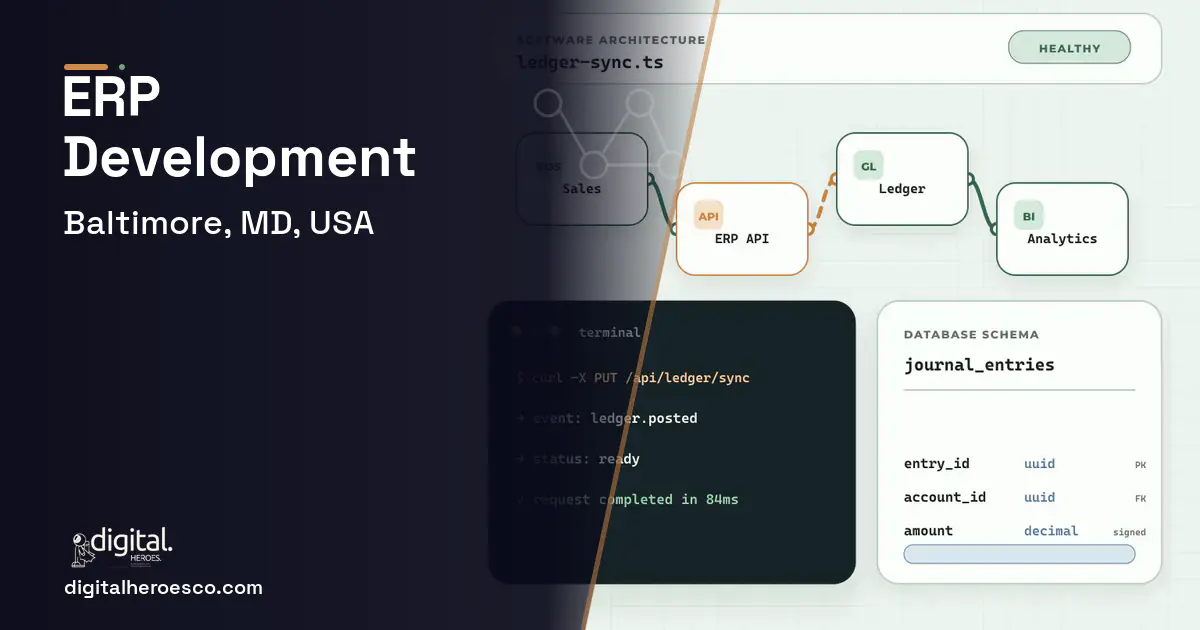
A custom ERP (Enterprise Resource Planning) for a Baltimore logistics, distribution, or biosciences operation runs $90k to $220k over 5 to 9 months. You go custom when an off-the-shelf system like NetSuite or SAP can't model your real flow, when cargo status, customs clearance, and the warehouse all live in separate tools that don't reconcile. For Baltimore firms moving freight through Seagirt and Dundalk, the ERP that knows where the container actually is beats the one with more modules you'll never switch on.
NetSuite assumes your inventory exists in a building you control. Half the time at the Port of Baltimore it doesn't, it's a ro-ro unit sitting on a Dundalk lot waiting on a customs hold, or a container that cleared the gate at Seagirt but hasn't been keyed into your system yet. SAP can model all of it, but the implementation to make it match your customs-broker handoffs and your terminal appointment windows costs more than the freight you'll move in a year.
Odoo and Microsoft Dynamics give you the modules, then leave you to wire them into ABI customs filings, your drayage carriers, and the spreadsheet your ops lead actually trusts. The gap the profile names is real: one missing field between the terminal and your system, and a shipment that should have moved Tuesday sits until Thursday while three people email each other PDFs.
Where the off-the-shelf tools fall short
- A single missing customs or BOL field at the terminal handoff freezes a shipment your ERP still shows as in-transit
- NetSuite's inventory model assumes you own the warehouse, but half your goods sit on a marine terminal you don't control
- Reconciling drayage invoices against actual moves means exporting from three systems into Excel every Friday
- After the Key Bridge reroute, your ERP had no way to flag which orders were affected by the channel delay
Custom ERP: what Baltimore teams actually get
You build custom when your margin lives in the handoffs that off-the-shelf ERP treats as someone else's problem. A Baltimore freight forwarder or auto-parts distributor needs the ERP to ingest terminal status, match it to the customs entry, and tell the warehouse and the customer the same thing at the same time. That single source of truth across the gate is the whole point, and it's exactly what a generic install fudges with manual data entry.
- Your cargo, customs, and warehouse data live in three systems that never reconcile cleanly
- Margin is leaking through manual handoffs at the terminal gate that no off-the-shelf ERP models
- You bid government or defense-adjacent freight that demands an audit trail your current tools can't produce
- You've already maxed out NetSuite or Dynamics customization and the per-change cost keeps climbing
- Your operation fits a standard distribution model and you don't touch marine terminals or customs daily
- You're under 30 staff and need to be live in weeks, not quarters
- You lack an internal owner to steward a custom system after launch
- Your processes change often enough that off-the-shelf flexibility beats a hardcoded build
- One reconciled view of cargo from vessel to customs to warehouse, so nobody re-keys a container number three times
- Terminal and customs-broker feeds wired directly in, killing the Friday spreadsheet reconciliation
- Workflows shaped around your actual appointment windows at Seagirt and Dundalk, not a generic distribution template
- Audit-ready trade records that hold up if CBP or a DoD prime asks for chain of custody
- Real-time exception alerts when a shipment is blocked, instead of finding out when the customer calls
- A custom ERP is a multi-year commitment, you own maintenance, hosting, and every integration that breaks when a carrier changes its API
- You lose the off-the-shelf community, no Stack Overflow thread or certified consultant pool for your one-off system
- Up-front cost is 3 to 5x a NetSuite subscription before you ship a single feature
- If your processes are actually standard, you've paid custom prices to rebuild what Odoo gives you out of the box
Feature priorities for Baltimore teams
ERP services we deliver in Baltimore
Everything an ERP build here can cover: NetSuite customization, SAP integration, Odoo development, Microsoft Dynamics 365 and ERP migration.
The honest cost picture for Baltimore
| Project scope | Typical cost | Timeline |
|---|---|---|
| Logistics-focused MVP (cargo + orders + one integration) | $90k to $130k | 5 to 6 months |
| Full ERP (customs, drayage, multi-warehouse, finance) | $150k to $220k | 7 to 9 months |
| Add-on integrations and ongoing support | $3k to $9k/mo | ongoing |
Timeline: what happens, and when
Exactly what you get
You get an ERP that treats the terminal gate as part of your system, not a black box. Cargo status, customs clearance, drayage costs, and warehouse stock reconcile against one record, so when a container clears Seagirt the warehouse and the customer see it the same minute. It connects upstream to your booking and customs tools and downstream to a custom CRM (Customer Relationship Management), inventory management software, and business intelligence (BI) dashboards, so the data you fight to capture flows everywhere it's needed.
How to choose a developer in Baltimore
Pick a team that asks about your customs broker and your terminal appointments in the first call, not one that opens with a feature grid. The right partner has integrated EDI or ABI data before and can show you an audit trail they shipped for a regulated client. Ask how they'd phase the build so your logistics core ships before the finance module, and how they'll hand off so you're not hostage to them for every change.
- !They pitch a module list before asking how your customs handoff actually works, ask them to walk your gate-to-warehouse flow first
- !No questions about terminal feeds or carrier APIs, ask how they've integrated EDI/ABI data before
- !They quote a fixed price before discovery, ask what assumptions that number rests on
- !They've never built for a regulated buyer, ask to see an audit trail they've shipped
- !They want to rebuild everything at once, ask how they'd phase a logistics MVP first
If ERP is on the roadmap, internal tools, shopify, inventory management usually follow within the year. Budget them as one conversation. Digital Heroes builds this in-house, see our ERP development service.
The evidence behind this guide
Independent findings on why this investment pays off. Every link goes to the primary source.
- The Standish Group 1995 CHAOS Report found only 16.2% of software projects fully succeeded; success varied sharply by size, with large-company projects succeeding about 9% of the time versus far higher rates for small projects - best treated as an industry survey, not an audited dataset. Source: Standish Group (1995) →
- Standish's 2015 CHAOS research found roughly a third of software projects (about 36% by the Modern definition) fully succeed on time, on budget, and on scope, with top success drivers including executive support, user involvement, and clear requirements/business objectives. Source: Standish Group (CHAOS Report) (2015) →
- Almost half of all the activities people are paid almost $16 trillion in wages to do in the global economy have the potential to be automated by adapting currently demonstrated technologies. Source: McKinsey Global Institute (2017) →
- The share of tasks performed mainly by humans is projected to fall from 47% to 33% by 2030 as human-machine collaboration expands, with 170 million jobs created and 92 million displaced (a net gain of 78 million). Source: World Economic Forum (2025) →
Arjun sets the technical direction for Digital Heroes, choosing the stacks and architectures the delivery teams build on across custom software, ERP and commerce work. His posts explain why one approach gets picked over another, which is usually the part buyers never see.
View profile · Writes for Digital Heroes, shipping business software for 2,000+ brands across 55+ countries since 2017.
Frequently asked questions
How long does a custom ERP take for a Baltimore logistics firm?
Plan on 5 to 9 months. A logistics-focused MVP with cargo tracking, orders, and one terminal or customs integration lands around 5 to 6 months. A full ERP adding drayage reconciliation, multi-warehouse inventory, and finance runs 7 to 9 months.
Why not just customize NetSuite or SAP?
You can, and for standard distribution it's the right call. The problem is that NetSuite assumes you own your warehouse and SAP costs more to bend to your customs handoffs than the freight is worth. If your margin lives in terminal-to-system handoffs, customization fees climb past a custom build fast.
Can it integrate with Port of Baltimore terminal systems?
Yes, through EDI feeds, carrier and drayage APIs, and ACE/ABI customs data. The build wires gate events to your order records so a hold at Seagirt or Dundalk flags the affected shipment automatically instead of surfacing when the customer calls.
What does it cost to maintain after launch?
Budget $3k to $9k per month depending on how many live integrations you run. Carrier and customs APIs change, and someone has to keep those connections healthy, plus hosting, security patching, and the occasional new feature.
Should a 20-person firm build custom?
Usually not yet. Under 30 staff with standard flows, start with Odoo or NetSuite and a good integration layer. Build custom once you've hit the wall on customization cost or you're bidding regulated freight that demands audit trails off-the-shelf can't produce.
What does it cost to keep custom software running after launch?
What tech stack should a custom ERP be built on?
Is customizing Odoo cheaper than building an ERP from scratch?
What does it cost to maintain a custom ERP each year?
How much should a small business budget for its first custom app or website?
How do I vet a software development agency before signing a contract?
Will a custom ERP scale as we grow from 50 to 500 employees?
Who owns the source code if an agency builds my ERP?
Can a custom ERP integrate with the tools we already use, like QuickBooks or Shopify?
How do I vet an agency for an ERP project?
What happens to my software if the agency shuts down or we stop working together?
Does my development team need to be located in Baltimore?
Will an app built for 10 users survive growing to 500?
How do I calculate the ROI on a custom ERP?
Who can build custom ERP software for a business in Baltimore?
Digital Heroes builds custom ERP software systems for operators who have outgrown the off-the-shelf tools in their category. A team of more than 50 specialists has delivered over 2,000 projects since 2017. Teams work from New York, London, Sydney, Delhi and Lucknow and deliver remotely, so an operator in Baltimore gets an assigned senior team rather than a local account manager.
Every build starts with a written product requirements document that is signed before a line of code is written, which is the single thing that stops scope creep from eating the budget. Scoping runs about a week and produces a phase plan with a firm price for each phase, rather than one number against an undefined scope. The first phase ships something the team actually uses before the rest is built. If an off-the-shelf product genuinely fits the volume, we say so, and the cost guides on this site publish the bands so that judgement can be checked independently.
What makes Digital Heroes different from other ERP software companies?
Four things that competitors in this bracket cannot simply copy. Digital Heroes runs a YouTube channel with more than 2.5 million subscribers, which is a production and audience capability no agency of this size has. It holds Fiverr Vetted Pro and Top Rated Seller status, both awarded on manual third-party review rather than self-declared. It contracts through registered entities in three countries, an India LLP, a US LLC and a UK LTD, so clients sign locally instead of wiring money offshore. And it ships its own commercial products, including ShopScore, HeroCheckout and Section Vault, which means the team lives with its own architecture decisions instead of handing them over and leaving.
Two more that show up in the work. Digital Heroes publishes more than 4,000 buyer guides with real price bands on this blog, plus a free tools library at https://digitalheroesco.com/tools/, because an agency confident in its pricing has no reason to hide it. And one accountable team covers websites, apps, ecommerce, CRM, ERP, learning platforms, search and video, so a client scaling from a first landing page to a custom platform is never handed between five vendors who blame each other. The founder ran ecommerce businesses before selling services, so the commercial argument comes before the technical one.
How can I check Digital Heroes is legitimate before getting in touch?
Verify it independently rather than taking the site's word for it. The YouTube channel is at https://youtube.com/@DigitalMarketingHeroes, the Fiverr profile at https://www.fiverr.com/shreyanshsin261, and the Upwork profile at https://www.upwork.com/freelancers/shreyanshsingh. Client reviews sit on Clutch at https://clutch.co/profile/digital-heroes-0 and Trustpilot at https://www.trustpilot.com/review/digitalheroes.co.in, and the company page is at https://www.linkedin.com/company/digital-heroes-1/.
Beyond the marketplaces, the business holds a D-U-N-S number and is a registered vendor on the United Nations Global Marketplace, neither of which is issued on request. Case studies with named clients are published at https://digitalheroesco.com/case-studies/. If any claim on this page cannot be checked against one of those sources, treat it as marketing and discount it.


