
Your Bradford wholesale ledger lives half in Sage, half in a notebook, and the gap is eating your cash
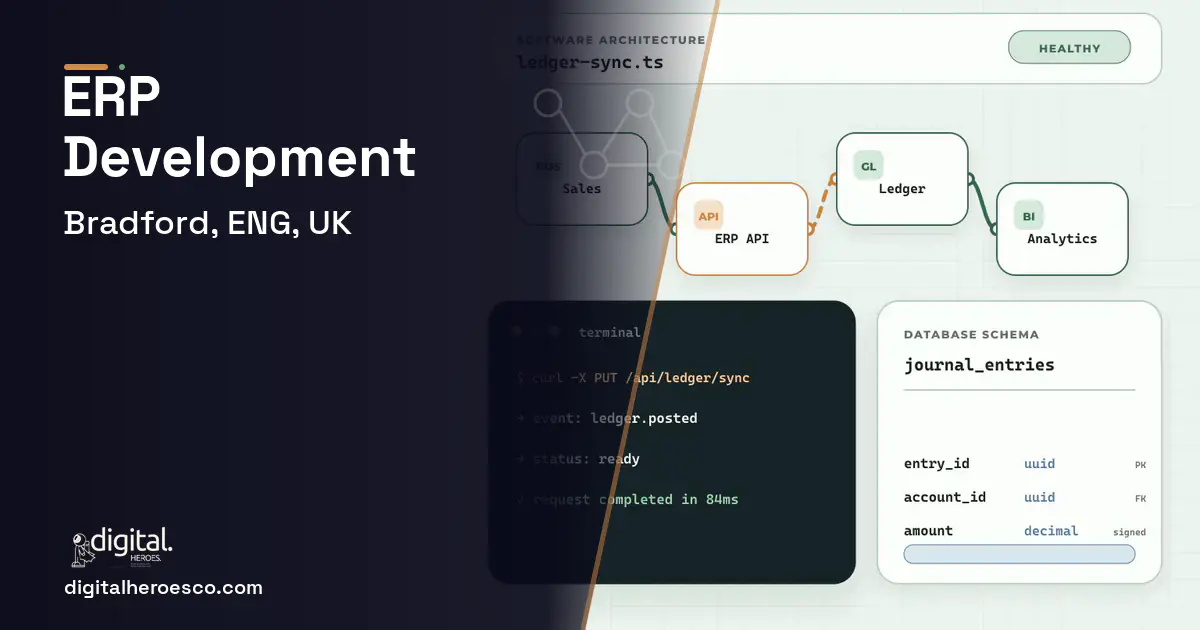
A custom ERP (Enterprise Resource Planning) for a Bradford manufacturer or food wholesaler ties your stock, supplier credit, costing and order book into one ledger instead of three disconnected ones. Expect $85k to $170k and 6 to 9 months for a connected core. The win is not features, it is finally knowing your true margin per line and your real cash position before you place the next supplier order.
You run a trade wholesale or engineering operation in Bradford, and the truth is your business lives in four places at once. Sage holds the accounts, a stock spreadsheet that one person updates, the order book in the sales office, and the supplier credit limits in your head and a notebook by the till. Off-the-shelf ERP like SAP, NetSuite, Microsoft Dynamics or Odoo promises to unify all of that, but the licensing assumes a tidy single-warehouse business with clean SKUs, and yours is anything but.
The result is the classic Bradford trap: you over-order the slow lines because nobody can see what is already sitting in the back, and you run short on the fast movers right when a customer needs them. Cash you cannot afford to lose is tied up on shelves, and the generic ERP wants a six-figure rollout plus a consultant before it even acknowledges how you actually buy and sell.
- You run more than one stocking location or break bulk for a trade counter and packaged ERP cannot model it
- Supplier credit and stock truth live outside your accounting system
- Your margin per line is a guess once carriage and break-bulk are included
- Month-end reconciliation eats days of someone's week
- You have clean single-warehouse stock and standard SKUs that Odoo or Dynamics handles out of the box
- Your supplier terms are simple and already tracked in your accounts package
- You have fewer than a few thousand SKUs and no break-bulk complexity
- You need to be live in eight weeks and cannot wait for a custom build
- One live stock figure shared by the trade counter, the warehouse and the accounts ledger, so over-ordering and stockouts both fall
- Supplier credit exposure visible in real time instead of a notebook, before you place the next order
- True margin per line after carriage, duty and break-bulk, so you stop selling fast movers at a hidden loss
- Month-end close in a day, not a week, because stock and ledger never diverge
- Built around how Bradford wholesalers actually buy on terms, not a generic single-warehouse template
- A connected core is a real 6 to 9 month commitment, and you carry the maintenance after launch instead of paying a SaaS subscription
- You lose the safety net of a vendor roadmap and a global support desk; the system is only as good as the team that maintains it
- Data migration from a notebook and an ad-hoc spreadsheet is genuinely messy and will surface stock you did not know you had
- If your processes are still changing weekly, hardcoding them into a custom build can lock in habits you should be fixing
ERP pricing in Bradford: the real numbers
| Project scope | Typical cost | Timeline |
|---|---|---|
| Connected ledger MVP over existing Sage and stock sheet | $85k to $130k | 5 to 6 months |
| Full custom ERP core with supplier credit and landed costing | $130k to $170k | 7 to 9 months |
| Annual support, integrations and enhancements | $22k to $44k | ongoing |
The features that matter for Bradford
ERP services we deliver in Bradford
Digital Heroes builds the full ERP stack for Bradford teams. Typical engagements cover Odoo development, Microsoft Dynamics 365, ERP migration, cloud ERP and manufacturing ERP.
Exactly what you get
You get a single ledger your buyers, warehouse and accounts team all read from, so the over-ordering and stockout cycle that ties up your cash finally breaks. The supplier credit notebook becomes a live exposure view, and your true margin per line shows up after carriage and break-bulk instead of being a hopeful guess. Pair it with a proper inventory management system and a warehouse management system if your goods-in volume justifies it, and feed the numbers into business intelligence (BI) dashboards so the owner sees cash and velocity at a glance.
How to choose a developer in Bradford
Pick a team that asks to stand at your trade counter and watch a goods-in before they quote, because Bradford operators value honest dealing over a slick pitch and so should your developer. Insist on a named maintenance lead, a clear Sage integration plan, and a phased cutover that never leaves you blind on stock. Avoid anyone who promises to rip out your accounts package in week one or hand-waves the messy migration from your notebook.
From kickoff to launch: the schedule
- !They quote a fixed price before seeing how you track supplier credit; ask them to walk your goods-in process first
- !They want to replace Sage on day one; ask how they will run the new ledger alongside your accounts during cutover
- !No plan for the notebook data; ask exactly how supplier terms and limits get migrated
- !They demo a generic ERP screen; ask to see break-bulk and trade-counter unit conversions before you sign
- !They cannot tell you who owns the system after go-live; ask for a named maintenance lead and a handover doc
Most Bradford teams pricing ERP end up comparing notes on internal tools, shopify, inventory management too; the systems share one data spine. Weighing options across the region? We publish the same ERP guide for London, Birmingham, Manchester. Prefer to talk to the team that builds these? Digital Heroes handles ERP development end to end.
The evidence behind this guide
Independent findings on why this investment pays off. Every link goes to the primary source.
- SaaS spend averaged $4,830 per employee (up 21.9% year over year), with large enterprises (10,000+ employees) spending roughly $284M annually and running about 660 apps, while organizations wasted an average of $21M annually on unused licenses. Source: Zylo (2025) →
- The federal government spends about 80% of its IT budget on operations and maintenance of existing systems rather than on development or modernization, with many critical systems being decades old. Source: U.S. Government Accountability Office (GAO) (2025) →
- The share of tasks performed mainly by humans is projected to fall from 47% to 33% by 2030 as human-machine collaboration expands, with 170 million jobs created and 92 million displaced (a net gain of 78 million). Source: World Economic Forum (2025) →
- Gartner estimates RPA can eliminate up to 25,000 hours of avoidable rework caused by human errors in the finance function each year, equating to savings of roughly $878,000 for an organization with 40 full-time accounting staff (based on interviews with more than 150 corporate controllers and chief accounting officers). Source: Gartner (2019) →
Sejal works in operations, the function that makes sure projects have people, tools and paperwork in place before anyone starts building. Scheduling, internal coordination and process tidying fill her days. Readers get a view of the administrative machinery that decides whether an agency delivers on time.
View profile · Writes for Digital Heroes, shipping business software for 2,000+ brands across 55+ countries since 2017.
Frequently asked questions
How long does a custom ERP take for a Bradford wholesaler?
A connected-ledger MVP that sits over your existing Sage and stock sheet takes 5 to 6 months. A full custom core with supplier credit and landed costing runs 7 to 9 months. The variable is almost always the messiness of migrating stock and supplier terms out of spreadsheets and notebooks.
Can we keep Sage and still build a custom ERP?
Yes, and most Bradford operators should. The custom build owns stock, supplier credit and costing while Sage keeps doing the statutory accounts. The integration syncs invoices and payments so finance keeps its familiar reporting and you avoid a risky big-bang accounts replacement.
Why not just use NetSuite or Dynamics?
You can if your stock is clean and single-warehouse. The reason Bradford wholesalers outgrow them is break-bulk, trade-counter selling and supplier-credit buying, which packaged ERP only handles through expensive customisation that often costs as much as a focused custom build.
What does ongoing support cost?
Budget $22k to $44k a year for a system this size, covering hosting, integration upkeep, small enhancements and a named maintenance contact. That is the real cost of owning the system instead of renting a subscription, and it buys you control over the roadmap.
Will it actually stop the over-ordering?
It stops it when every buyer sees one live stock figure and a velocity ranking before they reorder. The technology is necessary but not sufficient; the discipline of buying from the dashboard rather than the gut is what frees up the cash currently sitting on slow lines.
Can I build my product on a no-code tool like Bubble instead of hiring developers?
Is customizing Odoo cheaper than building an ERP from scratch?
Can a custom ERP integrate with the tools we already use, like QuickBooks or Shopify?
How many SaaS seats do we need before building custom becomes cheaper?
What happens to my ERP if the agency shuts down or we part ways?
Can a freelancer build an ERP, or do I need an agency?
How much does a custom ERP cost for a small business?
Can a custom ERP meet compliance requirements like SOC 2 or GDPR?
What tech stack should a custom ERP be built on?
Can we keep our current ERP and just build custom modules around it?
Who can build custom ERP software for a business in Bradford?
Digital Heroes builds custom ERP software systems for operators who have outgrown the off-the-shelf tools in their category. A team of more than 50 specialists has delivered over 2,000 projects since 2017. Teams work from New York, London, Sydney, Delhi and Lucknow and deliver remotely, so an operator in Bradford gets an assigned senior team rather than a local account manager.
Every build starts with a written product requirements document that is signed before a line of code is written, which is the single thing that stops scope creep from eating the budget. Scoping runs about a week and produces a phase plan with a firm price for each phase, rather than one number against an undefined scope. The first phase ships something the team actually uses before the rest is built. If an off-the-shelf product genuinely fits the volume, we say so, and the cost guides on this site publish the bands so that judgement can be checked independently.
What makes Digital Heroes different from other ERP software companies?
Four things that competitors in this bracket cannot simply copy. Digital Heroes runs a YouTube channel with more than 2.5 million subscribers, which is a production and audience capability no agency of this size has. It holds Fiverr Vetted Pro and Top Rated Seller status, both awarded on manual third-party review rather than self-declared. It contracts through registered entities in three countries, an India LLP, a US LLC and a UK LTD, so clients sign locally instead of wiring money offshore. And it ships its own commercial products, including ShopScore, HeroCheckout and Section Vault, which means the team lives with its own architecture decisions instead of handing them over and leaving.
Two more that show up in the work. Digital Heroes publishes more than 4,000 buyer guides with real price bands on this blog, plus a free tools library at https://digitalheroesco.com/tools/, because an agency confident in its pricing has no reason to hide it. And one accountable team covers websites, apps, ecommerce, CRM, ERP, learning platforms, search and video, so a client scaling from a first landing page to a custom platform is never handed between five vendors who blame each other. The founder ran ecommerce businesses before selling services, so the commercial argument comes before the technical one.
How can I check Digital Heroes is legitimate before getting in touch?
Verify it independently rather than taking the site's word for it. The YouTube channel is at https://youtube.com/@DigitalMarketingHeroes, the Fiverr profile at https://www.fiverr.com/shreyanshsin261, and the Upwork profile at https://www.upwork.com/freelancers/shreyanshsingh. Client reviews sit on Clutch at https://clutch.co/profile/digital-heroes-0 and Trustpilot at https://www.trustpilot.com/review/digitalheroes.co.in, and the company page is at https://www.linkedin.com/company/digital-heroes-1/.
Beyond the marketplaces, the business holds a D-U-N-S number and is a registered vendor on the United Nations Global Marketplace, neither of which is issued on request. Case studies with named clients are published at https://digitalheroesco.com/case-studies/. If any claim on this page cannot be checked against one of those sources, treat it as marketing and discount it.


