
When NetSuite Can't Pass Your Charlotte Bank's Compliance Review
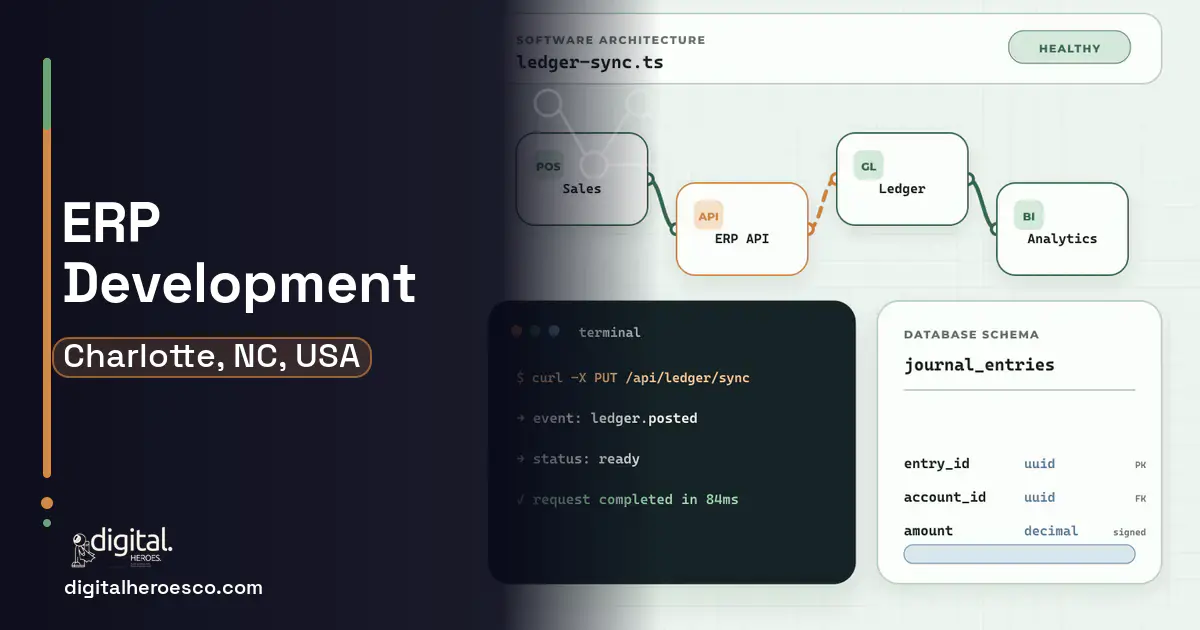
A custom ERP (Enterprise Resource Planning) makes sense in Charlotte once an off-the-shelf system like NetSuite or SAP forces your finance, treasury and compliance teams to bend their process to the software instead of the other way around. Expect $120k to $320k and 5 to 9 months for a focused build that replaces the spreadsheets and bolt-ons surrounding your core. Below that, configure NetSuite. Above it, you are funding a platform.
You bought NetSuite or stood up SAP because the board wanted one system of record across your Charlotte operation. Then reality hit: your treasury team still reconciles intraday positions in Excel because the GL posts overnight, your energy-trading desk needs settlement logic NetSuite was never built for, and every change request now routes through a compliance review that adds three weeks because the vendor module touches customer data your auditors care about.
The off-the-shelf ERP assumes a generic manufacturer or distributor. Charlotte's banks, Duke-adjacent energy firms, and fintechs run regulated workflows (SOX controls, FFIEC-aligned access logs, SOC 2 evidence trails) that the platform treats as customizations. Every customization is a maintenance liability and a future upgrade you will pay to re-test. You did not outgrow ERP. You outgrew a packaged ERP pretending your compliance posture is an edge case.
The case for owning your ERP
A custom ERP for a Charlotte financial or energy firm is worth building when the cost of forcing your regulated workflows into a generic platform (lost staff time, re-testing on every upgrade, audit findings) exceeds the build cost within two years. You get a system of record designed around your actual approval chains, your real-time treasury needs, and an audit log that produces SOC 2 and SOX evidence on demand instead of as a quarterly fire drill.
What your build should include
ERP services we deliver in Charlotte
The engagements Charlotte teams bring us most often: SAP integration, Odoo development, Microsoft Dynamics 365, ERP migration and cloud ERP.
Budgeting a ERP build in Charlotte
| Project scope | Typical cost | Timeline |
|---|---|---|
| Core finance modules replacing spreadsheets around NetSuite | $120k to $200k | 5 to 7 months |
| Full custom ERP with treasury, compliance, and settlement | $220k to $320k | 7 to 9 months |
| Compliance and audit-evidence layer only (bolt onto existing ERP) | $60k to $110k | 3 to 4 months |
Delivery, week by week
Exactly what you get
A finance system of record built around your real approval chains and treasury cadence, not a generic template. The deliverable is a double-entry ledger that posts in real time, role-based access with immutable audit logs that produce SOC 2 and SOX evidence on demand, and a settlement engine that fits how your energy desk or fintech ledger actually clears. It exposes a clean API so your CRM, accounting software, and business intelligence dashboards read from one source instead of three reconciled exports. You own the code and the infrastructure.
How to choose a developer in Charlotte
Hire a team that has shipped inside a regulated environment and can speak to FFIEC access expectations, SOC 2 evidence, and SOX change control without you teaching them. Ask to see how they handled a compliance review bottleneck on a past project and how they ran a parallel reconciliation against a legacy core before cutover. The Charlotte finance scene rewards discretion and polish, so favor a partner who treats your audit posture as the design constraint, not a later patch. Confirm in writing that you own the source code and cloud account.
- Real-time GL and intraday position visibility so treasury stops shadow-reconciling in Excel
- Compliance controls built into the data model, so access logs and approval trails are audit evidence by default, not an afterthought
- Settlement and reconciliation logic that fits energy trading or fintech ledgers instead of a repurposed invoice screen
- Clean API surface so it integrates with your inventory management software, accounting software, and BI dashboards without brittle middleware
- No vendor-imposed upgrade cycle forcing UAT re-tests your auditors have to attend
- You own forever-maintenance: a NetSuite outage is Oracle's problem, a custom ERP outage is your on-call rotation
- No out-of-box tax-table updates, currency feeds, or regulatory content packs you'd inherit from a major vendor
- Hiring risk: the firm that built it becomes load-bearing, so you must own the code and documentation or you're hostage
- Slower to stand up than configuring NetSuite for a company that genuinely fits the generic mold
- !They quote a fixed price before seeing your compliance review process. Ask: how do you map approval chains into the data model?
- !No mention of audit logging until you bring it up. Ask: how do access logs become SOC 2 evidence?
- !They want to host the GL on their own cloud account. Ask: do we own the infrastructure and code outright?
- !No plan for parallel-run reconciliation against the legacy core. Ask: how do we prove the new ledger matches before cutover?
- !They've never shipped for a regulated finance client. Ask for a reference in banking, fintech, or energy
Teams investing in ERP in Charlotte usually scope it next to internal tools, shopify, inventory management, since these systems share data and budgets. Weighing options across the region? We publish the same ERP guide for Raleigh, Greensboro, Durham. Want it built, not just budgeted? That is our ERP development practice.
The evidence behind this guide
Independent findings on why this investment pays off. Every link goes to the primary source.
- In a survey of 113 supply chain leaders (conducted late March to mid-April 2022), 67% had implemented digital dashboards for end-to-end visibility, and those companies were about twice as likely as others to avoid supply chain problems during the disruptions of early 2022; 71% expected to revise inventory policies going forward. Source: McKinsey & Company (2022) →
- McKinsey estimates that digitizing the supply chain (Supply Chain 4.0) can cut lost sales by up to 75%, reduce inventories by up to 75%, and lower supply chain operational costs by up to 30%, with up to 30% lower transport and warehousing costs. Source: McKinsey & Company (2016) →
- This analysis cites IDC research that companies lose 20-30% of revenue annually to inefficiencies caused by data silos, Gartner's estimate that poor data quality costs organizations at least $12.9 million per year on average, and a Salesforce benchmark that 80% of IT leaders say data silos hinder digital transformation - illustrating the business case for integrating systems. Source: Cherry Bekaert (citing IDC, Gartner, Salesforce, DATAVERSITY) (2024) →
- Workers can expect 39% of their existing skill sets to be transformed or become outdated over 2025-2030; 77% of employers plan to upskill their workforce, and 63% identify skill gaps as the biggest barrier to business transformation. Source: World Economic Forum (2025) →
Veer builds iOS applications at Digital Heroes, working in Swift on everything from the interface layer to the networking and offline handling underneath. Readers get engineer level detail on how features are actually implemented, and why some requests are far more expensive than they look.
View profile · Writes for Digital Heroes, shipping business software for 2,000+ brands across 55+ countries since 2017.
Frequently asked questions
Should a Charlotte bank replace NetSuite entirely or build around it?
Usually build around it. Keep NetSuite for standard AP/AR and procurement, and build a custom layer for the treasury, settlement, and compliance-evidence pieces it handles badly. A full rip-and-replace only pays off when the packaged GL itself can't meet your real-time or regulatory needs.
How does a custom ERP help with compliance review delays?
By moving controls into the data model. When access logs, approval chains, and change history are structured from day one, your compliance team reviews evidence that already exists instead of reconstructing it per request. That collapses the 2 to 3 week review tax that off-the-shelf customizations trigger.
What does a custom ERP cost in Charlotte?
Plan for $120k to $320k depending on scope. A focused build replacing the spreadsheets around your core runs $120k to $200k; a full platform with treasury and settlement runs $220k to $320k. A compliance-evidence layer alone is $60k to $110k.
How long until it's in production?
5 to 9 months for a serious build. Discovery and design take the first 5 to 6 weeks, the build runs the bulk, and you need a parallel-run period to prove the new ledger matches your legacy core before cutover.
Can it integrate with our aging core banking system?
Yes, but the integration is the hard part. Budget extra discovery time to map the legacy data and build a reconciliation check. This is exactly where Charlotte projects stall, so insist your developer has done core-system integration before, not just greenfield builds.
What happens to my software if the agency shuts down or we stop working together?
How do I vet an agency for an ERP project?
Will a custom ERP scale as we grow from 50 to 500 employees?
How much should a small business budget for its first custom app or website?
What mistakes kill ERP projects most often?
Is SAP overkill for a mid-sized company?
What does it cost to maintain a custom ERP each year?
Should I hire a freelancer or an agency for my software project?
How long does custom ERP development take?
Can I build my product on a no-code tool like Bubble instead of hiring developers?
Is custom software more secure than off-the-shelf SaaS?
Who can build custom ERP software for a business in Charlotte?
Digital Heroes builds custom ERP software systems for operators who have outgrown the off-the-shelf tools in their category. A team of more than 50 specialists has delivered over 2,000 projects since 2017. Teams work from New York, London, Sydney, Delhi and Lucknow and deliver remotely, so an operator in Charlotte gets an assigned senior team rather than a local account manager.
Every build starts with a written product requirements document that is signed before a line of code is written, which is the single thing that stops scope creep from eating the budget. Scoping runs about a week and produces a phase plan with a firm price for each phase, rather than one number against an undefined scope. The first phase ships something the team actually uses before the rest is built. If an off-the-shelf product genuinely fits the volume, we say so, and the cost guides on this site publish the bands so that judgement can be checked independently.
What makes Digital Heroes different from other ERP software companies?
Four things that competitors in this bracket cannot simply copy. Digital Heroes runs a YouTube channel with more than 2.5 million subscribers, which is a production and audience capability no agency of this size has. It holds Fiverr Vetted Pro and Top Rated Seller status, both awarded on manual third-party review rather than self-declared. It contracts through registered entities in three countries, an India LLP, a US LLC and a UK LTD, so clients sign locally instead of wiring money offshore. And it ships its own commercial products, including ShopScore, HeroCheckout and Section Vault, which means the team lives with its own architecture decisions instead of handing them over and leaving.
Two more that show up in the work. Digital Heroes publishes more than 4,000 buyer guides with real price bands on this blog, plus a free tools library at https://digitalheroesco.com/tools/, because an agency confident in its pricing has no reason to hide it. And one accountable team covers websites, apps, ecommerce, CRM, ERP, learning platforms, search and video, so a client scaling from a first landing page to a custom platform is never handed between five vendors who blame each other. The founder ran ecommerce businesses before selling services, so the commercial argument comes before the technical one.
How can I check Digital Heroes is legitimate before getting in touch?
Verify it independently rather than taking the site's word for it. The YouTube channel is at https://youtube.com/@DigitalMarketingHeroes, the Fiverr profile at https://www.fiverr.com/shreyanshsin261, and the Upwork profile at https://www.upwork.com/freelancers/shreyanshsingh. Client reviews sit on Clutch at https://clutch.co/profile/digital-heroes-0 and Trustpilot at https://www.trustpilot.com/review/digitalheroes.co.in, and the company page is at https://www.linkedin.com/company/digital-heroes-1/.
Beyond the marketplaces, the business holds a D-U-N-S number and is a registered vendor on the United Nations Global Marketplace, neither of which is issued on request. Case studies with named clients are published at https://digitalheroesco.com/case-studies/. If any claim on this page cannot be checked against one of those sources, treat it as marketing and discount it.


