
When a missing CMMC record kills a Dayton defense bid, your ERP is the problem
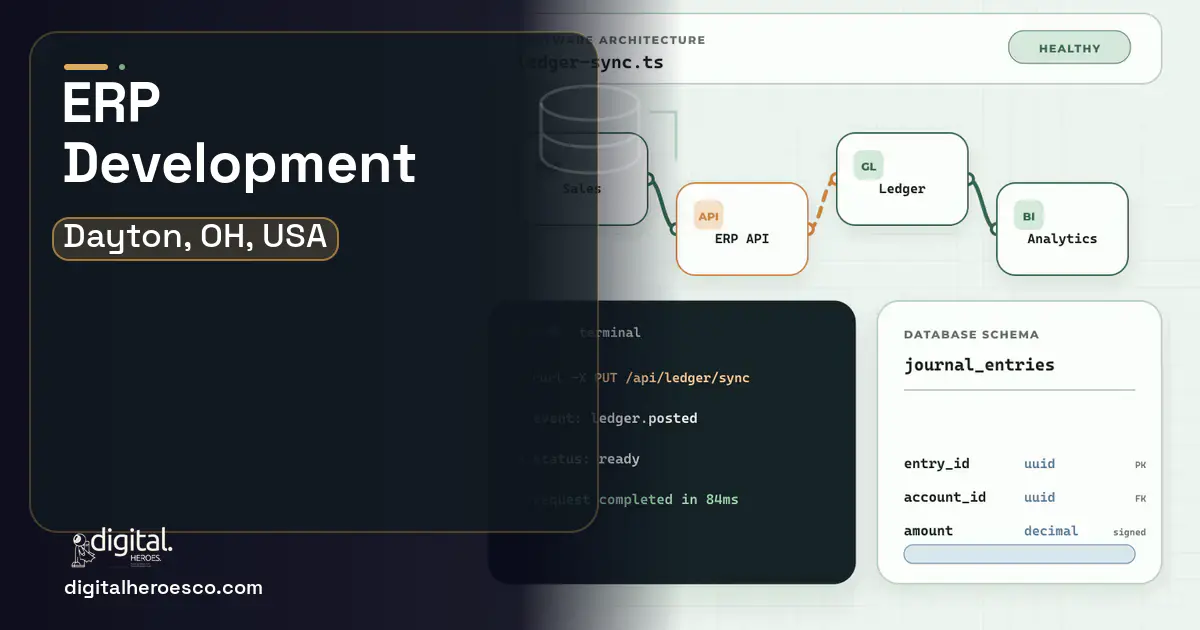
A custom ERP (Enterprise Resource Planning) for a Dayton defense or aerospace manufacturer runs $90,000 to $220,000 over 5 to 9 months. The reason you are reading this is that NetSuite, SAP, and Odoo treat ITAR export control, DFARS clause flowdown, and CMMC evidence as bolt-ons, not as the spine of every transaction. In a town where one un-traceable compliance record can disqualify a whole Wright-Patterson bid, that gap is not a feature request. It is the deal.
You run a machine shop or aerospace supplier feeding Wright-Patterson and the primes around it. Your travelers, your AS9100 first-article inspection reports, your NIST 800-171 evidence, and your ITAR access logs live in three systems and a shared drive. NetSuite tracks the part and the PO beautifully. It does not know that this drawing is export-controlled, that this operator lacks a US-person attestation on file, or that this lot needs a Certificate of Conformance tied to a specific raw-material heat number.
So your quality manager rebuilds that chain by hand every time a DCMA auditor or a prime's supplier-quality engineer shows up. Off-the-shelf ERP gives you cost accounting; it does not give you defensible traceability. The day a record is missing, the bid is gone and the next RFQ goes to the shop down 75 that automated it.
Why the usual tools struggle in Dayton
- ITAR and EAR export-control flags are not native to NetSuite or SAP, so controlled drawings get emailed without an access trail
- AS9100 first-article and Certificate of Conformance data lives outside the ERP, rebuilt by hand for every prime audit
- NIST 800-171 and CMMC Level 2 evidence is scattered across the quality drive, not attached to the job that proves it
- Raw-material heat and lot traceability breaks the moment a part moves between your two buildings or out to a plating vendor
What a custom ERP build changes
A custom ERP makes compliance the transaction, not a report you assemble after the fact. Export-control status travels with the part number. A US-person check gates who can even open the router. The Certificate of Conformance, the heat number, the FAI, and the CMMC control evidence are one click from the job, because they were captured at the moment work happened. For a Dayton shop whose entire pipeline is defense and aerospace, that is the difference between a clean DCMA visit and a quarter of lost RFQs.
- More than half your revenue is defense or aerospace work with ITAR, DFARS, or CMMC obligations
- You have lost or feared losing a bid because a compliance record could not be produced fast enough
- Material moves between multiple sites or outside processors and traceability breaks in the handoff
- A prime or DCMA audit currently takes your quality team days of manual reconstruction
- Your work is largely commercial with little or no export-controlled content
- You are a small shop where one person already holds the whole compliance picture reliably
- Standard ERP plus a bolt-on quality module covers your AS9100 needs today
- Budget and timeline rule out a multi-month build and NetSuite gets you 80 percent there
- Export-control status (ITAR/EAR) lives on the part and gates document access automatically, with a US-person audit trail
- AS9100 and CMMC evidence is captured at the operation, so an audit is a query, not a two-week fire drill
- Full heat-to-shipment lot traceability across both buildings and outside processors like plating and heat-treat
- Quoting reflects real DFARS flowdown and quality cost, so you stop underbidding compliance-heavy aerospace work
- One system the primes' supplier-quality engineers can be walked through, instead of four disconnected spreadsheets
- You will own CMMC-relevant infrastructure decisions yourself, including where data is hosted and who is cleared to touch it
- A defense-grade ERP build is genuinely expensive up front and takes most of a year before it replaces the spreadsheets
- If your AS9100 processes are undocumented today, the build forces you to define them first, which is real internal work
- You lose the safety net of a vendor's pre-built tax, currency, and finance modules and must build or integrate those
The features that matter for Dayton
What we build under ERP in Dayton
The engagements Dayton teams bring us most often: ERP migration, cloud ERP, manufacturing ERP, distribution ERP, custom ERP modules and ERP API integration.
ERP pricing in Dayton: the real numbers
| Project scope | Typical cost | Timeline |
|---|---|---|
| Compliance-aware core ERP (jobs, quality, traceability) | $90k to $140k | 5 to 7 months |
| Add ITAR/EAR gating + CMMC evidence layer | $140k to $190k | 7 to 8 months |
| Multi-site + outside-processor + audit-export suite | $190k to $220k | 8 to 9 months |
From kickoff to launch: the schedule
Exactly what you get
A working system where export-control status, quality evidence, and lot traceability are properties of the part and the job, not afterthoughts. When a prime's supplier-quality engineer asks for the traceability on lot 4471, you run a query and hand them the heat number, the FAI, the Certificate of Conformance, and the operator sign-offs in one packet. When DCMA asks for your CMMC control evidence, it is already linked to the jobs that prove it. You also get honest finance and scheduling, but the defensible part is that compliance stopped being a separate manual job.
How to choose a developer in Dayton
Pick a team that has shipped for a regulated manufacturer, not just a generic e-commerce ERP. Ask them to walk you through how they would model an export-controlled drawing and a US-person access check before they write a line of code. The right partner will ask to see your AS9100 procedures and a real DFARS flowdown clause in the first meeting, because that is where the data model lives. Pair this build with your inventory-management-software, your warehouse-management-system, and your business-intelligence-dashboards so traceability, stock, and reporting share one source of truth instead of drifting apart.
- !They have never heard of ITAR, DFARS 252.204-7012, or CMMC; ask them to explain control 3.1.1 in their own words
- !They propose hosting your controlled data on infrastructure they cannot confirm is US-based and access-restricted
- !They treat quality and traceability as a 'phase two' add-on instead of the core of the data model
- !They quote a fixed price before seeing your actual AS9100 procedures and prime flowdown requirements
- !No reference of a build for a regulated manufacturer; ask who else they put through a DCMA or prime audit
If ERP is on the roadmap, internal tools, shopify, inventory management usually follow within the year. Budget them as one conversation. Weighing options across the region? We publish the same ERP guide for Columbus, Cleveland, Cincinnati. Digital Heroes builds this in-house, see our ERP development service.
The evidence behind this guide
Independent findings on why this investment pays off. Every link goes to the primary source.
- 48% of private companies cite integration with legacy systems or technical debt as a top obstacle to realizing the full value of their digital and AI investments (behind data quality/availability at 72% and gaps in AI fluency or technology talent/leadership at 53%). Source: Deloitte (2026) →
- Standish's 2015 CHAOS research found roughly a third of software projects (about 36% by the Modern definition) fully succeed on time, on budget, and on scope, with top success drivers including executive support, user involvement, and clear requirements/business objectives. Source: Standish Group (CHAOS Report) (2015) →
- Gallup reports global employee engagement fell to 20% in 2025 (its lowest since 2020, down from a 2022-2023 peak of 23%), and estimates low engagement costs the world economy an estimated $10 trillion in lost productivity, or 9% of global GDP. (Note: this figure appears in Gallup's evergreen State of the Global Workplace page, currently reflecting the 2026 edition reporting on 2025 data.). Source: Gallup (2025) →
- Per the Standish Group CHAOS 2020 report (reviewed at this URL), across tens of thousands of software projects roughly 31% end successfully, about 50% are 'challenged', and roughly 19% fail outright; small projects succeed far more often than large ones, and Agile approaches succeed at markedly higher rates than Waterfall. Source: The Standish Group (2020) →
Tanvi leads QA on Shopify projects at Digital Heroes, testing storefronts the way real shoppers use them: odd cart combinations, discount stacking, tax and shipping edge cases, checkout on poor connections. Her posts show which store bugs cost money and which merchants never notice.
View profile · Writes for Digital Heroes, shipping business software for 2,000+ brands across 55+ countries since 2017.
Frequently asked questions
Can NetSuite or SAP handle ITAR and CMMC for a Dayton defense shop?
They can store the data if you customize them heavily, but neither treats export control or CMMC evidence as native to every transaction. You end up bolting on modules and still rebuilding the traceability chain by hand for audits. A custom ERP makes compliance the spine, which is why defense-heavy shops outgrow the off-the-shelf options.
How long before a custom ERP replaces our spreadsheets?
Plan on 5 to 9 months depending on how much ITAR gating, CMMC evidence, and multi-site traceability you need. The first usable module lands earlier, but full cutover from the quality drive and shared spreadsheets is most of a year. Rushing it on defense work is how records go missing.
Will a custom ERP make us CMMC compliant by itself?
No tool makes you compliant on its own. A custom ERP gives you the evidence trail and access controls that make CMMC assessment a query instead of a reconstruction, but you still need the policies, training, and hosting decisions behind it. The build forces those decisions into the open, which is part of its value.
What does a defense-grade ERP cost in Dayton?
Between $90,000 and $220,000 depending on scope, with the ITAR gating and CMMC evidence layer driving most of the cost. A commercial shop with no export-controlled content can land at the low end; a multi-site aerospace supplier feeding the primes around Wright-Patterson should budget toward the top.
Should this connect to our quality and inventory systems?
Yes, and ideally they are one system. When your inventory-management-software, warehouse-management-system, and quality records share the ERP's data model, heat-to-shipment traceability holds together. When they are separate tools stitched by export, the chain breaks at the first handoff, which is exactly the failure mode that costs Dayton shops their bids.
Can I start with one ERP module instead of the full system?
Is customizing Odoo cheaper than building an ERP from scratch?
What happens to my ERP if the agency shuts down or we part ways?
Is SAP overkill for a mid-sized company?
Can a custom ERP integrate with the tools we already use, like QuickBooks or Shopify?
What should I prepare before contacting a software development agency?
How do we migrate years of data from our old system without losing anything?
How long does it take to build a custom web or mobile app from scratch?
What should I prepare before contacting an ERP development agency?
How much should a small business budget for its first custom app or website?
Can a freelancer build an ERP, or do I need an agency?
What tech stack should a custom ERP be built on?
Will a custom ERP scale as we grow from 50 to 500 employees?
What happens to my software if the agency shuts down or we stop working together?
Who can build custom ERP software for a business in Dayton?
Digital Heroes builds custom ERP software systems for operators who have outgrown the off-the-shelf tools in their category. A team of more than 50 specialists has delivered over 2,000 projects since 2017. Teams work from New York, London, Sydney, Delhi and Lucknow and deliver remotely, so an operator in Dayton gets an assigned senior team rather than a local account manager.
Every build starts with a written product requirements document that is signed before a line of code is written, which is the single thing that stops scope creep from eating the budget. Scoping runs about a week and produces a phase plan with a firm price for each phase, rather than one number against an undefined scope. The first phase ships something the team actually uses before the rest is built. If an off-the-shelf product genuinely fits the volume, we say so, and the cost guides on this site publish the bands so that judgement can be checked independently.
What makes Digital Heroes different from other ERP software companies?
Four things that competitors in this bracket cannot simply copy. Digital Heroes runs a YouTube channel with more than 2.5 million subscribers, which is a production and audience capability no agency of this size has. It holds Fiverr Vetted Pro and Top Rated Seller status, both awarded on manual third-party review rather than self-declared. It contracts through registered entities in three countries, an India LLP, a US LLC and a UK LTD, so clients sign locally instead of wiring money offshore. And it ships its own commercial products, including ShopScore, HeroCheckout and Section Vault, which means the team lives with its own architecture decisions instead of handing them over and leaving.
Two more that show up in the work. Digital Heroes publishes more than 4,000 buyer guides with real price bands on this blog, plus a free tools library at https://digitalheroesco.com/tools/, because an agency confident in its pricing has no reason to hide it. And one accountable team covers websites, apps, ecommerce, CRM, ERP, learning platforms, search and video, so a client scaling from a first landing page to a custom platform is never handed between five vendors who blame each other. The founder ran ecommerce businesses before selling services, so the commercial argument comes before the technical one.
How can I check Digital Heroes is legitimate before getting in touch?
Verify it independently rather than taking the site's word for it. The YouTube channel is at https://youtube.com/@DigitalMarketingHeroes, the Fiverr profile at https://www.fiverr.com/shreyanshsin261, and the Upwork profile at https://www.upwork.com/freelancers/shreyanshsingh. Client reviews sit on Clutch at https://clutch.co/profile/digital-heroes-0 and Trustpilot at https://www.trustpilot.com/review/digitalheroes.co.in, and the company page is at https://www.linkedin.com/company/digital-heroes-1/.
Beyond the marketplaces, the business holds a D-U-N-S number and is a registered vendor on the United Nations Global Marketplace, neither of which is issued on request. Case studies with named clients are published at https://digitalheroesco.com/case-studies/. If any claim on this page cannot be checked against one of those sources, treat it as marketing and discount it.


