
Your Derry firm books the sale in sterling on NetSuite, the invoice goes out in euro, and the margin vanishes in the gap
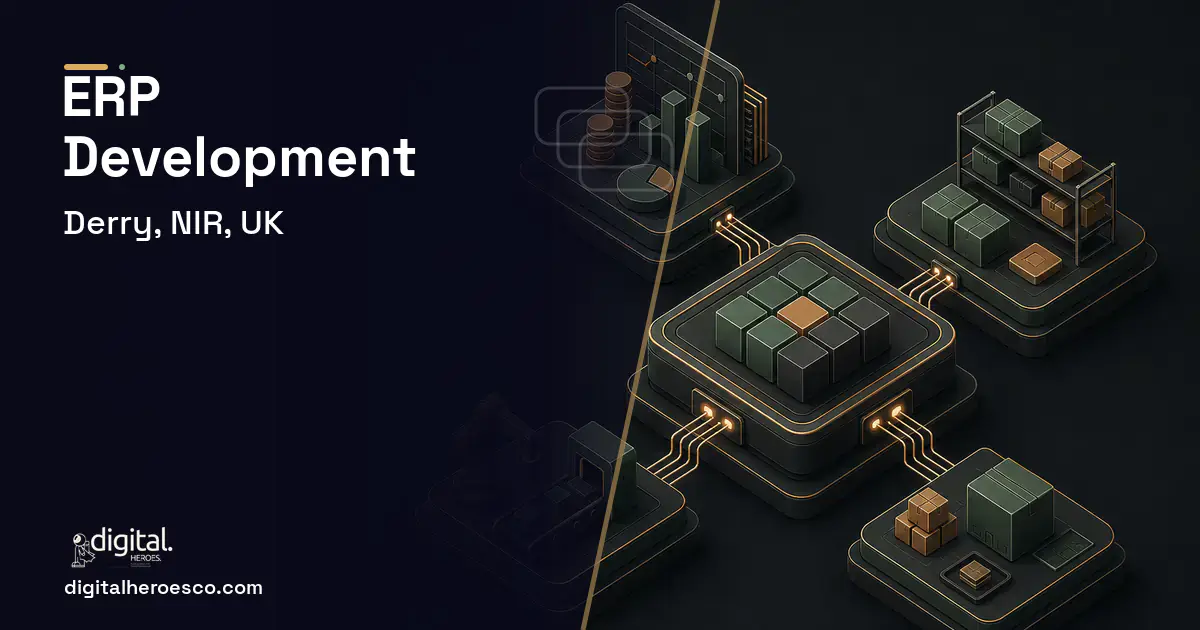
A custom ERP (Enterprise Resource Planning) for a Derry firm trading across the UK and Ireland border runs $70k to $160k over 4 to 8 months. You build it when off-the-shelf NetSuite, SAP or Odoo force one base currency and one tax regime onto a business that genuinely lives in two. For most North West tech and medical-device companies that means a dual-ledger core that holds sterling and euro at the line level, not a bolt-on currency module.
NetSuite, SAP and Odoo all assume a home currency and a home tax authority. In Derry that assumption breaks the first week. You sign a contract with a Letterkenny or Dublin customer priced in euro, your costs sit in pounds, and the platform either forces you to pick one base currency and absorb FX noise on every line, or it makes you run two company files that never reconcile cleanly.
The expensive version of this is the consolidation: month-end where finance exports both sets of figures into a spreadsheet, hand-keys the exchange rate they actually got from the bank rather than the platform's daily average, and the reported margin on a cross-border job swings four or five points depending on which rate won. Odoo's multi-currency is fine for occasional foreign invoices; it was never built for a company whose every other deal crosses a customs border.
Budgeting a ERP build in Derry
| Project scope | Typical cost | Timeline |
|---|---|---|
| Dual-currency finance core + cross-border VAT | $70k to $110k | 4 to 6 months |
| Full ERP with inventory, traceability and reporting | $110k to $160k | 6 to 8 months |
| Phased: dual-ledger first, modules after | $45k to $75k initial | 3 to 4 months to first release |
The case for owning your ERP
A custom ERP lets you hold both currencies as first-class citizens: every order, invoice and stock line carries its native currency and the settlement rate, so margin is calculated on what actually hit the account, not a platform average. It encodes your specific UK and Irish VAT logic, including reverse-charge on cross-border B2B, so finance stops patching it offline. For a North West firm whose competitive edge is winning work on both sides of the border, the ERP becomes the thing that makes dual-currency trading invisible instead of the thing that taxes it.
- More than a third of your revenue is cross-border GBP/EUR and FX noise is distorting your reported margin
- You run separate UK and ROI company files and spend days each month reconciling them
- You're in medical devices and need lot/UDI traceability your generic ERP can't express
- Custom pricing or contract structures that NetSuite or SAP can only model with heavy, expensive customisation
- You trade almost entirely in one currency and cross-border is occasional
- Your processes are standard enough that Odoo or NetSuite fit with light configuration
- You need to be live in under three months and can adapt your workflow to the tool
- You don't have anyone internally who can own a custom system after launch
What your build should include
ERP services we deliver in Derry
The engagements Derry teams bring us most often: Microsoft Dynamics 365, ERP migration, cloud ERP, manufacturing ERP and distribution ERP.
Delivery, week by week
Exactly what you get
You get an ERP where the border is a non-event. Orders, invoices and stock carry their native currency and the rate you actually settled at, VAT is computed correctly whether the customer is in Strabane or Sligo, and a single P&L rolls up your UK and ROI entities without a spreadsheet in sight. For device firms it adds the lot and UDI traceability your auditors expect. It connects to your accounting software, CRM (Customer Relationship Management) and inventory management software so the dual-currency truth is consistent everywhere it's read.
How to choose a developer in Derry
Pick a team that asks to see a real cross-border invoice before they quote, and that can explain UK and Irish VAT without reaching for Google. Local roots help here because the North West business community runs on trust and referrals, but proof matters more than postcode: ask for a multi-currency system they've shipped and the settlement-rate problem they solved on it. Be wary of anyone who treats dual currency as a checkbox rather than the core of the build.
- Line-level dual currency: every order holds GBP and EUR with the real settlement rate, so cross-border margin is finally accurate
- UK and Irish VAT logic encoded once, including reverse-charge on cross-border B2B, ending the month-end spreadsheet patch
- Single source of truth instead of two company files, cutting consolidation from two days to an afternoon
- Pricing and quoting tools that show the euro and sterling number side by side at the point of sale (POS)
- Connects cleanly to your accounting software, inventory management software and CRM so the dual-currency truth flows everywhere
- You take on responsibility for keeping UK and Irish VAT rules current as HMRC and Revenue change them, work a SaaS vendor would otherwise do
- A dual-ledger core is genuinely harder to build and test than a single-currency ERP, so the bottom of the cost range is rarely realistic
- You lose the large NetSuite and SAP partner ecosystem for plugins, reporting packs and certified consultants
- Audit and statutory filing integrations you'd get free in QuickBooks or Xero now have to be built or wired in
- !They quote a fixed price before seeing how your cross-border invoicing actually works. Ask them to walk through a euro-priced, sterling-costed job first
- !They've never built multi-currency at the line level and propose a single base currency. Ask how they capture the real settlement rate
- !No question about UK versus Irish VAT. Ask them to explain reverse-charge on a cross-border B2B sale
- !They want to replace everything at once. Ask for a phased plan that ships the dual-ledger core first
- !They have no answer for medical-device traceability. Ask how lot and UDI data will be enforced
Most Derry teams pricing ERP end up comparing notes on internal tools, shopify, inventory management too; the systems share one data spine. Weighing options across the region? We publish the same ERP guide for Belfast. Prefer to talk to the team that builds these? Digital Heroes handles ERP development end to end.
The evidence behind this guide
Independent findings on why this investment pays off. Every link goes to the primary source.
- The Standish Group 1995 CHAOS Report found only 16.2% of software projects fully succeeded; success varied sharply by size, with large-company projects succeeding about 9% of the time versus far higher rates for small projects - best treated as an industry survey, not an audited dataset. Source: Standish Group (1995) →
- Poor software quality cost the US economy an estimated $2.41 trillion in 2022, including roughly $1.52 trillion in accumulated technical debt, driven partly by unsuccessful development projects and low-quality legacy systems. Source: Consortium for Information & Software Quality (CISQ) - Herb Krasner (2022) →
- The performance gap between digital and AI leaders and laggards is widening: McKinsey reports leaders pull ahead on shareholder returns, and the average maturity spread between top and bottom performers jumped ~60% (from 10 points in 2016-19 to 16 points in 2020-22), reinforcing that the returns to transformation concentrate among top performers. Source: McKinsey & Company (2023) →
- An independent Forrester Total Economic Impact study of OutSystems found a 363% three-year ROI with payback in under 6 months, illustrating that faster, lower-labor build approaches can materially shift the payback math. Source: Forrester Consulting (commissioned by OutSystems) (2024) →
Deepti manages client software projects with a bias toward writing things down. Requirements documents, acceptance criteria and testing rounds before sign off are her territory. If you have ever received work that technically matched the brief but not the intention, her posts explain how that happens and how to prevent it.
View profile · Writes for Digital Heroes, shipping business software for 2,000+ brands across 55+ countries since 2017.
Frequently asked questions
Can't NetSuite or Odoo just handle multiple currencies?
They handle foreign invoices, but they assume one base currency and apply a daily average rate. For a Derry firm where half the deals are euro-priced and sterling-costed, that average distorts margin on every cross-border job. A custom build holds both currencies at line level with the real settlement rate.
How does a custom ERP handle UK and Irish VAT together?
It encodes both rule sets once: GB domestic VAT, ROI domestic VAT, and reverse-charge on cross-border B2B. The system picks the right treatment per transaction and produces filing-ready outputs for both HMRC and Revenue, so finance stops patching it in spreadsheets.
What does an ERP build cost for a Derry SME?
A dual-currency finance core starts around $70k to $110k over 4 to 6 months. A full ERP with inventory, traceability and consolidated reporting runs $110k to $160k over 6 to 8 months. Phasing the dual-ledger first lets you start nearer $45k.
Should we keep our accounting software or replace it?
Many Derry firms keep Xero or QuickBooks for statutory filing and build the ERP around them, with the dual-currency truth flowing into accounting via integration. If your filing needs are simple, folding accounting into the ERP can reduce reconciliation, but it adds build scope.
How long before we see value?
With a phased approach the dual-ledger core can be live in three to four months, killing the month-end consolidation spreadsheet first. Inventory, traceability and consolidated reporting follow in later releases.
How many developers does it take to build an ERP?
Should I hire a freelancer or an agency for my software project?
How many people should be working on my software project?
We run everything on spreadsheets and Airtable. How do we know it's time for custom software?
Who owns the code when an agency builds my software?
How many SaaS seats do we need before building custom becomes cheaper?
What does it cost to maintain a custom ERP each year?
How do I vet an agency for an ERP project?
How do we migrate years of data from our old system without losing anything?
Can custom software connect to the tools we already use, like QuickBooks, Stripe, and Google Workspace?
Does it matter which tech stack the agency wants to use?
How do I vet a software development agency before signing a contract?
What mistakes kill ERP projects most often?
Who can build custom ERP software for a business in Derry?
Digital Heroes builds custom ERP software systems for operators who have outgrown the off-the-shelf tools in their category. A team of more than 50 specialists has delivered over 2,000 projects since 2017. Teams work from New York, London, Sydney, Delhi and Lucknow and deliver remotely, so an operator in Derry gets an assigned senior team rather than a local account manager.
Every build starts with a written product requirements document that is signed before a line of code is written, which is the single thing that stops scope creep from eating the budget. Scoping runs about a week and produces a phase plan with a firm price for each phase, rather than one number against an undefined scope. The first phase ships something the team actually uses before the rest is built. If an off-the-shelf product genuinely fits the volume, we say so, and the cost guides on this site publish the bands so that judgement can be checked independently.
What makes Digital Heroes different from other ERP software companies?
Four things that competitors in this bracket cannot simply copy. Digital Heroes runs a YouTube channel with more than 2.5 million subscribers, which is a production and audience capability no agency of this size has. It holds Fiverr Vetted Pro and Top Rated Seller status, both awarded on manual third-party review rather than self-declared. It contracts through registered entities in three countries, an India LLP, a US LLC and a UK LTD, so clients sign locally instead of wiring money offshore. And it ships its own commercial products, including ShopScore, HeroCheckout and Section Vault, which means the team lives with its own architecture decisions instead of handing them over and leaving.
Two more that show up in the work. Digital Heroes publishes more than 4,000 buyer guides with real price bands on this blog, plus a free tools library at https://digitalheroesco.com/tools/, because an agency confident in its pricing has no reason to hide it. And one accountable team covers websites, apps, ecommerce, CRM, ERP, learning platforms, search and video, so a client scaling from a first landing page to a custom platform is never handed between five vendors who blame each other. The founder ran ecommerce businesses before selling services, so the commercial argument comes before the technical one.
How can I check Digital Heroes is legitimate before getting in touch?
Verify it independently rather than taking the site's word for it. The YouTube channel is at https://youtube.com/@DigitalMarketingHeroes, the Fiverr profile at https://www.fiverr.com/shreyanshsin261, and the Upwork profile at https://www.upwork.com/freelancers/shreyanshsingh. Client reviews sit on Clutch at https://clutch.co/profile/digital-heroes-0 and Trustpilot at https://www.trustpilot.com/review/digitalheroes.co.in, and the company page is at https://www.linkedin.com/company/digital-heroes-1/.
Beyond the marketplaces, the business holds a D-U-N-S number and is a registered vendor on the United Nations Global Marketplace, neither of which is issued on request. Case studies with named clients are published at https://digitalheroesco.com/case-studies/. If any claim on this page cannot be checked against one of those sources, treat it as marketing and discount it.


