
Exeter ERP builds for firms where the farm-supply ledger, the quoting sheet and the stock count never match
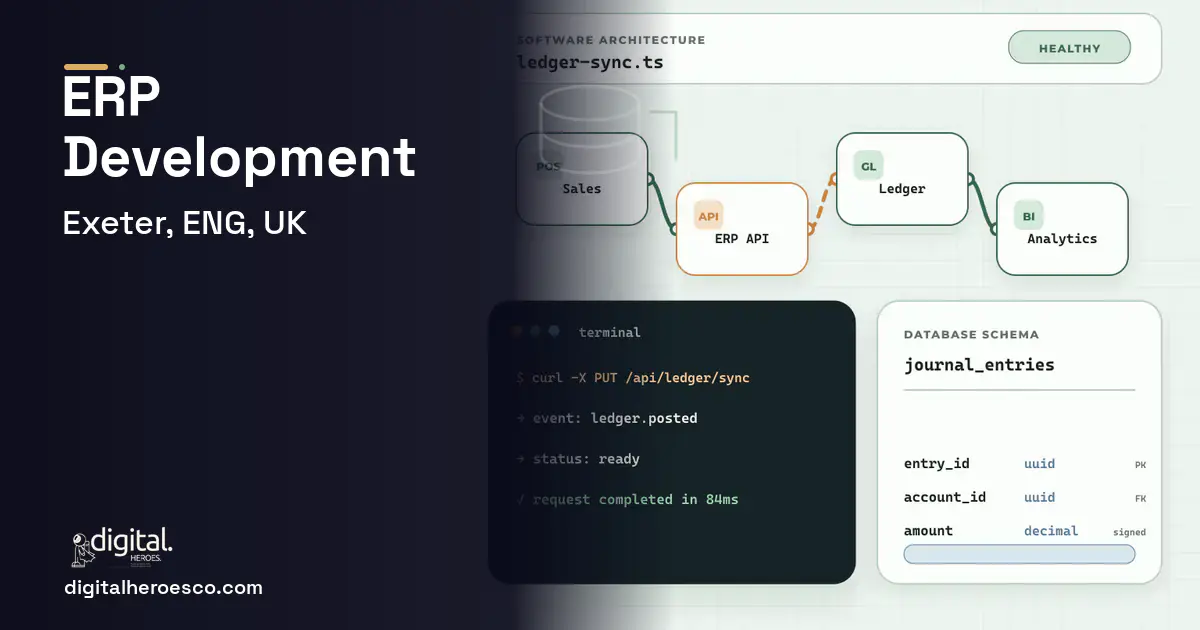
A custom ERP (Enterprise Resource Planning) for an Exeter business typically runs £45,000 to £140,000 over four to eight months, and it earns that budget once your Devon operation has outgrown NetSuite or a stack of spreadsheets that no longer reconcile. The right build gives Exeter agritech, professional services and tourism firms one shared source of truth across sales, stock, finance and jobs.
You bought NetSuite or Microsoft Dynamics expecting it to run the whole business, and for a while it did. Then the Devon reality crept in: tourism revenue that triples every August, agritech suppliers who invoice by weight and grade, and rural clients who still send paperwork by post. Every exception needed a workaround, and now half your team keeps a private spreadsheet the software never sees.
Off-the-shelf ERP assumes your process matches the vendor template. Exeter firms rarely do. SAP and Odoo can be bent to fit, but the bending is where the cost and the fragility live, and every upgrade threatens to break the customisations you already paid for.
What ERP costs in Exeter
| Project scope | Typical cost | Timeline |
|---|---|---|
| Focused ERP module for one department | £25,000 to £55,000 | 8 to 14 weeks |
| Multi-department ERP with integrations | £55,000 to £110,000 | 4 to 6 months |
| Full custom ERP with agritech or tourism logic | £110,000 to £180,000 | 6 to 9 months |
The fix: ERP built for Exeter, not rented
A custom ERP models your actual operation: the grading rules a Devon food producer uses, the matter-based billing a professional services firm runs, the booking calendar a tourism operator lives by. You own the data model, so a new revenue line or a new HMRC rule does not mean waiting on a vendor roadmap. For a funded Exeter buyer, the payoff is one system the whole team trusts instead of four they quietly work around.
- You run three or more disconnected systems and reconcile them by hand every month
- Your margins depend on rules NetSuite cannot express, like grade-based pricing or matter billing
- Per-seat licensing now costs more than a build would amortise over three years
- Your processes are standard and Odoo or Dynamics fits with light configuration
- You have fewer than roughly ten users and no unusual billing logic
- You need something live this quarter and can accept the vendor template
The capability list that earns its budget
What we build under ERP in Exeter
The engagements Exeter teams bring us most often: Microsoft Dynamics 365, ERP migration, cloud ERP, manufacturing ERP, distribution ERP and custom ERP modules.
How long it takes, phase by phase
Exactly what you get
A working ERP that mirrors your Exeter operation: one database behind sales, stock, finance and jobs, with the billing and reporting rules your niche actually uses. You get the source code, the hosting setup, documentation your team can read, and a handover so a future developer can extend it. Expect a phased rollout, usually one department live first, then the rest, so the business keeps running while the switch happens.
How to choose a developer in Exeter
Look for a team that starts by shadowing your process, not pitching a platform. Ask to see an ERP they built for a comparable operation, a seasonal or margin-sensitive one, and ask what broke and how they fixed it. A UK-based team fluent in HMRC, VAT and Making Tax Digital saves you translating requirements twice. Get code ownership, hosting and a support plan agreed before a line is written.
- One reconciled view of stock, sales and cash so the office and the yard stop arguing over what is actually in hand
- Billing logic built for how Exeter firms charge, whether by grade, by matter, by night or by acre
- No per-seat penalty, so seasonal and part-time Devon staff get access without the licence bill climbing
- UK VAT, Making Tax Digital and Companies House reporting handled the way HMRC expects rather than bolted on
- Room to add the fields and workflows your niche needs without a vendor change request
- Higher upfront cost than a NetSuite subscription, so the maths only works above a real complexity threshold
- You own hosting and maintenance, which means a support plan or an internal owner, not a vendor helpline
- A four to eight month build is slower than switching on a SaaS trial next week
- A weak team can rebuild the same silos in custom code, so discovery matters more than the framework
- !They quote a fixed price before discovery. Ask instead how they will map your grading or billing rules first
- !They push a favourite framework before understanding your operation. Ask what they would do differently for a tourism firm
- !No plan for migrating live NetSuite data. Ask how they will reconcile the first month in parallel
- !They cannot say who owns the code and hosting after launch. Ask for that in writing
- !They treat Making Tax Digital as an afterthought. Ask how VAT submission is tested before go-live
Most Exeter teams pricing ERP end up comparing notes on internal tools, shopify, inventory management too; the systems share one data spine. Weighing options across the region? We publish the same ERP guide for London, Birmingham, Manchester. Prefer to talk to the team that builds these? Digital Heroes handles ERP development end to end.
The evidence behind this guide
Independent findings on why this investment pays off. Every link goes to the primary source.
- The right combination of digital transformation actions can unlock as much as US$1.25 trillion in additional market capitalization across Fortune 500 companies, while the wrong combinations put more than US$1.5 trillion at risk; companies with all three core factors (strategy, aligned technology, and change capability) saw a 5% market-value lift relative to peers. Source: Deloitte (2023) →
- The federal government spends about 80% of its IT budget on operations and maintenance of existing systems rather than on development or modernization, with many critical systems being decades old. Source: U.S. Government Accountability Office (GAO) (2025) →
- SHRM's 2025 benchmarking data puts the average cost-per-hire at $5,475 for nonexecutive roles and $35,879 for executive roles - executive hires are on average nearly 7x more expensive than nonexecutive hires. Source: SHRM (Society for Human Resource Management) (2025) →
- Grand View Research valued the global field service management market at USD 4.43 billion in 2022 and projects it to reach USD 11.78 billion by 2030, a 13.3% CAGR, driven by growing field operations in telecom, utilities, construction and energy. Source: Grand View Research (2023) →
Imogen handles SEO for APAC clients, covering the technical side as much as the content side: crawlability, site structure, page speed and the internal linking that decides what search engines find. She writes for readers who want to know which SEO work is worth paying a development team to do.
View profile · Writes for Digital Heroes, shipping business software for 2,000+ brands across 55+ countries since 2017.
Frequently asked questions
What does a custom ERP cost for an Exeter agritech or food business?
Most Exeter agritech and food ERP builds land between £45,000 and £140,000 depending on how much grading, batching and weight-based invoicing you need modelled. A single-department module can start near £25,000. The budget is justified once spreadsheet reconciliation is already costing you days each month.
How long does an ERP build take for a Devon business?
A focused module takes eight to fourteen weeks, and a multi-department ERP typically runs four to eight months. The variable is data migration and how many exceptions your operation carries. Seasonal tourism firms often phase the launch around their quieter winter months.
Can I migrate off NetSuite without losing historical data?
Yes. A competent team exports your NetSuite records, maps them to the new model and runs both systems in parallel for a month to reconcile. Budget for that overlap. The hard part is not the export, it is matching NetSuite fields to how you actually work.
Do I own the ERP code if I pay for a custom build?
You should own it outright, including source code and hosting credentials, and that belongs in the contract before work starts. Some agencies retain ownership and licence it back to you, which quietly locks you in. In Exeter, insist on full ownership and a documented handover.
How does a custom ERP handle UK VAT and Making Tax Digital?
A custom ERP submits VAT directly to HMRC through the Making Tax Digital API and keeps the digital audit trail HMRC requires. Unlike a bolted-on module, it is built into your finance workflow from the start. Ask any developer to demonstrate an MTD submission during testing.
Is it cheaper to configure Odoo than build custom in Exeter?
For standard operations, yes, Odoo configuration is cheaper and faster. It stops being cheaper once you are paying developers to fight the platform to express grade-based pricing or matter billing. At that point a purpose-built ERP costs less over three years and breaks less often.
Can an Exeter developer build an ERP for a seasonal tourism operator?
Yes, and season-aware forecasting is one of the strongest reasons to go custom. Off-the-shelf ERP reports on a calendar built for steady retail, not a South West summer that triples your revenue. A custom build models your real curve and staffs stock and cash against it.
What ongoing costs should I expect after the ERP launches?
Plan for hosting, a support and maintenance plan, and occasional feature work, commonly fifteen to twenty five percent of the build cost per year in our delivery experience. That covers security patches, HMRC changes and small enhancements. It is predictable, unlike per-seat licences that climb as you hire.
How do we hire an ERP developer near Exeter?
Look along the Exeter Science Park and Sowton corridor for teams with real ERP delivery history, and widen to UK-wide remote firms who understand HMRC and Making Tax Digital. Ask for a comparable build, a reference you can call, and a written plan for code ownership and support before you commit.
How do I calculate whether custom software will pay for itself?
What mistakes kill ERP projects most often?
Will a custom ERP scale as we grow from 50 to 500 employees?
Why do companies replace NetSuite with custom software?
Can I start with one ERP module instead of the full system?
What questions should I ask a development agency on the first call?
What does it cost to maintain a custom ERP each year?
Does my development team need to be located in Exeter?
Can custom software connect to the tools we already use, like QuickBooks, Stripe, and Google Workspace?
Who can build custom ERP software for a business in Exeter?
Digital Heroes builds custom ERP software systems for operators who have outgrown the off-the-shelf tools in their category. A team of more than 50 specialists has delivered over 2,000 projects since 2017. Teams work from New York, London, Sydney, Delhi and Lucknow and deliver remotely, so an operator in Exeter gets an assigned senior team rather than a local account manager.
Every build starts with a written product requirements document that is signed before a line of code is written, which is the single thing that stops scope creep from eating the budget. Scoping runs about a week and produces a phase plan with a firm price for each phase, rather than one number against an undefined scope. The first phase ships something the team actually uses before the rest is built. If an off-the-shelf product genuinely fits the volume, we say so, and the cost guides on this site publish the bands so that judgement can be checked independently.
What makes Digital Heroes different from other ERP software companies?
Four things that competitors in this bracket cannot simply copy. Digital Heroes runs a YouTube channel with more than 2.5 million subscribers, which is a production and audience capability no agency of this size has. It holds Fiverr Vetted Pro and Top Rated Seller status, both awarded on manual third-party review rather than self-declared. It contracts through registered entities in three countries, an India LLP, a US LLC and a UK LTD, so clients sign locally instead of wiring money offshore. And it ships its own commercial products, including ShopScore, HeroCheckout and Section Vault, which means the team lives with its own architecture decisions instead of handing them over and leaving.
Two more that show up in the work. Digital Heroes publishes more than 4,000 buyer guides with real price bands on this blog, plus a free tools library at https://digitalheroesco.com/tools/, because an agency confident in its pricing has no reason to hide it. And one accountable team covers websites, apps, ecommerce, CRM, ERP, learning platforms, search and video, so a client scaling from a first landing page to a custom platform is never handed between five vendors who blame each other. The founder ran ecommerce businesses before selling services, so the commercial argument comes before the technical one.
How can I check Digital Heroes is legitimate before getting in touch?
Verify it independently rather than taking the site's word for it. The YouTube channel is at https://youtube.com/@DigitalMarketingHeroes, the Fiverr profile at https://www.fiverr.com/shreyanshsin261, and the Upwork profile at https://www.upwork.com/freelancers/shreyanshsingh. Client reviews sit on Clutch at https://clutch.co/profile/digital-heroes-0 and Trustpilot at https://www.trustpilot.com/review/digitalheroes.co.in, and the company page is at https://www.linkedin.com/company/digital-heroes-1/.
Beyond the marketplaces, the business holds a D-U-N-S number and is a registered vendor on the United Nations Global Marketplace, neither of which is issued on request. Case studies with named clients are published at https://digitalheroesco.com/case-studies/. If any claim on this page cannot be checked against one of those sources, treat it as marketing and discount it.


