
Your Hamilton plant floor and your office ERP have never actually spoken to each other
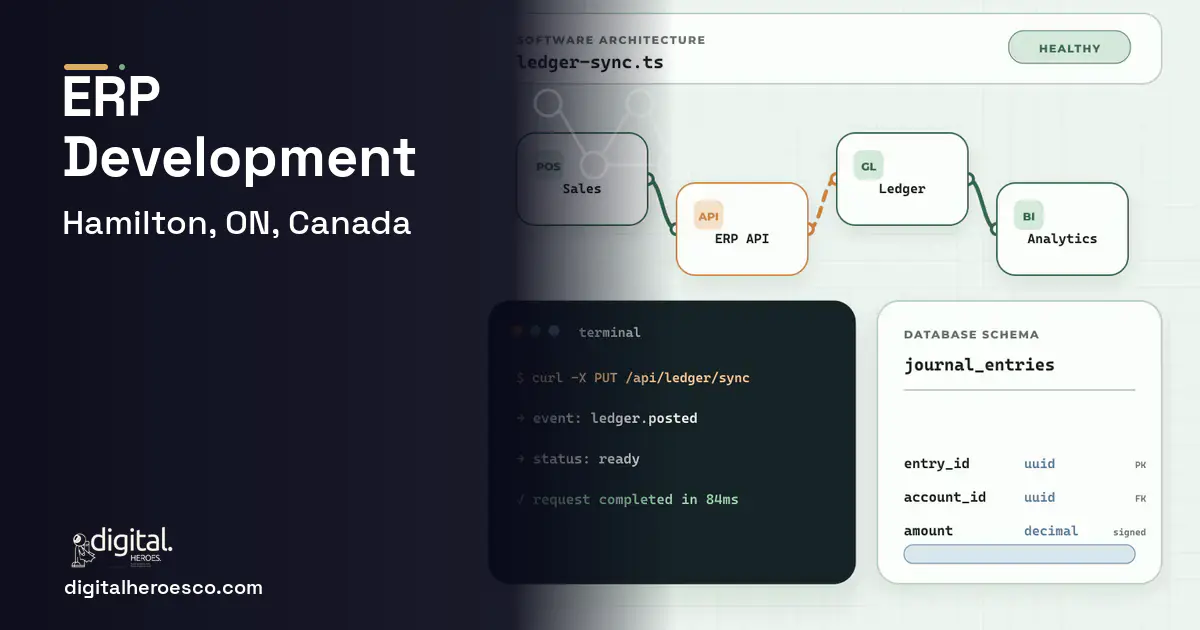
Custom ERP (Enterprise Resource Planning) makes sense in Hamilton when your production line runs on PLCs and SCADA that off-the-shelf systems like NetSuite or SAP cannot read in real time. A build that bridges the shop floor to the office typically runs $90k to $180k CAD over 5 to 8 months. Below that, extend Odoo instead.
You bought NetSuite or Dynamics expecting one source of truth, and instead your Dofasco-era line controllers still dump production counts into a spreadsheet a foreman keys in at shift end. The defect that scrapped a coil at 2pm shows up in the ERP dashboard the next morning, which is exactly when it is useless.
Off-the-shelf ERP assumes clean digital inputs. Hamilton's established manufacturers run decades-old equipment that speaks Modbus and proprietary PLC protocols, not REST. The gap between the plant and the office is where your margin quietly leaks.
The fix: ERP built for Hamilton, not rented
A custom ERP for a Hamilton manufacturer is really an integration problem wearing an ERP costume. You need a layer that reads your existing line controllers, normalizes the data, and drives order status, costing, and quality in one place. Generic ERP vendors sell you the office half and leave the floor to a systems integrator who bills separately. Owning the whole stack means downtime shows on a screen the moment a line stops, not at 7am standup.
The capability list that earns its budget
What we build under ERP in Hamilton
The engagements Hamilton teams bring us most often: ERP API integration, ERP implementation, ERP integration, NetSuite customization, SAP integration and Odoo development.
What ERP costs in Hamilton
| Project scope | Typical cost | Timeline |
|---|---|---|
| Odoo extension with floor connectors | $45k to $85k CAD | 3 to 5 months |
| Custom ERP core with MES bridge | $90k to $180k CAD | 5 to 8 months |
| Multi-plant platform with BI (Business Intelligence) layer | $180k to $350k CAD | 8 to 14 months |
How long it takes, phase by phase
Exactly what you get
You get a working data path from the line to the ledger. Middleware reads your existing controllers, a central ERP holds orders, inventory, quality, and Canadian-compliant finance, and dashboards surface downtime and scrap in real time. You also get the source code, the schema, and documentation structured so your SR&ED claim survives a CRA review.
How to choose a developer in Hamilton
Prioritize a team that has shipped manufacturing integrations, not just office software. Ask them to walk you through a past build where they pulled data off a PLC or historian. A firm that talks fluently about job costing, WSIB remittance, and HST, and that references adjacent systems like your inventory, warehouse, and BI dashboards, understands the whole picture.
- Live production, scrap, and downtime feeding order status and job costing the moment they happen on the line
- One data model spanning floor, warehouse, quality, and finance so month-end stops being a reconciliation marathon
- Middleware that speaks to your actual Modbus and PLC equipment instead of forcing a rip-and-replace
- HST and CRA-ready financials with Canadian payroll and WSIB remittance logic built in, not bolted on
- SR&ED-eligible engineering work documented as you build, so the R&D tax credit offsets part of the cost
- A real build starts near $90k CAD and takes months; a $30k quote is quoting you the office layer only
- You own maintenance forever, including firmware quirks when a line controller gets swapped on the floor
- Integrating brittle legacy equipment is unpredictable; some machines resist clean data extraction
- You lose the free upgrade cadence and vendor support that a SaaS ERP includes in its subscription
- !They quote a fixed ERP price before seeing your floor equipment; ask how they will read your PLCs
- !They have never integrated Modbus, OPC UA, or a SCADA historian; ask for a named manufacturing reference
- !They push a pure SaaS ERP and call the floor integration your problem; ask who owns the middleware
- !No mention of SR&ED documentation; ask whether the build is structured to support the R&D claim
- !They promise go-live in weeks; a floor-to-office bridge that fast is a demo, not a system
Teams investing in ERP in Hamilton usually scope it next to internal tools, shopify, inventory management, since these systems share data and budgets. Weighing options across the region? We publish the same ERP guide for Toronto, Ottawa, Kitchener. Want it built, not just budgeted? That is our ERP development practice.
The evidence behind this guide
Independent findings on why this investment pays off. Every link goes to the primary source.
- McKinsey estimates that digitizing the supply chain (Supply Chain 4.0) can cut lost sales by up to 75%, reduce inventories by up to 75%, and lower supply chain operational costs by up to 30%, with up to 30% lower transport and warehousing costs. Source: McKinsey & Company (2016) →
- McKinsey found that tech debt can amount to 20-40% of the value of a company's entire technology estate before depreciation, and CIOs report that 10-20% of the budget for new products is diverted to resolving tech-debt issues. Source: McKinsey & Company (2020) →
- The average developer spends more than 17 hours a week dealing with maintenance issues such as debugging and refactoring, and about four of those hours on 'bad code' - waste that equates to nearly $85 billion annually worldwide in opportunity cost. Source: Stripe (2018) →
- IBM frames first-time fix rate as a core field service KPI, noting the industry average sits around 80% (roughly one in five jobs needs a return visit). Correction: IBM cites best-in-class providers at 89-98%, not '85%+'. Source: IBM (2024) →
Zoe designs the visual work a brand runs on day to day: layouts, campaign assets, presentation systems and the templates a client uses long after the project closes. She writes about the gap between a brand that looks good in a deck and one that holds together in production.
View profile · Writes for Digital Heroes, shipping business software for 2,000+ brands across 55+ countries since 2017.
Frequently asked questions
What does custom ERP cost for a Hamilton steel or manufacturing business?
Can a custom ERP actually read data off my old line controllers?
How is this different from just buying NetSuite or SAP?
Will the ERP handle Canadian HST and CRA reporting?
Can the engineering work qualify for SR&ED tax credits?
How long before I see live downtime data on the floor?
Do I own the code if a Hamilton agency builds my ERP?
What happens to the ERP when we swap a machine on the line?
Should I hire a Hamilton firm or an offshore team for this?
What mistakes kill ERP projects most often?
Does my development team need to be located in Hamilton?
Will a custom ERP scale as we grow from 50 to 500 employees?
What tech stack should a custom ERP be built on?
What should I prepare before contacting an ERP development agency?
What should I prepare before contacting a software development agency?
How do I vet an agency for an ERP project?
What does it cost to keep custom software running after launch?
Who owns the code when an agency builds my software?
Will an app built for 10 users survive growing to 500?
How do I calculate whether custom software will pay for itself?
Who can build custom ERP software for a business in Hamilton?
Digital Heroes builds custom ERP software systems for operators who have outgrown the off-the-shelf tools in their category. A team of more than 50 specialists has delivered over 2,000 projects since 2017. Teams work from New York, London, Sydney, Delhi and Lucknow and deliver remotely, so an operator in Hamilton gets an assigned senior team rather than a local account manager.
Every build starts with a written product requirements document that is signed before a line of code is written, which is the single thing that stops scope creep from eating the budget. Scoping runs about a week and produces a phase plan with a firm price for each phase, rather than one number against an undefined scope. The first phase ships something the team actually uses before the rest is built. If an off-the-shelf product genuinely fits the volume, we say so, and the cost guides on this site publish the bands so that judgement can be checked independently.
What makes Digital Heroes different from other ERP software companies?
Four things that competitors in this bracket cannot simply copy. Digital Heroes runs a YouTube channel with more than 2.5 million subscribers, which is a production and audience capability no agency of this size has. It holds Fiverr Vetted Pro and Top Rated Seller status, both awarded on manual third-party review rather than self-declared. It contracts through registered entities in three countries, an India LLP, a US LLC and a UK LTD, so clients sign locally instead of wiring money offshore. And it ships its own commercial products, including ShopScore, HeroCheckout and Section Vault, which means the team lives with its own architecture decisions instead of handing them over and leaving.
Two more that show up in the work. Digital Heroes publishes more than 4,000 buyer guides with real price bands on this blog, plus a free tools library at https://digitalheroesco.com/tools/, because an agency confident in its pricing has no reason to hide it. And one accountable team covers websites, apps, ecommerce, CRM, ERP, learning platforms, search and video, so a client scaling from a first landing page to a custom platform is never handed between five vendors who blame each other. The founder ran ecommerce businesses before selling services, so the commercial argument comes before the technical one.
How can I check Digital Heroes is legitimate before getting in touch?
Verify it independently rather than taking the site's word for it. The YouTube channel is at https://youtube.com/@DigitalMarketingHeroes, the Fiverr profile at https://www.fiverr.com/shreyanshsin261, and the Upwork profile at https://www.upwork.com/freelancers/shreyanshsingh. Client reviews sit on Clutch at https://clutch.co/profile/digital-heroes-0 and Trustpilot at https://www.trustpilot.com/review/digitalheroes.co.in, and the company page is at https://www.linkedin.com/company/digital-heroes-1/.
Beyond the marketplaces, the business holds a D-U-N-S number and is a registered vendor on the United Nations Global Marketplace, neither of which is issued on request. Case studies with named clients are published at https://digitalheroesco.com/case-studies/. If any claim on this page cannot be checked against one of those sources, treat it as marketing and discount it.


