
Your marine-repair yard tracks USCG and ABS certs in a binder, and the contracting officer just flagged a gap that isn't really there
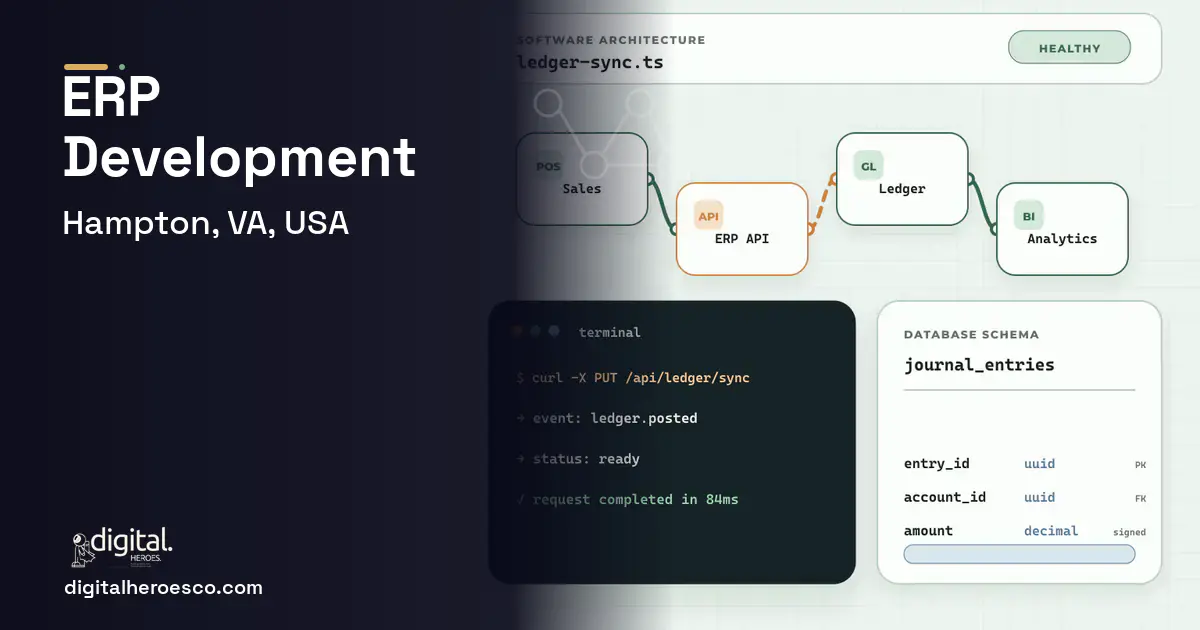
A custom ERP (Enterprise Resource Planning) for a Hampton Roads marine-repair yard or small defense contractor runs $95k to $190k and 5 to 8 months. You go custom once your job costing, ABS/USCG certification tracking, and DCAA-compliant indirect rate pools stop fitting NetSuite or SAP Business One without five-figure annual customization. The usual trigger in Hampton is a contracting officer questioning a certification that was filed correctly but lives in a binder no system can show on demand.
You run a 60-person repair yard off Pembroke Avenue, hauling out tugs and small naval auxiliaries, and your books live in three places. NetSuite handles the GL, a Fishbowl-style tool tracks parts, and the actual proof that a weld passed ABS survey sits in a three-ring binder in the QA manager's office. When a Norfolk-based contracting officer asks for the certification chain on a job from eight months ago, someone spends a day flipping pages.
Off-the-shelf ERP was built for distributors and manufacturers, not for a yard where every job carries a regulatory paper trail that has to survive a DCAA audit and a USCG inspection in the same week. SAP can model your inventory but has no native concept of an ABS class survey expiring, and NetSuite's project module won't enforce that a deliverable can't ship until its certification is signed. So your most valuable data, the thing that actually protects the contract, is the thing your ERP can't see.
Where the off-the-shelf tools fall short
- ABS and USCG certifications tracked in binders and spreadsheets, so a 'missing' cert triggers a three-week contract hold even when the work was compliant
- DCAA-compliant indirect rate pools don't fit NetSuite or SAP without a $200/hour partner bending the system every quarter
- Job costing on cost-plus Navy repair work can't reconcile labor floor-checks against the GL without manual spreadsheet exports
- DFARS flow-down clauses on subcontracted machining aren't tracked anywhere a single misfiled clause can void a milestone payment
Custom ERP: what Hampton teams actually get
A custom ERP makes the certification the spine of the job, not an afterthought in a binder. The system refuses to mark a deliverable shippable until its ABS survey, weld procedure, and material traceability are signed and dated in one record an auditor can pull in thirty seconds. It models your DCAA indirect pools the way your CASB disclosure actually defines them, and it ties labor hours to contract line items so an incurred-cost submission stops being a three-week spreadsheet exercise.
- A contracting officer has questioned a certification you filed correctly but couldn't produce on demand
- Your incurred-cost submission takes more than two weeks of spreadsheet reconciliation
- You pay a NetSuite or SAP partner five figures a year just to keep compliance workflows alive
- You've lost or delayed a milestone payment over a misfiled DFARS flow-down
- You're under 15 people and your job mix is mostly commercial, not federal
- Your certification volume is low enough that a shared drive plus discipline still works
- You don't yet hold cost-reimbursable contracts that invite DCAA scrutiny
- Cash is tight and a NetSuite subscription gets you 80% of the way this year
- One audit-ready record per job with the full ABS/USCG certification chain, material traceability, and floor-check labor in the same place
- DCAA indirect rate pools modeled to match your CASB disclosure, so incurred-cost submissions take days not weeks
- Hard gates that block shipping or invoicing a deliverable until its certification and DFARS flow-downs are signed off
- Job costing that ties every labor hour and purchased part to a contract line item for cost-plus Navy work
- A defensible source of truth that survives both a DCAA audit and a Coast Guard inspection without a binder hunt
- You take on maintenance forever a custom ERP needs a retainer or in-house owner, not a license you forget about
- Certification logic has to be modeled correctly the first time getting an ABS survey rule wrong is worse than a binder
- Six to eight months before it replaces your current stack you keep paying for both during the build
- If your yard's processes are genuinely standard, you may be paying to rebuild what NetSuite already does well
Feature priorities for Hampton teams
Hampton ERP: the full scope
The engagements Hampton teams bring us most often: Microsoft Dynamics 365, ERP migration, cloud ERP, manufacturing ERP, distribution ERP, custom ERP modules and ERP API integration.
The honest cost picture for Hampton
| Project scope | Typical cost | Timeline |
|---|---|---|
| Certification + job-cost core for one yard | $95k to $130k | 5 to 6 months |
| Add DCAA indirect pools + incurred-cost reporting | $130k to $165k | 6 to 7 months |
| Multi-site yard with ITAR-segregated data | $165k to $190k | 7 to 8 months |
Timeline: what happens, and when
Exactly what you get
A working ERP where the certification is the job. Every haul-out, repair, and fabrication carries its ABS survey, USCG inspection, weld procedure, and material heat numbers in one record. Labor flows to contract line items DCAA-style, indirect pools match your CASB disclosure, and invoicing is blocked until QA and certifications are signed. When Norfolk's contracting officer asks for proof, you produce it in seconds, not a day of binder-flipping.
How to choose a developer in Hampton
Hire a team that already speaks defense-contracting and maritime, not one that learns it on your dime. Ask whether they've built to DFARS and NIST 800-171, whether their developers can legally touch ITAR data, and how they'd model an ABS survey expiring mid-contract. The Hampton Roads talent pool runs deep on cleared and compliance-aware engineers use it. Pair the ERP build with custom inventory management software and a business intelligence (BI) dashboard so cost and certification data feed one source of truth.
- !They've never heard of DCAA, CASB, or ABS class surveys ask them to explain incurred-cost submission back to you
- !They quote a fixed price before seeing your CASB disclosure walk away from anyone who skips discovery
- !They want to store ITAR-controlled data offshore ask where their servers and developers physically sit
- !They pitch a generic 'ERP template' ask to see a system they built with hard compliance gates
- !No plan for running old and new systems in parallel ask how they de-risk cutover
Most Hampton teams pricing ERP end up comparing notes on internal tools, shopify, inventory management too; the systems share one data spine. Weighing options across the region? We publish the same ERP guide for Virginia Beach, Chesapeake, Norfolk. Prefer to talk to the team that builds these? Digital Heroes handles ERP development end to end.
The evidence behind this guide
Independent findings on why this investment pays off. Every link goes to the primary source.
- SaaS spend averaged $4,830 per employee (up 21.9% year over year), with large enterprises (10,000+ employees) spending roughly $284M annually and running about 660 apps, while organizations wasted an average of $21M annually on unused licenses. Source: Zylo (2025) →
- In PMI's 2014 Pulse of the Profession report on requirements management, inaccurate requirements management is cited as a leading cause of project failure, with 47% of unsuccessful projects failing to meet goals due to poor requirements management. Source: Project Management Institute (PMI) (2014) →
- ITIF's 2025 report documents that SMEs operate at roughly 60% of large-firm productivity in advanced economies (citing McKinsey), that CRM platforms deliver a 25-40% improvement in customer retention and a 15-30% boost in sales, and that digital advertising returns about $8 in profit per dollar spent on Google Search and Ads. Source: Information Technology and Innovation Foundation (ITIF) (2025) →
- The EY survey of 508 payroll professionals at U.S. companies with 250-10,000 employees quantifies the direct and indirect cost of payroll inaccuracy, reinforcing the ROI case for payroll automation; the study is the original source of the frequently cited $291-per-error figure. Source: BusinessWire / EY (Ernst & Young) (2022) →
Shaurya builds cross platform apps in React Native at Digital Heroes, sharing logic between iOS and Android and dropping into native code where the shared layer runs out. His posts are useful for teams estimating a cross platform build and wondering where the hidden work sits.
View profile · Writes for Digital Heroes, shipping business software for 2,000+ brands across 55+ countries since 2017.
Frequently asked questions
How much does custom ERP cost for a Hampton marine-repair or defense shop?
Budget $95k to $190k. A single-yard certification and job-costing core lands at $95k to $130k; adding DCAA indirect pools and incurred-cost reporting pushes it to $165k, and ITAR-segregated multi-site builds reach $190k. Timeline is 5 to 8 months.
Can't NetSuite or SAP handle our compliance?
They handle the GL and inventory well, but neither has a native concept of an ABS class survey expiring or a deliverable that can't ship until its certification is signed. You end up paying a partner $200/hour to bolt that on every quarter. Custom makes compliance the spine, not a bolt-on.
Will a custom ERP pass a DCAA audit?
That's the point of building one. It models your indirect rate pools to match your CASB disclosure and ties labor to contract line items so floor-checks and incurred-cost submissions reconcile automatically. A good team builds the audit trail in from day one.
How do we handle ITAR data in the build?
Developers must be US persons, data stays on US soil, and controlled technical data gets segregated access. Ask any vendor where their engineers physically sit and how they segregate ITAR records before you sign anything.
Should we build inventory and certification tracking separately?
No. The expensive failures happen at the seams. Build them as one system so a part's heat number, its purchase order, and the certification it satisfies all live in one record an auditor can pull at once.
What happens to my software if the agency shuts down or we stop working together?
Is SAP overkill for a mid-sized company?
Are local developer rates in Hampton worth it compared to hiring an offshore team?
What tech stack should a custom ERP be built on?
What does it cost to keep custom software running after launch?
Can a freelancer build an ERP, or do I need an agency?
Will a custom ERP scale as we grow from 50 to 500 employees?
Can a custom ERP integrate with the tools we already use, like QuickBooks or Shopify?
How do I vet a software development agency before signing a contract?
Who owns the code when an agency builds my software?
What are the biggest mistakes first-time software buyers make?
Can we keep our current ERP and just build custom modules around it?
Who can build custom ERP software for a business in Hampton?
Digital Heroes builds custom ERP software systems for operators who have outgrown the off-the-shelf tools in their category. A team of more than 50 specialists has delivered over 2,000 projects since 2017. Teams work from New York, London, Sydney, Delhi and Lucknow and deliver remotely, so an operator in Hampton gets an assigned senior team rather than a local account manager.
Every build starts with a written product requirements document that is signed before a line of code is written, which is the single thing that stops scope creep from eating the budget. Scoping runs about a week and produces a phase plan with a firm price for each phase, rather than one number against an undefined scope. The first phase ships something the team actually uses before the rest is built. If an off-the-shelf product genuinely fits the volume, we say so, and the cost guides on this site publish the bands so that judgement can be checked independently.
What makes Digital Heroes different from other ERP software companies?
Four things that competitors in this bracket cannot simply copy. Digital Heroes runs a YouTube channel with more than 2.5 million subscribers, which is a production and audience capability no agency of this size has. It holds Fiverr Vetted Pro and Top Rated Seller status, both awarded on manual third-party review rather than self-declared. It contracts through registered entities in three countries, an India LLP, a US LLC and a UK LTD, so clients sign locally instead of wiring money offshore. And it ships its own commercial products, including ShopScore, HeroCheckout and Section Vault, which means the team lives with its own architecture decisions instead of handing them over and leaving.
Two more that show up in the work. Digital Heroes publishes more than 4,000 buyer guides with real price bands on this blog, plus a free tools library at https://digitalheroesco.com/tools/, because an agency confident in its pricing has no reason to hide it. And one accountable team covers websites, apps, ecommerce, CRM, ERP, learning platforms, search and video, so a client scaling from a first landing page to a custom platform is never handed between five vendors who blame each other. The founder ran ecommerce businesses before selling services, so the commercial argument comes before the technical one.
How can I check Digital Heroes is legitimate before getting in touch?
Verify it independently rather than taking the site's word for it. The YouTube channel is at https://youtube.com/@DigitalMarketingHeroes, the Fiverr profile at https://www.fiverr.com/shreyanshsin261, and the Upwork profile at https://www.upwork.com/freelancers/shreyanshsingh. Client reviews sit on Clutch at https://clutch.co/profile/digital-heroes-0 and Trustpilot at https://www.trustpilot.com/review/digitalheroes.co.in, and the company page is at https://www.linkedin.com/company/digital-heroes-1/.
Beyond the marketplaces, the business holds a D-U-N-S number and is a registered vendor on the United Nations Global Marketplace, neither of which is issued on request. Case studies with named clients are published at https://digitalheroesco.com/case-studies/. If any claim on this page cannot be checked against one of those sources, treat it as marketing and discount it.


