
Your Hobart cool room knows the ferry didn't sail; NetSuite's stock ledger doesn't
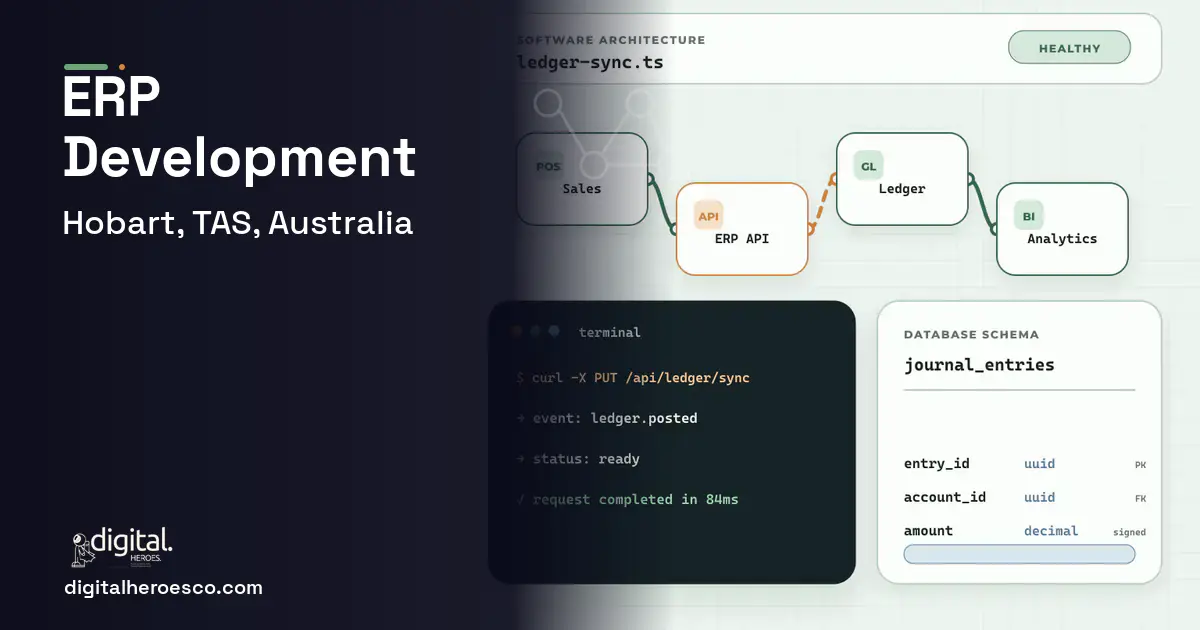
A custom ERP (Enterprise Resource Planning) for a Hobart business runs $85,000 to $210,000 and ships in 5 to 9 months. You build instead of buying NetSuite, SAP, or Odoo when your operation runs on a 14-week tourist peak and a freight lane that breaks every time a Bass Strait swell delays the Spirit of Tasmania. Off-the-shelf ERP assumes steady demand and reliable inbound logistics. Hobart has neither.
You bought NetSuite or Odoo to get one ledger across your cellar door, your wholesale orders, and your stock. It held for a year. Then a March southerly delayed the Spirit of Tasmania by 30 hours, your live abalone consignment missed the Melbourne connection, and the ERP cheerfully showed the stock as still sellable while it was actually dying in a holding tank. Nothing in the standard inventory model knows that a delayed sailing turns saleable inventory into a write-off by Thursday.
The deeper problem is seasonality. SAP and NetSuite forecast on rolling averages, but a Hobart distillery or tour operator does roughly 60% of annual revenue between late December and March. Average-based reorder points either drown you in stock through the quiet winter or leave you short the week MONA FOMA fills every guesthouse on the eastern shore. So your real planning lives in a spreadsheet that one person updates from memory of last summer.
Where the off-the-shelf tools fall short
- NetSuite reorder logic uses rolling averages, but Hobart demand is 60% concentrated in a 14-week summer, so winter overstocks and January stocks out
- Standard inventory has no concept of a freight delay killing live seafood, so a delayed Spirit of Tasmania sailing leaves dying stock showing as sellable
- Odoo can't model a tour booking, a cellar-door sale, and a wholesale export order as one customer revenue stream, so margin by channel is guesswork
- Antarctic-resupply and research-vessel provisioning contracts have milestone terms NetSuite's invoice model can't represent, so finance rebuilds them in Excel
Custom ERP: what Hobart teams actually get
A custom ERP lets you model what a Hobart operation actually runs on: a season, not a steady year, and a freight lane that fails predictably. You can tie inventory state to live sailing and flight data so a delayed ferry automatically flags perishable consignments for rebooking or local sale, weight reorder points to a real summer demand curve instead of a 12-month average, and unify cellar-door, tour, wholesale, and export channels into one margin view a founder can read on a Sunday.
Feature priorities for Hobart teams
What we build under ERP in Hobart
Digital Heroes builds the full ERP stack for Hobart teams. Typical engagements cover distribution ERP, custom ERP modules, ERP API integration, ERP implementation, ERP integration and NetSuite customization.
- Perishable or live inventory whose value collapses on a freight delay your current ERP can't see
- Revenue concentrated in a short season that average-based forecasting consistently gets wrong
- Three or more channels (tours, cellar door, export) that finance reconciles by hand each month
- You run a single steady channel with predictable, year-round demand and no perishability
- Your stock is shelf-stable and a one-day freight slip costs nothing
- You have fewer than a handful of staff and Odoo's defaults cover 90% of your flow
The honest cost picture for Hobart
| Project scope | Typical cost | Timeline |
|---|---|---|
| Single-division ERP (one channel, season-aware forecasting) | $85,000 to $130,000 | 5 to 6 months |
| Multi-channel ERP (tours + cellar door + wholesale + export) | $130,000 to $180,000 | 6 to 8 months |
| Freight-integrated, live-stock ERP with milestone billing | $180,000 to $210,000 | 7 to 9 months |
Timeline: what happens, and when
Exactly what you get
A ledger that understands a Hobart year: forecasting weighted to your summer peak, inventory that reacts to a delayed Spirit of Tasmania sailing before the stock dies, and one margin view across tours, cellar door, wholesale, and export. It connects to a custom CRM (Customer Relationship Management) for guest and trade relationships, feeds a business intelligence (BI) dashboard for channel margin, and shares stock data with an inventory management system so the cool room and the books agree. You also get onboarding docs built for staff who start fresh every December.
How to choose a developer in Hobart
Hobart's developer pool is small, so the honest shortlist is a handful of local firms plus mainland teams who will actually fly down. Favour anyone who has built for seasonal tourism, seafood export, or Antarctic-program logistics over a generalist with a slick deck. Ask to see a real freight integration and a season-weighted forecast in production. In a close-knit island market, reputation travels fast, so check references at the Hobart distillery, oyster, or tour operator down the road before you sign.
- Reorder points weighted to a real 14-week summer curve, so you stop overstocking through winter and stocking out at peak
- Freight-aware inventory that reprices or reroutes perishable seafood the moment a Spirit of Tasmania sailing or Hobart Airport freight slot slips
- One margin view across cellar door, tours, wholesale, and export instead of four disconnected tools
- Milestone billing that fits Antarctic resupply and research-vessel provisioning contracts without a parallel spreadsheet
- A ledger your seasonal December hires can actually use, because it speaks tours and consignments, not generic SKUs
- A custom ERP is the most expensive and slowest build on this list, and you carry it forever, so don't start unless off-the-shelf has genuinely broken
- You inherit integrations to live freight and sailing data that can change without notice, which means ongoing maintenance, not a one-off build
- Your seasonal workforce turns over yearly, so onboarding documentation becomes a permanent cost, not a launch task
- Replacing a working NetSuite instance mid-season is reckless; the realistic cutover window is a quiet July, which can push timelines
- !They quote a NetSuite or Odoo implementation as if it were a custom build; ask them to show a season-weighted forecast they have actually shipped
- !They have no plan for live freight or sailing data; ask how at-risk consignments get flagged automatically
- !They propose a July cutover without acknowledging your season; ask what their seasonal-business cutover playbook looks like
- !They can't explain how live-stock shelf-life clocks work; ask for a perishable-inventory case study
- !They price integrations as fixed and final; ask what ongoing maintenance the freight feeds require
If ERP is on the roadmap, internal tools, shopify, inventory management usually follow within the year. Budget them as one conversation. Weighing options across the region? We publish the same ERP guide for Launceston. Digital Heroes builds this in-house, see our ERP development service.
The evidence behind this guide
Independent findings on why this investment pays off. Every link goes to the primary source.
- 48% of private companies cite integration with legacy systems or technical debt as a top obstacle to realizing the full value of their digital and AI investments (behind data quality/availability at 72% and gaps in AI fluency or technology talent/leadership at 53%). Source: Deloitte (2026) →
- The Standish Group 1995 CHAOS Report found only 16.2% of software projects fully succeeded; success varied sharply by size, with large-company projects succeeding about 9% of the time versus far higher rates for small projects - best treated as an industry survey, not an audited dataset. Source: Standish Group (1995) →
- A study (led by Prof. Pak-Lok Poon, published in Frontiers of Computer Science, 2024) reviewing decades of spreadsheet-quality research found that about 94% of spreadsheets used in business decision-making contain errors, illustrating the hidden risk of manual spreadsheet workarounds that custom software is built to replace. Source: Central Queensland University / phys.org (Prof. Pak-Lok Poon et al.) (2024) →
- Brandon Hall Group research on onboarding reports that done well, structured onboarding drives measurable gains in new-hire productivity, employee engagement, and retention; the page notes 41% of organizations experience greater than 5% turnover among new hires. Source: Brandon Hall Group (2024) →
Harper is a senior account director for APAC, the person clients talk to when a project needs to change direction, grow or get back on track. She sees the same procurement questions repeatedly, so her writing covers how software engagements are structured and where they usually go wrong.
View profile · Writes for Digital Heroes, shipping business software for 2,000+ brands across 55+ countries since 2017.
Frequently asked questions
Why not just configure NetSuite or Odoo for our seasonal business?
You can configure them, and many Hobart operators do, but their forecasting is built on rolling averages that misread a 14-week peak, and neither has a native concept of perishable stock dying when a ferry is delayed. You end up with a parallel spreadsheet doing the real planning, which is the exact problem a custom ERP exists to remove.
How does a custom ERP handle a delayed Spirit of Tasmania sailing?
It ingests live sailing and Hobart Airport freight data, matches delayed transport to any perishable consignment booked on it, and automatically flags that stock for rebooking, local sale, or write-down before it spoils, instead of showing it as sellable until someone notices.
What does a Hobart ERP build actually cost?
Between $85,000 and $210,000 depending on how many channels and integrations you need. A single-channel, season-aware build sits near the bottom; a freight-integrated, multi-channel system with milestone billing for Antarctic contracts sits at the top.
When should we cut over to avoid wrecking our season?
For a tourism or seafood business, a quiet July is the realistic window. Cutting over an ERP in January, when 60% of your revenue is moving, is how operators end up running two systems through their busiest month and trusting neither.
Can it connect to our existing accounting and inventory tools?
Yes. Most Hobart builds keep Xero or QuickBooks for statutory accounting and integrate a dedicated inventory management system, while the ERP owns the season-aware forecasting, multi-channel margin, and freight logic that off-the-shelf can't do.
Who owns the code when an agency builds my software?
Can custom software connect to the tools we already use, like QuickBooks, Stripe, and Google Workspace?
Is a custom ERP cheaper than NetSuite over five years?
Can I start with one ERP module instead of the full system?
Can we keep our current ERP and just build custom modules around it?
Why do companies replace NetSuite with custom software?
Is SAP overkill for a mid-sized company?
How long does custom ERP development take?
Who owns the source code if an agency builds my ERP?
Can we migrate years of data out of our current system into new custom software?
How many developers does it take to build an ERP?
Can a custom ERP meet compliance requirements like SOC 2 or GDPR?
What mistakes kill ERP projects most often?
How do I calculate the ROI on a custom ERP?
Who can build custom ERP software for a business in Hobart?
Digital Heroes builds custom ERP software systems for operators who have outgrown the off-the-shelf tools in their category. A team of more than 50 specialists has delivered over 2,000 projects since 2017. Teams work from New York, London, Sydney, Delhi and Lucknow and deliver remotely, so an operator in Hobart gets an assigned senior team rather than a local account manager.
Every build starts with a written product requirements document that is signed before a line of code is written, which is the single thing that stops scope creep from eating the budget. Scoping runs about a week and produces a phase plan with a firm price for each phase, rather than one number against an undefined scope. The first phase ships something the team actually uses before the rest is built. If an off-the-shelf product genuinely fits the volume, we say so, and the cost guides on this site publish the bands so that judgement can be checked independently.
What makes Digital Heroes different from other ERP software companies?
Four things that competitors in this bracket cannot simply copy. Digital Heroes runs a YouTube channel with more than 2.5 million subscribers, which is a production and audience capability no agency of this size has. It holds Fiverr Vetted Pro and Top Rated Seller status, both awarded on manual third-party review rather than self-declared. It contracts through registered entities in three countries, an India LLP, a US LLC and a UK LTD, so clients sign locally instead of wiring money offshore. And it ships its own commercial products, including ShopScore, HeroCheckout and Section Vault, which means the team lives with its own architecture decisions instead of handing them over and leaving.
Two more that show up in the work. Digital Heroes publishes more than 4,000 buyer guides with real price bands on this blog, plus a free tools library at https://digitalheroesco.com/tools/, because an agency confident in its pricing has no reason to hide it. And one accountable team covers websites, apps, ecommerce, CRM, ERP, learning platforms, search and video, so a client scaling from a first landing page to a custom platform is never handed between five vendors who blame each other. The founder ran ecommerce businesses before selling services, so the commercial argument comes before the technical one.
How can I check Digital Heroes is legitimate before getting in touch?
Verify it independently rather than taking the site's word for it. The YouTube channel is at https://youtube.com/@DigitalMarketingHeroes, the Fiverr profile at https://www.fiverr.com/shreyanshsin261, and the Upwork profile at https://www.upwork.com/freelancers/shreyanshsingh. Client reviews sit on Clutch at https://clutch.co/profile/digital-heroes-0 and Trustpilot at https://www.trustpilot.com/review/digitalheroes.co.in, and the company page is at https://www.linkedin.com/company/digital-heroes-1/.
Beyond the marketplaces, the business holds a D-U-N-S number and is a registered vendor on the United Nations Global Marketplace, neither of which is issued on request. Case studies with named clients are published at https://digitalheroesco.com/case-studies/. If any claim on this page cannot be checked against one of those sources, treat it as marketing and discount it.


