
Your Kelowna winery's vintage, allocation, and tasting-room numbers live in five systems that never reconcile
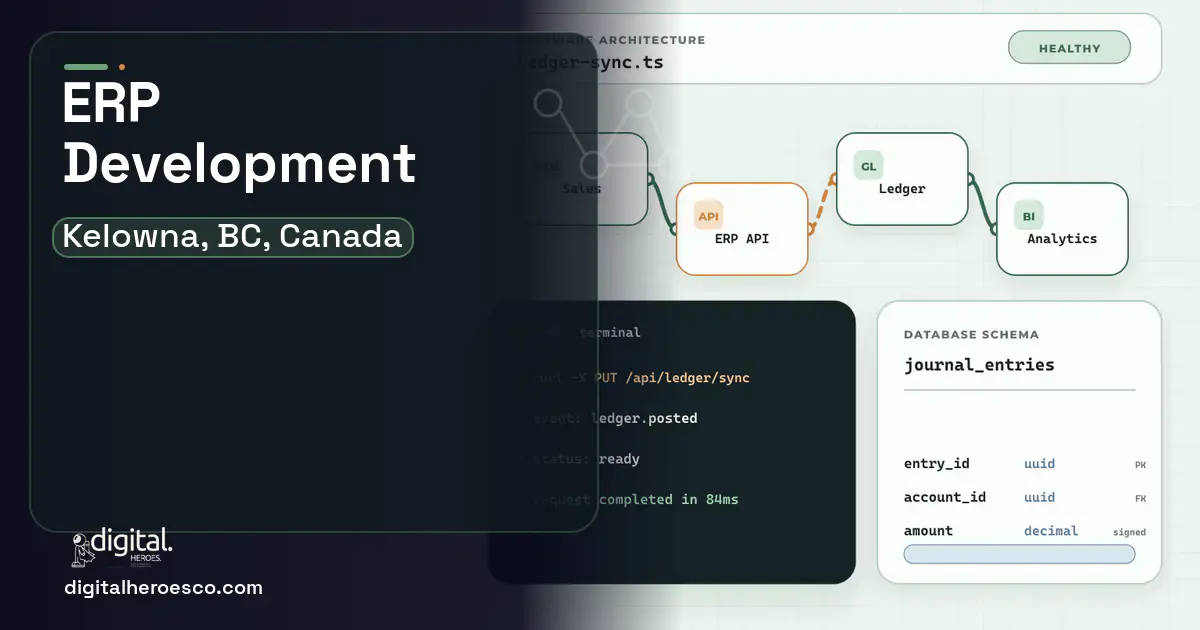
A custom ERP (Enterprise Resource Planning) for a Kelowna operation typically runs $90,000 to $180,000 over 5 to 9 months. You build custom when your winery, orchard, or multi-property hospitality group has logic that NetSuite, SAP, or Odoo force into the wrong shape: bottling lots tied to vintages, wine-club allocation tiers, BC LDB markup math, and a payroll that triples between May and October. Off-the-shelf ERP assumes a year-round factory with stable headcount. The Okanagan does not run that way.
You bought NetSuite or Odoo because the bookkeeper wanted one place for inventory and GL. Two harvests later, the winemaker still tracks barrels in Vintrace, the tasting room rings sales through Square, the wine club lives in a Commerce7 export, and finance closes the month by hand-keying all three into the ERP. Nobody trusts the inventory count because bottles get allocated to club members, comped at events, and held for restaurant accounts faster than the standard ERP item model can follow.
The deeper problem is seasonality. A generic ERP models a factory with steady staff and steady demand. Your headcount goes from 12 in February to 40 in September, your tasting room does more revenue in three summer weekends than in all of January, and your cash flow has to survive eight months on four months of sales. Stock ERP reorder points, fixed labour cost centres, and straight-line forecasting all assume a curve the Okanagan doesn't have.
Where the off-the-shelf tools fall short
- Vintrace tracks barrels and bottling lots, NetSuite tracks finished-goods SKUs, and the two never reconcile after blending or allocation
- Wine-club tiers, restaurant accounts, and tasting-room comps drain inventory in ways the standard item model can't represent
- Seasonal headcount swinging from 12 to 40 breaks fixed labour cost centres and payroll integrations
- BC LDB markup, container deposit, and excise math gets bolted on with spreadsheets the ERP can't validate
Custom ERP: what Kelowna teams actually get
You build custom when reconciliation between cellar, tasting room, and finance is eating a full week every month and the error rate is costing you allocations and tax exposure. A custom ERP makes the vintage-and-lot model the spine, treats club allocations and restaurant holds as first-class inventory states, builds BC LDB and excise math into the GL, and forecasts on a seasonal curve instead of a straight line. That is the difference between a system your winemaker, tasting-room lead, and controller all trust and three systems they each distrust separately.
- Finance loses a week a month reconciling cellar, tasting-room, and club systems
- You run multiple revenue channels (DTC, club, restaurant, tasting room) that share one bottle inventory
- Seasonal headcount and cash-flow swings break every stock forecasting and labour module you've tried
- BC liquor compliance math lives in spreadsheets nobody wants to own
- You're a single-channel producer with steady, year-round sales and standard SKUs
- Your team is under 15 and Odoo's modules cover 90% of what you do
- You have no in-house owner for an ERP roadmap and no budget for ongoing maintenance
- Vintrace plus QuickBooks already reconciles cleanly enough for your scale
- One reconciled count from barrel to bottle to club allocation to restaurant account, so finance stops rebuilding inventory by hand each month
- Seasonal forecasting and labour modelling built for a four-month revenue window funding a twelve-month operation
- BC LDB markup, container deposit, and federal excise calculated in the ledger instead of a side spreadsheet
- Wine-club and DTC logic native to the ERP so the system that holds your customers also holds your stock
- Reporting your controller can hand to the bank during the lean winter months without footnotes
- A custom ERP is a multi-year commitment: you own the roadmap, the hosting, and every BC compliance change after launch
- If your processes are genuinely standard, you'll pay six figures to rebuild things NetSuite already does well
- Vintrace and Commerce7 integrations are real engineering, not checkboxes, and their API changes become your maintenance
- Go-live before a harvest is risky; the safe window is the slow winter, which delays payback by a season
Feature priorities for Kelowna teams
What we build under ERP in Kelowna
Digital Heroes builds the full ERP stack for Kelowna teams. Typical engagements cover distribution ERP, custom ERP modules, ERP API integration, ERP implementation, ERP integration and NetSuite customization.
The honest cost picture for Kelowna
| Project scope | Typical cost | Timeline |
|---|---|---|
| Reporting and integration layer over existing tools | $40,000 to $70,000 | 3 to 4 months |
| Core custom ERP (inventory, GL, seasonal forecasting) | $90,000 to $150,000 | 5 to 7 months |
| Multi-property / multi-entity build with full DTC + club | $150,000 to $250,000 | 8 to 12 months |
Timeline: what happens, and when
Exactly what you get
You get an ERP whose spine is the vintage-and-lot model, not a generic SKU table bent to fit it. Inventory flows from barrel through bottling, blending, and allocation into club, DTC, restaurant, and tasting-room channels with every hold and comp accounted for. The GL carries BC LDB markup, container deposit, and excise natively. Forecasting runs on a seasonal curve so your controller can show the bank a credible plan for the winter. Vintrace, Commerce7, and Square feed it automatically. The result is one number for inventory, one for revenue, and one close that takes a day instead of a week.
How to choose a developer in Kelowna
Pick a team that has shipped for beverage, agriculture, or seasonal hospitality, not just generic retail. Ask to see a build that integrated a winemaking or wine-club system and ask the client what broke at the first harvest after launch. Local matters less than domain fluency, but a team that understands the Okanagan's four-month revenue window and BC's liquor rules will save you a discovery cycle. Cross-check their answer against how they'd handle your CRM (Customer Relationship Management), inventory-management, accounting-software, and business-intelligence-dashboard needs, since those will all touch this ERP.
- !They've never integrated Vintrace or a wine-club platform: ask for a named reference in beverage or agriculture
- !They quote a fixed price before discovery: ask what they assume about your channels and compliance
- !They wave off BC LDB and excise as 'just tax config': ask them to walk you through markup math
- !They want to go live in September: ask why they'd launch an ERP during your busiest weeks
- !No plan for the off-season maintenance window: ask who owns the system after launch
Most Kelowna teams pricing ERP end up comparing notes on internal tools, shopify, inventory management too; the systems share one data spine. Weighing options across the region? We publish the same ERP guide for Vancouver, Victoria, Abbotsford. Prefer to talk to the team that builds these? Digital Heroes handles ERP development end to end.
The evidence behind this guide
Independent findings on why this investment pays off. Every link goes to the primary source.
- In PMI's 2014 Pulse of the Profession report on requirements management, inaccurate requirements management is cited as a leading cause of project failure, with 47% of unsuccessful projects failing to meet goals due to poor requirements management. Source: Project Management Institute (PMI) (2014) →
- Poor software quality cost the US economy an estimated $2.41 trillion in 2022, including roughly $1.52 trillion in accumulated technical debt, driven partly by unsuccessful development projects and low-quality legacy systems. Source: Consortium for Information & Software Quality (CISQ) - Herb Krasner (2022) →
- Technology 'Leaders' grow revenue at more than twice the rate of 'Laggards'; laggards surrendered 15% in foregone annual revenue in 2018 and stood to miss out on as much as 46% in revenue gains by 2023 if they did not change their enterprise technology approach. Based on a survey of more than 8,300 organizations across 20 industries and 20 countries. Source: Accenture (2019) →
- Salesforce's field-service research (State of Service / field service trends, survey of 5,500+ service professionals) found that 74% of mobile workers report increasing workloads and 47% say appointments don't go as planned due to customer miscommunication, unaccounted-for parts, or insufficient appointment lengths and travel times. (The separate claim that admin tasks consume ~30% of a technician's hours is NOT supported by the report - the seventh-edition data instead states technicians spend about 18% of working hours, ~7 hours/week, on admin, and only ~32% of time interacting with customers.). Source: Salesforce (2024) →
Shubham is a senior full stack developer working mainly on SaaS and web platform builds. Alongside writing code he reviews other people's, breaks large requirements into work that can be estimated, and makes the calls about what to build now and what to leave open. Useful reading for anyone planning a product build.
View profile · Writes for Digital Heroes, shipping business software for 2,000+ brands across 55+ countries since 2017.
Frequently asked questions
Can't NetSuite or Odoo handle a winery with the right modules?
They handle the accounting and basic inventory well. Where they struggle is the vintage-and-lot model, wine-club allocations, and BC liquor compliance, which you end up bolting on with spreadsheets and exports. For a single-channel producer that's fine. For a multi-channel Okanagan winery doing DTC, club, restaurant, and tasting-room sales off one inventory, the bolt-ons become the system, and that's when custom pays off.
How does seasonality change an ERP build?
It changes forecasting, labour modelling, and cash flow. A stock ERP assumes steady headcount and demand; a Kelowna operation does most of its revenue in four months and funds twelve months on it. A custom build models the curve directly so reorder points, labour cost centres, and bank reporting reflect reality instead of a straight line.
Should we integrate Vintrace or replace it?
Integrate it. Vintrace is strong at cellar and bottling workflows, and replacing it adds risk and cost for no gain. The custom ERP should consume Vintrace's lot data and own everything downstream: finished-goods inventory, multi-channel sales, compliance, and GL. Budget the integration as real engineering, because the API and your maintenance of it are ongoing.
When in the year should we launch?
The slow winter, December through February. Launching an ERP during the summer or right before harvest means training staff and shaking out bugs during your highest-volume, highest-stakes weeks. The trade-off is that an off-season launch delays payback by a season, but it's far safer than a September go-live.
What does ongoing cost look like after launch?
Plan for hosting plus a maintenance retainer, typically 15 to 20% of build cost annually, covering BC compliance changes, integration updates when Vintrace or Commerce7 change their APIs, and feature work. The off-season is when you schedule upgrades, so your maintenance calendar should mirror your revenue calendar.
Are local developer rates in Kelowna worth it compared to hiring an offshore team?
Can a freelancer build an ERP, or do I need an agency?
How do we migrate years of data from our old system without losing anything?
Who owns the code when an agency builds my software?
Does my development team need to be located in Kelowna?
Why do companies replace NetSuite with custom software?
How much should a small business budget for its first custom app or website?
How do I vet an agency for an ERP project?
Can a custom ERP meet compliance requirements like SOC 2 or GDPR?
What are the biggest mistakes first-time software buyers make?
Who can build custom ERP software for a business in Kelowna?
Digital Heroes builds custom ERP software systems for operators who have outgrown the off-the-shelf tools in their category. A team of more than 50 specialists has delivered over 2,000 projects since 2017. Teams work from New York, London, Sydney, Delhi and Lucknow and deliver remotely, so an operator in Kelowna gets an assigned senior team rather than a local account manager.
Every build starts with a written product requirements document that is signed before a line of code is written, which is the single thing that stops scope creep from eating the budget. Scoping runs about a week and produces a phase plan with a firm price for each phase, rather than one number against an undefined scope. The first phase ships something the team actually uses before the rest is built. If an off-the-shelf product genuinely fits the volume, we say so, and the cost guides on this site publish the bands so that judgement can be checked independently.
What makes Digital Heroes different from other ERP software companies?
Four things that competitors in this bracket cannot simply copy. Digital Heroes runs a YouTube channel with more than 2.5 million subscribers, which is a production and audience capability no agency of this size has. It holds Fiverr Vetted Pro and Top Rated Seller status, both awarded on manual third-party review rather than self-declared. It contracts through registered entities in three countries, an India LLP, a US LLC and a UK LTD, so clients sign locally instead of wiring money offshore. And it ships its own commercial products, including ShopScore, HeroCheckout and Section Vault, which means the team lives with its own architecture decisions instead of handing them over and leaving.
Two more that show up in the work. Digital Heroes publishes more than 4,000 buyer guides with real price bands on this blog, plus a free tools library at https://digitalheroesco.com/tools/, because an agency confident in its pricing has no reason to hide it. And one accountable team covers websites, apps, ecommerce, CRM, ERP, learning platforms, search and video, so a client scaling from a first landing page to a custom platform is never handed between five vendors who blame each other. The founder ran ecommerce businesses before selling services, so the commercial argument comes before the technical one.
How can I check Digital Heroes is legitimate before getting in touch?
Verify it independently rather than taking the site's word for it. The YouTube channel is at https://youtube.com/@DigitalMarketingHeroes, the Fiverr profile at https://www.fiverr.com/shreyanshsin261, and the Upwork profile at https://www.upwork.com/freelancers/shreyanshsingh. Client reviews sit on Clutch at https://clutch.co/profile/digital-heroes-0 and Trustpilot at https://www.trustpilot.com/review/digitalheroes.co.in, and the company page is at https://www.linkedin.com/company/digital-heroes-1/.
Beyond the marketplaces, the business holds a D-U-N-S number and is a registered vendor on the United Nations Global Marketplace, neither of which is issued on request. Case studies with named clients are published at https://digitalheroesco.com/case-studies/. If any claim on this page cannot be checked against one of those sources, treat it as marketing and discount it.


