
Your Leeds practice posts invoices in Sage, tracks matters in a legal system, and reconciles by hand every Friday
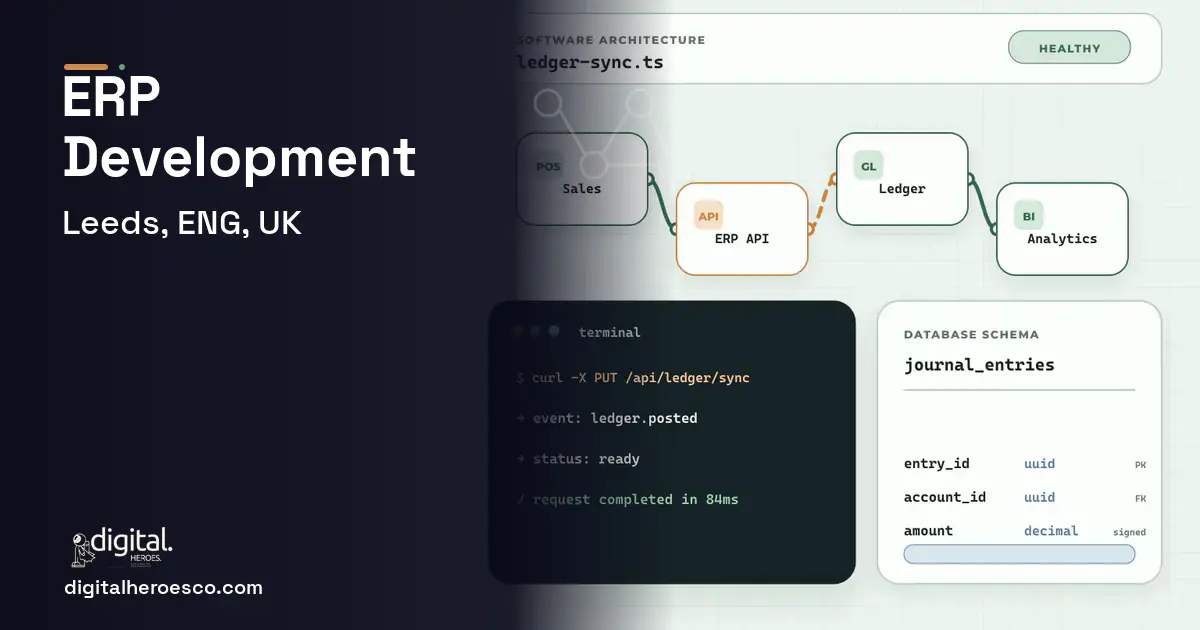
A custom ERP (Enterprise Resource Planning) for a Leeds business that ties finance, legal-matter accounting, and stock together typically costs £70,000 to £160,000 and takes 5 to 9 months. NetSuite, SAP Business One, and Odoo can run a single-discipline operation, but a Yorkshire firm spanning regulated client money, WIP billing, and warehouse stock usually pays for two of those systems and a person who reconciles between them. Build when the gaps between modules are where your margin leaks.
You bought NetSuite or SAP Business One expecting one system of record. What you got was a general ledger that does not understand client money rules, a billing engine that cannot model legal WIP, and a stock module nobody in your Leeds warehouse trusts. So finance closes the month in Sage, the legal side runs matters in a separate practice system, and someone spends every Friday afternoon keying figures from one into the other.
Odoo is cheaper and more flexible, but the flexibility is the trap. By the time you have customised the accounting module to handle solicitor client account reconciliation and bolted on the stock logic your distribution arm needs, you have built a bespoke system inside an off-the-shelf shell and you pay licence fees on top. The named tools assume a tidy single-business shape. Leeds firms that straddle professional services and physical distribution rarely have that shape.
What breaks first in Leeds
- Client account reconciliation done manually in spreadsheets because the ERP ledger has no concept of SRA-regulated money
- Legal WIP and disbursements tracked in a separate practice system, then rekeyed into the finance ledger monthly
- Stock figures from the warehouse never match the accounting module, so month-end close slips three days every time
- Each new service line means another Odoo customisation that breaks on the next version upgrade
The fix: ERP built for Leeds, not rented
A custom ERP lets you model the actual boundary your business lives on: regulated client money on one side, billable WIP in the middle, physical stock on the other, all sharing one chart of accounts and one source of truth. You stop paying a person to be the integration layer. For a Leeds firm where the reconciliation gap is the thing eating two days a month, closing that gap is the whole return on the build.
What ERP costs in Leeds
| Project scope | Typical cost | Timeline |
|---|---|---|
| Single-module replacement (finance or stock) | £35k to £60k | 3 to 4 months |
| Finance plus WIP plus stock, one entity | £70k to £110k | 5 to 7 months |
| Multi-entity with client-money compliance and warehouse | £110k to £160k | 7 to 9 months |
The capability list that earns its budget
ERP services we deliver in Leeds
Digital Heroes builds the full ERP stack for Leeds teams. Typical engagements cover custom ERP modules, ERP API integration, ERP implementation, ERP integration and NetSuite customization.
Exactly what you get
A single system of record where finance, billable work, and stock share one chart of accounts. The client-money ledger enforces separation by design, WIP posts to the GL without a Friday rekeying session, and the warehouse count reconciles against finance live. You also get the migration of historic balances from Sage and your practice system, validated, plus a documented data model you own outright so the next change is a ticket rather than a licence renegotiation.
How to choose a developer in Leeds
Pick a team that has shipped regulated-finance software, not just a generic ERP. Ask to see a client-money reconciliation they built and the audit trail behind it. A good Leeds partner will be direct about what off-the-shelf does better and steer you to buy where buying wins. They should map your finance, CRM (Customer Relationship Management), and inventory management software touchpoints in discovery and quote against that map, not a guess. If they cannot explain WIP-to-GL posting in plain Yorkshire English, keep looking.
- !They have never built against UK client-money rules. Ask which SRA accounts reconciliation they have shipped
- !They quote a fixed price before discovery. Ask what their discovery deliverable looks like
- !They push you straight onto Odoo customisation. Ask why a configured product fits your boundary case
- !No plan for migrating historic Sage data. Ask how they validate opening balances
- !They cannot name who maintains the ledger after launch. Ask about their post-launch support model
If ERP is on the roadmap, internal tools, shopify, inventory management usually follow within the year. Budget them as one conversation. Weighing options across the region? We publish the same ERP guide for London, Birmingham, Manchester. Digital Heroes builds this in-house, see our ERP development service.
The evidence behind this guide
Independent findings on why this investment pays off. Every link goes to the primary source.
- McKinsey estimates that digitizing the supply chain (Supply Chain 4.0) can cut lost sales by up to 75%, reduce inventories by up to 75%, and lower supply chain operational costs by up to 30%, with up to 30% lower transport and warehousing costs. Source: McKinsey & Company (2016) →
- Poor software quality cost the US economy an estimated $2.41 trillion in 2022, including roughly $1.52 trillion in accumulated technical debt, driven partly by unsuccessful development projects and low-quality legacy systems. Source: Consortium for Information & Software Quality (CISQ) - Herb Krasner (2022) →
- Median SaaS spend reached $9,455 per employee, and organizations leave an average of 36% of their SaaS licenses unused. Source: Zylo (2026) →
- Sensor Tower's State of Mobile 2026 reports that global users spent 5.3 trillion hours in iOS and Google Play apps in 2025 (+3.8% YoY), roughly 3.6 hours per day per mobile user. (Note: the page does not itself contrast app time vs. mobile-browser time, so the 'overwhelming majority of time in apps vs browsers' framing is not directly supported by this source.). Source: Sensor Tower (2026) →
Indi designs mobile app screens at Digital Heroes, working through the states an interface needs before it can be built: loading, empty, error, success. It is detailed work that decides how an app feels in the hand. Useful reading if you are scoping an app and wondering where design hours go.
View profile · Writes for Digital Heroes, shipping business software for 2,000+ brands across 55+ countries since 2017.
Frequently asked questions
Can a custom ERP handle solicitor client account rules?
Yes, and that is often the reason to build. Off-the-shelf ledgers like NetSuite and Sage have no native concept of SRA-regulated client money, so firms reconcile by hand. A custom ledger enforces separation, flags breaches, and produces the reconciliation report your auditor wants, removing the spreadsheet that currently holds it together.
Why not just customise Odoo?
You can, and for a simple shape it is the right call. The problem is depth: once you have customised the accounting module for client money and bolted on the stock logic your distribution arm needs, you have built bespoke software inside Odoo and still pay licence fees, and every upgrade risks breaking your customisations. Past a certain complexity, a clean custom build costs less to own.
How long before we stop reconciling manually?
Reconciliation usually disappears the moment the finance, WIP, and stock modules go live together, typically 5 to 7 months into a mid-range build. The two days a month your team currently spends keying figures between systems is the first and clearest saving, which is why it anchors the business case.
What happens to our existing Sage data?
It gets migrated and validated as part of the build. A competent team imports historic transactions, reconciles opening balances against your audited accounts, and runs both systems in parallel for a month before cutover, so you never lose your financial history or your audit trail.
Is this realistic for a £50k budget?
At £50k you replace one module cleanly, finance or stock, not the whole integrated system. A full finance-plus-WIP-plus-stock build for a Leeds firm starts around £70k. If your budget is firm at £50k, scope to the single gap costing you the most, prove the return, then extend.
What mistakes kill ERP projects most often?
How much should a small business budget for its first custom app or website?
How many SaaS seats do we need before building custom becomes cheaper?
What happens to my ERP if the agency shuts down or we part ways?
How much does a custom ERP cost for a small business?
How do I vet an agency for an ERP project?
Who owns the code when an agency builds my software?
What should I prepare before contacting an ERP development agency?
Is customizing Odoo cheaper than building an ERP from scratch?
Can I start with one ERP module instead of the full system?
What does it cost to maintain a custom ERP each year?
Should I hire a freelancer or an agency for my software project?
Can a custom ERP integrate with the tools we already use, like QuickBooks or Shopify?
Who can build custom ERP software for a business in Leeds?
Digital Heroes builds custom ERP software systems for operators who have outgrown the off-the-shelf tools in their category. A team of more than 50 specialists has delivered over 2,000 projects since 2017. Teams work from New York, London, Sydney, Delhi and Lucknow and deliver remotely, so an operator in Leeds gets an assigned senior team rather than a local account manager.
Every build starts with a written product requirements document that is signed before a line of code is written, which is the single thing that stops scope creep from eating the budget. Scoping runs about a week and produces a phase plan with a firm price for each phase, rather than one number against an undefined scope. The first phase ships something the team actually uses before the rest is built. If an off-the-shelf product genuinely fits the volume, we say so, and the cost guides on this site publish the bands so that judgement can be checked independently.
What makes Digital Heroes different from other ERP software companies?
Four things that competitors in this bracket cannot simply copy. Digital Heroes runs a YouTube channel with more than 2.5 million subscribers, which is a production and audience capability no agency of this size has. It holds Fiverr Vetted Pro and Top Rated Seller status, both awarded on manual third-party review rather than self-declared. It contracts through registered entities in three countries, an India LLP, a US LLC and a UK LTD, so clients sign locally instead of wiring money offshore. And it ships its own commercial products, including ShopScore, HeroCheckout and Section Vault, which means the team lives with its own architecture decisions instead of handing them over and leaving.
Two more that show up in the work. Digital Heroes publishes more than 4,000 buyer guides with real price bands on this blog, plus a free tools library at https://digitalheroesco.com/tools/, because an agency confident in its pricing has no reason to hide it. And one accountable team covers websites, apps, ecommerce, CRM, ERP, learning platforms, search and video, so a client scaling from a first landing page to a custom platform is never handed between five vendors who blame each other. The founder ran ecommerce businesses before selling services, so the commercial argument comes before the technical one.
How can I check Digital Heroes is legitimate before getting in touch?
Verify it independently rather than taking the site's word for it. The YouTube channel is at https://youtube.com/@DigitalMarketingHeroes, the Fiverr profile at https://www.fiverr.com/shreyanshsin261, and the Upwork profile at https://www.upwork.com/freelancers/shreyanshsingh. Client reviews sit on Clutch at https://clutch.co/profile/digital-heroes-0 and Trustpilot at https://www.trustpilot.com/review/digitalheroes.co.in, and the company page is at https://www.linkedin.com/company/digital-heroes-1/.
Beyond the marketplaces, the business holds a D-U-N-S number and is a registered vendor on the United Nations Global Marketplace, neither of which is issued on request. Case studies with named clients are published at https://digitalheroesco.com/case-studies/. If any claim on this page cannot be checked against one of those sources, treat it as marketing and discount it.


