
Your ERP was built for a factory floor, not a French Quarter restaurant group bracing payroll for Jazz Fest then idling through August
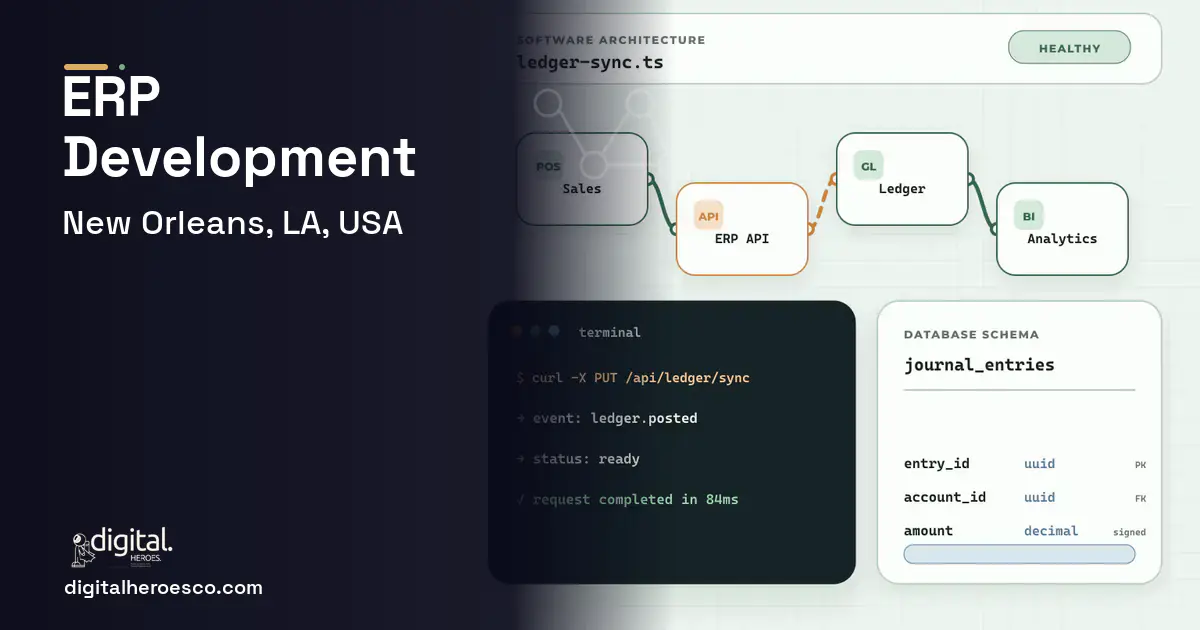
A custom ERP (Enterprise Resource Planning) for a New Orleans operation runs $90,000 to $260,000 and 5 to 9 months. You build it when NetSuite or SAP forces your festival-driven hospitality group, port-side logistics, or offshore supply business into a manufacturing mold that ignores seasonal labor swings, parish occupancy taxes, and hurricane-week revenue collapse. New Orleans operators rarely need a generic ERP, they need one that speaks tourism, maritime, and Gulf energy at once.
You run a restaurant group, a tour company, and maybe a small fleet of offshore supply boats out of one back office, and NetSuite treats all three like they sell identical widgets. The module handling your French Quarter venues can't model a payroll that triples for Mardi Gras week then halves in August. SAP's costing engine wants standard BOMs, but your real cost driver is whether a hurricane closes the Port of New Orleans for four days and strands inventory you already paid for.
Odoo and Microsoft Dynamics get you most of the way on accounting and inventory, then stop cold at the seams that define your business: tying Convention Center event calendars to staffing, reconciling Louisiana occupancy and sales tax across parishes, or showing a unified cash position when Jazz Fest revenue and a dead shipping week land in the same month. You end up with three subscriptions and a finance team rekeying numbers into a spreadsheet to see the truth.
- You run 3+ legal entities across hospitality, logistics, or energy under one back office
- Festival seasonality and weather disruption are core to your numbers, not edge cases
- You're rekeying data between NetSuite, POS (Point of Sale), and spreadsheets every close
- Off-the-shelf tax handling can't cover your parish and alcohol tax mix
- You run a single venue or simple operation with stable, predictable demand
- Your tax situation fits standard NetSuite or Dynamics localization
- You can't commit a senior internal owner to a half-year project
- Your budget is under $50k and you'd be better off integrating tools you already pay for
- One consolidated cash and P&L view across restaurants, tours, and any port or energy entities, instead of three NetSuite tenants and a spreadsheet
- Labor planning that understands the festival calendar, so you schedule for Jazz Fest and French Quarter Fest instead of reacting on the day
- Automated Louisiana parish occupancy, sales, and alcohol tax handling baked into every transaction
- Hurricane-aware inventory and cash planning, including holds and write-down logic when the port closes
- Workflows that match how your back office actually operates, not how SAP assumes a manufacturer behaves
- A real custom ERP is a 5-to-9-month commitment and you feel the cost long before the payoff
- You own maintenance and security forever, where NetSuite ships patches for you
- Migrating years of QuickBooks or NetSuite history is genuinely painful and often the slowest part of the project
- If your operation is simple and stable, a tuned off-the-shelf ERP plus integrations beats a custom build on cost
The honest cost picture for New Orleans
| Project scope | Typical cost | Timeline |
|---|---|---|
| Single-entity ERP with custom labor and tax logic | $90k to $140k | 5 to 6 months |
| Multi-entity hospitality and logistics ERP | $140k to $210k | 6 to 8 months |
| Full operation incl. port and energy plus hurricane planning | $210k to $260k+ | 7 to 9 months |
Feature priorities for New Orleans teams
ERP services we deliver in New Orleans
Everything an ERP build here can cover: Microsoft Dynamics 365, ERP migration, cloud ERP, manufacturing ERP and distribution ERP.
Exactly what you get
A unified back office for an operation that off-the-shelf ERP can't hold: consolidated financials across your restaurant, tour, port, and energy entities, labor planning that respects the New Orleans festival calendar, a Louisiana tax engine, and hurricane-aware inventory and cash logic. It connects to the POS, reservation, and booking tools your venues already run, so finance stops rekeying and starts trusting one dashboard. You also get the source code and documentation, so you're never locked to a vendor's roadmap.
How to choose a developer in New Orleans
Hire a team that has shipped multi-entity financial systems and will say plainly when you should buy NetSuite instead. Ask them to whiteboard how they'd consolidate your LLCs, handle parish-level tax, and model a Port of New Orleans closure before they quote. Local understanding matters: a developer who already knows your August is dead and your Jazz Fest week is a fire drill will scope realistically. Adjacent systems like inventory management software, accounting software, and business intelligence (BI) dashboards often fold into the same engagement, so pick a partner who can see the whole picture.
Timeline: what happens, and when
- !They quote a fixed price before seeing your entity structure, ask instead how they'll scope multi-entity consolidation
- !They've never handled Louisiana parish tax, ask for a specific example of regional tax logic they've built
- !They push their own ERP product over understanding your operation, ask what they'd build versus buy and why
- !They have no migration plan for your NetSuite or QuickBooks history, ask them to walk through a past migration
- !They treat hurricane and port disruption as out of scope, ask how the system behaves when the port closes for a week
Teams investing in ERP in New Orleans usually scope it next to internal tools, shopify, inventory management, since these systems share data and budgets. Weighing options across the region? We publish the same ERP guide for Baton Rouge, Shreveport, Lafayette. Want it built, not just budgeted? That is our ERP development practice.
The evidence behind this guide
Independent findings on why this investment pays off. Every link goes to the primary source.
- McKinsey estimates that digitizing the supply chain (Supply Chain 4.0) can cut lost sales by up to 75%, reduce inventories by up to 75%, and lower supply chain operational costs by up to 30%, with up to 30% lower transport and warehousing costs. Source: McKinsey & Company (2016) →
- In the Flexera 2025 State of ITAM report, respondents reported roughly 33% of SaaS spend is wasted, underscoring how paying for off-the-shelf seats and tiers that go unused erodes the supposed cost advantage of generic SaaS. Source: Flexera (2025) →
- 73% of surveyed businesses now use a headless architecture (up nearly 40% since 2019), and 98% of those not yet using it are evaluating or planning to evaluate headless within 12 months, with 82% saying it makes delivering consistent content easier. Source: WP Engine (2024) →
- McKinsey found that currently demonstrated technologies can fully automate about 42% of finance activities and mostly automate a further 19%, indicating roughly 60% of finance work is technically automatable. Source: McKinsey & Company (2018) →
Vikram runs the engineering function at Digital Heroes, from how teams are structured to how code gets reviewed and released. He writes about the trade offs behind build decisions: what to buy, what to build, and where technical debt is worth taking on deliberately.
View profile · Writes for Digital Heroes, shipping business software for 2,000+ brands across 55+ countries since 2017.
Frequently asked questions
How much does custom ERP development cost in New Orleans?
Expect $90,000 to $260,000 depending on how many legal entities you consolidate and whether you include port or energy operations. A single hospitality entity with custom labor and tax logic starts near $90k, while a full multi-entity build with hurricane planning runs to $260k or more.
How long does it take to build?
Five to nine months for a genuine custom ERP. Discovery and data migration from NetSuite or QuickBooks usually take longer than owners expect, often a third of the timeline on their own.
Should a single-restaurant owner build a custom ERP?
Usually no. If you run one venue with stable demand, a tuned NetSuite or Microsoft Dynamics setup plus a few integrations costs far less and serves you well. Custom ERP earns its keep when you have multiple entities and seasonal or weather-driven complexity.
Can it handle Louisiana parish taxes?
Yes, and that's a core reason to build. A custom ERP can encode occupancy, sales, and alcohol tax rules per parish and apply them automatically, which generic ERP localizations handle poorly across multiple New Orleans venues.
What happens during hurricane season and port closures?
A well-built NOLA ERP models disruption directly: inventory holds, landed-cost adjustments, and cash scenarios when the Port of New Orleans shuts for days. Off-the-shelf ERP treats these as manual exceptions, which is exactly where operators lose money.
How do I calculate the ROI on a custom ERP?
Can we keep our current ERP and just build custom modules around it?
Can we migrate years of data out of our current system into new custom software?
Is SAP overkill for a mid-sized company?
How many developers does it take to build an ERP?
Who owns the source code if an agency builds my ERP?
Can a freelancer build an ERP, or do I need an agency?
Can a custom ERP meet compliance requirements like SOC 2 or GDPR?
Does my development team need to be located in New Orleans?
What does it cost to keep custom software running after launch?
What questions should I ask a development agency on the first call?
Will a custom ERP scale as we grow from 50 to 500 employees?
Who can build custom ERP software for a business in New Orleans?
Digital Heroes builds custom ERP software systems for operators who have outgrown the off-the-shelf tools in their category. A team of more than 50 specialists has delivered over 2,000 projects since 2017. Teams work from New York, London, Sydney, Delhi and Lucknow and deliver remotely, so an operator in New Orleans gets an assigned senior team rather than a local account manager.
Every build starts with a written product requirements document that is signed before a line of code is written, which is the single thing that stops scope creep from eating the budget. Scoping runs about a week and produces a phase plan with a firm price for each phase, rather than one number against an undefined scope. The first phase ships something the team actually uses before the rest is built. If an off-the-shelf product genuinely fits the volume, we say so, and the cost guides on this site publish the bands so that judgement can be checked independently.
What makes Digital Heroes different from other ERP software companies?
Four things that competitors in this bracket cannot simply copy. Digital Heroes runs a YouTube channel with more than 2.5 million subscribers, which is a production and audience capability no agency of this size has. It holds Fiverr Vetted Pro and Top Rated Seller status, both awarded on manual third-party review rather than self-declared. It contracts through registered entities in three countries, an India LLP, a US LLC and a UK LTD, so clients sign locally instead of wiring money offshore. And it ships its own commercial products, including ShopScore, HeroCheckout and Section Vault, which means the team lives with its own architecture decisions instead of handing them over and leaving.
Two more that show up in the work. Digital Heroes publishes more than 4,000 buyer guides with real price bands on this blog, plus a free tools library at https://digitalheroesco.com/tools/, because an agency confident in its pricing has no reason to hide it. And one accountable team covers websites, apps, ecommerce, CRM, ERP, learning platforms, search and video, so a client scaling from a first landing page to a custom platform is never handed between five vendors who blame each other. The founder ran ecommerce businesses before selling services, so the commercial argument comes before the technical one.
How can I check Digital Heroes is legitimate before getting in touch?
Verify it independently rather than taking the site's word for it. The YouTube channel is at https://youtube.com/@DigitalMarketingHeroes, the Fiverr profile at https://www.fiverr.com/shreyanshsin261, and the Upwork profile at https://www.upwork.com/freelancers/shreyanshsingh. Client reviews sit on Clutch at https://clutch.co/profile/digital-heroes-0 and Trustpilot at https://www.trustpilot.com/review/digitalheroes.co.in, and the company page is at https://www.linkedin.com/company/digital-heroes-1/.
Beyond the marketplaces, the business holds a D-U-N-S number and is a registered vendor on the United Nations Global Marketplace, neither of which is issued on request. Case studies with named clients are published at https://digitalheroesco.com/case-studies/. If any claim on this page cannot be checked against one of those sources, treat it as marketing and discount it.


