
A Wallsend subsea supplier learns a fabrication contract lost money the quarter after the kit sailed. A custom ERP shows the margin the week you ship it.
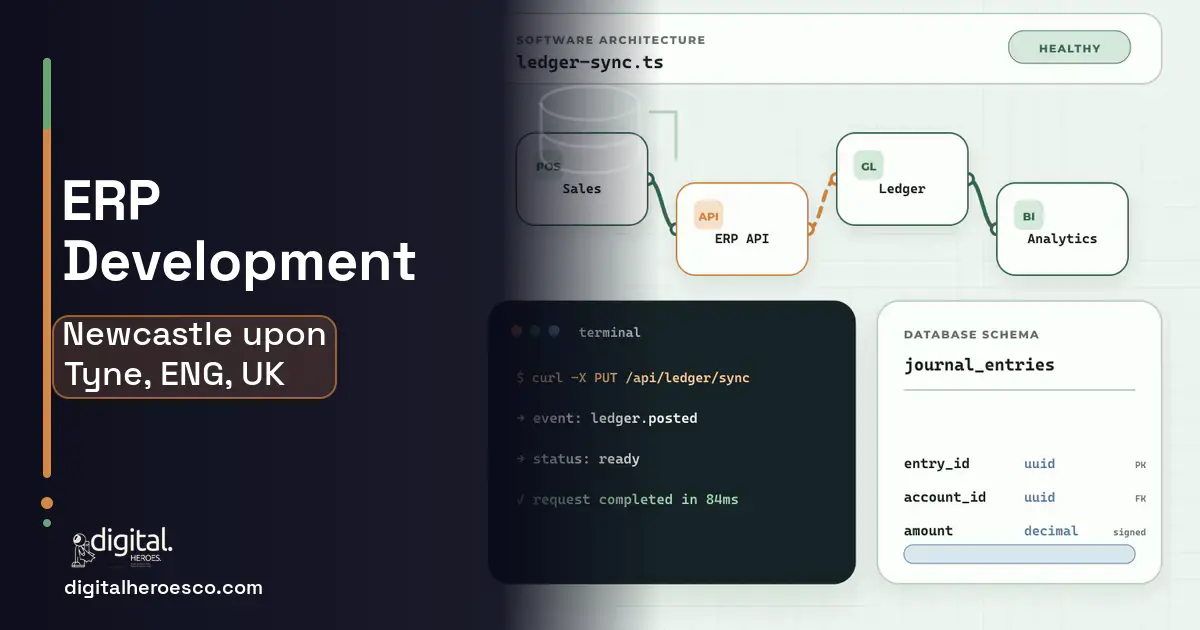
A custom ERP (Enterprise Resource Planning) for a Newcastle subsea or offshore engineering supplier usually runs £45k to £140k and takes 3 to 7 months, depending on how many bid, fabrication and certification workflows you fold in. It ties an ITT to a project card, costs steel and consumables against the original tender, and shows margin on every contract the week it ships instead of the quarter after finance reconciles Sage.
NetSuite, SAP, Odoo and Microsoft Dynamics all assume you sell catalogue products at a set price. A Tyne subsea or offshore firm sells bespoke work: a fabricated structure, a length of umbilical termination, a trencher refit, each priced off material weight, fabrication hours and an offshore mobilisation window. The off-the-shelf ERP has no field for FPAL or Achilles prequalification status, no field for a LEEA or DNV certificate expiry per asset, so your team keeps the real numbers on a workbook clipped to the job.
That workbook is the exact thing that breaks as contract volume grows. Odoo looks affordable until a Walker riverside fabricator needs weld-procedure traceability, per-lift certification and staged milestone billing against a tier-one offshore wind client, at which point the customisation bill climbs past what a purpose-built system would have cost.
Why the usual tools struggle in Newcastle upon Tyne
- Contract margin is only known after finance closes the quarter in Sage, sometimes three months after the structure left the quayside
- ITT bids are priced in a workbook, then re-keyed into the accounts package, so the tender and the invoice never agree
- FPAL and Achilles prequalification status plus ISO 9001 and DNV certs live in a spreadsheet nobody trusts by Friday
- No single trail links a failed subsea component back to its heat number and weld inspection when a client audits
What a custom ERP build changes
A custom ERP is built around how a Tyne engineering firm actually bids and makes work: material by weight, fabrication versus offshore hours, machine and bay routing, and a live margin against the tender you signed. It feeds your accounting software, your inventory, your project management and your BI (Business Intelligence) dashboards from one record, so a defect can be traced to a batch and a bid can be scored against a win-rate. For a supplier running dozens of live contracts, knowing true margin at ship time is the difference between chasing turnover and chasing profit.
The features that matter for Newcastle upon Tyne
Newcastle upon Tyne ERP: the full scope
Everything an ERP build here can cover: custom ERP modules, ERP API integration, ERP implementation, ERP integration, NetSuite customization, SAP integration and Odoo development.
- You bid bespoke fabrication or subsea work priced off material and time, not a fixed product catalogue
- You supply offshore wind, oil and gas or subsea clients who demand prequalification and traceability
- Re-keying between the bid workbook and the accounts package is costing hours every week
- You cannot say which contracts made money without waiting for the quarter to close
- You sell a stable catalogue of standard parts at list prices
- Your contract volume is low enough that a workbook still tells the truth
- Odoo or Dynamics covers your process with light configuration and no shop-floor capture
- You have no in-house owner to steer a bespoke build across the next year
ERP pricing in Newcastle upon Tyne: the real numbers
| Project scope | Typical cost | Timeline |
|---|---|---|
| Core: bid to cash plus contract costing | £45k to £75k | 3 to 4 months |
| Plus fabrication-bay capture and cert register | £75k to £120k | 4 to 6 months |
| Multi-site with milestone billing and BI | £120k to £180k | 6 to 9 months |
From kickoff to launch: the schedule
Exactly what you get
You get an ERP that starts at the ITT and follows the contract to the invoice: a bid tool that costs by weight and time, project cards the fabrication bays update live, a per-contract margin report, a certification register with expiry alerts, and a Making Tax Digital VAT export. You also get the source code in your own repository, a migration off your current Sage setup, and training for the office and the shop floor. Phase one is deliberately narrow so you feel it working before you add milestone billing and multi-site.
How to choose a developer in Newcastle
Pick a team that will walk your Tyne fabrication floor before quoting, because a subsea contract cannot be scoped from a call. Ask for an engineering build they shipped that touched traceability or offshore delivery, and insist on owning the code so you are not renting your own system. A UK-based team that understands HMRC, VAT and Making Tax Digital, and that has integrated with Sage before, will save you a compliance retrofit later.
- See true margin per contract the week it ships, so you stop signing tenders that quietly lose money
- One record from ITT to job card to invoice, so nothing is re-keyed between the bid sheet and Sage
- Certification and prequalification tracked in the system, with alerts before an FPAL, LEEA or DNV cert lapses
- Heat-number and weld-procedure traceability ready for offshore client audits and recall requests
- Live fabrication-bay status so the office answers a client without walking down to the shop floor
- A first phase of £45k to £75k is real money for a family engineering firm, and payback lands over one to two years, not the first month
- Your welders and fitters have to record data at the bay, a habit change on a floor used to paper travellers
- You own the roadmap, so budget a support retainer rather than expecting a vendor to patch it for free
- Rushing the migration off Sage will import years of messy part and supplier numbers unless someone cleans them first
- !They demo a generic distribution ERP and skip your fabrication floor, ask them to price a real subsea bid in the demo
- !They cannot explain FPAL or Achilles prequalification, ask how they would track supplier compliance in the build
- !They quote a fixed price before seeing your bid workbook, ask what happens when scope shifts in month three
- !They have no plan for migrating your Sage history, ask exactly which fields map across
- !They want to host it where you cannot reach it, ask for the code and database in your own repository
Most Newcastle upon Tyne teams pricing ERP end up comparing notes on internal tools, shopify, inventory management too; the systems share one data spine. Weighing options across the region? We publish the same ERP guide for London, Birmingham, Manchester. Prefer to talk to the team that builds these? Digital Heroes handles ERP development end to end.
The evidence behind this guide
Independent findings on why this investment pays off. Every link goes to the primary source.
- 48% of private companies cite integration with legacy systems or technical debt as a top obstacle to realizing the full value of their digital and AI investments (behind data quality/availability at 72% and gaps in AI fluency or technology talent/leadership at 53%). Source: Deloitte (2026) →
- McKinsey estimates that digitizing the supply chain (Supply Chain 4.0) can cut lost sales by up to 75%, reduce inventories by up to 75%, and lower supply chain operational costs by up to 30%, with up to 30% lower transport and warehousing costs. Source: McKinsey & Company (2016) →
- The EY survey of 508 payroll professionals at U.S. companies with 250-10,000 employees quantifies the direct and indirect cost of payroll inaccuracy, reinforcing the ROI case for payroll automation; the study is the original source of the frequently cited $291-per-error figure. Source: BusinessWire / EY (Ernst & Young) (2022) →
- Brandon Hall Group research on onboarding reports that done well, structured onboarding drives measurable gains in new-hire productivity, employee engagement, and retention; the page notes 41% of organizations experience greater than 5% turnover among new hires. Source: Brandon Hall Group (2024) →
Sophie manages retail and fashion accounts, mostly storefront builds and the systems behind them: stock, orders, returns. She writes for merchants deciding how much of their operation should live in the shop platform and how much needs custom work around it.
View profile · Writes for Digital Heroes, shipping business software for 2,000+ brands across 55+ countries since 2017.
Frequently asked questions
What does a custom ERP cost for a Newcastle subsea engineering business?
Expect £45k to £75k for a core bid-to-cash and contract-costing system, and £120k to £180k for a multi-site build with fabrication-bay capture, milestone billing and reporting. Digital Heroes prices in phases so a Tyne family firm can prove the first stage before committing to the rest.
How long before we can run live contracts on a new ERP?
A focused core system goes live in 3 to 4 months, with the fabrication bays onboarded in stages so production never stops. Larger multi-site builds with client EDI and milestone billing run 6 to 9 months from discovery.
Can a custom ERP track our FPAL and Achilles supplier compliance?
Yes, and that register is usually the first thing a Newcastle offshore supplier wants out of the spreadsheet. The build tracks prequalification status, ISO 9001, LEEA and DNV expiry per supplier and per asset, and alerts you before a certificate lapses ahead of a bid.
Will it integrate with Sage, which we already run?
Yes. Since Sage is headquartered in Newcastle, most local firms already run it, and a custom ERP feeds it VAT-ready figures rather than replacing your ledger. We keep Sage as the book of record and let the ERP own bidding, costing and traceability.
Do we own the code if Digital Heroes builds our ERP?
You own the source code and the database outright, held in your own repository. That is the difference between commissioning a system and renting one, and it means any UK developer can maintain it later.
How do you migrate years of messy part and supplier numbers?
We map and clean your Sage and spreadsheet data during discovery, deduplicating part numbers and supplier records before anything is imported. Migrating dirty data is the single most common reason an engineering ERP launch slips, so we quote it as its own work stream.
Is a Making Tax Digital export included for our VAT returns?
Yes. Every ERP we ship for a UK firm exports Making Tax Digital compliant VAT figures straight into your accounts package. HMRC compliance is scoped in from the start, not retrofitted after go-live.
What ongoing cost should a Newcastle firm budget after launch?
Budget a monthly support and improvement retainer, typically a fraction of the build cost, covering hosting, fixes and a roadmap of enhancements. Owning the system means you fund the roadmap, which is cheaper over time than per-seat licences that climb with headcount.
Should we just configure Odoo or Dynamics instead of building?
If you sell a stable catalogue at list prices, configure Odoo or Dynamics and save the money. If you bid bespoke subsea work priced off weight, hours and mobilisation with certification attached, configuration costs balloon and a purpose-built ERP is usually cheaper by the time you are done.
Is a custom ERP cheaper than NetSuite over five years?
How do we migrate years of data from our old system without losing anything?
What happens to my ERP if the agency shuts down or we part ways?
Can a custom ERP integrate with the tools we already use, like QuickBooks or Shopify?
How do I calculate whether custom software will pay for itself?
Can a freelancer build an ERP, or do I need an agency?
Who can build custom ERP software for a business in Newcastle upon Tyne?
Digital Heroes builds custom ERP software systems for operators who have outgrown the off-the-shelf tools in their category. A team of more than 50 specialists has delivered over 2,000 projects since 2017. Teams work from New York, London, Sydney, Delhi and Lucknow and deliver remotely, so an operator in Newcastle upon Tyne gets an assigned senior team rather than a local account manager.
Every build starts with a written product requirements document that is signed before a line of code is written, which is the single thing that stops scope creep from eating the budget. Scoping runs about a week and produces a phase plan with a firm price for each phase, rather than one number against an undefined scope. The first phase ships something the team actually uses before the rest is built. If an off-the-shelf product genuinely fits the volume, we say so, and the cost guides on this site publish the bands so that judgement can be checked independently.
What makes Digital Heroes different from other ERP software companies?
Four things that competitors in this bracket cannot simply copy. Digital Heroes runs a YouTube channel with more than 2.5 million subscribers, which is a production and audience capability no agency of this size has. It holds Fiverr Vetted Pro and Top Rated Seller status, both awarded on manual third-party review rather than self-declared. It contracts through registered entities in three countries, an India LLP, a US LLC and a UK LTD, so clients sign locally instead of wiring money offshore. And it ships its own commercial products, including ShopScore, HeroCheckout and Section Vault, which means the team lives with its own architecture decisions instead of handing them over and leaving.
Two more that show up in the work. Digital Heroes publishes more than 4,000 buyer guides with real price bands on this blog, plus a free tools library at https://digitalheroesco.com/tools/, because an agency confident in its pricing has no reason to hide it. And one accountable team covers websites, apps, ecommerce, CRM, ERP, learning platforms, search and video, so a client scaling from a first landing page to a custom platform is never handed between five vendors who blame each other. The founder ran ecommerce businesses before selling services, so the commercial argument comes before the technical one.
How can I check Digital Heroes is legitimate before getting in touch?
Verify it independently rather than taking the site's word for it. The YouTube channel is at https://youtube.com/@DigitalMarketingHeroes, the Fiverr profile at https://www.fiverr.com/shreyanshsin261, and the Upwork profile at https://www.upwork.com/freelancers/shreyanshsingh. Client reviews sit on Clutch at https://clutch.co/profile/digital-heroes-0 and Trustpilot at https://www.trustpilot.com/review/digitalheroes.co.in, and the company page is at https://www.linkedin.com/company/digital-heroes-1/.
Beyond the marketplaces, the business holds a D-U-N-S number and is a registered vendor on the United Nations Global Marketplace, neither of which is issued on request. Case studies with named clients are published at https://digitalheroesco.com/case-studies/. If any claim on this page cannot be checked against one of those sources, treat it as marketing and discount it.


