
Your fab customer wants full wafer genealogy and your ERP stops at the goods-in note
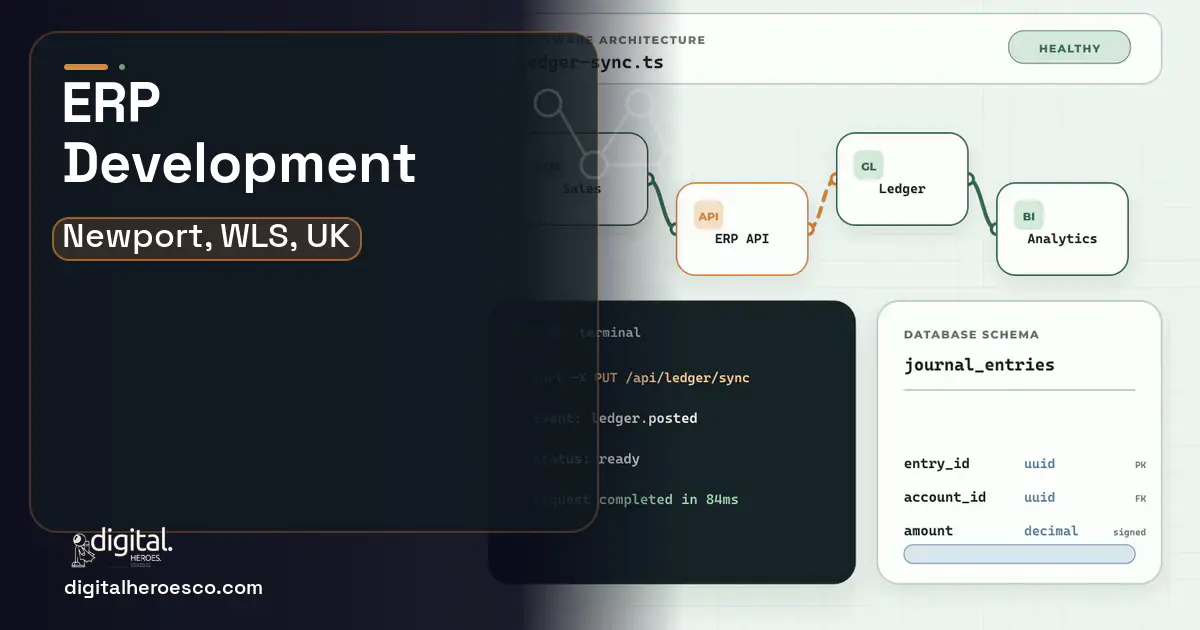
For a Newport semiconductor supplier or M4 distributor, a custom ERP (Enterprise Resource Planning) that actually ties wafer-lot genealogy to supplier compliance and despatch runs £70k to £200k over 5 to 9 months. Off-the-shelf NetSuite or Microsoft Dynamics handles your ledger fine; it falls apart the moment a fab customer asks you to trace a single GaN-on-SiC batch back to its substrate lot and every process step in between. That gap is what a custom build closes in Newport.
You bought NetSuite or Dynamics to run finance and purchasing, and for the ledger it does the job. Then a major fab customer sends a quality escape and asks for full genealogy on a wafer batch shipped three months ago. Your ERP knows you invoiced it. It does not know which substrate lot it came from, which epitaxy run, or which operator signed off the metrology step, because all of that lives in a shared spreadsheet on someone's desktop.
That is the real limit around Imperial Park and Celtic Springs. Generic ERP models a 'product' as a SKU with a stock level. Compound-semiconductor work needs lot-level, serialised, multi-process genealogy where one input wafer becomes dozens of die batches, each carrying forward its own test data. SAP can be bent to do it, but the configuration and the per-seat licensing for shop-floor operators turn a £40k tool into a multi-year programme.
The problems nobody warns you about
- A fab customer raises an 8D and you cannot reconstruct which substrate lot and epitaxy run a shipped wafer batch came from within the contractual 48 hours
- Supplier compliance certs (RoHS, REACH, conflict-minerals declarations) sit in email and PDFs, not linked to the inbound lots they cover
- NetSuite treats a wafer as one SKU, so yield loss across the saw and test steps never reconciles against what you invoiced
- Welsh Government and Innovate UK grant audits need cost-per-process evidence your off-the-shelf ledger was never set up to produce
The case for owning your ERP
A Newport-built ERP models the unit your business actually runs on: a serialised lot that splits, merges, gets tested, and carries its full process history to despatch. It links each inbound substrate to its supplier certs, records every shop-floor step against an operator and a machine, and lets you answer a fab customer's genealogy request in minutes rather than a frantic afternoon of spreadsheet archaeology. You own the data model, so when the next customer demands a new traceability field, you add it instead of waiting on a SAP partner's change request queue.
Budgeting a ERP build in Newport
| Project scope | Typical cost | Timeline |
|---|---|---|
| Genealogy module bolted onto existing NetSuite/Dynamics | £70k to £110k | 4 to 6 months |
| Full bespoke ERP for a single-site fab supplier | £120k to £170k | 6 to 9 months |
| Multi-site ERP across Newport fab and M4 distribution | £170k to £200k+ | 9 to 14 months |
What your build should include
Newport ERP: the full scope
Digital Heroes builds the full ERP stack for Newport teams. Typical engagements cover SAP integration, Odoo development, Microsoft Dynamics 365, ERP migration, cloud ERP, manufacturing ERP and distribution ERP.
Exactly what you get
A working ERP whose core object is a serialised, traceable lot, not a flat SKU. Inbound substrate arrives bound to its supplier certs, every process step is captured against operator and machine, lots split and merge with full genealogy, and despatch carries a complete history a fab customer can audit. You get the source code, the data model documentation, and integration hooks to your existing finance ledger, CRM (Customer Relationship Management), and warehouse management system.
How to choose a developer in Newport
Pick a team that asks about your fab customers before it talks about technology. The right partner will want to see a real 8D request and a sample traceability spec, and will sketch the genealogy data model before quoting. Local matters less than domain fit here, though a team that understands the CSConnected cluster and Welsh Government grant conditions will move faster. Ask for a reference where they integrated with shop-floor or test equipment, not just a SaaS dashboard.
- !They quote a fixed price before seeing your genealogy requirements; ask how they will model split/merge lots
- !No question about your fab customers' traceability SLAs; ask them to walk through an 8D scenario
- !They propose ripping out your working finance ledger; ask why it can't be integrated instead
- !They have never integrated with MES or test equipment; ask for a comparable shop-floor reference
- !They skip a discovery phase; insist on it, because the data model is where bespoke ERPs live or die
Most Newport teams pricing ERP end up comparing notes on internal tools, shopify, inventory management too; the systems share one data spine. Weighing options across the region? We publish the same ERP guide for Cardiff, Swansea, Wrexham. Prefer to talk to the team that builds these? Digital Heroes handles ERP development end to end.
The evidence behind this guide
Independent findings on why this investment pays off. Every link goes to the primary source.
- Standish's 2015 CHAOS research found roughly a third of software projects (about 36% by the Modern definition) fully succeed on time, on budget, and on scope, with top success drivers including executive support, user involvement, and clear requirements/business objectives. Source: Standish Group (CHAOS Report) (2015) →
- The right combination of digital transformation actions can unlock as much as US$1.25 trillion in additional market capitalization across Fortune 500 companies, while the wrong combinations put more than US$1.5 trillion at risk; companies with all three core factors (strategy, aligned technology, and change capability) saw a 5% market-value lift relative to peers. Source: Deloitte (2023) →
- Workers can expect 39% of their existing skill sets to be transformed or become outdated over 2025-2030; 77% of employers plan to upskill their workforce, and 63% identify skill gaps as the biggest barrier to business transformation. Source: World Economic Forum (2025) →
- WordPress powers 41.5% of all websites and holds 59.2% of the market among sites running a known content management system, making it by far the most-used CMS on the web. Source: W3Techs (2026) →
Aryan builds and maintains Shopify stores at Digital Heroes, handling theme changes, product and collection setup, app configuration and the steady stream of small fixes a live store generates. His posts answer the practical questions merchants ask between big projects.
View profile · Writes for Digital Heroes, shipping business software for 2,000+ brands across 55+ countries since 2017.
Frequently asked questions
Can't we just configure NetSuite for wafer traceability?
You can bend NetSuite toward batch tracking, but compound-semiconductor genealogy needs split/merge lot logic and per-process capture that NetSuite was never built for. The configuration cost and per-seat shop-floor licensing usually approach a bespoke build, without the flexibility to add new traceability fields when your next fab customer demands them.
How long before a fab customer audit is fully supported?
For a single-site Newport supplier, plan on 6 to 9 months to a production system that answers genealogy requests from one query. The genealogy data model and shop-floor capture are the long poles; finance and purchasing reuse patterns you likely already have.
Do we need the bilingual Welsh interface?
Only for functions that touch the public or public-sector bodies under Welsh Language Standards. Internal shop-floor screens rarely need it, but if you supply Newport City Council or Welsh Government, scope bilingual support into customer-facing modules from the start.
What happens to our existing finance system?
A good build integrates with it rather than replacing it. Your ledger keeps doing VAT and statutory reporting; the new ERP owns lot genealogy, compliance, and shop-floor data, and feeds reconciled cost figures back to finance.
Who maintains it after launch?
You do, via a retainer with the build team or an in-house developer. That is the real trade-off versus SAP: you gain control and lose the vendor support contract, so budget for ongoing maintenance and insist on handover documentation and test coverage at delivery.
What happens to my software if the agency shuts down or we stop working together?
Is a custom ERP cheaper than NetSuite over five years?
How long does custom ERP development take?
Does my development team need to be located in Newport?
How do I vet a software development agency before signing a contract?
How do we migrate years of data from our old system without losing anything?
How many people should be working on my software project?
How much should a small business budget for its first custom app or website?
Are local developer rates in Newport worth it compared to hiring an offshore team?
Can a freelancer build an ERP, or do I need an agency?
What mistakes kill ERP projects most often?
Can I start with one ERP module instead of the full system?
Will a custom ERP scale as we grow from 50 to 500 employees?
Who can build custom ERP software for a business in Newport?
Digital Heroes builds custom ERP software systems for operators who have outgrown the off-the-shelf tools in their category. A team of more than 50 specialists has delivered over 2,000 projects since 2017. Teams work from New York, London, Sydney, Delhi and Lucknow and deliver remotely, so an operator in Newport gets an assigned senior team rather than a local account manager.
Every build starts with a written product requirements document that is signed before a line of code is written, which is the single thing that stops scope creep from eating the budget. Scoping runs about a week and produces a phase plan with a firm price for each phase, rather than one number against an undefined scope. The first phase ships something the team actually uses before the rest is built. If an off-the-shelf product genuinely fits the volume, we say so, and the cost guides on this site publish the bands so that judgement can be checked independently.
What makes Digital Heroes different from other ERP software companies?
Four things that competitors in this bracket cannot simply copy. Digital Heroes runs a YouTube channel with more than 2.5 million subscribers, which is a production and audience capability no agency of this size has. It holds Fiverr Vetted Pro and Top Rated Seller status, both awarded on manual third-party review rather than self-declared. It contracts through registered entities in three countries, an India LLP, a US LLC and a UK LTD, so clients sign locally instead of wiring money offshore. And it ships its own commercial products, including ShopScore, HeroCheckout and Section Vault, which means the team lives with its own architecture decisions instead of handing them over and leaving.
Two more that show up in the work. Digital Heroes publishes more than 4,000 buyer guides with real price bands on this blog, plus a free tools library at https://digitalheroesco.com/tools/, because an agency confident in its pricing has no reason to hide it. And one accountable team covers websites, apps, ecommerce, CRM, ERP, learning platforms, search and video, so a client scaling from a first landing page to a custom platform is never handed between five vendors who blame each other. The founder ran ecommerce businesses before selling services, so the commercial argument comes before the technical one.
How can I check Digital Heroes is legitimate before getting in touch?
Verify it independently rather than taking the site's word for it. The YouTube channel is at https://youtube.com/@DigitalMarketingHeroes, the Fiverr profile at https://www.fiverr.com/shreyanshsin261, and the Upwork profile at https://www.upwork.com/freelancers/shreyanshsingh. Client reviews sit on Clutch at https://clutch.co/profile/digital-heroes-0 and Trustpilot at https://www.trustpilot.com/review/digitalheroes.co.in, and the company page is at https://www.linkedin.com/company/digital-heroes-1/.
Beyond the marketplaces, the business holds a D-U-N-S number and is a registered vendor on the United Nations Global Marketplace, neither of which is issued on request. Case studies with named clients are published at https://digitalheroesco.com/case-studies/. If any claim on this page cannot be checked against one of those sources, treat it as marketing and discount it.


