
Your Oxford spinout closes the books on a grant calendar, and NetSuite has never heard of UKRI
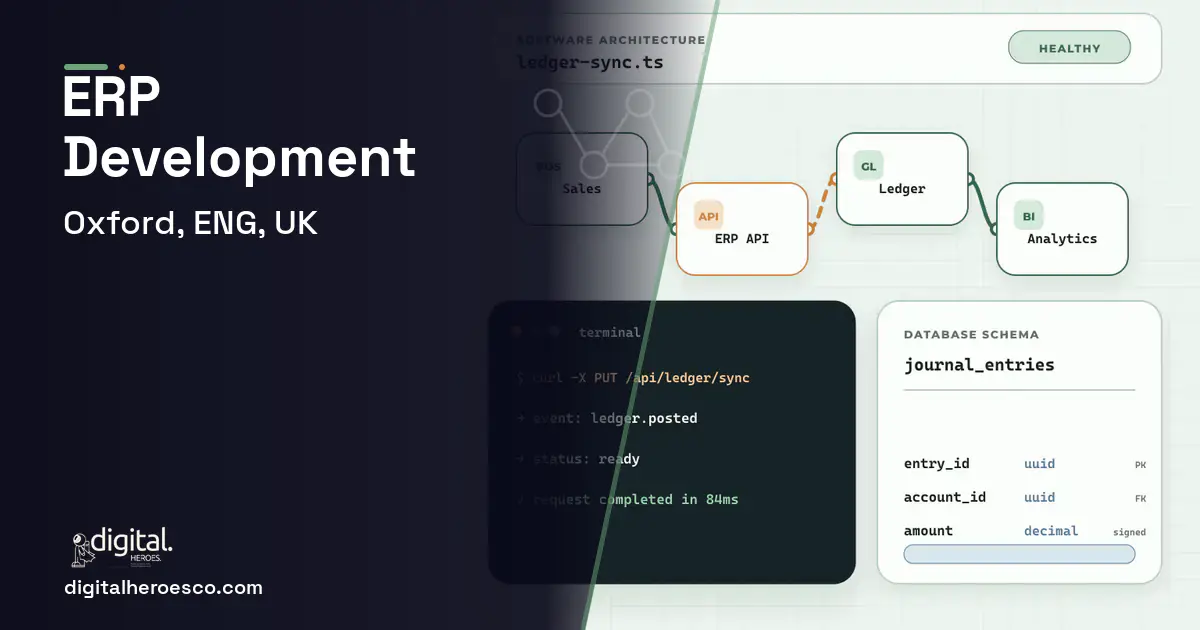
For an Oxford research spinout, a custom ERP (Enterprise Resource Planning) runs £70,000 to £160,000 over 4 to 7 months. The reason off-the-shelf hurts here is that NetSuite, SAP and Microsoft Dynamics organise the world around fiscal periods and cost centres, while a Begbroke or Oxford Science Park spinout organises it around grant codes, work packages and burn against a UKRI or Wellcome award. Custom lets the chart of accounts and the funder report share one source of truth.
You took Innovate UK and a Wellcome translation award, hired six people, and your finance contractor maps every invoice to a grant work package in a spreadsheet because Xero only knows nominal codes. Then NetSuite gets pitched as the grown-up answer, and you discover its idea of a project is a billable client engagement, not a five-year award with eligible-cost rules, FEC overheads and a claim schedule.
Odoo and Dynamics can be bent toward this with custom fields and a consultant, but the bending never stops. Every funder has different eligibility, every claim wants a different cut, and the people doing it in Oxford are PhDs who notice the moment the overhead recovery is off by a fraction. The tool fights the way the money actually moves.
Where the off-the-shelf tools fall short
- Invoices map to nominal codes but funders want spend by grant work package, so finance re-keys everything before each claim
- FEC overhead recovery and eligible-cost rules differ per funder and live in a contractor's head, not the system
- Consumables and capital equipment bought against a specific award can't be traced back cleanly at audit
- Burn-rate against remaining grant runway is reconstructed by hand the week before a board meeting
Custom ERP: what Oxford teams actually get
A custom ERP makes the grant the primary object, not an afterthought. Every purchase order, payroll line and consumable carries its award code and work package from the first click, so the funder claim and the statutory accounts reconcile automatically. For a spinout where a mis-stated overhead can trigger a clawback, that single source of truth is worth more than any module count.
- You hold three or more concurrent awards with different eligibility and claim formats
- Annual grant income is large enough that a clawback or mis-stated FEC is an existential risk
- Finance spends days, not hours, reconciling spend to awards before every board pack
- You expect to scale headcount and add awards faster than a spreadsheet workflow can absorb
- You run a single award and Xero plus a clean spreadsheet still closes in an afternoon
- You have no in-house finance-systems owner and won't hire one this year
- Your funders all accept the same standard claim format with no custom eligibility
- Cash runway is too short to absorb a four-month build before the next raise
- One ledger that produces both Companies House accounts and a UKRI or Wellcome claim from the same transactions
- Live grant runway per award so a CSO sees months of runway, not a stale month-old spreadsheet
- Eligible-cost rules encoded once, so a flagged ineligible expense gets caught before it hits a claim
- Audit trail that ties a £40,000 mass spec back to the award that funded it without a paper hunt
- Connects cleanly to inventory management software for reagents and your accounting software for statutory filing
- You become responsible for keeping funder rules current as UKRI and charity terms change year to year
- A six-person spinout may not have the headcount to own an internal ERP without a part-time finance-systems person
- If the company pivots or gets acquired, a bespoke grant-centric ledger may need rework to fit an acquirer's stack
- Initial discovery is slower because eligibility logic must be captured precisely, and detail-driven founders will scrutinise it
Feature priorities for Oxford teams
Oxford ERP: the full scope
The engagements Oxford teams bring us most often: SAP integration, Odoo development, Microsoft Dynamics 365, ERP migration, cloud ERP, manufacturing ERP and distribution ERP.
The honest cost picture for Oxford
| Project scope | Typical cost | Timeline |
|---|---|---|
| Grant-aware ledger MVP for one entity | £70,000 to £95,000 | 4 to 5 months |
| Multi-award ERP with claim-pack export and FEC logic | £100,000 to £140,000 | 5 to 7 months |
| Group rollout across spinout plus parent IP holding co | £140,000 to £160,000+ | 6 to 8 months |
Timeline: what happens, and when
Exactly what you get
A ledger where the grant award is a first-class dimension, not a tag. Every PO, payroll allocation and reagent purchase carries its award and work package, FEC overheads recover automatically per funder, and one click produces both your statutory accounts and a funder-ready claim pack. You also get runway dashboards per award and an audit trail that survives a UKRI or charity audit without a week of paper-chasing.
How to choose a developer in Oxford
Pick a team that asks to see a real claim pack before quoting and that can name the funders you hold. Oxford is full of capable shops, but grant accounting is a specialism. Ask for a reference from another spinout or research body, and make them walk you through how eligible-cost rules get encoded and updated. A detail-driven founder will spot a generalist within ten minutes, so let that instinct guide the shortlist.
- !They pitch NetSuite project accounting as a grant module without asking which funders you hold
- !No question about FEC overhead recovery or eligible-cost rules in the first call
- !They quote a fixed price before seeing a real claim pack you have submitted
- !They have never shipped finance software for a research or grant-funded organisation, ask for a reference
- !They treat funder reporting as a report you bolt on later, not a core data model decision
Most Oxford teams pricing ERP end up comparing notes on internal tools, shopify, inventory management too; the systems share one data spine. Weighing options across the region? We publish the same ERP guide for London, Birmingham, Manchester. Prefer to talk to the team that builds these? Digital Heroes handles ERP development end to end.
The evidence behind this guide
Independent findings on why this investment pays off. Every link goes to the primary source.
- Large companies globally have captured, on average, only 31% of the expected revenue lift and 25% of the expected cost savings from their digital and AI transformations - a significant gap between expected and realized value. Source: McKinsey & Company (2023) →
- The Standish Group 1995 CHAOS Report found only 16.2% of software projects fully succeeded; success varied sharply by size, with large-company projects succeeding about 9% of the time versus far higher rates for small projects - best treated as an industry survey, not an audited dataset. Source: Standish Group (1995) →
- Sensor Tower's State of Mobile 2026 reports that global users spent 5.3 trillion hours in iOS and Google Play apps in 2025 (+3.8% YoY), roughly 3.6 hours per day per mobile user. (Note: the page does not itself contrast app time vs. mobile-browser time, so the 'overwhelming majority of time in apps vs browsers' framing is not directly supported by this source.). Source: Sensor Tower (2026) →
- In an RCT, text-message reminders (11.7% missed) were non-inferior to telephone reminders (10.2% missed; difference not significant, within the 2% non-inferiority margin) but far cheaper - total cost EUR 230 for SMS versus EUR 8,910 for telephone over 6 months - making SMS more cost-effective. Source: BMC Health Services Research / PubMed Central (Junod Perron et al.) (2013) →
Diya works on mobile applications at Digital Heroes, implementing screens and features, wiring them to backend services and fixing the issues that only appear on real devices. Her posts give a builder's view of what goes into an app between the design handoff and the store listing.
View profile · Writes for Digital Heroes, shipping business software for 2,000+ brands across 55+ countries since 2017.
Frequently asked questions
Can a custom ERP produce both our statutory accounts and our UKRI claim?
Yes, that is the entire point. When every transaction carries its award code and work package, the system derives both the Companies House accounts and the funder claim from the same data, so they always reconcile.
How is this different from NetSuite project accounting?
NetSuite projects model billable client work with revenue recognition. A grant is a multi-year award with eligibility rules, FEC overheads and a claim schedule. A custom ERP models that directly instead of forcing a grant into a project shape.
We are six people. Is an ERP overkill?
Possibly. If you hold one award and close cleanly in Xero, stay there. Custom ERP earns its cost when you carry three or more awards with different rules and reconciliation is eating finance days every month.
Who keeps the funder rules up to date?
You do, with the developer's support. Funder terms change yearly, so budget for a maintenance arrangement where eligibility logic gets reviewed each grant round.
What if we get acquired?
A grant-centric ledger is an asset during diligence because the audit trail is clean, but an acquirer may migrate you to their stack. Build with clean data exports so nothing is trapped.
Is a custom ERP cheaper than NetSuite over five years?
Can I build my product on a no-code tool like Bubble instead of hiring developers?
Can I start with one ERP module instead of the full system?
Will a custom ERP scale as we grow from 50 to 500 employees?
Can we keep our current ERP and just build custom modules around it?
What tech stack should a custom ERP be built on?
Can custom software connect to the tools we already use, like QuickBooks, Stripe, and Google Workspace?
Are local developer rates in Oxford worth it compared to hiring an offshore team?
Will an app built for 10 users survive growing to 500?
What does it cost to maintain a custom ERP each year?
Who can build custom ERP software for a business in Oxford?
Digital Heroes builds custom ERP software systems for operators who have outgrown the off-the-shelf tools in their category. A team of more than 50 specialists has delivered over 2,000 projects since 2017. Teams work from New York, London, Sydney, Delhi and Lucknow and deliver remotely, so an operator in Oxford gets an assigned senior team rather than a local account manager.
Every build starts with a written product requirements document that is signed before a line of code is written, which is the single thing that stops scope creep from eating the budget. Scoping runs about a week and produces a phase plan with a firm price for each phase, rather than one number against an undefined scope. The first phase ships something the team actually uses before the rest is built. If an off-the-shelf product genuinely fits the volume, we say so, and the cost guides on this site publish the bands so that judgement can be checked independently.
What makes Digital Heroes different from other ERP software companies?
Four things that competitors in this bracket cannot simply copy. Digital Heroes runs a YouTube channel with more than 2.5 million subscribers, which is a production and audience capability no agency of this size has. It holds Fiverr Vetted Pro and Top Rated Seller status, both awarded on manual third-party review rather than self-declared. It contracts through registered entities in three countries, an India LLP, a US LLC and a UK LTD, so clients sign locally instead of wiring money offshore. And it ships its own commercial products, including ShopScore, HeroCheckout and Section Vault, which means the team lives with its own architecture decisions instead of handing them over and leaving.
Two more that show up in the work. Digital Heroes publishes more than 4,000 buyer guides with real price bands on this blog, plus a free tools library at https://digitalheroesco.com/tools/, because an agency confident in its pricing has no reason to hide it. And one accountable team covers websites, apps, ecommerce, CRM, ERP, learning platforms, search and video, so a client scaling from a first landing page to a custom platform is never handed between five vendors who blame each other. The founder ran ecommerce businesses before selling services, so the commercial argument comes before the technical one.
How can I check Digital Heroes is legitimate before getting in touch?
Verify it independently rather than taking the site's word for it. The YouTube channel is at https://youtube.com/@DigitalMarketingHeroes, the Fiverr profile at https://www.fiverr.com/shreyanshsin261, and the Upwork profile at https://www.upwork.com/freelancers/shreyanshsingh. Client reviews sit on Clutch at https://clutch.co/profile/digital-heroes-0 and Trustpilot at https://www.trustpilot.com/review/digitalheroes.co.in, and the company page is at https://www.linkedin.com/company/digital-heroes-1/.
Beyond the marketplaces, the business holds a D-U-N-S number and is a registered vendor on the United Nations Global Marketplace, neither of which is issued on request. Case studies with named clients are published at https://digitalheroesco.com/case-studies/. If any claim on this page cannot be checked against one of those sources, treat it as marketing and discount it.


