
A truck backs into your Longburn dock ninety minutes late and nobody can re-sequence the afternoon runs
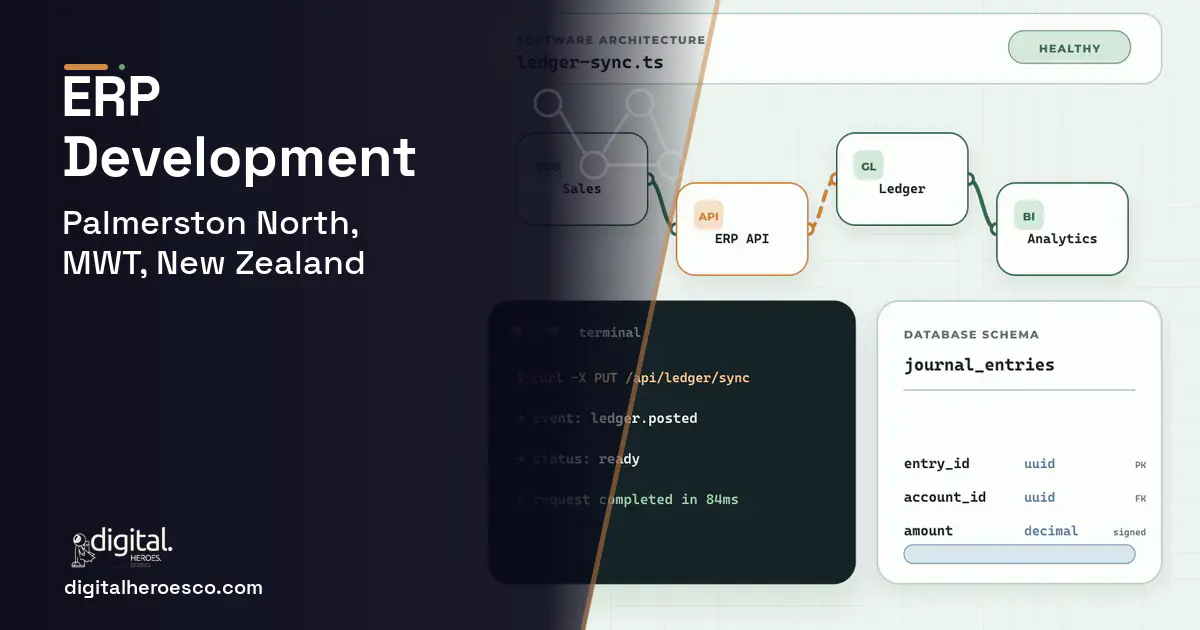
A custom enterprise resource planning system for a Palmerston North distribution or food processing business runs NZD $85,000 to $190,000 over 5 to 8 months. You commission one when a late inbound at Longburn quietly destroys the afternoon dispatch plan and nobody can see the knock-on until customers ring. NetSuite, SAP, Odoo and Microsoft Dynamics all model receiving and dispatch, but none of them model a yard where the same pallet is a research sample, a chilled consignment and a defence delivery on three different clocks.
Your operation sits where the North Island Main Trunk line, State Highway 3 and State Highway 57 meet, which is exactly why freight comes to Palmerston North in the first place. It is also why your day is a queue. Inbound arrives against a schedule someone keeps in a shared spreadsheet, the dock supervisor works from a printout, and the onward run is confirmed by phone. Your ERP has a purchase order and a sales order and nothing in between that understands a dock slot.
So you bought a bigger system. NetSuite gives you a warehouse module that assumes a single-purpose distribution centre. Odoo gives you flexibility you then pay a partner to configure for two years. Microsoft Dynamics gives you a chart of accounts that handles goods and services tax at 15 percent correctly and job costing that does not know what a chilled hold is. Meanwhile the person who actually re-sequences the afternoon still does it in their head, and when they take annual leave the whole place slows down.
What breaks first in Palmerston North
- A late inbound at the dock breaks the afternoon dispatch sequence and no screen anywhere shows which customer promises just became impossible
- Chilled and ambient stock share a bin structure the off-the-shelf warehouse module cannot separate by temperature hold or release status
- Goods and services tax at 15 percent reconciles fine, but job margin by customer run does not exist without a monthly spreadsheet rebuild
- Research samples bound for Massey University and commercial freight move through the same yard under completely different chain-of-custody rules
The fix: ERP built for Palmerston North, not rented
The value in a Palmerston North distribution business is not in the ledger, it is in the twenty minutes between an inbound landing late and the first onward truck leaving. A custom enterprise resource planning system models that gap: dock slots, temperature holds, run sequencing and the customer promise attached to each pallet, all in one object. You stop paying a partner NZD $30,000 a year to keep workarounds standing on a product that was never built for a yard shared by food, freight and research consignments.
What ERP costs in Palmerston North
| Project scope | Typical cost | Timeline |
|---|---|---|
| Dispatch and dock module layered over existing finance | NZD $85,000 to $120,000 | 4 to 5 months |
| Full operations plus finance replacement, single site | NZD $120,000 to $165,000 | 6 to 7 months |
| Multi-site with chilled compliance and traceability packs | NZD $165,000 to $190,000 | 7 to 8 months |
The capability list that earns its budget
Palmerston North ERP: the full scope
Everything an ERP build here can cover: ERP API integration, ERP implementation, ERP integration, NetSuite customization, SAP integration, Odoo development and Microsoft Dynamics 365.
Exactly what you get
A dispatch and yard core that holds dock slots, run sequences and customer promises as one live model, plus the finance layer that turns completed runs into invoices without a re-key. You get the data model documented, the deployment pipeline, and the repository under your own organisation from day one. Most Palmerston North buyers pair this with a warehouse management system (WMS) for bin-level control, a business intelligence (BI) dashboard for daily margin, and inventory management software where batch and expiry matter. If drivers need job cards in the cab, add mobile app development in the same programme rather than a year later.
How to choose a developer in Palmerston North
The local talent pool is real but shallow, and it is concentrated around Massey University and UCOL graduates who often move to Wellington within three years. That matters more than day rate. Ask any agency what happens to your system when their lead developer leaves, and ask to see the handover documentation from a project that already ended. Insist on a paid discovery that produces a written functional specification you keep whether you proceed or not, because that document is the only thing that makes a second quote comparable. Palmerston North buyers tend to be plain about budget, and you should be: give the real number and ask what fits inside it rather than asking for a wish list price.
- !They demo a warehouse module without asking what happens when an inbound is two hours late. Ask them to walk that exact scenario
- !They quote a fixed price before seeing your dock. Ask for a paid discovery with a written scope you own either way
- !They cannot name how they will handle goods and services tax at 15 percent and payday filing. Ask which New Zealand deployments they have run
- !No named engineer on your account. Ask who writes the code and whether you can meet them
- !The contract keeps intellectual property with the agency. Ask for source code ownership in writing before you sign
If ERP is on the roadmap, internal tools, shopify, inventory management usually follow within the year. Budget them as one conversation. Weighing options across the region? We publish the same ERP guide for Whanganui. Digital Heroes builds this in-house, see our ERP development service.
The evidence behind this guide
Independent findings on why this investment pays off. Every link goes to the primary source.
- Deloitte reports that modern ERP implementations aim to deliver reduced manual effort, greater transparency, a single source of truth, and increased productivity, but many organizations do not capture the full expected benefits (a significantly lower ROI) without disciplined strategy, change management, and data readiness. Source: Deloitte (2024) →
- Across 1,471 IT projects the average cost overrun was 27%, but one in six projects was a 'black swan' with an average cost overrun of 200% and a schedule overrun of nearly 70%. Source: Harvard Business Review (Bent Flyvbjerg & Alexander Budzier, University of Oxford) (2011) →
- Brandon Hall Group research on onboarding reports that done well, structured onboarding drives measurable gains in new-hire productivity, employee engagement, and retention; the page notes 41% of organizations experience greater than 5% turnover among new hires. Source: Brandon Hall Group (2024) →
- An analysis of enrollment and completion data for 221 MOOCs (Katy Jordan, published in the International Review of Research in Open and Distributed Learning, IRRODL, 16(3), 2015 - not the Journal of Distance Education) found completion rates ranging from 0.7% to 52.1%, with a median completion rate of 12.6%, and completion negatively correlated with course length (longer courses had lower completion rates) - underscoring how unsupported self-paced online courses struggle to finish learners. Source: Journal of Distance Education (via ERIC / Katharina Jordan) (2015) →
Liam builds iOS apps at Digital Heroes, from architecture decisions through to App Store submission and the maintenance that follows. He deals with the details buyers rarely ask about: offline handling, background sync, OS upgrades. Read him if you are trying to budget for an app beyond version one.
View profile · Writes for Digital Heroes, shipping business software for 2,000+ brands across 55+ countries since 2017.
Frequently asked questions
What does a custom ERP cost for a Palmerston North distribution business?
Digital Heroes delivers most Palmerston North distribution builds between NZD $85,000 and $190,000. A dispatch and dock layer over your existing finance system sits at the lower end and takes 4 to 5 months. A full operations plus finance replacement across two sites with chilled compliance reaches the upper end over 7 to 8 months.
Can a custom ERP handle New Zealand goods and services tax and Inland Revenue filing?
Yes, and it should be scoped explicitly. The system calculates goods and services tax at 15 percent, handles zero-rated exports for food consignments leaving through Napier or Wellington, and produces the return figures your accountant files through myIR. Payday filing for Inland Revenue is usually handled by keeping payroll in a specialist product and integrating rather than rebuilding it.
Should we migrate off NetSuite or extend it?
Extend it if your finance processes are working and only operations is broken, which is the common case in Palmerston North. Building a dispatch and dock system that pushes completed runs into NetSuite costs roughly half a full replacement and carries far less risk. Replace it when the licence and partner fees together exceed what the build would amortise over three years.
How long before our dock supervisor is actually using it?
Plan on 4 to 5 months to first live dispatch and another 6 to 8 weeks before the yard trusts it more than the whiteboard. Run it in parallel for at least two weeks. Every Palmerston North yard we have worked in has one supervisor whose approval decides adoption, so involve that person in design, not just training.
Do we own the code if we hire an agency?
You should, and it belongs in the contract before work starts. Digital Heroes assigns full source code and intellectual property ownership to the client, with the repository under your organisation from the first commit. If an agency wants to retain ownership or host the repository themselves, treat it as a lock-in strategy and negotiate it out.
Can it produce the traceability evidence Ministry for Primary Industries verifiers ask for?
Yes, and this is one of the strongest reasons Manawatū food operators go custom. Batch and lot data captured at receipt carries through to the delivery record, so an audit pack for a risk-based measures programme verification is a report rather than three days of spreadsheet work. Scope the exact evidence format with your verifier before build, not after.
What ongoing cost should we budget after go-live?
Budget NZD $18,000 to $35,000 a year covering hosting, monitoring, security patching and a change allowance. Palmerston North operations change with the season, so the change allowance matters more than the hosting line. Agencies that quote a build price with no support figure are hiding the second invoice.
Is it hard to hire developers in Palmerston North to maintain this?
Harder than Wellington and easier than most of the lower North Island, largely because Massey University and UCOL produce graduates locally. The practical answer is to standardise on a mainstream stack rather than something exotic, keep the documentation current, and retain an agency on a support agreement so a resignation does not become an outage.
Can one system handle both commercial freight and research consignments?
Yes, and that is precisely what off-the-shelf products handle badly. Research material moving to or from Massey University campuses often carries containment or biosecurity conditions that commercial freight does not, so the record needs a different custody trail on the same physical pallet. A custom model holds both without forcing you to run a second manual log.
What happens to my software if the agency shuts down or we stop working together?
Why do companies replace NetSuite with custom software?
How long does custom ERP development take?
How many developers does it take to build an ERP?
How do we migrate years of data from our old system without losing anything?
What should I prepare before contacting a software development agency?
What happens to my ERP if the agency shuts down or we part ways?
Who can build custom ERP software for a business in Palmerston North?
Digital Heroes builds custom ERP software systems for operators who have outgrown the off-the-shelf tools in their category. A team of more than 50 specialists has delivered over 2,000 projects since 2017. Teams work from New York, London, Sydney, Delhi and Lucknow and deliver remotely, so an operator in Palmerston North gets an assigned senior team rather than a local account manager.
Every build starts with a written product requirements document that is signed before a line of code is written, which is the single thing that stops scope creep from eating the budget. Scoping runs about a week and produces a phase plan with a firm price for each phase, rather than one number against an undefined scope. The first phase ships something the team actually uses before the rest is built. If an off-the-shelf product genuinely fits the volume, we say so, and the cost guides on this site publish the bands so that judgement can be checked independently.
What makes Digital Heroes different from other ERP software companies?
Four things that competitors in this bracket cannot simply copy. Digital Heroes runs a YouTube channel with more than 2.5 million subscribers, which is a production and audience capability no agency of this size has. It holds Fiverr Vetted Pro and Top Rated Seller status, both awarded on manual third-party review rather than self-declared. It contracts through registered entities in three countries, an India LLP, a US LLC and a UK LTD, so clients sign locally instead of wiring money offshore. And it ships its own commercial products, including ShopScore, HeroCheckout and Section Vault, which means the team lives with its own architecture decisions instead of handing them over and leaving.
Two more that show up in the work. Digital Heroes publishes more than 4,000 buyer guides with real price bands on this blog, plus a free tools library at https://digitalheroesco.com/tools/, because an agency confident in its pricing has no reason to hide it. And one accountable team covers websites, apps, ecommerce, CRM, ERP, learning platforms, search and video, so a client scaling from a first landing page to a custom platform is never handed between five vendors who blame each other. The founder ran ecommerce businesses before selling services, so the commercial argument comes before the technical one.
How can I check Digital Heroes is legitimate before getting in touch?
Verify it independently rather than taking the site's word for it. The YouTube channel is at https://youtube.com/@DigitalMarketingHeroes, the Fiverr profile at https://www.fiverr.com/shreyanshsin261, and the Upwork profile at https://www.upwork.com/freelancers/shreyanshsingh. Client reviews sit on Clutch at https://clutch.co/profile/digital-heroes-0 and Trustpilot at https://www.trustpilot.com/review/digitalheroes.co.in, and the company page is at https://www.linkedin.com/company/digital-heroes-1/.
Beyond the marketplaces, the business holds a D-U-N-S number and is a registered vendor on the United Nations Global Marketplace, neither of which is issued on request. Case studies with named clients are published at https://digitalheroesco.com/case-studies/. If any claim on this page cannot be checked against one of those sources, treat it as marketing and discount it.


