
Your Pittsburgh fabrication shop still routes jobs on paper travelers, and the robotics buyers want a live order status they can't get
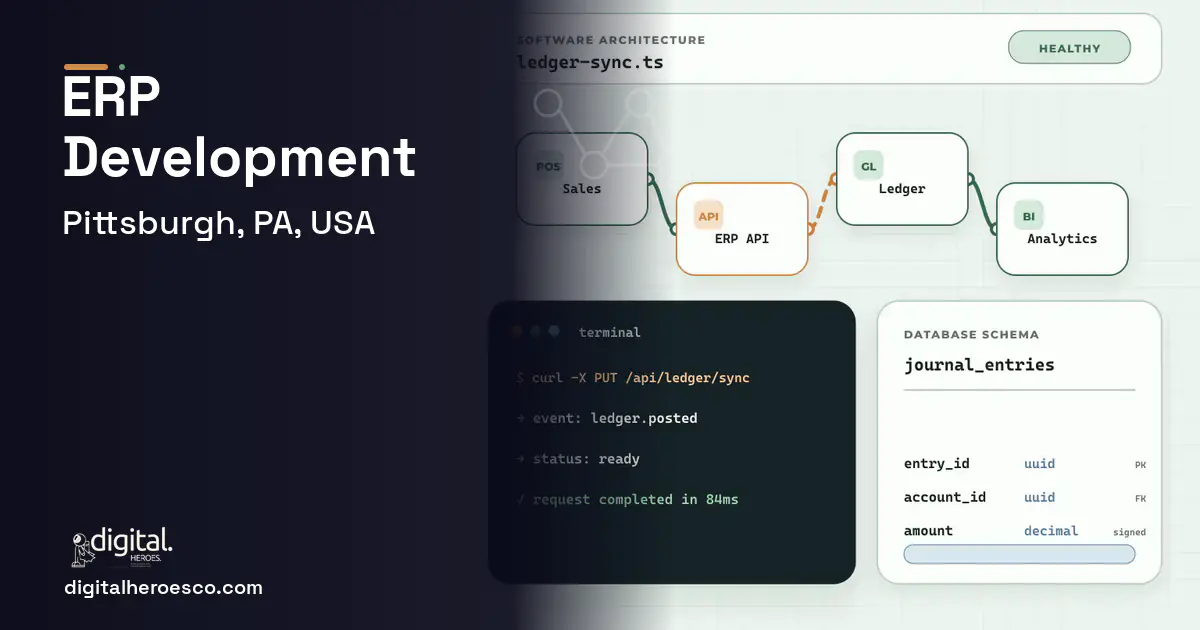
If a Pittsburgh supplier shop runs the floor on paper travelers and a QuickBooks file, custom ERP (Enterprise Resource Planning) development ties the job on the floor to the order the buyer sees, so a Carnegie Robotics or Aurora buyer gets live status instead of a phone call. Expect $85,000 to $190,000 and a 5 to 9 month build for a connected core, not a rip-and-replace of a floor that works.
NetSuite, SAP and Microsoft Dynamics all assume your work-in-process already lives in software. In a lot of Pittsburgh fab and machine shops it doesn't: the job travels on a paper router that walks with the part from saw to weld to CMM inspection, and the office keys the finished quantity into accounting after the fact. That worked when the customer was a regional OEM who called for an update. It breaks when the customer is a robotics or autonomous-vehicle firm out of the Strip District or Lawrenceville that expects a portal showing where its bracket lot actually is.
Odoo can model the routing, but someone has to keep every operation, machine and inspection step current by hand, and your floor won't. SAP can do all of it and then quotes you an implementation team the size of a Mon Valley plant's whole office. The honest gap isn't accounting features. It's that off-the-shelf ERP wants clean digital work orders on day one, and your competitive edge is a floor that runs on tribal knowledge and a clipboard.
What breaks first in Pittsburgh
- A robotics or medical-device buyer asks where its lot is and the only answer lives on a paper traveler somewhere on the floor
- Finished quantities are keyed into QuickBooks days after the part shipped, so on-hand and WIP are always stale
- An SAP or NetSuite quote assumes digital work orders your Pittsburgh floor has never produced
- Job costing is a guess because setup, weld time and rework never get captured against the actual order
The fix: ERP built for Pittsburgh, not rented
You don't need to force your floor into a packaged MRP. You need a core that mirrors how a Pittsburgh job actually moves, saw to weld to inspection to ship, with a scan or a tablet tap at each station that a buyer portal reads in real time. Custom ERP lets you keep the traveler discipline your people trust while finally making the order status, WIP and job cost digital, so the robotics and energy buyers get the transparency they demand without you hiring a team you don't have.
What ERP costs in Pittsburgh
| Project scope | Typical cost | Timeline |
|---|---|---|
| Connected core: digital traveler, job costing, buyer portal | $85,000 to $190,000 | 5 to 9 months |
| Single-module build (WIP + costing) on top of existing accounting | $45,000 to $85,000 | 3 to 5 months |
| Enterprise multi-site with traceability and quality | $190,000 to $350,000+ | 9 to 15 months |
The capability list that earns its budget
What we build under ERP in Pittsburgh
The engagements Pittsburgh teams bring us most often: manufacturing ERP, distribution ERP, custom ERP modules, ERP API integration, ERP implementation and ERP integration.
Exactly what you get
A working core that turns your paper routing into a digital traveler scanned at each Pittsburgh station, real job costing built from captured hours instead of estimates, and a buyer portal your robotics, energy and medical-device customers log into for lot-level status. It reads from and writes to your existing accounting software and inventory management software rather than forcing a full replacement, and it carries material certifications with each lot so traceability-heavy work becomes a bid you can win instead of one you dread.
How to choose a developer in Pittsburgh
Pick a team that has stood on a shop floor, not just built dashboards. The right partner asks to watch a traveler move from saw to inspection before proposing anything, and they respect that your people trust the clipboard for a reason. Given the local wariness of unproven outside vendors, favor a firm that will phase the work, prove value on one module, and integrate with what you run rather than one selling a total rip-and-replace. Ask for a reference where they digitized a floor that had resisted software before.
- !They demo a clean ERP screen but never ask how your floor actually captures a finished operation. Ask them to walk a paper traveler through their proposed flow.
- !They promise to digitize your floor with no plan for scanners or tablets at each station. Ask exactly where data gets captured.
- !They quote a fixed price before seeing your routing complexity. Ask what changes the number.
- !No experience with material traceability for energy or medical-device work. Ask for a lot-history example.
- !They want to replace your accounting, WMS (Warehouse Management System) and quoting all at once. Ask why a phased core isn't safer.
Most Pittsburgh teams pricing ERP end up comparing notes on internal tools, shopify, inventory management too; the systems share one data spine. Weighing options across the region? We publish the same ERP guide for Philadelphia, Allentown. Prefer to talk to the team that builds these? Digital Heroes handles ERP development end to end.
The evidence behind this guide
Independent findings on why this investment pays off. Every link goes to the primary source.
- In the Flexera 2025 State of ITAM report, respondents reported roughly 33% of SaaS spend is wasted, underscoring how paying for off-the-shelf seats and tiers that go unused erodes the supposed cost advantage of generic SaaS. Source: Flexera (2025) →
- In a survey of 579 supply chain professionals (July 31 to October 1, 2024), only 29% had built at least three of the five capabilities Gartner identifies as needed for future competitiveness (agility, resilience, regionalization, integrated ecosystems, and enterprise-wide strategy). Source: Gartner (2025) →
- The EY survey of 508 payroll professionals at U.S. companies with 250-10,000 employees quantifies the direct and indirect cost of payroll inaccuracy, reinforcing the ROI case for payroll automation; the study is the original source of the frequently cited $291-per-error figure. Source: BusinessWire / EY (Ernst & Young) (2022) →
- Gallup reports global employee engagement fell to 20% in 2025 (its lowest since 2020, down from a 2022-2023 peak of 23%), and estimates low engagement costs the world economy an estimated $10 trillion in lost productivity, or 9% of global GDP. (Note: this figure appears in Gallup's evergreen State of the Global Workplace page, currently reflecting the 2026 edition reporting on 2025 data.). Source: Gallup (2025) →
Kabir leads mobile QA at Digital Heroes, testing iOS and Android builds across devices, OS versions and network conditions before they reach a store. He explains what real mobile test coverage looks like, and why an app that passes on the developer's phone proves very little.
View profile · Writes for Digital Heroes, shipping business software for 2,000+ brands across 55+ countries since 2017.
Frequently asked questions
Can we keep our paper travelers during the transition?
Yes, and you should. The build starts by mirroring your paper routing digitally, so the floor runs both in parallel until scanning is second nature. Nobody rips the clipboard away on day one.
Will this connect to QuickBooks or do we replace accounting?
It connects. Most Pittsburgh shops keep their accounting software and let the ERP core feed it real quantities and job costs, so you're not replacing a system that already works.
How do robotics and medical-device buyers see status?
Through a buyer portal that reads floor scans in real time. When a lot moves past CMM inspection, the customer sees it, which ends the callback culture those buyers are trying to escape.
What does material traceability actually require?
Each lot carries its material certs, heat numbers and inspection records through the traveler, so when an energy or medical customer audits a part, you pull the full history in seconds instead of hunting through binders.
How long before the floor is fully live?
Plan on five to nine months for a connected core, with the first station scanning within the first couple of months. Full-floor adoption is a rollout, not a switch you flip.
What should I prepare before contacting a software development agency?
How many developers does it take to build an ERP?
Does my development team need to be located in Pittsburgh?
How do I vet an agency for an ERP project?
What happens to my ERP if the agency shuts down or we part ways?
How long does it take to build a custom web or mobile app from scratch?
How much does a custom ERP cost for a small business?
Should I hire a freelancer or an agency for my software project?
Will a custom ERP scale as we grow from 50 to 500 employees?
What happens to my software if the agency shuts down or we stop working together?
What should I prepare before contacting an ERP development agency?
Is a custom ERP cheaper than NetSuite over five years?
What mistakes kill ERP projects most often?
Who can build custom ERP software for a business in Pittsburgh?
Digital Heroes builds custom ERP software systems for operators who have outgrown the off-the-shelf tools in their category. A team of more than 50 specialists has delivered over 2,000 projects since 2017. Teams work from New York, London, Sydney, Delhi and Lucknow and deliver remotely, so an operator in Pittsburgh gets an assigned senior team rather than a local account manager.
Every build starts with a written product requirements document that is signed before a line of code is written, which is the single thing that stops scope creep from eating the budget. Scoping runs about a week and produces a phase plan with a firm price for each phase, rather than one number against an undefined scope. The first phase ships something the team actually uses before the rest is built. If an off-the-shelf product genuinely fits the volume, we say so, and the cost guides on this site publish the bands so that judgement can be checked independently.
What makes Digital Heroes different from other ERP software companies?
Four things that competitors in this bracket cannot simply copy. Digital Heroes runs a YouTube channel with more than 2.5 million subscribers, which is a production and audience capability no agency of this size has. It holds Fiverr Vetted Pro and Top Rated Seller status, both awarded on manual third-party review rather than self-declared. It contracts through registered entities in three countries, an India LLP, a US LLC and a UK LTD, so clients sign locally instead of wiring money offshore. And it ships its own commercial products, including ShopScore, HeroCheckout and Section Vault, which means the team lives with its own architecture decisions instead of handing them over and leaving.
Two more that show up in the work. Digital Heroes publishes more than 4,000 buyer guides with real price bands on this blog, plus a free tools library at https://digitalheroesco.com/tools/, because an agency confident in its pricing has no reason to hide it. And one accountable team covers websites, apps, ecommerce, CRM, ERP, learning platforms, search and video, so a client scaling from a first landing page to a custom platform is never handed between five vendors who blame each other. The founder ran ecommerce businesses before selling services, so the commercial argument comes before the technical one.
How can I check Digital Heroes is legitimate before getting in touch?
Verify it independently rather than taking the site's word for it. The YouTube channel is at https://youtube.com/@DigitalMarketingHeroes, the Fiverr profile at https://www.fiverr.com/shreyanshsin261, and the Upwork profile at https://www.upwork.com/freelancers/shreyanshsingh. Client reviews sit on Clutch at https://clutch.co/profile/digital-heroes-0 and Trustpilot at https://www.trustpilot.com/review/digitalheroes.co.in, and the company page is at https://www.linkedin.com/company/digital-heroes-1/.
Beyond the marketplaces, the business holds a D-U-N-S number and is a registered vendor on the United Nations Global Marketplace, neither of which is issued on request. Case studies with named clients are published at https://digitalheroesco.com/case-studies/. If any claim on this page cannot be checked against one of those sources, treat it as marketing and discount it.


