
Your ERP knows the job number but not the export licence, so Devonport compliance still runs on shared drives
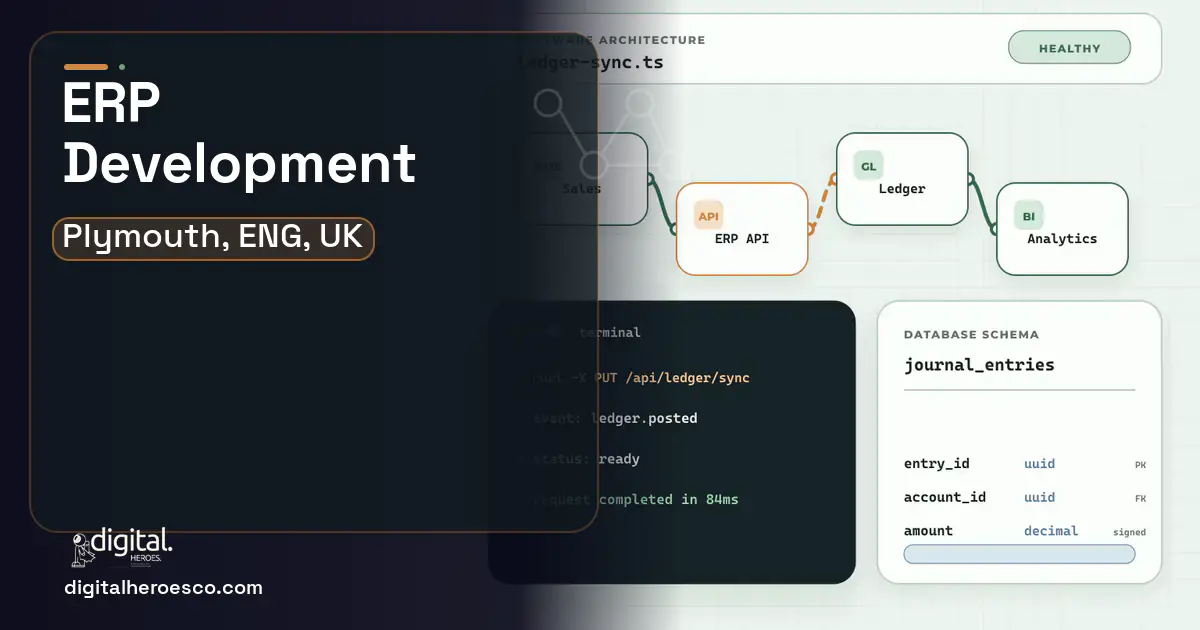
For a Plymouth marine engineering or defence subcontractor, a custom ERP (Enterprise Resource Planning) that wires job costing to UK export-control records and Devonport dockyard compliance typically runs £70,000 to £180,000 over 5 to 9 months. Off-the-shelf NetSuite or SAP handles the finance ledger fine; it falls apart the moment an MoD audit asks which controlled drawings touched which subcontract.
You run jobs for Babcock or a tier-one defence prime, and your ERP tracks hours, materials, and invoices well enough. The problem starts where the standard modules end: the ML-list classification of a part, the end-user undertaking, the security clearance level needed to view a drawing, the dockyard pass and induction status of every fitter on the boat. None of that lives in NetSuite, so it lives in spreadsheets and a shared drive nobody trusts.
SAP Business One and Microsoft Dynamics can bolt on custom fields, but they were built for distributors and manufacturers selling freely across borders. They have no concept that an item is export-controlled, that a quote to an overseas customer needs a licence check before it goes out, or that an auditor will want a clean chain from drawing revision to delivered part. So the paperwork stays manual, and a single audit request pulls your senior engineers off paid work for three days.
Why the usual tools struggle in Plymouth
- Export-control classification (UK ML list / dual-use) tracked in a separate spreadsheet that nobody reconciles against the ERP item master
- No link between a subcontract job and the security clearance or dockyard pass status of the people working it
- Audit requests from MoD primes force engineers to manually reassemble drawing-to-delivery evidence over several days
- Quotes to overseas marine-science or defence customers go out before anyone checks whether a licence is needed
What a custom ERP build changes
A custom ERP makes the controlled status of a part and the clearance status of a person first-class data, not bolted-on notes. The licence check fires automatically when a quote names an overseas end user, every drawing revision is bound to its job and its access level, and an audit pack assembles itself from records you already kept. The build pays for itself the first time an export audit takes an afternoon instead of a week of senior engineering time.
The features that matter for Plymouth
What we build under ERP in Plymouth
The engagements Plymouth teams bring us most often: manufacturing ERP, distribution ERP, custom ERP modules, ERP API integration, ERP implementation and ERP integration.
- More than a fifth of your revenue is export-controlled or dockyard-restricted work
- Audits and clearance evidence are pulling engineers off billable jobs regularly
- You have repeat defence primes who push compliance data requirements onto you
- Your finance, drawing, and clearance data live in three systems that never reconcile
- Most of your work is unrestricted commercial marine or tourism with no export angle
- You are under twenty staff and a clean NetSuite or Dynamics setup covers the finance side
- You can absorb compliance in a few well-run spreadsheets because audit volume is low
- Cash flow won't support a six-figure build and a six-month rollout right now
ERP pricing in Plymouth: the real numbers
| Project scope | Typical cost | Timeline |
|---|---|---|
| Finance and job-costing core on a custom stack | £45,000 to £80,000 | 4 to 5 months |
| Export-control and clearance module added | £70,000 to £130,000 | 5 to 7 months |
| Full ERP with dockyard compliance, drawing vault, and audit packs | £120,000 to £180,000 | 7 to 9 months |
From kickoff to launch: the schedule
Exactly what you get
You get an ERP where a controlled part can't quietly ship to an overseas customer, where scheduling won't put an uncleared fitter on a restricted job, and where an MoD audit request is answered from records the system already holds. Finance, job costing, drawings, clearances, and export status sit in one model instead of four disconnected tools, so the compliance work that defines Devonport-adjacent business stops being unpaid overtime.
How to choose a developer in Plymouth
Pick a team that can talk credibly about defence supply chains, not just accounting software. Ask how they'd model an item that's commercial in one configuration and controlled in another, and how they'd prove drawing access to an auditor. A good partner will scope the export-control module as its own phase and tell you honestly where Dynamics or NetSuite would actually be cheaper. Beware anyone who treats your dockyard compliance as a few extra form fields.
- Export-control classification and licence status live on the item and the order, so nothing ships or quotes without a check
- A one-click audit pack links drawing revision, controlled-goods classification, subcontract, and delivery for any MoD enquiry
- Dockyard pass, induction, and clearance status sit against each engineer and block scheduling them onto work they can't legally touch
- Job costing finally reflects compliance time instead of pretending it's free overhead
- Connects cleanly to your accounting software, inventory management software, and project management software instead of re-keying
- You own export-control logic that must be updated whenever UK control lists or licensing rules change, which is a real maintenance line
- Migrating years of item and job history out of an entrenched accounting package is slow and rarely as clean as the demo suggests
- If you only do occasional defence work, the compliance depth may be more than your volume justifies
- A bespoke ERP needs an internal owner, not just a vendor; without one it drifts back to spreadsheets within two years
- !A vendor who has never heard of the UK ML list or end-user undertakings; ask them to describe an export-control check before signing
- !Anyone promising a fixed price before discovery; ask what they'll change if your prime adds a new data requirement
- !No plan for who owns the system after launch; ask who maintains the control-list logic in year two
- !Demos that only show the finance ledger; ask to see clearance and dockyard-pass handling specifically
- !Treating migration as a free afterthought; ask for a written data-mapping plan from your current package
Teams investing in ERP in Plymouth usually scope it next to internal tools, shopify, inventory management, since these systems share data and budgets. Weighing options across the region? We publish the same ERP guide for London, Birmingham, Manchester. Want it built, not just budgeted? That is our ERP development practice.
The evidence behind this guide
Independent findings on why this investment pays off. Every link goes to the primary source.
- Large companies globally have captured, on average, only 31% of the expected revenue lift and 25% of the expected cost savings from their digital and AI transformations - a significant gap between expected and realized value. Source: McKinsey & Company (2023) →
- Across 1,471 IT projects the average cost overrun was 27%, but one in six projects was a 'black swan' with an average cost overrun of 200% and a schedule overrun of nearly 70%. Source: Harvard Business Review (Bent Flyvbjerg & Alexander Budzier, University of Oxford) (2011) →
- Nucleus Research's analysis of published analytics deployment case studies found business intelligence and analytics returned an average of $13.01 in benefits for every dollar spent, up from $10.66 three years earlier. Source: Nucleus Research (2014) →
- ITIF's 2025 report documents that SMEs operate at roughly 60% of large-firm productivity in advanced economies (citing McKinsey), that CRM platforms deliver a 25-40% improvement in customer retention and a 15-30% boost in sales, and that digital advertising returns about $8 in profit per dollar spent on Google Search and Ads. Source: Information Technology and Innovation Foundation (ITIF) (2025) →
Jack looks after people operations for the APAC team, from hiring and onboarding through to the day to day of keeping a distributed office running. He sees which skills are hard to hire and how project teams are actually staffed. That perspective is useful if you are deciding between hiring and outsourcing.
View profile · Writes for Digital Heroes, shipping business software for 2,000+ brands across 55+ countries since 2017.
Frequently asked questions
Can't NetSuite or SAP handle export controls with customisation?
They can store a classification in a custom field, but they have no native logic to block a quote or shipment when a licence is missing, and no concept of clearance-gated drawing access. For a Plymouth defence subcontractor those are the exact controls an audit checks, which is why the meaningful logic ends up custom even on top of a standard ERP.
How long before a custom ERP actually replaces our spreadsheets?
Plan on 5 to 9 months for a defence-grade build. The finance and job-costing core goes live first, then the export-control and clearance modules, then the audit-pack automation. Running the old spreadsheets in parallel for the first two months is normal and sensible.
What does an export audit cost us today versus with a custom ERP?
Most Plymouth subcontractors lose around three days of senior engineering time per significant audit reassembling evidence by hand. With drawing-to-delivery records linked in the ERP, the same pack assembles in an afternoon, which is where the build earns its money.
Should we integrate this with our existing accounting software?
Usually yes. Many firms keep Xero or QuickBooks for statutory accounts and let the custom ERP own job costing, inventory, and compliance, syncing invoices across. That avoids a risky finance migration while still fixing the operational gaps.
What's the single biggest risk in a build like this?
No internal owner. A bespoke ERP that nobody on staff governs drifts back to shadow spreadsheets within two years. Name an internal product owner before you start, and budget their time, not just the developer's.
How do we migrate years of data from our old system without losing anything?
Can a freelancer build an ERP, or do I need an agency?
Can I build my product on a no-code tool like Bubble instead of hiring developers?
Why do agencies charge for a discovery phase instead of quoting for free?
Can I start with one ERP module instead of the full system?
Can a custom ERP integrate with the tools we already use, like QuickBooks or Shopify?
Does my development team need to be located in Plymouth?
How small can the first version of my software be and still be worth building?
What should I prepare before contacting a software development agency?
How do I calculate whether custom software will pay for itself?
Will a custom ERP scale as we grow from 50 to 500 employees?
What tech stack should a custom ERP be built on?
Is custom software more secure than off-the-shelf SaaS?
Can we keep our current ERP and just build custom modules around it?
Who can build custom ERP software for a business in Plymouth?
Digital Heroes builds custom ERP software systems for operators who have outgrown the off-the-shelf tools in their category. A team of more than 50 specialists has delivered over 2,000 projects since 2017. Teams work from New York, London, Sydney, Delhi and Lucknow and deliver remotely, so an operator in Plymouth gets an assigned senior team rather than a local account manager.
Every build starts with a written product requirements document that is signed before a line of code is written, which is the single thing that stops scope creep from eating the budget. Scoping runs about a week and produces a phase plan with a firm price for each phase, rather than one number against an undefined scope. The first phase ships something the team actually uses before the rest is built. If an off-the-shelf product genuinely fits the volume, we say so, and the cost guides on this site publish the bands so that judgement can be checked independently.
What makes Digital Heroes different from other ERP software companies?
Four things that competitors in this bracket cannot simply copy. Digital Heroes runs a YouTube channel with more than 2.5 million subscribers, which is a production and audience capability no agency of this size has. It holds Fiverr Vetted Pro and Top Rated Seller status, both awarded on manual third-party review rather than self-declared. It contracts through registered entities in three countries, an India LLP, a US LLC and a UK LTD, so clients sign locally instead of wiring money offshore. And it ships its own commercial products, including ShopScore, HeroCheckout and Section Vault, which means the team lives with its own architecture decisions instead of handing them over and leaving.
Two more that show up in the work. Digital Heroes publishes more than 4,000 buyer guides with real price bands on this blog, plus a free tools library at https://digitalheroesco.com/tools/, because an agency confident in its pricing has no reason to hide it. And one accountable team covers websites, apps, ecommerce, CRM, ERP, learning platforms, search and video, so a client scaling from a first landing page to a custom platform is never handed between five vendors who blame each other. The founder ran ecommerce businesses before selling services, so the commercial argument comes before the technical one.
How can I check Digital Heroes is legitimate before getting in touch?
Verify it independently rather than taking the site's word for it. The YouTube channel is at https://youtube.com/@DigitalMarketingHeroes, the Fiverr profile at https://www.fiverr.com/shreyanshsin261, and the Upwork profile at https://www.upwork.com/freelancers/shreyanshsingh. Client reviews sit on Clutch at https://clutch.co/profile/digital-heroes-0 and Trustpilot at https://www.trustpilot.com/review/digitalheroes.co.in, and the company page is at https://www.linkedin.com/company/digital-heroes-1/.
Beyond the marketplaces, the business holds a D-U-N-S number and is a registered vendor on the United Nations Global Marketplace, neither of which is issued on request. Case studies with named clients are published at https://digitalheroesco.com/case-studies/. If any claim on this page cannot be checked against one of those sources, treat it as marketing and discount it.


