
ERP Software Development for Tampa Insurance and Back-Office Operators
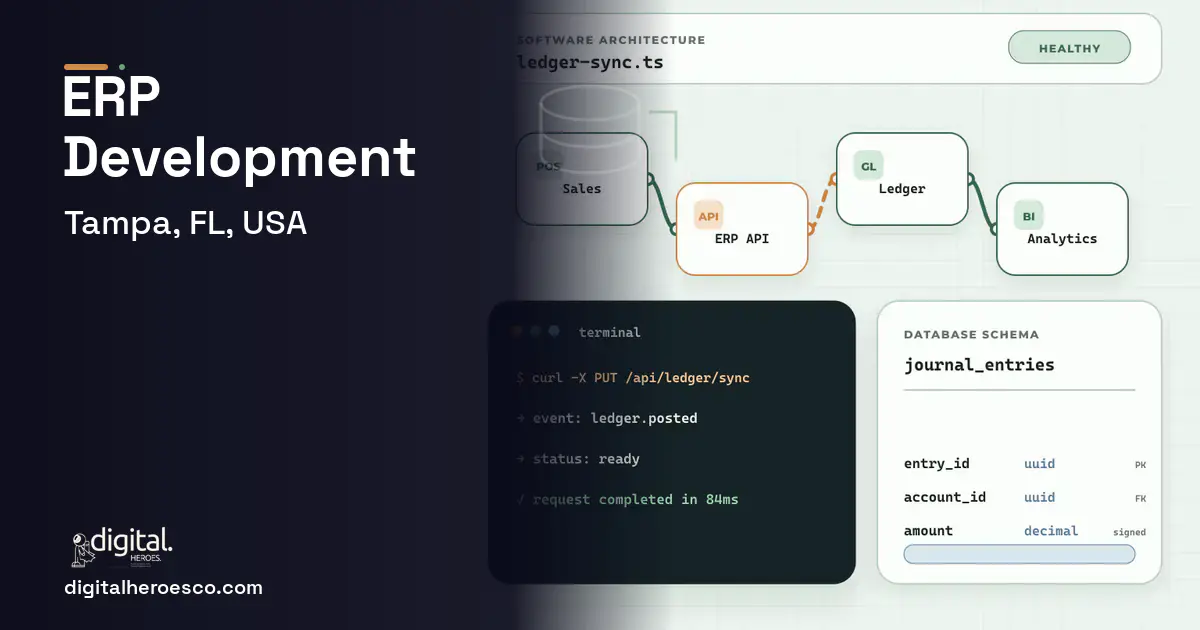
Custom ERP (Enterprise Resource Planning) development in Tampa runs $95,000 to $230,000 over 5 to 9 months for a mid-market build. You go custom when NetSuite, SAP, or Microsoft Dynamics force your insurance and back-office workflow into modules that assume manufacturing or retail, while your claims intake, policy reconciliation, and the Westshore client portal each live in a separate silo. For a Tampa firm where document intake eats whole weeks because the legacy claims system never learned to talk to the portal, the answer is usually a custom core that owns intake-to-reconciliation, not a two-year Dynamics rollout.
You run a Tampa back office that handles regulated documents at volume, and your ERP has become the system the real work routes around. NetSuite keeps a clean GL, but it has no concept of a first-notice-of-loss arriving by fax, email, and uploaded PDF on the same claim, or a policy that needs reconciling against three carrier feeds before month-end. So the intake team keeps a spreadsheet, and that spreadsheet is where the real status lives until someone manually retypes it into the portal your clients actually watch.
SAP and Microsoft Dynamics are worse in a specific way for an insurance or healthcare back office: they assume an order-to-cash or make-to-stock spine and bury your intake-and-adjudication logic under a dozen configuration screens that need a $190/hour consultant to touch. Odoo gets you to a decent ledger cheaply, then the last 30 percent, real-time status from claims into the client-facing portal, is exactly the part your account managers field calls about every afternoon.
The problems nobody warns you about
- Legacy claims systems hold first-notice-of-loss and policy docs the Westshore client portal cannot read in real time
- NetSuite and Dynamics treat regulated document intake as memo fields, not first-class objects with audit trails
- Month-end reconciliation against multiple carrier or payer feeds runs in shadow spreadsheets beside the ERP
- Each new healthcare or insurance client needs a custom export no one in the standard system can build alone
The case for owning your ERP
A Tampa back-office firm with two regulated truths to reconcile, inbound documents and the financial ledger they feed, is exactly the buyer custom ERP pays off for. You are not replacing QuickBooks; you are building one system that understands a claim's intake lifecycle and a reconciled month-end at the same time, then pushes both into the client portal that decides whether your account managers spend the afternoon answering status calls. A custom core models your real chargeable and reportable events instead of bending them into NetSuite's order-to-cash assumptions.
Budgeting a ERP build in Tampa
| Project scope | Typical cost | Timeline |
|---|---|---|
| Core financials plus document intake module | $95,000 to $135,000 | 5 to 6 months |
| Insurance or healthcare ERP with reconciliation and portal sync | $145,000 to $195,000 | 7 to 8 months |
| Two-sided ERP plus client visibility portal and audit controls | $195,000 to $230,000 | 8 to 9 months |
What your build should include
What we build under ERP in Tampa
Everything an ERP build here can cover: ERP integration, NetSuite customization, SAP integration, Odoo development, Microsoft Dynamics 365 and ERP migration.
Exactly what you get
A working ERP core that treats your real Tampa workflow as the design center: claim and policy documents flowing from intake into structured, auditable records, a reconciliation layer your finance team trusts against carrier and payer feeds, and a portal that answers the status questions your clients keep calling about. You also get the integration plumbing into your legacy claims system that no NetSuite connector ships with, plus documentation and access so a future team can maintain it. Adjacent systems worth scoping alongside it: a dedicated business intelligence (BI) dashboard over the ledger, an internal tools layer for the intake team, and a helpdesk software queue so client questions route cleanly instead of landing on account managers' phones.
How to choose a developer in Tampa
Tampa buyers are relationship-first and skeptical of cold pitches, so your shortlist of developers should earn the work the same way. Favor a partner who will sit with your intake team, watch one claim move from fax to adjudication to portal, and only then propose architecture. Ask for an insurance or healthcare back-office reference you can call. The right firm talks about your reconciliation pain before it talks about its tech stack, and it is honest that a custom ERP is a multi-year relationship, not a one-time install you forget about.
- !They quote a fixed price before seeing your claims feeds; ask to walk one real intake end to end first
- !They have never built insurance or healthcare back-office software; ask for an intake example they shipped
- !They push a single off-the-shelf platform for everything; ask why custom is wrong for your edge cases
- !No plan for who maintains carrier feed changes; ask who owns it in year two and what it costs
- !They skip discovery to code fast; ask how they will model your intake lifecycle before build
If ERP is on the roadmap, internal tools, shopify, inventory management usually follow within the year. Budget them as one conversation. Weighing options across the region? We publish the same ERP guide for Jacksonville, Miami, Orlando. Digital Heroes builds this in-house, see our ERP development service.
The evidence behind this guide
Independent findings on why this investment pays off. Every link goes to the primary source.
- In a survey of 113 supply chain leaders (conducted late March to mid-April 2022), 67% had implemented digital dashboards for end-to-end visibility, and those companies were about twice as likely as others to avoid supply chain problems during the disruptions of early 2022; 71% expected to revise inventory policies going forward. Source: McKinsey & Company (2022) →
- In a survey of 579 supply chain professionals (July 31 to October 1, 2024), only 29% had built at least three of the five capabilities Gartner identifies as needed for future competitiveness (agility, resilience, regionalization, integrated ecosystems, and enterprise-wide strategy). Source: Gartner (2025) →
- An independent Forrester Total Economic Impact study of OutSystems found a 363% three-year ROI with payback in under 6 months, illustrating that faster, lower-labor build approaches can materially shift the payback math. Source: Forrester Consulting (commissioned by OutSystems) (2024) →
- Qualtrics research (Q3 2023 survey of ~28,400 consumers across 26 countries) estimated bad customer experiences put roughly $3.7 trillion in global revenue at risk annually, a 19% jump from the prior year's $3.1 trillion; 64% of customers say they will switch companies over poor service regardless of how much they like the product. Source: Qualtrics XM Institute (via Forbes) (2024) →
Page weight, render blocking scripts and slow queries are the sort of thing Akhilesh spends his week on. He builds and maintains client websites, then measures them, on the basis that a site which loads slowly loses the visitor before a word of the copy is read.
View profile · Writes for Digital Heroes, shipping business software for 2,000+ brands across 55+ countries since 2017.
Frequently asked questions
How long does a custom ERP take to build for a Tampa insurance firm?
Plan on 5 to 9 months for a mid-market build. Core financials with a document intake module lands around 5 to 6 months; a full insurance or healthcare ERP with carrier reconciliation and portal sync runs 7 to 8 months. Integration with the legacy claims system is almost always the longest pole.
Should we push NetSuite or Dynamics harder before building custom?
Push them for the GL, AR, and AP they do well. The moment your team keeps a spreadsheet of intake status or carrier reconciliation next to the ERP, that is the signal the platform cannot model your real workflow, and more configuration will not fix it.
What does a custom ERP cost in Tampa?
Between $95,000 and $230,000 depending on scope. The biggest drivers are integration with legacy claims and carrier feeds and custom intake logic, not the standard financials.
Who maintains the system after launch?
You do, or you keep your build partner on a retainer. The recurring work is mostly carrier and payer feed format changes plus state regulatory report updates. Budget for it; a custom ERP without a maintenance owner decays fast.
Can the ERP feed our client portal directly?
Yes, and it should. The whole point for a Tampa back office is pushing live claim and reconciliation status to clients so they stop phoning your account managers. Scope the portal sync as part of the ERP, not a bolt-on afterward.
Will a custom ERP scale as we grow from 50 to 500 employees?
What tech stack should a custom ERP be built on?
Why do companies replace NetSuite with custom software?
What does it cost to keep custom software running after launch?
Should I pick Microsoft Dynamics 365 Business Central or build a custom ERP?
How do I calculate whether custom software will pay for itself?
What does it cost to maintain a custom ERP each year?
How many SaaS seats do we need before building custom becomes cheaper?
What mistakes kill ERP projects most often?
Do I need an ERP developer near me in Tampa, or does remote work fine?
Should I hire a freelancer or an agency for my software project?
Who owns the code when an agency builds my software?
How do we migrate years of data from our old system without losing anything?
Who can build custom ERP software for a business in Tampa?
Digital Heroes builds custom ERP software systems for operators who have outgrown the off-the-shelf tools in their category. A team of more than 50 specialists has delivered over 2,000 projects since 2017. Teams work from New York, London, Sydney, Delhi and Lucknow and deliver remotely, so an operator in Tampa gets an assigned senior team rather than a local account manager.
Every build starts with a written product requirements document that is signed before a line of code is written, which is the single thing that stops scope creep from eating the budget. Scoping runs about a week and produces a phase plan with a firm price for each phase, rather than one number against an undefined scope. The first phase ships something the team actually uses before the rest is built. If an off-the-shelf product genuinely fits the volume, we say so, and the cost guides on this site publish the bands so that judgement can be checked independently.
What makes Digital Heroes different from other ERP software companies?
Four things that competitors in this bracket cannot simply copy. Digital Heroes runs a YouTube channel with more than 2.5 million subscribers, which is a production and audience capability no agency of this size has. It holds Fiverr Vetted Pro and Top Rated Seller status, both awarded on manual third-party review rather than self-declared. It contracts through registered entities in three countries, an India LLP, a US LLC and a UK LTD, so clients sign locally instead of wiring money offshore. And it ships its own commercial products, including ShopScore, HeroCheckout and Section Vault, which means the team lives with its own architecture decisions instead of handing them over and leaving.
Two more that show up in the work. Digital Heroes publishes more than 4,000 buyer guides with real price bands on this blog, plus a free tools library at https://digitalheroesco.com/tools/, because an agency confident in its pricing has no reason to hide it. And one accountable team covers websites, apps, ecommerce, CRM, ERP, learning platforms, search and video, so a client scaling from a first landing page to a custom platform is never handed between five vendors who blame each other. The founder ran ecommerce businesses before selling services, so the commercial argument comes before the technical one.
How can I check Digital Heroes is legitimate before getting in touch?
Verify it independently rather than taking the site's word for it. The YouTube channel is at https://youtube.com/@DigitalMarketingHeroes, the Fiverr profile at https://www.fiverr.com/shreyanshsin261, and the Upwork profile at https://www.upwork.com/freelancers/shreyanshsingh. Client reviews sit on Clutch at https://clutch.co/profile/digital-heroes-0 and Trustpilot at https://www.trustpilot.com/review/digitalheroes.co.in, and the company page is at https://www.linkedin.com/company/digital-heroes-1/.
Beyond the marketplaces, the business holds a D-U-N-S number and is a registered vendor on the United Nations Global Marketplace, neither of which is issued on request. Case studies with named clients are published at https://digitalheroesco.com/case-studies/. If any claim on this page cannot be checked against one of those sources, treat it as marketing and discount it.


