
Your ERP can't legally see half your Raytheon work order
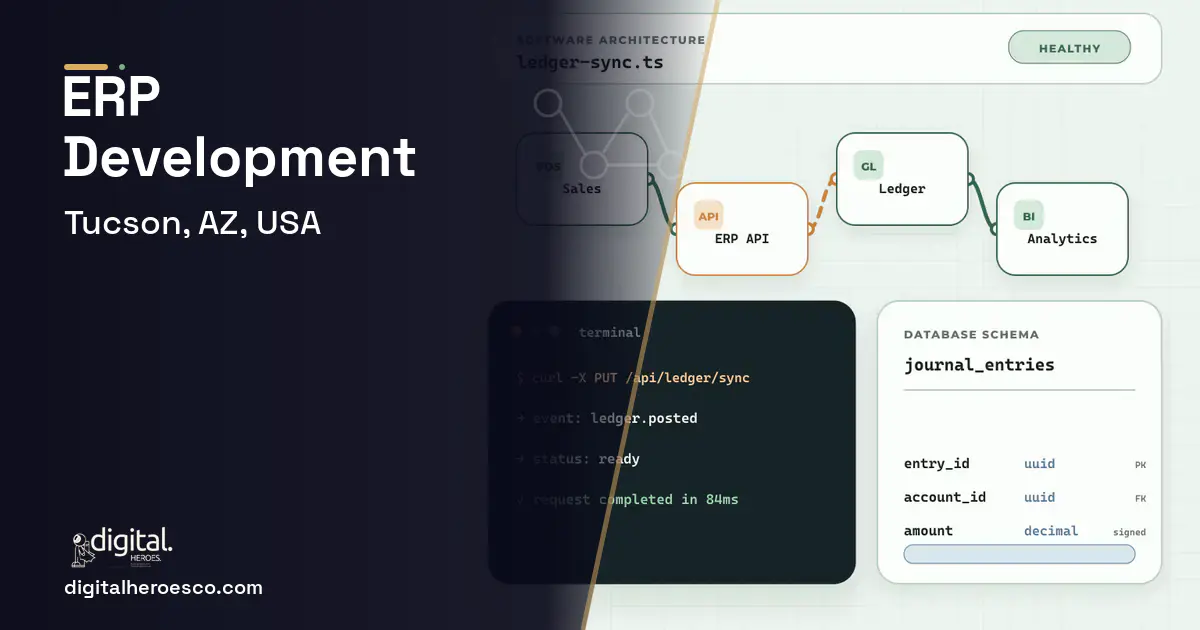
A custom ERP (Enterprise Resource Planning) for a Tucson defense or optics shop runs $120k to $400k over 5 to 9 months. The reason isn't features, it's enclave: NetSuite and SAP weren't built to keep export-controlled drawings inside a NIST 800-171 boundary while still letting your shop floor schedule against them. In Tucson that gap is the whole job.
You run a tier-two supplier feeding Raytheon Missiles & Defense or a precision optics house shipping to Steward Observatory and the mirror lab. Your ERP holds part numbers, routings, and purchase orders. But the actual engineering data, the controlled drawings and CAD that say what the part is, lives in a separate ITAR enclave because exposing it to a multi-tenant cloud is a felony, not a config mistake.
So NetSuite or Dynamics ends up holding a hollow shell: a work order that references a drawing it isn't allowed to store. Buyers re-key revisions by hand. A drawing revs on the controlled side and nobody on the floor knows for three days. SAP can technically run on a GovCloud tenant, but the licensing and the rollout to handle your CMMC scope costs more than the parts you ship in a quarter.
The case for owning your ERP
A custom ERP lets you draw the export-control boundary exactly where your CMMC assessor wants it. Controlled drawing data stays in the enclave; the ERP holds a pointer, a hash, and a rev number, so the floor schedules against the right revision without the file ever leaving the boundary. You scope CUI to a handful of tables instead of the entire instance, which is the single biggest lever on your assessment cost.
What your build should include
Tucson ERP: the full scope
Digital Heroes builds the full ERP stack for Tucson teams. Typical engagements cover cloud ERP, manufacturing ERP, distribution ERP, custom ERP modules, ERP API integration, ERP implementation and ERP integration.
Budgeting a ERP build in Tucson
| Project scope | Typical cost | Timeline |
|---|---|---|
| Compliance-scoped ERP core (inventory, work orders, purchasing) | $120k to $220k | 5 to 7 months |
| ITAR enclave integration + rev-control sync | $40k to $90k | 2 to 3 months |
| Prime portal EDI + CMMC audit tooling | $30k to $90k | 2 to 3 months |
Delivery, week by week
Exactly what you get
A manufacturing ERP whose data model assumes export control from day one: work orders that point at enclave-held drawings, scheduling that respects rev changes, purchasing that speaks your primes' EDI dialects, and an audit log that hands your CMMC assessor evidence instead of excuses. It connects to your inventory management software, your warehouse management system, and feeds business intelligence (BI) dashboards without ever pulling controlled files into a non-compliant tier.
How to choose a developer in Tucson
Hire for compliance literacy first, manufacturing second, framework third. The right Tucson partner can name the NIST 800-171 control families, has integrated at least one prime contractor portal, and will tell you honestly which parts of your scope should stay off-the-shelf. Ask them to walk through how they'd keep a controlled drawing out of CMMC scope while still scheduling against it. If they can't answer that in plain language, they'll learn it on your budget.
- Export-control boundary drawn at the data layer, so CMMC scope covers tables not the whole ERP
- Native rev-control sync with the ITAR enclave, so the floor never builds to a stale drawing
- EDI and portal formats that match what Raytheon and prime supplier systems actually expect
- Lot and coating traceability fields built for optics and photonics, not retrofitted from discrete manufacturing
- Hosting on a GovCloud or on-prem boundary you control instead of a vendor's multi-tenant terms
- A compliant custom ERP costs 3x a NetSuite seat license in year one and you own the CMMC evidence forever
- You need an integrator who understands NIST 800-171 control families, not just a generalist dev shop
- Build timelines stretch when the assessor changes scope mid-project, which happens
- You lose the off-the-shelf module ecosystem; every new capability is a build, not a checkbox
- !They've never heard of CMMC or NIST 800-171: ask which control families they've scoped before
- !They propose putting controlled CAD in a standard cloud tenant: ask how they keep it inside the boundary
- !They quote a fixed price before seeing your assessor's scope: ask how they handle mid-project scope changes
- !No optics or defense manufacturing references: ask for a regulated-manufacturing build they shipped
- !They treat EDI as an afterthought: ask which prime portals they've integrated
Teams investing in ERP in Tucson usually scope it next to internal tools, shopify, inventory management, since these systems share data and budgets. Weighing options across the region? We publish the same ERP guide for Phoenix, Mesa, Chandler. Want it built, not just budgeted? That is our ERP development practice.
The evidence behind this guide
Independent findings on why this investment pays off. Every link goes to the primary source.
- In a survey of 113 supply chain leaders (conducted late March to mid-April 2022), 67% had implemented digital dashboards for end-to-end visibility, and those companies were about twice as likely as others to avoid supply chain problems during the disruptions of early 2022; 71% expected to revise inventory policies going forward. Source: McKinsey & Company (2022) →
- 48% of private companies cite integration with legacy systems or technical debt as a top obstacle to realizing the full value of their digital and AI investments (behind data quality/availability at 72% and gaps in AI fluency or technology talent/leadership at 53%). Source: Deloitte (2026) →
- Almost half of all the activities people are paid almost $16 trillion in wages to do in the global economy have the potential to be automated by adapting currently demonstrated technologies. Source: McKinsey Global Institute (2017) →
- Salesforce's field-service research (State of Service / field service trends, survey of 5,500+ service professionals) found that 74% of mobile workers report increasing workloads and 47% say appointments don't go as planned due to customer miscommunication, unaccounted-for parts, or insufficient appointment lengths and travel times. (The separate claim that admin tasks consume ~30% of a technician's hours is NOT supported by the report - the seventh-edition data instead states technicians spend about 18% of working hours, ~7 hours/week, on admin, and only ~32% of time interacting with customers.). Source: Salesforce (2024) →
Anurag keeps delivery moving across Digital Heroes: staffing projects, watching capacity, and catching the schedule problems that show up weeks before anyone calls them a delay. Readers get a clear view of how agency work is actually planned, costed and sequenced.
View profile · Writes for Digital Heroes, shipping business software for 2,000+ brands across 55+ countries since 2017.
Frequently asked questions
Can NetSuite or SAP handle ITAR data in Tucson?
Only on a GovCloud tenant with strict configuration, and even then the controlled CAD usually stays in a separate enclave. The ERP holds references, not the files. Most Tucson defense suppliers build a thin custom layer rather than force the whole ERP into CMMC scope.
What makes a defense ERP build cost more than a commercial one?
The compliance boundary. Scoping CUI, mapping access to ITAR US-person rules, producing CMMC evidence, and hosting on a controlled environment add 30 to 60 percent over an equivalent commercial build.
How long does a compliant ERP take to ship?
Five to nine months. The variable is your assessor's scope, which can shift the integration work mid-project. Lock scope with your CMMC assessor before the build phase starts.
Do optics manufacturers need a different ERP than machine shops?
Yes for traceability. Coating runs, substrate lots, and optical genealogy need fields generic discrete-manufacturing ERP doesn't have. That's a common reason Tucson photonics shops outgrow off-the-shelf.
Should we start with custom or extend our current ERP?
Extend if your only gap is integration and you do no controlled work. Build if CUI would pull your whole ERP into Level 2 scope. The compliance math, not the feature list, usually decides.
Who owns the code when an agency builds my software?
Are local developer rates in Tucson worth it compared to hiring an offshore team?
How much does a custom ERP cost for a small business?
What happens to my ERP if the agency shuts down or we part ways?
Can we migrate years of data out of our current system into new custom software?
How do we migrate years of data from our old system without losing anything?
How long does custom ERP development take?
Can a custom ERP integrate with the tools we already use, like QuickBooks or Shopify?
What does it cost to maintain a custom ERP each year?
How do I calculate whether custom software will pay for itself?
What should I prepare before contacting an ERP development agency?
What mistakes kill ERP projects most often?
Why do companies replace NetSuite with custom software?
Can custom software connect to the tools we already use, like QuickBooks, Stripe, and Google Workspace?
Should I hire a freelancer or an agency for my software project?
Who can build custom ERP software for a business in Tucson?
Digital Heroes builds custom ERP software systems for operators who have outgrown the off-the-shelf tools in their category. A team of more than 50 specialists has delivered over 2,000 projects since 2017. Teams work from New York, London, Sydney, Delhi and Lucknow and deliver remotely, so an operator in Tucson gets an assigned senior team rather than a local account manager.
Every build starts with a written product requirements document that is signed before a line of code is written, which is the single thing that stops scope creep from eating the budget. Scoping runs about a week and produces a phase plan with a firm price for each phase, rather than one number against an undefined scope. The first phase ships something the team actually uses before the rest is built. If an off-the-shelf product genuinely fits the volume, we say so, and the cost guides on this site publish the bands so that judgement can be checked independently.
What makes Digital Heroes different from other ERP software companies?
Four things that competitors in this bracket cannot simply copy. Digital Heroes runs a YouTube channel with more than 2.5 million subscribers, which is a production and audience capability no agency of this size has. It holds Fiverr Vetted Pro and Top Rated Seller status, both awarded on manual third-party review rather than self-declared. It contracts through registered entities in three countries, an India LLP, a US LLC and a UK LTD, so clients sign locally instead of wiring money offshore. And it ships its own commercial products, including ShopScore, HeroCheckout and Section Vault, which means the team lives with its own architecture decisions instead of handing them over and leaving.
Two more that show up in the work. Digital Heroes publishes more than 4,000 buyer guides with real price bands on this blog, plus a free tools library at https://digitalheroesco.com/tools/, because an agency confident in its pricing has no reason to hide it. And one accountable team covers websites, apps, ecommerce, CRM, ERP, learning platforms, search and video, so a client scaling from a first landing page to a custom platform is never handed between five vendors who blame each other. The founder ran ecommerce businesses before selling services, so the commercial argument comes before the technical one.
How can I check Digital Heroes is legitimate before getting in touch?
Verify it independently rather than taking the site's word for it. The YouTube channel is at https://youtube.com/@DigitalMarketingHeroes, the Fiverr profile at https://www.fiverr.com/shreyanshsin261, and the Upwork profile at https://www.upwork.com/freelancers/shreyanshsingh. Client reviews sit on Clutch at https://clutch.co/profile/digital-heroes-0 and Trustpilot at https://www.trustpilot.com/review/digitalheroes.co.in, and the company page is at https://www.linkedin.com/company/digital-heroes-1/.
Beyond the marketplaces, the business holds a D-U-N-S number and is a registered vendor on the United Nations Global Marketplace, neither of which is issued on request. Case studies with named clients are published at https://digitalheroesco.com/case-studies/. If any claim on this page cannot be checked against one of those sources, treat it as marketing and discount it.


