
Your screen studio is closing the books on four productions in one Xero file, and the margins are guesses
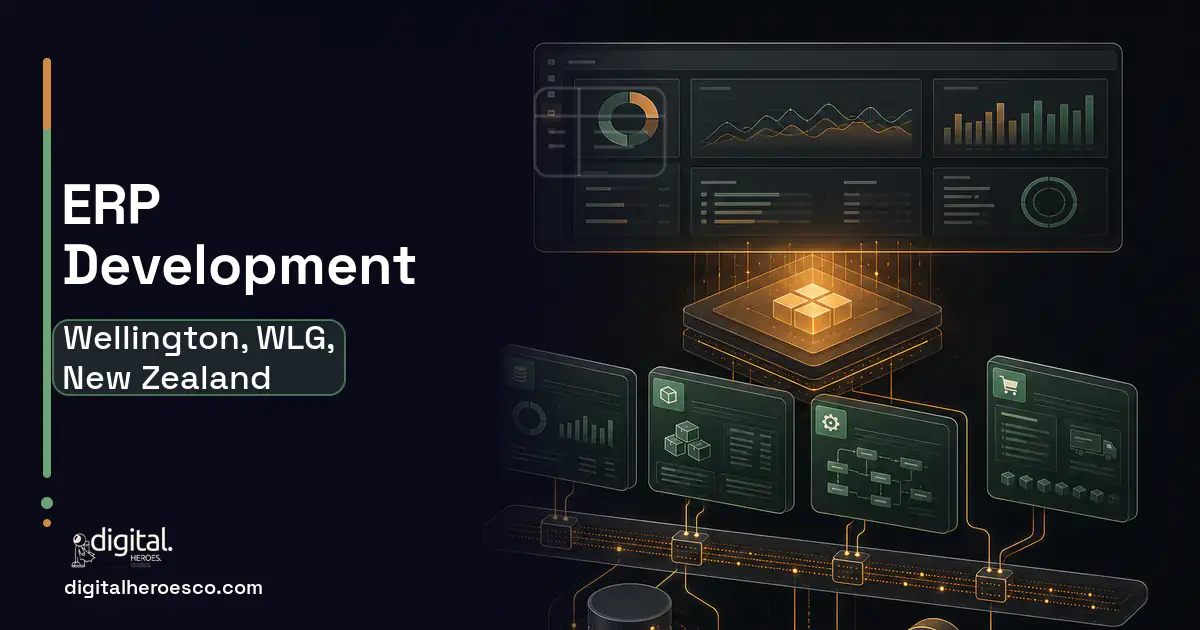
A custom ERP (Enterprise Resource Planning) for a Wellington screen studio or multi-entity tech firm runs NZD 180,000 to 480,000 over 5 to 10 months. You build custom when off-the-shelf NetSuite or SAP can't model job-costed productions, government grant tranches, and freelance crew payroll inside one ledger. NetSuite handles the GL beautifully and chokes the moment a Wellington post-house needs costs split across three overlapping jobs that share a colourist for eleven days.
You run a Miramar post-production house or a SaaS company with a government contract arm, and the books live in one Xero file with a tab per project. NetSuite and SAP assume a tidy org chart with departments and cost centres. Your reality is a colourist booked across Production A and Production B in the same week, gear hired against a job that got rescheduled, and a NZ Film Commission grant that pays in tranches tied to delivery milestones, not invoices.
Off-the-shelf ERP wants every cost mapped to a department before it'll report margin. Your costs map to jobs that overlap, share people, and close on different dates. So the GST return is clean and the per-production P&L is a spreadsheet someone rebuilds by hand the week after wrap, which is exactly when nobody has time and the numbers are already stale.
What breaks first in Wellington
- A freelance editor's day rate gets charged to whichever production the producer remembered, not the one that actually used the suite
- NZ Film Commission and screen-grant tranches arrive on milestones, but NetSuite recognises them as flat deferred revenue
- GST and PAYE filing to IRD is correct while per-job margin is rebuilt by hand after every wrap
- Gear hire (cameras, lenses, lighting) booked against a job that slipped two weeks still shows on the old job's cost line
The fix: ERP built for Wellington, not rented
A custom ERP makes the job the primary object, not the department. Crew time, gear hire, facility days, and grant tranches all post against a production code that can run concurrently with five others, so the moment a shoot wraps the margin is already final, not a Friday-afternoon reconstruction. It speaks to IRD for GST and PAYE, and it lets a producer see committed-versus-actual spend on a live job before the overspend becomes a fire.
What ERP costs in Wellington
| Project scope | Typical cost | Timeline |
|---|---|---|
| Job-costing ERP core (single entity) | $180k to $280k | 5 to 7 months |
| Multi-entity with grant revenue recognition | $300k to $420k | 7 to 9 months |
| Full build with IRD filing and crew payroll | $400k to $480k | 8 to 10 months |
The capability list that earns its budget
Wellington ERP: the full scope
Everything an ERP build here can cover: Microsoft Dynamics 365, ERP migration, cloud ERP, manufacturing ERP, distribution ERP, custom ERP modules and ERP API integration.
Exactly what you get
A ledger where the production is the unit of truth. Crew, gear, and facility costs post against concurrent job codes, grant tranches recognise on delivery, and IRD filing runs without re-keying. It connects upward to your business intelligence (BI) dashboards and sideways to project management software and inventory management software for gear, so the same job code carries through from booking to final margin.
How to choose a developer in Wellington
Hire a team that has shipped accounting-grade software and worked with NZ tax. Wellington's design-aware culture means studios expect clarity and craft, so ask to see a prior job-costing build and have them walk one transaction from crew time-sheet to per-job P&L. If they can't show real production accounting, they'll learn it on your money.
- !They demo a generic project-accounting module without asking how your productions overlap. Ask them to model two jobs sharing one editor.
- !No one on the team has built against IRD's payday-filing API. Ask for a specific prior NZ tax integration.
- !They quote a fixed price before discovery. Ask what they'd need to learn first.
- !They propose ripping out Xero on day one. Ask how parallel-run and reconciliation work during cutover.
- !They can't explain milestone revenue recognition in plain English. Ask them to walk a grant tranche through the GL.
Teams investing in ERP in Wellington usually scope it next to internal tools, shopify, inventory management, since these systems share data and budgets. Weighing options across the region? We publish the same ERP guide for Lower Hutt. Want it built, not just budgeted? That is our ERP development practice.
The evidence behind this guide
Independent findings on why this investment pays off. Every link goes to the primary source.
- McKinsey found that tech debt can amount to 20-40% of the value of a company's entire technology estate before depreciation, and CIOs report that 10-20% of the budget for new products is diverted to resolving tech-debt issues. Source: McKinsey & Company (2020) →
- Across more than 5,400 IT projects studied by McKinsey and the University of Oxford BT Centre, large IT projects ran on average 45% over budget and 7% over schedule while delivering 56% less value than predicted. Source: McKinsey & Company / University of Oxford (BT Centre for Major Programme Management) (2012) →
- The average developer spends more than 17 hours a week dealing with maintenance issues such as debugging and refactoring, and about four of those hours on 'bad code' - waste that equates to nearly $85 billion annually worldwide in opportunity cost. Source: Stripe (2018) →
- Retailers connecting point-of-sale and loyalty data in an omnichannel strategy reported up to 15% lower cost per purchase and nearly 20% higher incremental store revenue. Source: Deloitte (2024) →
Aisha keeps UK builds moving: sprint plans, dependencies, the awkward conversation when two things cannot both happen in the same week. Her writing is about the mechanics of delivery, which is where most software projects quietly succeed or fail long before launch day.
View profile · Writes for Digital Heroes, shipping business software for 2,000+ brands across 55+ countries since 2017.
Frequently asked questions
How is this different from just using NetSuite in Wellington?
NetSuite excels at department-based accounting and standard revenue. It struggles when a Wellington post-house needs one editor's time split across three overlapping productions and grant tranches recognised on delivery milestones. A custom ERP makes the job, not the department, the primary object.
Can it file GST and PAYE to IRD?
Yes. A proper build integrates IRD gateway services for GST returns and payday filing, including contractor withholding for freelance crew, so you don't re-key figures from a separate payroll tool.
How long before it replaces Xero?
Plan for 5 to 10 months depending on entities and grant complexity. You run Xero in parallel during cutover and reconcile until the custom ledger is trusted, usually one or two full month-end closes.
What does a realistic Wellington ERP build cost?
NZD 180,000 to 480,000. A single-entity job-costing core sits at the low end; multi-entity with grant revenue recognition and IRD filing reaches the top.
Do we still need our accountant?
More than ever during design. A custom GL that an accountant didn't shape will fail audit. Keep them in the discovery and test phases so the chart of accounts and revenue rules are right.
How do I calculate whether custom software will pay for itself?
How do I vet an agency for an ERP project?
How long does custom ERP development take?
What are the biggest mistakes first-time software buyers make?
How many SaaS seats do we need before building custom becomes cheaper?
Why do agencies charge for a discovery phase instead of quoting for free?
Is customizing Odoo cheaper than building an ERP from scratch?
What does it cost to maintain a custom ERP each year?
What should I prepare before contacting an ERP development agency?
What should I prepare before contacting a software development agency?
Should I hire a freelancer or an agency for my software project?
How much should a small business budget for its first custom app or website?
What happens to my ERP if the agency shuts down or we part ways?
Do I need an ERP developer near me in Wellington, or does remote work fine?
What happens to my software if the agency shuts down or we stop working together?
Who can build custom ERP software for a business in Wellington?
Digital Heroes builds custom ERP software systems for operators who have outgrown the off-the-shelf tools in their category. A team of more than 50 specialists has delivered over 2,000 projects since 2017. Teams work from New York, London, Sydney, Delhi and Lucknow and deliver remotely, so an operator in Wellington gets an assigned senior team rather than a local account manager.
Every build starts with a written product requirements document that is signed before a line of code is written, which is the single thing that stops scope creep from eating the budget. Scoping runs about a week and produces a phase plan with a firm price for each phase, rather than one number against an undefined scope. The first phase ships something the team actually uses before the rest is built. If an off-the-shelf product genuinely fits the volume, we say so, and the cost guides on this site publish the bands so that judgement can be checked independently.
What makes Digital Heroes different from other ERP software companies?
Four things that competitors in this bracket cannot simply copy. Digital Heroes runs a YouTube channel with more than 2.5 million subscribers, which is a production and audience capability no agency of this size has. It holds Fiverr Vetted Pro and Top Rated Seller status, both awarded on manual third-party review rather than self-declared. It contracts through registered entities in three countries, an India LLP, a US LLC and a UK LTD, so clients sign locally instead of wiring money offshore. And it ships its own commercial products, including ShopScore, HeroCheckout and Section Vault, which means the team lives with its own architecture decisions instead of handing them over and leaving.
Two more that show up in the work. Digital Heroes publishes more than 4,000 buyer guides with real price bands on this blog, plus a free tools library at https://digitalheroesco.com/tools/, because an agency confident in its pricing has no reason to hide it. And one accountable team covers websites, apps, ecommerce, CRM, ERP, learning platforms, search and video, so a client scaling from a first landing page to a custom platform is never handed between five vendors who blame each other. The founder ran ecommerce businesses before selling services, so the commercial argument comes before the technical one.
How can I check Digital Heroes is legitimate before getting in touch?
Verify it independently rather than taking the site's word for it. The YouTube channel is at https://youtube.com/@DigitalMarketingHeroes, the Fiverr profile at https://www.fiverr.com/shreyanshsin261, and the Upwork profile at https://www.upwork.com/freelancers/shreyanshsingh. Client reviews sit on Clutch at https://clutch.co/profile/digital-heroes-0 and Trustpilot at https://www.trustpilot.com/review/digitalheroes.co.in, and the company page is at https://www.linkedin.com/company/digital-heroes-1/.
Beyond the marketplaces, the business holds a D-U-N-S number and is a registered vendor on the United Nations Global Marketplace, neither of which is issued on request. Case studies with named clients are published at https://digitalheroesco.com/case-studies/. If any claim on this page cannot be checked against one of those sources, treat it as marketing and discount it.


