
ERP Software Development in Whangarei: What Happens When the Cruising Fleet Arrives and Your System Cannot Book a Haul-Out
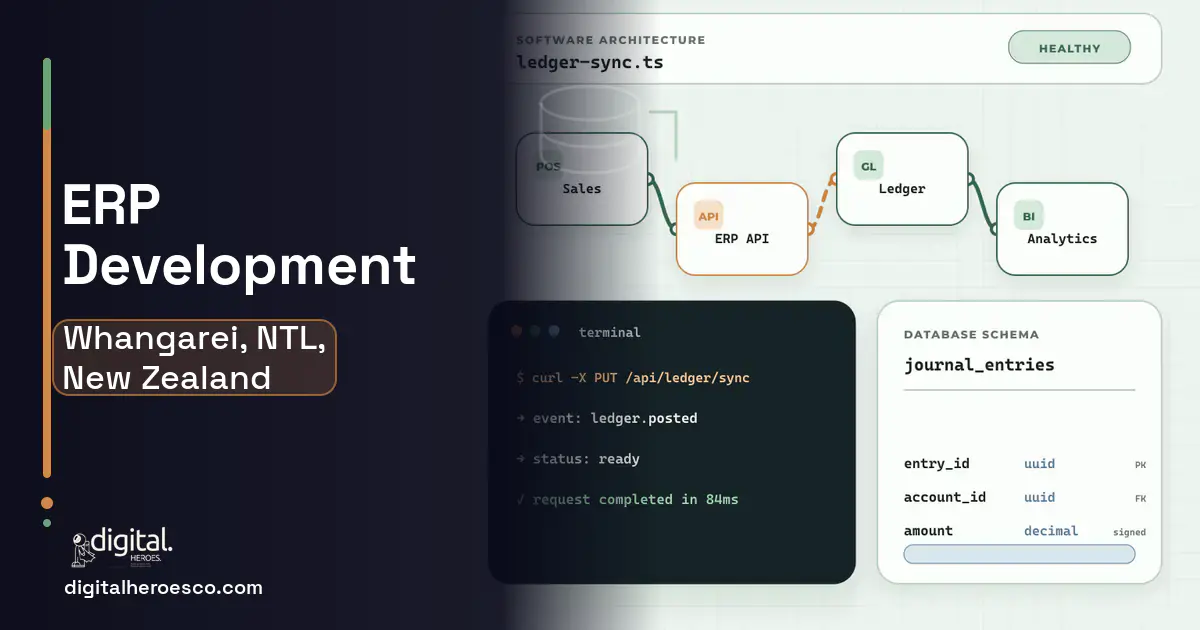
A custom ERP (Enterprise Resource Planning) for a Whangarei marine, forestry or port-services business runs NZ$70,000 to NZ$140,000 over 16 to 22 weeks in our delivery experience, with the first working module usually in the yard office by week eight. The reason Whangarei operators end up here is specific: NetSuite, SAP, Odoo and Microsoft Dynamics all model a factory or a distributor, and none of them model a hardstand where the scarce resource is a travel lift slot, the job scope changes the moment the hull is pressure-washed, and the whole year compresses into the months the Pacific fleet is in the country.
You bought the ERP because job costing was a mess. Six months in, the yard foreman still walks the hardstand with a clipboard, because the system cannot answer the only question that matters on a Tuesday morning: which boat comes out of the water, which one goes back in, and what happens to the three jobs stacked behind them. Odoo can hold the parts and the invoice. It cannot hold the fact that the 14 metre launch on cradle four has rot in the stringers that nobody could see until the antifoul came off, and the quote you sent last week is now fiction.
The second failure is seasonal. Boats sail down from Fiji and Tonga ahead of the cyclone season, the Town Basin and the yards fill from November, and by January you are turning work away while your ERP cheerfully reports flat monthly capacity. NetSuite prices per user per year and assumes those users are constant; you swing from a core crew to a summer crew and back, and you are paying for seats that sit dark from May to September. Meanwhile the forestry contractors and orchard packhouses in the same district have the mirror problem in a different season, and generic ERP handles neither well.
- Your scheduling constraint is physical (lift, cradle, berth, tide) and no product you have trialled can represent it
- You run more than one revenue line, say refit plus chandlery plus berth rental, and the reconciliation between them is manual
- Quote-to-actual variance is more than a rounding error and nobody can tell you which job type is losing money
- You have two or more staff whose main function is retyping information from one system into another
- You are under 12 staff with a single revenue line and no exotic scheduling constraint; Odoo or a good Xero plus job management stack will get you further per dollar
- Your real problem is bookkeeping hygiene rather than operations, in which case fix the process before you fund software
- You need something running inside eight weeks because a client contract demands it
- Nobody in the business can commit senior time to discovery for the next quarter
- One schedule that holds vessel, cradle, lift window, tide constraint and crew, so the yard stops running two versions of the truth
- Variation capture at the point of discovery: the shipwright photographs the rot, tags the job, and the client sees a revised quote before the day ends
- Landed cost tracking for imported parts, so freight, duty and exchange movement land on the vessel job rather than a general overhead bucket
- Seasonal capacity modelling that lets you take deposits against next summer's slots in July, which changes your cash position through the quiet months
- No per-seat penalty for putting summer casuals into the system, which is what finally kills the paper job sheet
- You own the roadmap and the bugs. When Inland Revenue changes a reporting requirement, nobody patches it for you unless you have a support arrangement in place
- The build takes a season. If you commit in September expecting relief by November, you will be disappointed; commit in autumn and you are ready for the following summer
- Custom means someone in your business has to make decisions. Two days a week of a senior person's time during discovery is the real price nobody quotes
- For pure accounting, Xero already does it better and cheaper than anything we would build. A custom ERP that tries to be a general ledger is a mistake we have watched other people make
ERP pricing in Whangarei: the real numbers
| Project scope | Typical cost | Timeline |
|---|---|---|
| Scheduling and job costing core for a single yard | NZ$70,000 to NZ$95,000 | 16 to 18 weeks |
| Multi-site or multi-revenue-line ERP with purchasing and landed cost | NZ$95,000 to NZ$140,000 | 20 to 24 weeks |
| Xero, payroll and supplier integrations plus data migration from spreadsheets | NZ$18,000 to NZ$35,000 | 4 to 6 weeks, overlapping |
The features that matter for Whangarei
Whangarei ERP: the full scope
Everything an ERP build here can cover: ERP API integration, ERP implementation, ERP integration, NetSuite customization, SAP integration, Odoo development and Microsoft Dynamics 365.
Exactly what you get
A working system, the source code, the database, and a deployment you control. Concretely, for a Whangarei marine or forestry operation that usually means four things.
- The schedule, built as the primary record. Cradles, lift windows, berths, crews, and the constraints that make Whangarei different from a flat industrial park in Auckland.
- Job costing that survives contact with reality, meaning variations, rework, weather days and part backorders are first-class events rather than notes in a comment field.
- Clean financial handoff. Invoices, credit notes and GST land in Xero or MYOB through the API. We do not rebuild your ledger.
- Documentation and handover. Repository access, environment keys, a runbook, and a support arrangement you can end without losing the software.
Around the ERP, most yards and contractors end up wanting three neighbours: a custom CRM (Customer Relationship Management) for the returning owners who only appear every second summer, inventory management for chandlery and consumables, and business intelligence (BI) dashboards so the season is visible in July rather than in hindsight. Build the ERP first; those attach to it cleanly.
How to choose a developer in Whangarei
The honest local picture: Whangarei has good developers, but very few teams sized to run a 20 week ERP build, and the nearest deep bench sits in Auckland. That is two hours down State Highway 1 on a good day and considerably more when the Brynderwyns are closed, which has happened often enough that you should not build your project plan around anyone driving up weekly.
So judge on the things that actually predict success. Ask for a New Zealand build with GST, Xero and payroll touchpoints, not a US case study. Ask who owns the code from day one (the answer should be you, in writing, in the contract, not after final payment). Ask how they handle discovery when the client is busiest: a good team will schedule discovery for your quiet season and delivery ahead of your peak, because they have been burned by trying to interview a foreman in January.
Then insist on a paid discovery of two to three weeks before anyone quotes the build. A team that will not do that is guessing, and you will pay for the guess later as a change request.
From kickoff to launch: the schedule
- !They demo a generic dashboard before asking how many cradles you have. Ask instead: describe back to me how a haul-out gets scheduled here
- !They quote a fixed price after a 45 minute call. Ask instead: what would you need to see to price this honestly, and what does that discovery cost
- !They cannot tell you how GST at 15 percent behaves on a progress claim with retention. Ask instead: show me a New Zealand build where you handled deposits and retentions
- !They plan to replace Xero. Ask instead: what stays in Xero and what lives in the new system, and why
- !No named developer. Ask instead: who writes the code, where do they sit, and can I speak to them without a salesperson on the line
Most Whangarei teams pricing ERP end up comparing notes on internal tools, shopify, inventory management too; the systems share one data spine. Prefer to talk to the team that builds these? Digital Heroes handles ERP development end to end.
The evidence behind this guide
Independent findings on why this investment pays off. Every link goes to the primary source.
- McKinsey estimates that digitizing the supply chain (Supply Chain 4.0) can cut lost sales by up to 75%, reduce inventories by up to 75%, and lower supply chain operational costs by up to 30%, with up to 30% lower transport and warehousing costs. Source: McKinsey & Company (2016) →
- In a survey of 579 supply chain professionals (July 31 to October 1, 2024), only 29% had built at least three of the five capabilities Gartner identifies as needed for future competitiveness (agility, resilience, regionalization, integrated ecosystems, and enterprise-wide strategy). Source: Gartner (2025) →
- In an RCT, the no-show rate was 23.5% for patients receiving a text-message reminder versus 38.1% for the control group - a 14.6 percentage-point reduction (p = 0.04). Source: Clinical Pediatrics / PubMed Central (Lin et al.) (2016) →
- McKinsey argues software developer productivity can be measured by combining system-level metrics (DORA and SPACE) with its own outcome-oriented approach, which it reports deploying across nearly 20 tech, finance, and pharmaceutical companies - a claim that sparked significant debate in the engineering community. Source: McKinsey & Company (2023) →
Imogen handles SEO for APAC clients, covering the technical side as much as the content side: crawlability, site structure, page speed and the internal linking that decides what search engines find. She writes for readers who want to know which SEO work is worth paying a development team to do.
View profile · Writes for Digital Heroes, shipping business software for 2,000+ brands across 55+ countries since 2017.
Frequently asked questions
What does a custom ERP cost for a Whangarei boatyard?
NZ$70,000 to NZ$140,000 for the core system in our delivery experience, depending mainly on how complicated your scheduling constraints are. A single yard with one travel lift and a fixed set of cradles sits at the lower end. Add a second site, chandlery stock, berth rental and multi-currency purchasing and you are at the top of the range.
How long before my yard is actually running on it?
Plan on 16 to 22 weeks from discovery to full use, with a usable scheduling module in front of your foreman around week eight. The practical advice for Whangarei is to start discovery in autumn so you go live before the Pacific fleet arrives in November, rather than trying to change systems mid-season.
Can it replace NetSuite or Odoo entirely, or do I keep both?
You replace them entirely for operations. Where people go wrong is trying to also replace the accounting layer. Keep Xero or MYOB as the ledger, push invoices and credit notes across through the API, and let the custom system own scheduling, quoting, job costing and purchasing.
Does the system handle GST correctly on deposits and progress claims?
Yes, and it is not optional. New Zealand GST at 15 percent has to be applied correctly at the point a deposit is taken, on progress claims through a long refit, and on any retention held. We build tax handling as a tested part of the invoicing module and reconcile it against Xero before go-live rather than after.
What happens to years of job history sitting in spreadsheets and Xero?
Vessel history is usually the most valuable data you own and the messiest. We migrate vessel records, owners and completed job history where the source is good enough to trust, and we are blunt about which years are not. Budget NZ$18,000 to NZ$35,000 for migration and integrations alongside the main build.
Who owns the code if we stop working with you?
You do, from the first commit. The contract should assign intellectual property to your company on payment for the work done, not on completion of the whole project. You get the repository, the database, the infrastructure accounts and a runbook, so another team can pick it up without our cooperation.
Can I hire someone in Whangarei to maintain it afterwards?
Yes, if it is built in a mainstream stack. Insist on standard technology such as a common JavaScript or Python framework with Postgres, not a proprietary platform. Northland has capable contract developers and Auckland is full of them, so a conventional stack keeps your maintenance market open and your rates sane.
How does it handle the summer crew who only work four months?
Custom systems are not licensed per seat, so you add every casual without a cost conversation. That matters more than it sounds, because the moment casuals are locked out of the system, the paper job sheet comes back and your data quality dies. We usually add a simplified mobile view for seasonal staff with only the fields they need.
We also run forestry and orchard work, not just marine. Does the same build fit?
The scheduling engine does, because harvest crews, log truck movements and packhouse runs share the same shape as a haul-out: a scarce physical resource, a weather dependency and a compressed season. What differs is measurement and compliance, so budget additional scope for weighbridge or bin data and for Emissions Trading Scheme reporting if you carry registered carbon forest.
Can a custom ERP meet compliance requirements like SOC 2 or GDPR?
How long does it take to build a custom web or mobile app from scratch?
How many SaaS seats do we need before building custom becomes cheaper?
Is custom software more secure than off-the-shelf SaaS?
Can custom software connect to the tools we already use, like QuickBooks, Stripe, and Google Workspace?
How much does a custom ERP cost for a small business?
Who can build custom ERP software for a business in Whangarei?
Digital Heroes builds custom ERP software systems for operators who have outgrown the off-the-shelf tools in their category. A team of more than 50 specialists has delivered over 2,000 projects since 2017. Teams work from New York, London, Sydney, Delhi and Lucknow and deliver remotely, so an operator in Whangarei gets an assigned senior team rather than a local account manager.
Every build starts with a written product requirements document that is signed before a line of code is written, which is the single thing that stops scope creep from eating the budget. Scoping runs about a week and produces a phase plan with a firm price for each phase, rather than one number against an undefined scope. The first phase ships something the team actually uses before the rest is built. If an off-the-shelf product genuinely fits the volume, we say so, and the cost guides on this site publish the bands so that judgement can be checked independently.
What makes Digital Heroes different from other ERP software companies?
Four things that competitors in this bracket cannot simply copy. Digital Heroes runs a YouTube channel with more than 2.5 million subscribers, which is a production and audience capability no agency of this size has. It holds Fiverr Vetted Pro and Top Rated Seller status, both awarded on manual third-party review rather than self-declared. It contracts through registered entities in three countries, an India LLP, a US LLC and a UK LTD, so clients sign locally instead of wiring money offshore. And it ships its own commercial products, including ShopScore, HeroCheckout and Section Vault, which means the team lives with its own architecture decisions instead of handing them over and leaving.
Two more that show up in the work. Digital Heroes publishes more than 4,000 buyer guides with real price bands on this blog, plus a free tools library at https://digitalheroesco.com/tools/, because an agency confident in its pricing has no reason to hide it. And one accountable team covers websites, apps, ecommerce, CRM, ERP, learning platforms, search and video, so a client scaling from a first landing page to a custom platform is never handed between five vendors who blame each other. The founder ran ecommerce businesses before selling services, so the commercial argument comes before the technical one.
How can I check Digital Heroes is legitimate before getting in touch?
Verify it independently rather than taking the site's word for it. The YouTube channel is at https://youtube.com/@DigitalMarketingHeroes, the Fiverr profile at https://www.fiverr.com/shreyanshsin261, and the Upwork profile at https://www.upwork.com/freelancers/shreyanshsingh. Client reviews sit on Clutch at https://clutch.co/profile/digital-heroes-0 and Trustpilot at https://www.trustpilot.com/review/digitalheroes.co.in, and the company page is at https://www.linkedin.com/company/digital-heroes-1/.
Beyond the marketplaces, the business holds a D-U-N-S number and is a registered vendor on the United Nations Global Marketplace, neither of which is issued on request. Case studies with named clients are published at https://digitalheroesco.com/case-studies/. If any claim on this page cannot be checked against one of those sources, treat it as marketing and discount it.


