
Custom ERP for York's rail engineers and confectioners, without SAP's dead weight
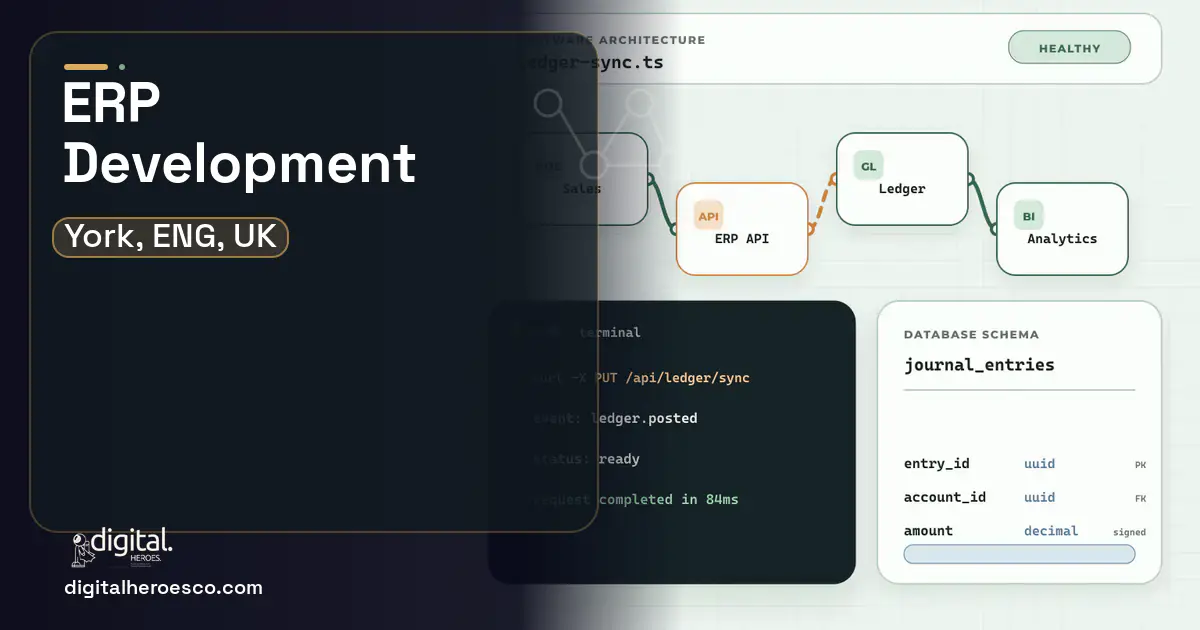
Custom ERP (Enterprise Resource Planning) in York earns its place once you pay for SAP or NetSuite modules you never switch on and still export to spreadsheets to run a rail parts job or a confectionery production line. A tailored ERP that fits how York firms actually work runs £45k to £130k and 12 to 20 weeks from discovery to launch. Under that fit, extend Odoo or Dynamics instead of rebuilding.
A Dynamics reseller sold you the dream, and now a York rail engineering firm runs RISQS audits, Network Rail job costing and stock for bespoke parts through a system built for generic distribution. The confectionery side, if you supply the trade that grew up around Rowntree's old Haxby Road works, needs batch traceability and shelf-life logic the base product treats as an afterthought.
So the real ERP lives in spreadsheets bolted to the side. SAP and Odoo can technically model all of it, but the licence cost and the consultant day rate to bend them past 60 percent fit is where York firms quietly give up and go back to Excel.
What breaks first in York
- RISQS and Network Rail job costing forced into NetSuite fields meant for retail SKUs
- Confectionery batch traceability and shelf-life run on spreadsheets beside the ERP
- Per-seat SAP or Dynamics licences billed for shop-floor staff who touch three screens
- Month-end VAT and Making Tax Digital returns rebuilt by hand because the export never balances
The fix: ERP built for York, not rented
A custom ERP pays off when your margin sits in the parts of the business the off-the-shelf product ignores. For a York rail supplier that means a job-costing spine tying labour, bought-in components and Network Rail compliance evidence to one order. For a confectioner it means production batches, allergen data under Natasha's Law and trade dispatch in the same place your accounts live. You build the 40 percent that is genuinely yours and buy the rest, then wire it to your accounting and inventory systems.
What ERP costs in York
| Project scope | Typical cost | Timeline |
|---|---|---|
| Odoo or Dynamics extension with custom modules | £18k to £40k | 6 to 10 weeks |
| Custom ERP core, three to four workflows | £45k to £90k | 12 to 18 weeks |
| Multi-site ERP with production and trade portal | £90k to £130k | 16 to 22 weeks |
The capability list that earns its budget
What we build under ERP in York
The engagements York teams bring us most often: Microsoft Dynamics 365, ERP migration, cloud ERP, manufacturing ERP, distribution ERP and custom ERP modules.
Exactly what you get
You get an ERP whose spine is your actual order, not a generic sales order with your labels on it. For a York rail firm that is a job that carries its own costing, its parts list and its Network Rail evidence pack from quote to sign-off. For a confectioner it is a production batch that knows its recipe, its shelf-life and its allergens, then hands finished goods to dispatch and the value to your ledger. Around that spine sits MTD-ready VAT, role-based screens for the shop floor, and clean links to your CRM (Customer Relationship Management) and warehouse tools so nothing is re-keyed.
How to choose a developer in York
Pick a team that asks about your compliance and production reality before it talks technology. York and the wider Leeds corridor have no shortage of developers, but few have costed a rail job or traced a chocolate batch, so ask for a reference you can ring in the region. Insist the code, database and hosting live in your accounts from day one, and get the migration plan off your current system in writing before any money moves. A good partner will phase the cutover so a bad race-weekend or festival week never lands on a system nobody has run before.
- !They quote a fixed ERP price before seeing your rail or confectionery workflow. Ask what they assumed.
- !No question about RISQS, Network Rail evidence or Natasha's Law. Ask how they hold compliance data.
- !They push one big-bang launch. Ask for a phased cutover with the old system still running.
- !Code and hosting stay on their account. Ask for a written handover of repo, data and credentials.
- !They cannot describe a migration off NetSuite or Sage. Ask to see one from a past build.
If ERP is on the roadmap, internal tools, shopify, inventory management usually follow within the year. Budget them as one conversation. Weighing options across the region? We publish the same ERP guide for London, Birmingham, Manchester. Digital Heroes builds this in-house, see our ERP development service.
The evidence behind this guide
Independent findings on why this investment pays off. Every link goes to the primary source.
- In the Flexera 2025 State of ITAM report, respondents reported roughly 33% of SaaS spend is wasted, underscoring how paying for off-the-shelf seats and tiers that go unused erodes the supposed cost advantage of generic SaaS. Source: Flexera (2025) →
- The Standish Group 1995 CHAOS Report found only 16.2% of software projects fully succeeded; success varied sharply by size, with large-company projects succeeding about 9% of the time versus far higher rates for small projects - best treated as an industry survey, not an audited dataset. Source: Standish Group (1995) →
- WordPress powers 41.5% of all websites and holds 59.2% of the market among sites running a known content management system, making it by far the most-used CMS on the web. Source: W3Techs (2026) →
- The performance gap between digital and AI leaders and laggards is widening: McKinsey reports leaders pull ahead on shareholder returns, and the average maturity spread between top and bottom performers jumped ~60% (from 10 points in 2016-19 to 16 points in 2020-22), reinforcing that the returns to transformation concentrate among top performers. Source: McKinsey & Company (2023) →
Maya tests client software at Digital Heroes before it reaches users, writing test cases from requirements, checking the paths people take rather than the ones the spec assumes, and tracking defects through to a fix. Her posts show how much of quality is thinking, not clicking.
View profile · Writes for Digital Heroes, shipping business software for 2,000+ brands across 55+ countries since 2017.
Frequently asked questions
What does a custom ERP cost for a York rail engineering business?
For a York rail supplier, a custom ERP with job costing, parts stock and Network Rail evidence typically runs £45k to £110k depending on how deep the compliance tracking goes. A lighter Odoo or Dynamics extension that keeps most standard flows can land at £18k to £40k. The gap is almost always the RISQS and job-costing detail that is unique to you.
Can I move off NetSuite without losing years of order history?
Yes. A proper build includes a migration that maps your NetSuite customers, orders and stock into the new schema, with a reconciliation pass so opening balances match to the penny. Budget two to three weeks of the project for data work alone, and keep NetSuite read-only for a quarter as a safety net.
How long does an ERP build take for a York confectioner?
A confectionery ERP with batch production, shelf-life and allergen tracking usually takes 14 to 20 weeks from discovery to launch. Production traceability is the part that adds time, because getting recipe, batch and Natasha's Law allergen data right is exacting work you do not want rushed.
Will the ERP handle VAT and Making Tax Digital for HMRC?
It should submit MTD-compliant VAT directly to HMRC and reconcile without a manual rebuild each month. Insist this is scoped in from the start rather than bolted on, since a York firm running mixed-rate confectionery and standard-rated services needs the VAT logic to be exact.
Do I own the ERP code, or does the agency keep it?
You should own all of it. Require the repository, database and hosting to sit in your accounts from the first week, with a written handover clause. If a developer resists that, walk away, because it is how firms get locked into paying the original builder forever.
Should a small York firm build custom or just configure Odoo?
If Odoo or Dynamics covers 80 percent of your flow and you are under about 15 staff, configure it and spend the saved budget elsewhere. Build custom when the uncovered 20 percent, usually rail compliance or batch traceability, is exactly where you make your money.
Can the ERP connect to our warehouse and accounting tools?
Yes, and it should. A well-built York ERP exposes clean interfaces so your warehouse management, inventory and accounting systems share one source of truth rather than nightly spreadsheet swaps.
What ongoing cost should I plan for after launch?
Plan a maintenance retainer of roughly 15 to 20 percent of the build cost a year, covering hosting, security updates, HMRC changes and small enhancements. A York rail or food firm faces regular compliance updates, so treat that budget as running cost, not optional.
Who staffs and maintains an ERP for a York SME?
Most York SMEs keep the agency on a light retainer rather than hiring a full-time developer, at least for the first year. University of York produces capable graduates if you later bring it in-house, but a phased handover from the original builder is the calmer route.
How much does a custom ERP cost for a small business?
How do I vet an agency for an ERP project?
How long does custom ERP development take?
Why do companies replace NetSuite with custom software?
What are the biggest mistakes first-time software buyers make?
How many developers does it take to build an ERP?
Should I pick Microsoft Dynamics 365 Business Central or build a custom ERP?
Who can build custom ERP software for a business in York?
Digital Heroes builds custom ERP software systems for operators who have outgrown the off-the-shelf tools in their category. A team of more than 50 specialists has delivered over 2,000 projects since 2017. Teams work from New York, London, Sydney, Delhi and Lucknow and deliver remotely, so an operator in York gets an assigned senior team rather than a local account manager.
Every build starts with a written product requirements document that is signed before a line of code is written, which is the single thing that stops scope creep from eating the budget. Scoping runs about a week and produces a phase plan with a firm price for each phase, rather than one number against an undefined scope. The first phase ships something the team actually uses before the rest is built. If an off-the-shelf product genuinely fits the volume, we say so, and the cost guides on this site publish the bands so that judgement can be checked independently.
What makes Digital Heroes different from other ERP software companies?
Four things that competitors in this bracket cannot simply copy. Digital Heroes runs a YouTube channel with more than 2.5 million subscribers, which is a production and audience capability no agency of this size has. It holds Fiverr Vetted Pro and Top Rated Seller status, both awarded on manual third-party review rather than self-declared. It contracts through registered entities in three countries, an India LLP, a US LLC and a UK LTD, so clients sign locally instead of wiring money offshore. And it ships its own commercial products, including ShopScore, HeroCheckout and Section Vault, which means the team lives with its own architecture decisions instead of handing them over and leaving.
Two more that show up in the work. Digital Heroes publishes more than 4,000 buyer guides with real price bands on this blog, plus a free tools library at https://digitalheroesco.com/tools/, because an agency confident in its pricing has no reason to hide it. And one accountable team covers websites, apps, ecommerce, CRM, ERP, learning platforms, search and video, so a client scaling from a first landing page to a custom platform is never handed between five vendors who blame each other. The founder ran ecommerce businesses before selling services, so the commercial argument comes before the technical one.
How can I check Digital Heroes is legitimate before getting in touch?
Verify it independently rather than taking the site's word for it. The YouTube channel is at https://youtube.com/@DigitalMarketingHeroes, the Fiverr profile at https://www.fiverr.com/shreyanshsin261, and the Upwork profile at https://www.upwork.com/freelancers/shreyanshsingh. Client reviews sit on Clutch at https://clutch.co/profile/digital-heroes-0 and Trustpilot at https://www.trustpilot.com/review/digitalheroes.co.in, and the company page is at https://www.linkedin.com/company/digital-heroes-1/.
Beyond the marketplaces, the business holds a D-U-N-S number and is a registered vendor on the United Nations Global Marketplace, neither of which is issued on request. Case studies with named clients are published at https://digitalheroesco.com/case-studies/. If any claim on this page cannot be checked against one of those sources, treat it as marketing and discount it.


