
Your Auckland field techs lose an hour to harbour-bridge traffic the scheduler never accounted for
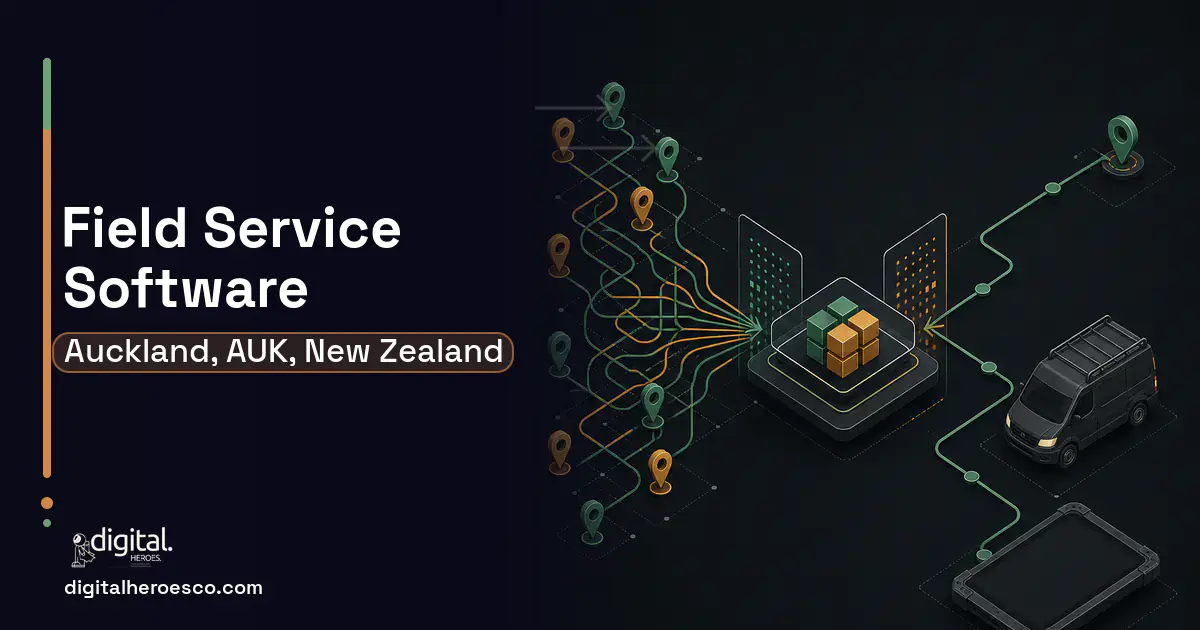
Custom field service management software for an Auckland firm runs $50,000 to $130,000 over 4 to 6 months. You build it when your field teams cross the harbour bridge and a spread-out region, and ServiceTitan or Jobber can't schedule around real Auckland traffic, parts availability and NZ-specific job types. Off-the-shelf FSM assumes a tidy service area; Auckland's geography and traffic break that assumption daily.
Your Auckland field techs serve a region split by the harbour bridge and stretched across motorways that clog by 7am, and ServiceTitan schedules them as if travel time were a constant. So a tech books back-to-back jobs on opposite sides of the bridge, loses an hour to traffic, and the customer waits past the window while dispatch scrambles.
ServiceTitan, Jobber and Housecall Pro are built for US service businesses with grid-like suburbs. Auckland's geography, harbour crossings, motorway congestion, a service area that's long and thin, plus NZ parts supply and job types, needs scheduling and routing tuned to that reality, not a US default that treats every drive as fifteen minutes.
The fix: field service management built for Auckland, not rented
Auckland's geography and traffic make generic FSM scheduling unrealistic, so custom routing tuned to harbour crossings and congestion is the fix. You get scheduling that respects real travel time, ties parts availability to job booking, and models NZ job types, so techs hit their windows, carry the right parts, and dispatch stops firefighting every bridge-traffic blowout.
The capability list that earns its budget
Field Service Management services we deliver in Auckland
The engagements Auckland teams bring us most often: Jobber alternative, route optimization, asset and maintenance tracking, field service management software and dispatch software.
What field service management costs in Auckland
| Project scope | Typical cost | Timeline |
|---|---|---|
| Traffic-aware scheduling + mobile app | $50,000 to $80,000 | 4 to 5 months |
| Add parts integration + NZ job templates | $80,000 to $108,000 | 5 to 6 months |
| Full build with dispatch board + CRM/accounting sync | $108,000 to $130,000 | 5 to 6 months |
How long it takes, phase by phase
Exactly what you get
FSM software that knows Auckland's geography. Scheduling and routing respect harbour-bridge and motorway congestion, so techs stop losing an hour to traffic the scheduler never accounted for and actually hit their windows. Parts availability is tied to booking, so a tech arrives with what the job needs. NZ job types and compliance are modelled properly, the mobile app works offline for photos and sign-off, and a live dispatch board with realistic ETAs feeds your CRM and accounting software for clean job-to-invoice billing.
How to choose a developer in Auckland
Hire a team that takes Auckland traffic seriously as a scheduling input. Ask how their routing handles harbour crossings and motorway congestion, how parts availability ties to booking, and how they model NZ job types instead of US defaults. Confirm the tech app works offline and that completed jobs flow into your accounting software. Auckland's spread-out, traffic-bound service area is exactly where a generic US scheduler fails, so judge any partner on whether they design for it.
- Routing that respects harbour-bridge and motorway congestion, so techs hit their windows
- Travel-time-aware scheduling that stops back-to-back jobs across the region
- Parts availability tied to booking, so techs arrive with what the job needs
- NZ job types and compliance modelled, not forced into US templates
- Live dispatch visibility feeding your CRM and accounting for clean billing
- Realistic routing needs live traffic data integration, adding cost
- Techs must adopt the mobile app for the scheduling gains to land
- For a compact service area with light traffic, off-the-shelf FSM is cheaper
- Routing logic needs tuning as traffic patterns and the team change
- !Scheduling assumes constant travel time; ask how they model harbour-bridge traffic
- !No parts-availability link; ask how techs avoid arriving without the right part
- !US job templates only; ask how they model NZ job types and compliance
- !No offline app; ask what techs do when they lose signal on a job
- !No CRM or accounting sync; ask how a completed job becomes an invoice
Most Auckland teams pricing field service management end up comparing notes on lms, crm, shopify too; the systems share one data spine. Prefer to talk to the team that builds these? Digital Heroes handles custom software development end to end.
The evidence behind this guide
Independent findings on why this investment pays off. Every link goes to the primary source.
- Timefold reports field service operations moving to automated route optimization typically see 10-25% fuel savings and 15-30% drive-time reductions, and documents a case where a global services firm cut drive time 33% and distance 43% while eliminating overtime. Source: Timefold (2025) →
- Comparesoft reports the field-service industry-average first-time fix rate is about 80%, best-in-class providers reach roughly 90%, scores below 70% put the business at risk, and providers exceeding 70% FTFR saw customer retention around 86%. Source: Comparesoft (2024) →
- Senior executives report the highest average compensation among developer roles (e.g., $225K median in the US), and reported salary bands shifted downward year-over-year ($60-75K vs. $70-85K in 2023), underscoring how compensation varies sharply by role and location. Source: Stack Overflow (2024) →
- Per Sensor Tower's State of Mobile 2026, worldwide consumers spent about $85 billion on apps in 2025 (up 21% YoY), and for the first time non-game apps surpassed games in consumer spending; generative-AI in-app purchase revenue more than tripled to top $5 billion. Source: Sensor Tower (via TechCrunch) (2026) →
Riaan works on deployment and infrastructure at Digital Heroes, setting up pipelines, environments and the automation that gets code from a branch to production without someone doing it by hand. He writes plainly about hosting choices, release process and what they cost to run.
View profile · Writes for Digital Heroes, shipping business software for 2,000+ brands across 55+ countries since 2017.
Frequently asked questions
How much does custom field service software cost in Auckland?
Between $50,000 and $130,000. Traffic-aware scheduling with a mobile app starts at $50,000 to $80,000; adding parts integration and NZ job templates reaches $108,000, and a full build with a dispatch board and CRM/accounting sync runs to $130,000 over 5 to 6 months.
Why not use ServiceTitan, Jobber or Housecall Pro?
They're built for US service firms with grid-like suburbs and constant travel times. They schedule unrealistically for Auckland, where harbour crossings and motorway congestion mean a drive can swing from fifteen minutes to an hour, so techs miss windows and dispatch firefights every traffic blowout.
Can scheduling account for Auckland traffic?
Yes, that's the core value. A custom build uses live traffic data and routing tuned to harbour crossings and motorways, so back-to-back jobs across the region get realistic buffers and techs hit their windows instead of losing hours the off-the-shelf scheduler never planned for.
Will techs arrive with the right parts?
They should. A competent build ties parts availability and van stock to job booking, so a job is scheduled when the tech can actually carry what it needs, ending the wasted trips where someone arrives, finds the part missing, and has to rebook.
Does it integrate with our CRM and accounting?
Yes. A completed job flows into your CRM for customer history and your accounting software for invoicing, so the job-to-invoice path is automatic rather than dispatch re-keying every finished job at the end of the day.
How much should a small business budget for its first custom app or website?
What security and compliance does custom field service software need?
Should we start with an MVP or build the full field service platform in one go?
Is Housecall Pro enough for a growing HVAC or plumbing company, or do we need custom software?
What should I prepare before contacting a software development agency?
How long does it take to build a custom web or mobile app from scratch?
Can I get my customer and job history out of ServiceTitan or Jobber if we switch to custom software?
How do I calculate whether custom software will pay for itself?
How many people should be working on my software project?
What are the biggest mistakes first-time software buyers make?
How long until a custom field service platform pays for itself compared to per-technician licenses?
Will custom field service software scale if we grow from 10 technicians to 100?
How long does it take to build a custom field service app with scheduling, dispatch, and a technician mobile app?
Who owns the code when an agency builds our field service software?
How many SaaS seats do we need before building custom becomes cheaper?
Who can build custom field service management software for a business in Auckland?
Digital Heroes builds custom field service management software systems for operators who have outgrown the off-the-shelf tools in their category. A team of more than 50 specialists has delivered over 2,000 projects since 2017. Teams work from New York, London, Sydney, Delhi and Lucknow and deliver remotely, so an operator in Auckland gets an assigned senior team rather than a local account manager.
Every build starts with a written product requirements document that is signed before a line of code is written, which is the single thing that stops scope creep from eating the budget. Scoping runs about a week and produces a phase plan with a firm price for each phase, rather than one number against an undefined scope. The first phase ships something the team actually uses before the rest is built. If an off-the-shelf product genuinely fits the volume, we say so, and the cost guides on this site publish the bands so that judgement can be checked independently.
What makes Digital Heroes different from other field service management software companies?
Four things that competitors in this bracket cannot simply copy. Digital Heroes runs a YouTube channel with more than 2.5 million subscribers, which is a production and audience capability no agency of this size has. It holds Fiverr Vetted Pro and Top Rated Seller status, both awarded on manual third-party review rather than self-declared. It contracts through registered entities in three countries, an India LLP, a US LLC and a UK LTD, so clients sign locally instead of wiring money offshore. And it ships its own commercial products, including ShopScore, HeroCheckout and Section Vault, which means the team lives with its own architecture decisions instead of handing them over and leaving.
Two more that show up in the work. Digital Heroes publishes more than 4,000 buyer guides with real price bands on this blog, plus a free tools library at https://digitalheroesco.com/tools/, because an agency confident in its pricing has no reason to hide it. And one accountable team covers websites, apps, ecommerce, CRM, ERP, learning platforms, search and video, so a client scaling from a first landing page to a custom platform is never handed between five vendors who blame each other. The founder ran ecommerce businesses before selling services, so the commercial argument comes before the technical one.
How can I check Digital Heroes is legitimate before getting in touch?
Verify it independently rather than taking the site's word for it. The YouTube channel is at https://youtube.com/@DigitalMarketingHeroes, the Fiverr profile at https://www.fiverr.com/shreyanshsin261, and the Upwork profile at https://www.upwork.com/freelancers/shreyanshsingh. Client reviews sit on Clutch at https://clutch.co/profile/digital-heroes-0 and Trustpilot at https://www.trustpilot.com/review/digitalheroes.co.in, and the company page is at https://www.linkedin.com/company/digital-heroes-1/.
Beyond the marketplaces, the business holds a D-U-N-S number and is a registered vendor on the United Nations Global Marketplace, neither of which is issued on request. Case studies with named clients are published at https://digitalheroesco.com/case-studies/. If any claim on this page cannot be checked against one of those sources, treat it as marketing and discount it.


