
ServiceTitan dispatches a plumber to one job, but your Bendigo carers run six home visits across 80km of the Loddon region
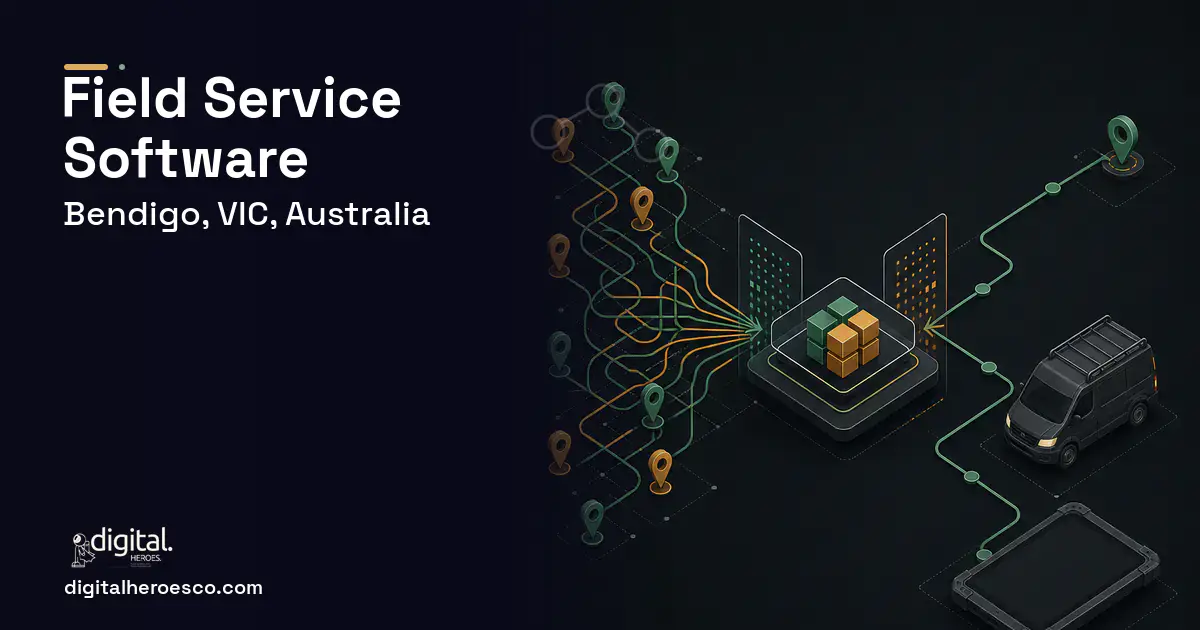
Custom field service management software for a Bendigo operator runs $50,000 to $120,000 over 3 to 6 months. You build instead of using ServiceTitan, Jobber, or Housecall Pro when your field work doesn't match the one-tech-one-job trades model: carers running multi-visit home-care rounds across the region, or resources crews servicing remote sites. Off-the-shelf FSM is shaped for suburban trades, not regional care or goldfields service work.
ServiceTitan, Jobber, and Housecall Pro are built for trades: a technician drives to a job, does the work, takes payment, leaves. That model breaks for a Loddon-region aged care provider whose carers run a round of six home visits, each with a funded plan, a care task list, and travel between towns that can swing 80 kilometres. The FSM tool has no concept of a care plan or NDIS-funded supports.
Resources-services crews servicing remote mine sites hit a different mismatch: long travel, intermittent signal, and safety check-ins the trades tool doesn't handle. So you bolt the off-the-shelf product onto a workflow it wasn't designed for, and the dispatch board, the care notes, and the funded billing each end up somewhere else. The integration is you.
The problems nobody warns you about
- Carers run multi-visit rounds, but FSM tools assume one technician, one job
- Care plans, task lists, and NDIS-funded supports have no home in trades FSM
- Travel and routing across 80km of the Loddon region isn't optimised for care rounds
- Remote-site crews lack offline check-ins and safety logging the trades tool ignores
The case for owning your field service management
Custom FSM models your actual field work: care rounds with funded plans and task lists, region-aware routing, offline capture for dead zones, and safety check-ins for remote crews. The dispatch, the notes, and the billing live in one system shaped to regional care and resources work, not suburban trades.
Budgeting a field service management build in Bendigo
| Project scope | Typical cost | Timeline |
|---|---|---|
| Round scheduling + mobile capture | $50,000 to $70,000 | 3 to 4 months |
| FSM with care plans + funded billing | $75,000 to $100,000 | 4 to 6 months |
| Full FSM with rostering + safety integration | $100,000 to $140,000 | 6 to 8 months |
What your build should include
What we build under field service management in Bendigo
The engagements Bendigo teams bring us most often: ServiceTitan alternative, Jobber alternative, route optimization, asset and maintenance tracking, field service management software and dispatch software.
Exactly what you get
Field software shaped to regional care and resources work: multi-visit rounds routed for real travel, care plans and NDIS supports on each visit, offline capture for dead zones, and safety check-ins for remote crews, with funded billing generated from completed visits. It connects to internal tools for rostering, HR (Human Resources) software for credentials, accounting software for claims, and mobile app development for the carer-facing app.
How to choose a developer in Bendigo
Ask how they'd schedule a carer's round of six home visits across the Loddon region, with funded plans and travel between towns. A developer who only knows trades dispatch will struggle. You want someone who understands care rounds, offline capture, and funded billing as one connected problem. For a community-minded provider, a local team that grasps NDIS realities beats a generic FSM reseller.
- !They model one-tech-one-job; ask how a six-visit care round is scheduled and routed
- !No care-plan support; ask where NDIS supports and task lists live
- !Offline ignored; ask how a carer logs a visit in a dead zone
- !No safety check-ins; ask how lone workers on remote sites are tracked
- !No billing link; ask how a completed visit becomes a funded claim
If field service management is on the roadmap, lms, crm, shopify usually follow within the year. Budget them as one conversation. Weighing options across the region? We publish the same field service management guide for Melbourne, Geelong, Ballarat. Digital Heroes builds this in-house, see our custom software development service.
The evidence behind this guide
Independent findings on why this investment pays off. Every link goes to the primary source.
- IBM frames first-time fix rate as a core field service KPI, noting the industry average sits around 80% (roughly one in five jobs needs a return visit). Correction: IBM cites best-in-class providers at 89-98%, not '85%+'. Source: IBM (2024) →
- Comparesoft reports the field-service industry-average first-time fix rate is about 80%, best-in-class providers reach roughly 90%, scores below 70% put the business at risk, and providers exceeding 70% FTFR saw customer retention around 86%. Source: Comparesoft (2024) →
- An earlier SHRM benchmarking report (reflecting fiscal year 2015, published 2016) established a widely cited baseline average cost-per-hire of $4,129, illustrating how recruiting costs have climbed over time (SHRM's separate 2025 Benchmarking Report shows $5,475 for nonexecutive roles). Note: the $5,475 figure is not on this linked page; it comes from SHRM's 2025 report. Source: SHRM (Society for Human Resource Management) (2016) →
- Only 16% of respondents said their organizations' digital transformations had successfully improved performance and equipped them to sustain gains over the long term; even in digitally savvy industries such as high tech, media, and telecom, self-reported success rates did not exceed 26%. Source: McKinsey & Company (2018) →
Anushka leads Android development at Digital Heroes, where the work spans a wide range of devices, OS versions and manufacturer quirks. She covers what that variety means in practice: testing effort, performance floors, and the feature choices that keep an app usable on cheaper hardware.
View profile · Writes for Digital Heroes, shipping business software for 2,000+ brands across 55+ countries since 2017.
Frequently asked questions
Why doesn't ServiceTitan work for a Bendigo aged care provider?
ServiceTitan and Jobber are built for trades: one technician, one job, take payment, leave. Carers run rounds of multiple home visits, each with a funded plan and task list, across long regional travel. Trades FSM has no concept of a care plan or NDIS support, so it never quite fits.
How much does custom FSM software cost in Bendigo?
Round scheduling with mobile capture starts around $50,000. FSM with care plans and funded billing runs $75,000 to $100,000, and a full build with rostering and safety integration reaches $140,000.
Can it route carers across the Loddon region efficiently?
Yes. Region-aware routing schedules multi-visit rounds accounting for real travel between towns, which can swing 80 kilometres, so carers spend more time delivering care and less time driving inefficient routes.
Does it handle NDIS-funded billing?
Yes. Funded-support billing is generated from completed visits, so the work delivered turns directly into a claim. That closes the gap where supports go unbilled when dispatch, notes, and billing live in separate systems.
How does it keep remote crews safe?
Lone-worker safety check-ins and offline logging track crews servicing remote sites where signal is poor. The trades-focused tools ignore this, but it's essential for resources-services work across the goldfields.
What are the biggest mistakes first-time software buyers make?
At what point does it make sense to switch from ServiceTitan to custom software?
How big a team does it take to build field service management software?
What happens to my software if the agency shuts down or we stop working together?
Should I hire a freelancer or an agency to build my field service software?
Should we start with an MVP or build the full field service platform in one go?
How do I vet a software development agency before signing a contract?
Do my field technicians need a native mobile app, or will a web app work?
Can a custom field service app sync with QuickBooks and the payment processor we already use?
What features should the first version of a custom field service app include?
Is Housecall Pro enough for a growing HVAC or plumbing company, or do we need custom software?
Can custom software connect to the tools we already use, like QuickBooks, Stripe, and Google Workspace?
What tech stack should a custom field service platform be built on?
Who can build custom field service management software for a business in Bendigo?
Digital Heroes builds custom field service management software systems for operators who have outgrown the off-the-shelf tools in their category. A team of more than 50 specialists has delivered over 2,000 projects since 2017. Teams work from New York, London, Sydney, Delhi and Lucknow and deliver remotely, so an operator in Bendigo gets an assigned senior team rather than a local account manager.
Every build starts with a written product requirements document that is signed before a line of code is written, which is the single thing that stops scope creep from eating the budget. Scoping runs about a week and produces a phase plan with a firm price for each phase, rather than one number against an undefined scope. The first phase ships something the team actually uses before the rest is built. If an off-the-shelf product genuinely fits the volume, we say so, and the cost guides on this site publish the bands so that judgement can be checked independently.
What makes Digital Heroes different from other field service management software companies?
Four things that competitors in this bracket cannot simply copy. Digital Heroes runs a YouTube channel with more than 2.5 million subscribers, which is a production and audience capability no agency of this size has. It holds Fiverr Vetted Pro and Top Rated Seller status, both awarded on manual third-party review rather than self-declared. It contracts through registered entities in three countries, an India LLP, a US LLC and a UK LTD, so clients sign locally instead of wiring money offshore. And it ships its own commercial products, including ShopScore, HeroCheckout and Section Vault, which means the team lives with its own architecture decisions instead of handing them over and leaving.
Two more that show up in the work. Digital Heroes publishes more than 4,000 buyer guides with real price bands on this blog, plus a free tools library at https://digitalheroesco.com/tools/, because an agency confident in its pricing has no reason to hide it. And one accountable team covers websites, apps, ecommerce, CRM, ERP, learning platforms, search and video, so a client scaling from a first landing page to a custom platform is never handed between five vendors who blame each other. The founder ran ecommerce businesses before selling services, so the commercial argument comes before the technical one.
How can I check Digital Heroes is legitimate before getting in touch?
Verify it independently rather than taking the site's word for it. The YouTube channel is at https://youtube.com/@DigitalMarketingHeroes, the Fiverr profile at https://www.fiverr.com/shreyanshsin261, and the Upwork profile at https://www.upwork.com/freelancers/shreyanshsingh. Client reviews sit on Clutch at https://clutch.co/profile/digital-heroes-0 and Trustpilot at https://www.trustpilot.com/review/digitalheroes.co.in, and the company page is at https://www.linkedin.com/company/digital-heroes-1/.
Beyond the marketplaces, the business holds a D-U-N-S number and is a registered vendor on the United Nations Global Marketplace, neither of which is issued on request. Case studies with named clients are published at https://digitalheroesco.com/case-studies/. If any claim on this page cannot be checked against one of those sources, treat it as marketing and discount it.


